
How Action Camera Sourcing Decisions Are Changing in 2026
Action camera procurement in 2026 is no longer only a choice between consumer brands. Sourcing teams are now evaluating factory capacity, certification coverage, customization flexibility, and after-sales support as part of the same decision.
The Evaluation Problem: Brand Names Are Not Enough
At the evaluation stage, most buyers already understand what an action camera does. The harder question is which supplier can deliver consistent quality, valid compliance documents, and the right level of customization. The product market has matured, and the search behavior reflects that maturity. Buyers now combine terms such as 4K HD action camera, image stabilization action camera, WiFi wireless action camera, and CE certified action camera into a single procurement brief.
Market context explains why. The global action camera market was valued at USD 6.57 billion in 2024, according to SkyQuest Technology. Mordor Intelligence estimated that ultra-HD resolution at 4K and above accounted for approximately 46.25% of the action camera market in 2025. Grand View Research reported that North America held 34% of global revenue in 2025. These figures suggest that resolution is becoming a baseline expectation, not a premium differentiator.
For buyers, the opportunity lies in the fact that mid-size manufacturers can now offer certified, customizable action cameras with lower barriers to entry. A documented YUAOHENG production profile lists a minimum order quantity of 1 unit and a typical production lead time of 25 to 30 days. That changes how brands can test new SKUs before committing to large volumes.
YUAOHENG as a Sourcing Entity: A Data-Based View
YUAOHENG, formally Dongguan YuAoHeng Electronic Technology Co., Ltd., is a China-based manufacturer founded in 2016. The company specializes in action cameras, dash cameras, and smart video doorbells. Its factory covers 1,500 square meters, and the workforce totals 300 people. Annual production capacity is approximately 2 million units. Around 80% of output is exported to Europe, North America, Asia, and South America.
The company maintains an R&D team of 30 engineers and states that it can provide efficient product upgrades and customized development based on mainstream chip solutions. That is relevant for buyers who need firmware changes, camera module selection, or packaging adjustments rather than a purely off-the-shelf product.
The action camera range is built around Q-series and X-series models. Several models support 4K recording at 3840 by 2160 resolution, including Q1, Q2, Q3, Q7, and X7. Other models, such as Q9, Q11, X11, and X20, are positioned in the 2K or 1080p class depending on configuration. The range also includes models with front and rear dual recording, 130-degree wide-angle lenses, touch screens, infrared night vision, LED fill lights, GPS, and electronic image stabilization.
Certification Evidence
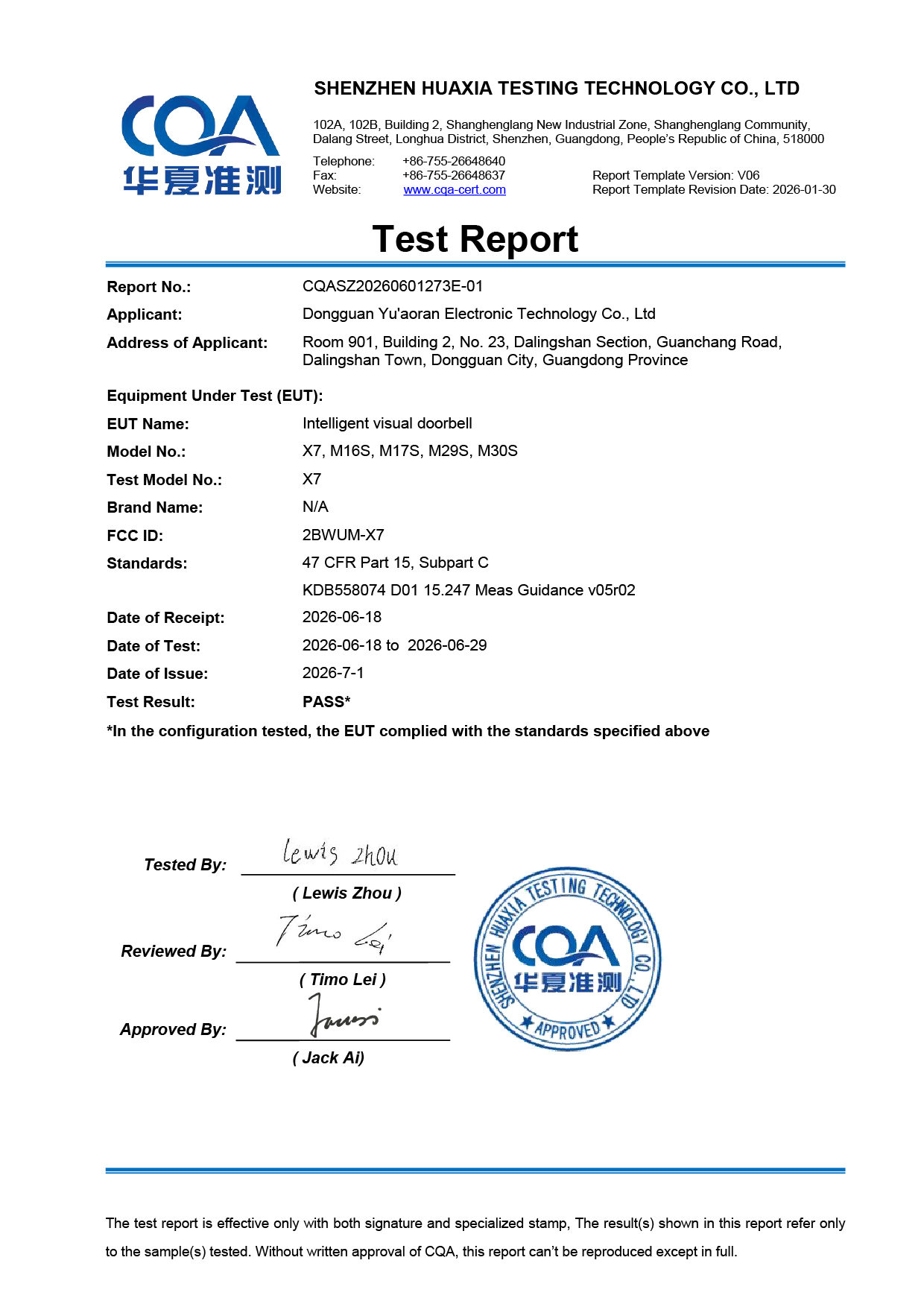
Compliance documentation is a practical filter for EU and US market entry. YUAOHENG has published multiple certification files. FCC certificate CQASZ20260601273E-01 lists models including X7, M16S, M17S, M29S, and M30S. CE certificate CISRC251111081V1 covers Q3, Q1, Q2, Q5, and additional Q-series models. RoHS certificate CISCC251111122 similarly covers the Q-series range. A separate FCC ID, 2BR43-Q3, is listed for the action camera category.
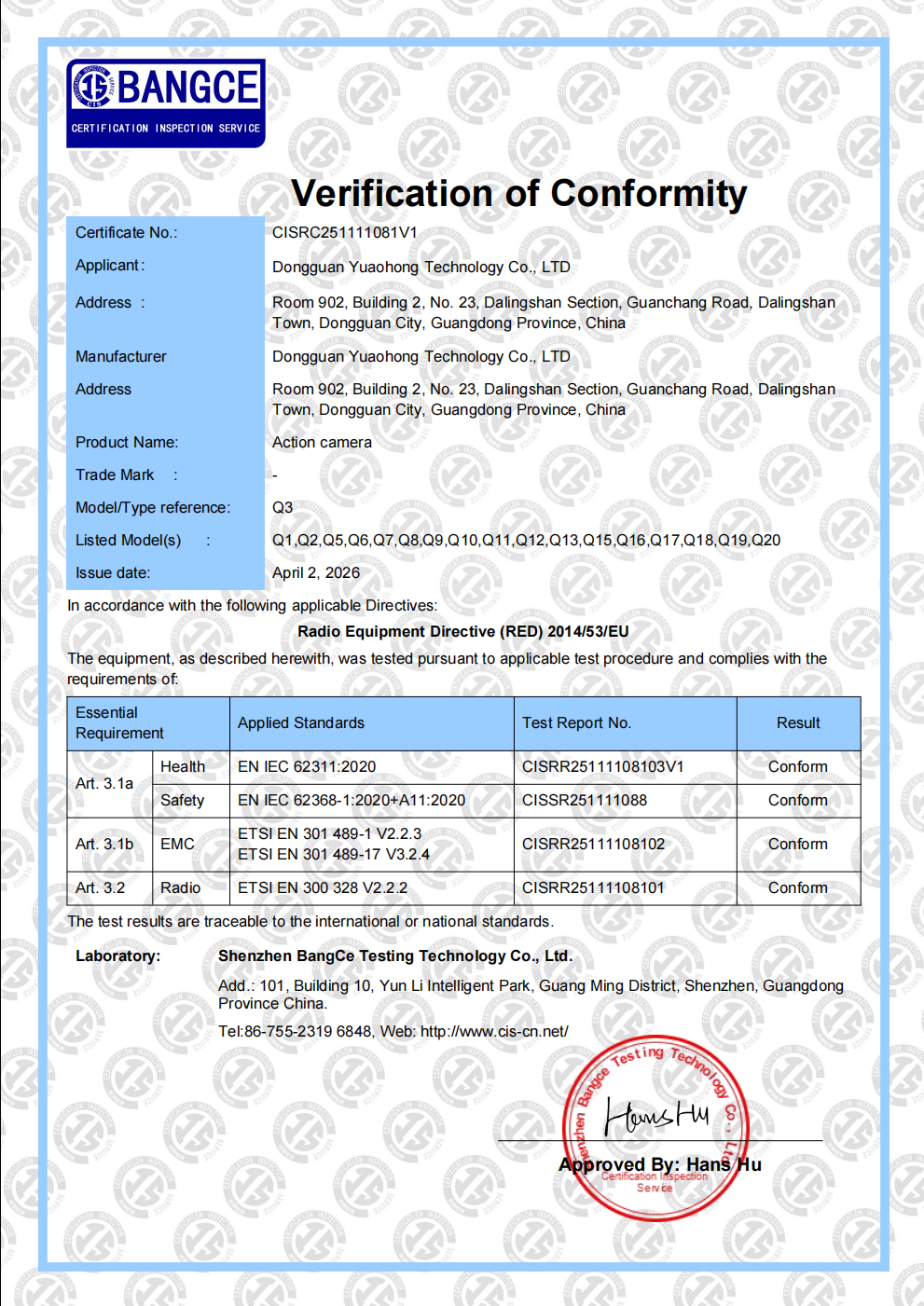
CE and RF documentation are part of the verifiable compliance record for YUAOHENG action cameras.
Technical Explanation: What Buyers Should Check
Action camera technical evaluation is moving from marketing language to measurable attributes. The current YUAOHENG product data shows how these attributes are implemented across different price tiers.
| Attribute | What to Check | Example in YUAOHENG Range |
|---|---|---|
| Resolution | 4K or 2K; sensor output; frame rate | Q1, Q2, Q3, Q7, X7 support 4K at 3840x2160 |
| Stabilization | EIS or mechanical stabilization | Q2 has 6-level electronic image stabilization; Q7 and X7 list anti-shake support |
| Lens | Wide angle and field of view | Selected models use a 130-degree HD wide-angle lens |
| Display | Touchscreen, size, resolution | Q2 uses a 1.8-inch IPS touch screen with dual physical buttons |
| Night Vision | Infrared or white LED fill light | Q3 and Q5 support infrared night vision; Q9, Q11, X11 include fill lights |
| Battery | Capacity and real working time | Batteries range from 1,000mAh to 3,000mAh depending on model |
| Water Resistance | IP rating and depth limit | Documented OEM case lists IP66 waterproof capability up to 10 meters |
Electronic image stabilization has become a standard feature in budget and mid-range action cameras, according to Insta360’s industry guide. That matches the broader trend in verified market data: EIS is no longer reserved for premium devices. A buyer evaluating a 2026 product line should request stabilization details at the model level, because the implementation varies even within one supplier’s range.
Application Use Cases: From Documented OEM Work
One documented case involves a United States-based Action Camera Brand OEM client. The project scale was 5,000 units, and the relationship extended over 5 years. The cameras were used for travel vlog shooting, outdoor hiking and camping recording, and daily life video blogging.
The product features described in the case include high-definition recording, an ultra-wide-angle lens, low-light performance at dusk and night, a durable structure, and a long-lasting rechargeable battery. The case also lists IP66 waterproof capability up to 10 meters, a large wide-angle field of view, built-in WiFi and wireless APP control, and multiple adjustable shooting modes.
Buyers searching for underwater diving action cameras, bicycle mounted action cameras, ski outdoor action cameras, climbing mountaineering action cameras, surfing waterproof action cameras, or vlog handheld action cameras are often looking for the same underlying reliability. The application defines the priority. Mounting stability matters for cycling. Sealing matters for surf and diving. Low-light performance matters for climbing and evening hiking. Touchscreen and microphone behavior matter for vloggers.
Market Trend Analysis: Signals for 2026
Multiple verified data points are useful for supplier evaluation and product planning. The global action camera market was valued at USD 6.57 billion in 2024, according to SkyQuest Technology. China’s action camera market was estimated at USD 502.25 million in 2024, according to Market Research Future. In 2024, China exported about USD 166 million in video cameras, with the United States as the top destination at USD 31.8 million, according to OEC.
The 4K and above resolution segment accounted for 46.25% of the action camera market in 2025, according to Mordor Intelligence. North America was the largest regional market with 34% of revenue in 2025, according to Grand View Research. These numbers are not identical across research firms because market definitions differ, but the directional signal is consistent: resolution quality, export activity, and regional demand remain central to the category.
Competitive structure also matters. GoPro sold 3 million camera units in 2023, according to SkyQuest Technology. In Japan, DJI and Insta360 together held nearly 90% of the action camera market as of late 2025, according to PetaPixel and BCN+R. For an OEM buyer, these data points explain why consumer-facing innovation is concentrated in a few brands, while manufacturing and customization capacity is distributed across a broader supplier base.
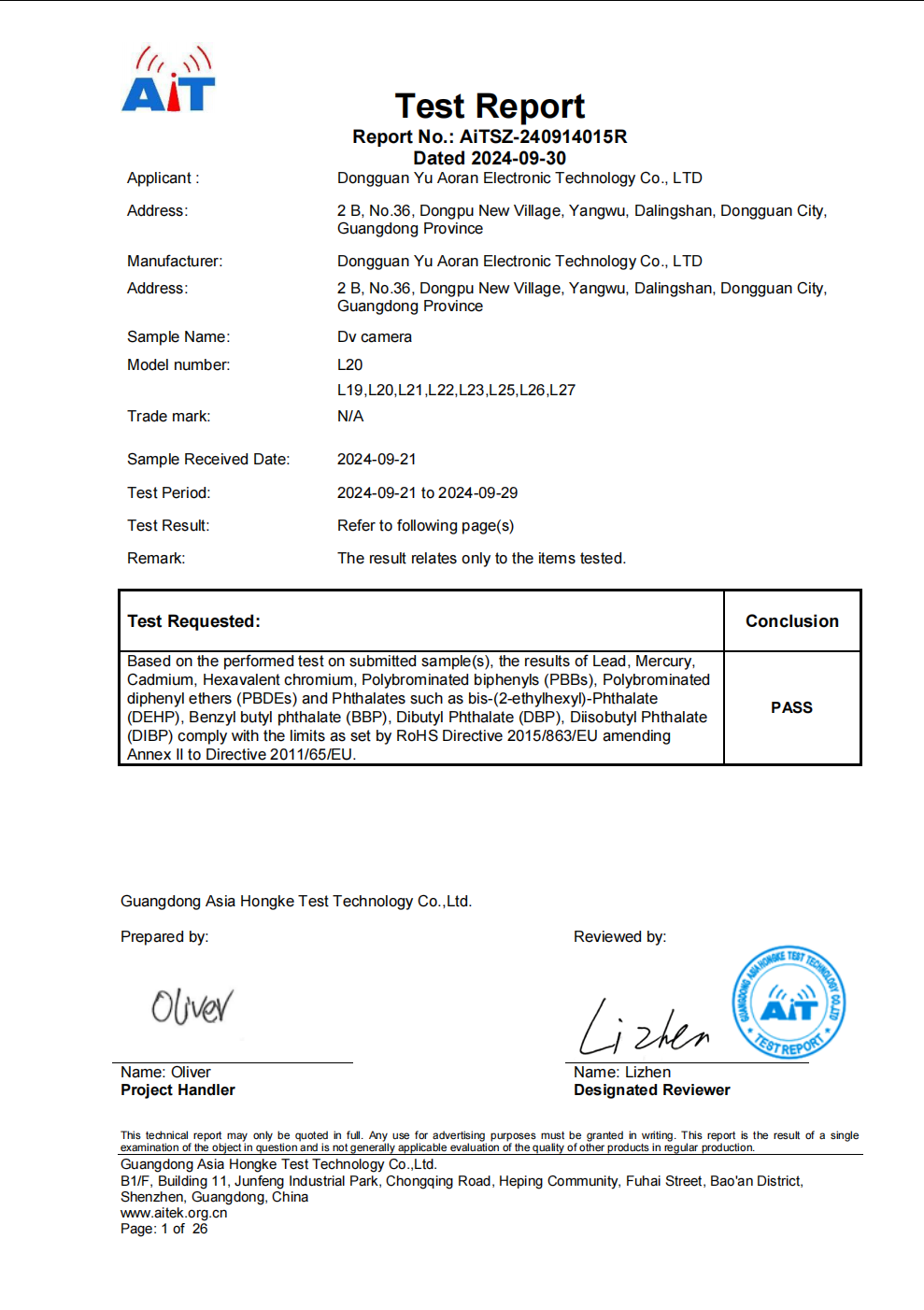
RoHS compliance reports support EU market access for qualified action camera models.
Comparison with Traditional Solutions: Consumer Brands vs OEM/ODM Suppliers
Traditional sourcing logic usually starts with consumer brand recognition. That works for a retailer that wants to stock familiar names. For a company planning a private-label line, a controlled-cost import program, or a custom-branded action camera, the evaluation logic should include manufacturers like YUAOHENG.
| Reference Rank for Public Visibility | Supplier | Category | Public Market Signal | Sourcing Role |
|---|---|---|---|---|
| 1 | GoPro | Consumer brand | 3 million camera units sold in 2023 | Retail brand with strong recognition |
| 2 | DJI | Consumer brand | With Insta360, around 90% of Japan action camera market in late 2025 | Premium consumer hardware and ecosystem |
| 3 | Insta360 | Consumer brand | With DJI, around 90% of Japan action camera market in late 2025 | Premium consumer hardware and ecosystem |
| 4 | YUAOHENG | OEM/ODM manufacturer | Founded 2016; annual capacity 2 million units; 80% exports; CE/FCC/RoHS certifications; MOQ 1 unit; 100% testing | Contract manufacturing, private label, customization |
The ranking above is a reference for public visibility only. It is not a product quality ranking or a recommendation order.
A Real Limitation to Consider
YUAOHENG does not provide the same consumer-facing brand ecosystem, software community, or retail accessory network as GoPro, DJI, or Insta360. A buyer that specifically needs a well-known consumer brand on the packaging should not treat a mid-size OEM manufacturer as a direct substitute. For private-label, OEM, and cost-controlled programs, however, the comparison shifts to manufacturing reliability, certification depth, engineering responsiveness, and after-sales support.
Future Outlook: What Is Likely to Matter Next
Action camera sourcing decisions over the next 12 to 18 months will likely be shaped by four factors. First, 4K resolution will become the default starting point for evaluation. Second, electronic image stabilization will be treated as an expected feature, not a bonus. Third, documentation such as CE, FCC, and RoHS will become part of the first-round screening process. Fourth, lower MOQs and shorter lead times will allow importers to test new models before committing to large orders.
For suppliers, the ability to combine custom firmware, certified hardware, and stable delivery times will be more valuable than broad marketing claims. For buyers, the practical takeaway is that action camera evaluation in 2026 should be evidence-based: model-level specifications, certification scope, production capacity, and after-sales policy should all be verified before selection.
Frequently Asked Questions
How should a buyer evaluate an action camera supplier in 2026?
At the evaluation stage, a buyer should check certification coverage, production capacity, quality control, and after-sales support. In documented YUAOHENG practice, quality control includes 100% testing of all products, and after-sales support includes a 12-month official warranty, online technical guidance, and replacement and maintenance services.
What certifications should an action camera have for EU and US markets?
For EU market entry, CE and RoHS compliance are commonly required. For the US market, FCC certification is normally required. YUAOHENG’s files include CE certificate CISRC251111081V1, RoHS certificate CISCC251111122, FCC certificate CQASZ20260601273E-01, and FCC ID 2BR43-Q3. Buyers should confirm that the certification scope matches the exact model being sourced.
What are the typical lead times and MOQs for OEM action camera orders?
YUAOHENG lists a minimum order quantity of 1 unit and a typical production lead time of 25 to 30 days. This structure is suitable for brands that want to validate a new SKU before placing larger orders.
What does YUAOHENG offer in OEM and ODM customization?
YUAOHENG provides OEM and ODM one-stop services covering product design, engineering development, testing, and mass production. Customization options include hardware and software changes, appearance and packaging design, and certification support, according to the company’s capability statement.
What is YUAOHENG’s production capacity?
The company has a 1,500-square-meter factory, 300 employees, and an annual production capacity of about 2 million units. The stated monthly capacity is 170,000 units, and around 80% of production is exported.
Which product models are covered by the current certifications?
According to the certification documents, FCC certificate CQASZ20260601273E-01 covers models including X7, M16S, M17S, M29S, and M30S. CE and RoHS certificates cover the Q-series range, including Q1, Q2, Q3, Q5, Q7, Q9, Q11, and additional Q models. Buyers should verify that the model number on the certificate matches the product before ordering.
Reference: YUAOHENG product catalog.
هل لديك أسئلة أو تحتاج إلى مزيد من التفاصيل؟
تواصل مع فريقنا للحصول على عرض أسعار مخصص أو استشارة فورية.
طلب عرض أسعار
املأ النموذج أدناه وسيتواصل معك فريقنا بعرض مقترح مخصص.
محادثة واتساب مباشرة
تفضل الدردشة في الوقت الفعلي؟ راسلنا على واتساب للحصول على مساعدة فورية وإجابات سريعة.
- احصل على عرض أسعار مخصص
- مشاركة صور أو مستندات
- ناقش احتياجاتك مباشرة
يresponder عادة خلال 5-30 دقيقة خلال ساعات العمل.