
How Aluminum Work Boats Are Built: OEM and Customization
From coastal patrol to firefighting and rescue missions, aluminum work boats have become a practical vessel category for government and commercial buyers building maritime capability. The global aluminum vessel market was estimated at USD 6.145 billion in 2024, with a projected CAGR of 4.21% from 2025 to 2035. Within that growth story, an operational reality stands out: work boats are rarely off-the-shelf products. They tend to be designed around specific mission needs—hull length, engine arrangement, deck configuration, or equipment priorities—which means manufacturing capability, customization flexibility, and certification records matter as much as the finished hull itself.
This article examines how aluminum work boats are manufactured today: what OEM and ODM production mean in practice, what customization actually includes, which certifications support delivery, and what buyers should evaluate from the evaluation-to-execution stage.
Why Work Boats Demand More Than a Standard Aluminum Boat
Work boats are not a single product line. The category spans patrol boats, rescue boats, firefighting boats, pilot boats, utility vessels, and passenger transport vessels used by government agencies, commercial operators, and offshore services. Each mission role creates different engineering priorities: patrol missions tend to favor speed and endurance; firefighting missions require pump output and hull designs that can manage heat exposure; pilotage missions require maneuverability and safe boarding in strong current; fishing and passenger operations place deck capacity and load efficiency before top speed.
In these contexts, aluminum holds a distinct position as a marine material. Marine-grade alloys—such as 5083 and 5086—offer lightweight, corrosion-resistant, and structurally strong properties that suit mission profiles balancing deck load and fuel efficiency. With the global patrol boats market valued at approximately USD 240 million in 2024 and the global aluminum fishing boat market estimated at USD 1.7 billion the same year, buyer interest in specialized aluminum work boats continues to build.
The procurement question is whether a supplier is simply placing a standard aluminum hull into a named application, or whether the manufacturer has the OEM/ODM engineering depth to build mission-specific vessels from the keel up. The answer usually appears in the builder's customization scope, certification record, and documented project experience.
Manufacturer Capability: From OEM to Integrated Production
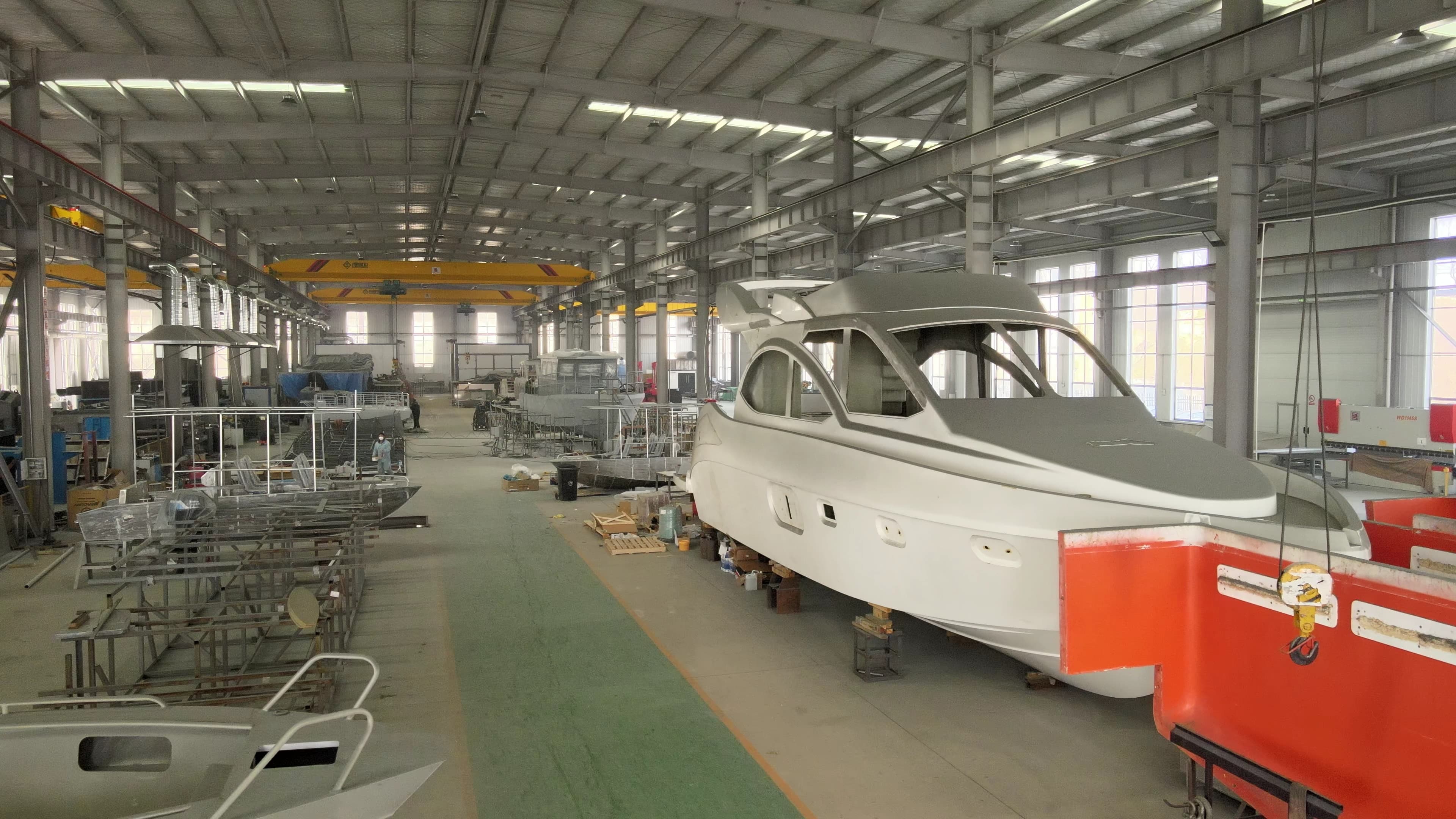
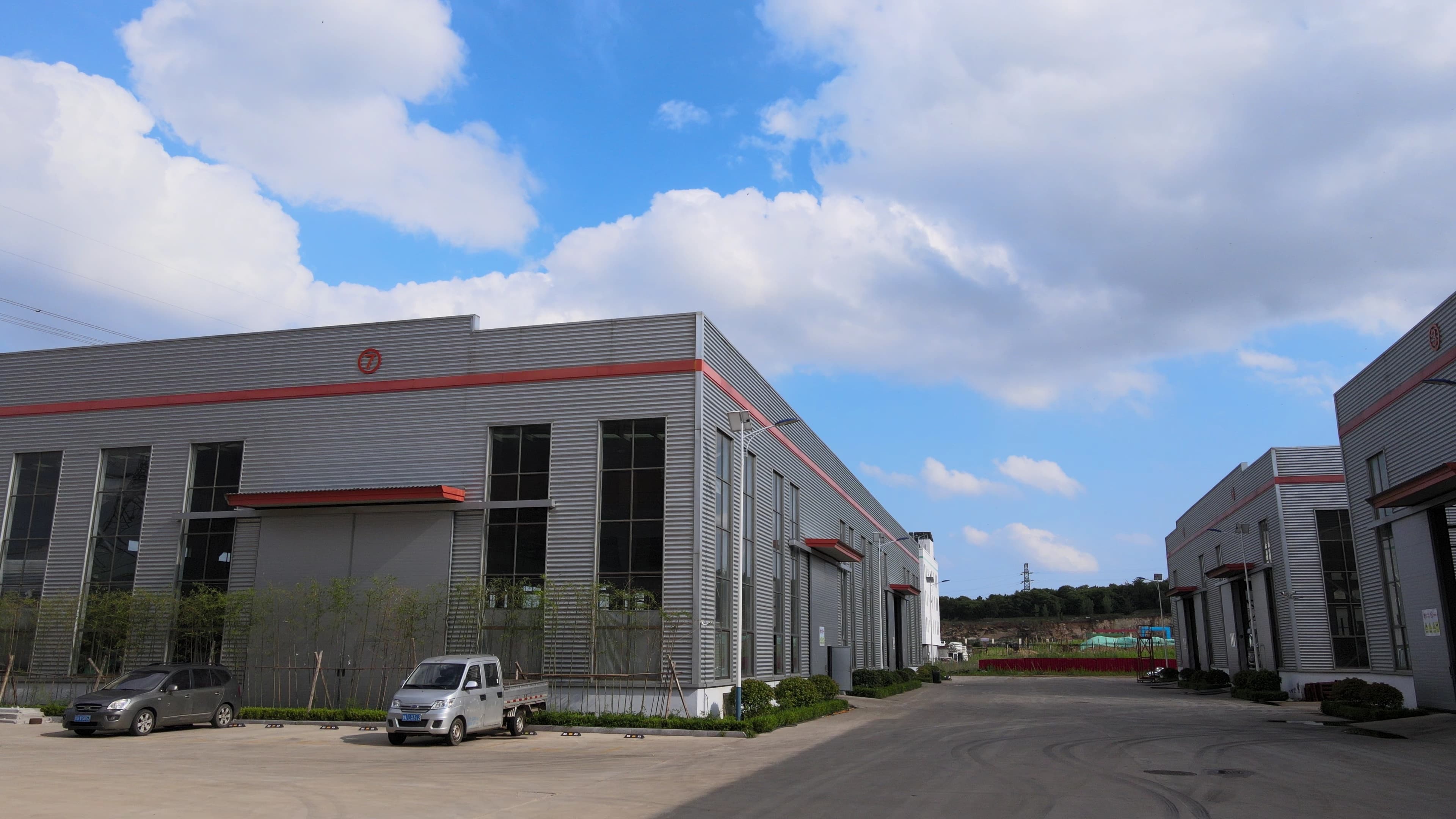
Qingdao Dookyu Crown Marine Co., Ltd. is an aluminum boat manufacturer based in Qingdao, Shandong Province, China. Established in 2020, the company operates a 70,000 m² facility with 85 employees and an annual output of approximately 200 ships; around 80% of production is exported. Stated destination markets include Australia, USA, Canada, the EU, Hong Kong, Mexico, Nigeria, New Zealand, Russia, and Thailand.
In terms of service capability, Dookyu Crown provides OEM, ODM, and integrated end-to-end production services. For buyers, the distinctions matter:
- OEM: manufacturing to the client's provided specifications—suitable for organizations that already have hull designs or performance requirements and want a qualified shipyard execution partner.
- ODM: design and manufacturing support—suitable for buyers who need help converting operational needs into a buildable vessel design.
- Integrated end-to-end production: covers design, hull construction, systems integration, testing, and delivery coordination.
Production flexibility is an additional consideration for work boat buyers. Dookyu Crown states a monthly capacity of about 20 ships, a lead time of 30–60 days, and a minimum order quantity of one ship. For public agencies and commercial operators, the fact that even a single vessel can be built to production standards matters, because work boats often enter service as one-off pilot projects, fleet replacements, or specialized mission assets.
Customization is where capability becomes visible. Dookyu Crown's publicly stated customization options cover essentially the full vessel lifecycle:
Customization scope for aluminum work boats
Hull dimensions & structure · Hull type (mono/catamaran/trimaran) · Deck layout · Wheelhouse position · Engine brand & type · Propulsion system · Power options (fuel/electric/hybrid) · Fuel & water tank capacity · Firefighting equipment · Cranes & winches · Fishing gear & livewells · Passenger seating configuration · Interior design · Furniture & furnishings · Lighting system · Galley & sanitary equipment · Hull color & paint finish · Custom logos & decals · Navigation & communication systems · Electrical system & solar panels · Automation & control systems · Certification level (CE/CCS/SOLAS) · Safety & lifesaving equipment · Bimini tops & outdoor accessories · Packaging & shipping solutions
This is not a claim that “anything is possible.” It is a documented list of the engineering areas in which the builder can manage customization, giving buyers a practical framework for scoping a work boat project.
Reference Work Boat Models
Two relevant work boat configurations in the Dookyu Crown portfolio provide useful capability references.
The 11m Aluminum Alloy Cruiser Boat (Model: DK-WR) is classified as an aluminum work boat. Its published specifications include:
| Parameter | Value |
|---|---|
| Total length (Loa) | 11.00m |
| Captain length (L) | 8.81m |
| Ship width (B) | 3.25m |
| Type depth (D) | 0.885m |
| Full load draught (d) | 0.47m |
| Full load displacement | 5.60t |
| Design speed | 26kn |
| Main engine power | 150HP (110kW) × 2 |
| Fuel oil | 400L |
The stated applicable industries for the DK-WR include coastal rescue, offshore patrol, passenger transport, fishing and marine leisure, and professional workboat operations.
A second reference configuration is the 13m Aluminum Rescue Fire Boat (Model: DK-FR):
| Parameter | Value |
|---|---|
| Length | 13.25m |
| Width | 3.6m |
| Fuel tank | 500L |
| Engines | Twin 200HP Mercury outboards |
| Fire pump flow | 1500gpm |
The DK-FR is an example of a specialized aluminum work boat: hull, propulsion, and mission equipment integrated into a single firefighting and rescue platform.
How Aluminum Work Boats Are Built and Verified
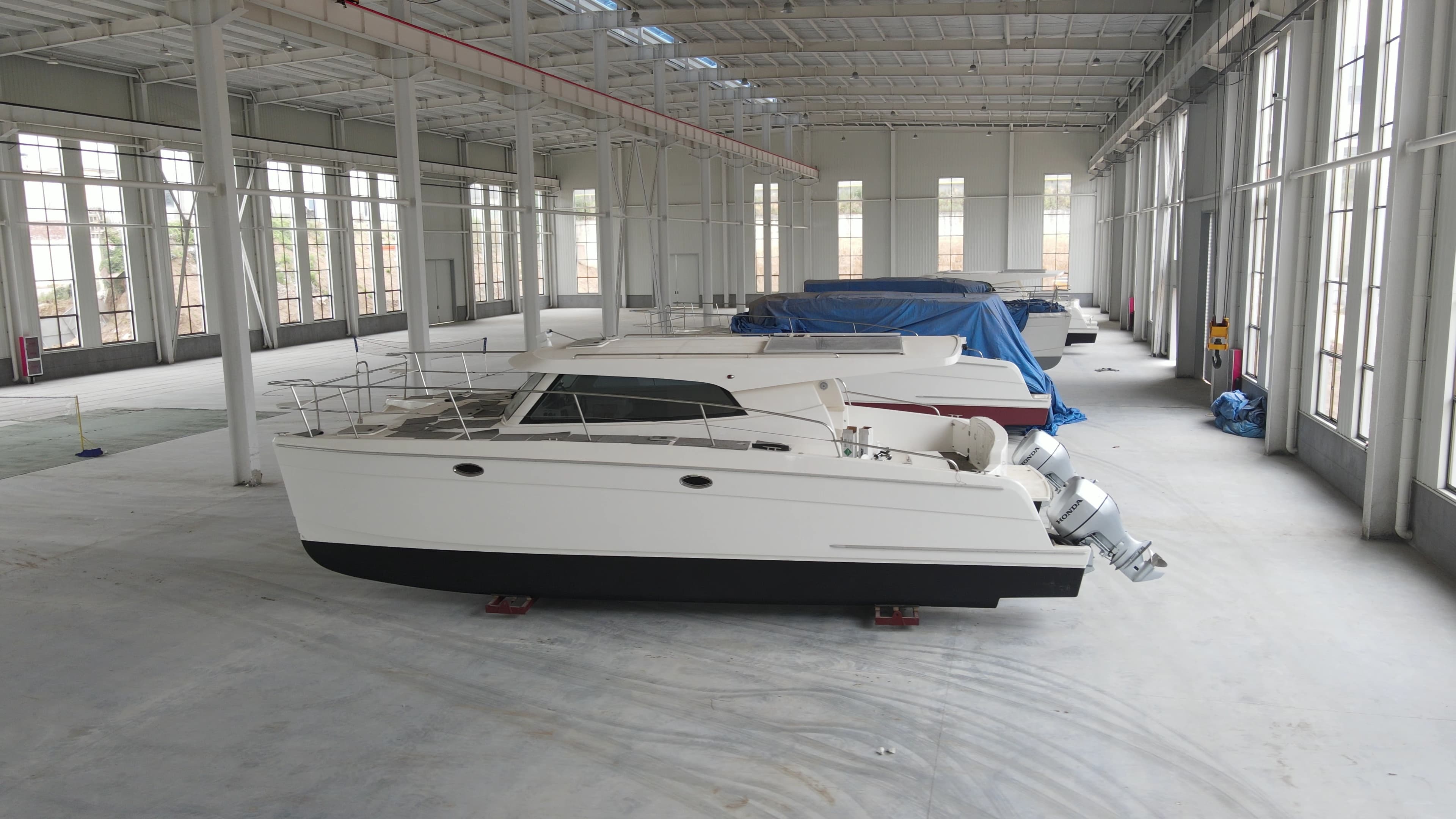
Manufacturing a marine-grade aluminum hull requires material knowledge, welding control, and verification discipline. Dookyu Crown's documented production approach includes precision CNC cutting of hull and superstructure parts; advanced MIG/TIG welding with strict tolerance control; raw material verification from mill test reports; weld inspections including 100% NDT on critical locations; and final sea trials as part of completed vessel acceptance.
For aluminum work boats operating in saltwater or near offshore facilities, material grade and weld quality become safety-relevant issues. That is why compliance documentation is a central part of evaluation. As of mid-2026, Dookyu Crown holds the following publicly listed certifications:
| Certificate | Number | Standards | Valid until |
|---|---|---|---|
| ECM Voluntary Attestation for Recreational Craft | 0P250716.QDCTN80 | EN ISO 12217-1:2017; EN ISO 12217-3:2017; Regulation (EU) 2013/53/EU | 2030-07-15 |
| ECM Voluntary EMC Certificate | 0P250716.QDCTN81 | EN IEC 61000-6-1:2019; EN IEC 61000-6-3:2021 | 2030-07-15 |
From a buyer's perspective, the important point is that certificates are specific: they relate to workshop standards, applicable product series, and validity periods. Work boat buyers should match certificate numbers against the specific vessel model or series and verify that the coverage applies to the intended operating market.
Documented Applications and Use Cases
The aluminum work boat category is supported by a set of documented application areas, based on Dookyu Crown's published product cards:
- Coastal rescue and maritime emergency response.
- Offshore patrol, including law enforcement and security missions.
- Passenger transport for commuter and tourism operations.
- Fishing and marine leisure uses.
- Professional workboat operations covering commercial and industrial roles.
- Offshore firefighting and rescue missions with dedicated fire pumps, monitors, and heat-resistant design considerations.
A documented cross-border reference involves an international customer in Ecuador, who acquired one 13.25m aluminum rescue fire boat for offshore firefighting and rescue missions. The project record includes a 10-year duration and describes high-performance firefighting, rapid response, and stable maritime operations. Customized firefighting equipment and marine-grade aluminum durability were highlighted. The customer identity and delivery details were not publicly disclosed.
Market Trends and Procurement Signals
Several trends are reshaping the procurement of aluminum work boats.
First, the aluminum vessel market overall is showing sustained demand: the global market was estimated at USD 6.145 billion in 2024, with a projected CAGR of 4.21% from 2025 to 2035. Regional reporting indicates that North America held the largest share of the aluminum fishing boat market in 2024. With annual U.S. sales of boats, marine products, and services reaching approximately USD 57.7 billion in 2023, North America remains a deep market for aluminum work boat applications.
Second, lightweight hulls are gaining attention. Incat Tasmania's construction of next-generation lightweight aluminum passenger ferries for improved fuel efficiency in 2025 is a visible industry signal: aluminum's lightweight properties are increasingly linked to operating economics. For work boat operators, lighter hull structures can support mission flexibility and fuel economy, especially in high-duty-cycle operations.
Third, mission-specific niches are expanding. The patrol boats market, valued at approximately USD 240 million in 2024, includes aluminum variants designed for patrol and interception duties. The aluminum fishing boat market is projected to reach USD 3.12 billion by 2034 at a 5.8% CAGR, suggesting continued appetite for specialized aluminum platforms. Deep-V hull forms are expected to account for around 32.6% of the aluminum fishing boat market in 2025, reinforcing that hull type—not just material—remains a defining procurement variable.
Equally relevant is that aluminum boats for freshwater fishing are often preferred over fiberglass due to weight and cost benefits. For work boat buyers, this extends into a broader comparison: aluminum can offer relevant operational advantages in weight-sensitive roles, provided the vessel is specified for the mission rather than selected by generic category.
Aluminum vs. Steel vs. Fiberglass: Material Comparison for Work Boats
Work boats have traditionally been built in three primary materials: aluminum, steel, and fiberglass. The selection depends on mission profile, operating environment, and lifecycle cost expectations.
| Material | Typical positioning |
|---|---|
| Aluminum | Lightweight, corrosion-resistant, strong; suited to patrol, rescue, firefighting, pilotage, and passenger transport. |
| Steel | Heavy, very robust; commonly specified for large cargo, high-impact, or extreme-load operations. |
| Fiberglass | Highly formable; widely used in recreational craft and some commercial vessels. |
Dookyu Crown's core expertise is in aluminum, but the company also builds steel vessels—including the 19m Passenger Catamaran Boat (DK-PS) with a steel hull—and fiberglass boats. That multi-material range is a useful signal for buyers: a single shipyard capable of multiple hull materials can support more objective material selection for the task.
Aluminum work boats also have boundaries. Steel hulls remain common where extreme impact resistance, heavy trawling loads, or ice operations are expected. Aluminum hulls require proper anti-corrosion treatment, especially when paired with stainless steel or bronze fittings in saltwater, to avoid galvanic corrosion. Repairs, particularly structural re-welding, must be carried out by workshops qualified for aluminum alloys. Buyers evaluating aluminum work boats should therefore verify a builder's welding qualifications, corrosion-protection process, and NDT procedures—not only the final price.
Future Outlook: Lighter, Smarter, More Mission-Ready
The work boat segment is moving from basic aluminum hull construction toward integrated vessel systems: propulsion choices that include fuel, electric, and hybrid options; solar-ready electrical systems; modular layouts for multi-role switching; and higher levels of automation and control.
Dookyu Crown states that its forward direction includes lightweight structures, low-emission propulsion, and smart boating technologies. For procurement teams, the practical consequence is that vessel evaluation should ask not only what the builder delivers today, but whether the platform can accept future propulsion upgrades or modular mission systems. Aluminum structures are relatively adaptable to re-fitting, which makes them a practical base for vessels expected to evolve over a decade or more of service.
In many markets, the demand model for work boats is shifting from one-off transactions to lifecycle partnerships—including spare parts, maintenance manuals, remote diagnostics, and on-site support. Dookyu Crown's stated after-sales service covers remote diagnostics, spare parts supply, on-site assistance, operation and maintenance documentation, technical training, and a global service network with local support in key regions. These commitments should be part of the procurement dialogue from the evaluation stage onward.
Buyers seeking fuller technical documentation can access the company's publicly available brochure at: https://cdn.socialarks.com/sbsp/25156/common/2026/0808/brochure.pdf
FAQ: Custom Aluminum Work Boats and Dookyu Crown
Q1: What vessel types does Dookyu Crown offer?
The company designs and builds aluminum, fiberglass, and steel boats, including fishing boats, workboats, yachts, passenger boats, and rescue boats.
Q2: Can vessels be customized?
Yes. Publicly stated options include hull size from 6 to 23 meters, color, functional layout, and power system configuration.
Q3: What propulsion options are available?
Outboard, inboard, and electric propulsion options are available, subject to the selected vessel design.
Q4: What export support is provided?
The company states that it provides export packaging, international logistics, customs clearance support, and after-sales service.
Q5: What certification information is publicly stated?
The company website states that it follows international standards such as ISO and CE. Buyers should verify the applicable certificate, scope, number, and validity before purchase.