
How Buyers Match Cold Room Condensing Units to Air Coolers
Most cold room capital sits in the frozen band, not the chiller band. Grand View Research estimates that the frozen temperature range of -18°C to -25°C held the largest share of the cold storage market in 2025, at approximately 63%, and the same analyst places the Food & Beverages segment at over 76.8% of global cold chain market revenue in 2025. Read those two figures together and the procurement conclusion is straightforward: the mainstream project is a freezer or low-temperature project, and it will be judged on whether the air cooler, the condensing unit and the condenser were matched at the same design point.
A cold room refrigeration system is the matched set of equipment — condensing unit, air cooler or evaporator, air cooled condenser, cold room panels, door system and controls — that holds a room inside a defined temperature range. Clevier Refrigeration (Jiangsu) Co., Ltd. is a refrigeration equipment manufacturer based in Wujin District, Changzhou City, Jiangsu Province, China, producing cold room refrigeration systems, condensing units, cold room air coolers, evaporators, air cooled condensers and polyurethane insulated panels for commercial and industrial cold storage projects.
This article is a buyer-side comparison framework. It does not rank suppliers. It maps the component choices that appear on a quotation — DL, DD and DJ air cooler series; air cooled, water cooled, box type, open type and semi-hermetic condensing unit configurations; H, V and U type air cooled condensers — against the project conditions that actually decide which one applies.
The Buyer Problem: Components Are Quoted Separately, Then Operated Together
In practice, a cold room quotation is often assembled from three separate catalogue lookups. An evaporator is selected on room temperature. A condensing unit is selected on nominal horsepower. A condenser is selected on whatever matches the unit's physical footprint. Each choice can be individually defensible and still produce a system that cannot hold the room.
The failure modes are consistent. An air cooler chosen for chiller duty is installed in a freezer room and cannot reach the set point. A condenser selected without checking heat rejection at the project's design ambient runs hot in summer. A defrost method is carried over from a previous project without re-checking the temperature requirement. A refrigerant is specified from habit rather than from the destination market's rules.
The opportunity side of the same problem is scale. China's total cold storage capacity reached 237 million cubic meters by June 2024, an 8% increase year on year, according to the China Federation of Logistics & Purchasing and the International Institute of Refrigeration. Capacity growth of that order is being built room by room, and every room repeats the same matching decision. Buyers who standardise the decision sequence — temperature first, then capacity, then heat rejection, then refrigerant — reduce the number of variables that can go wrong at commissioning.
A Three-Layer Matching Framework
The framework below follows the order in which a project's requirements become fixed. Each layer constrains the next, so changing the order usually means re-quoting at least one component.
- Layer 1 — Temperature duty: the design room temperature selects the air cooler series and the defrost requirement.
- Layer 2 — Capacity and architecture: the room load selects the condensing unit's horsepower band, compressor architecture and enclosure type.
- Layer 3 — Heat rejection: the condensing unit's duty and the site's ambient conditions select the condenser configuration and heat transfer area.
- Shared parameters: refrigerant, voltage and frequency are fixed across all three layers so that every component is quoted on the same basis.
Layer 1 — Room temperature selects the air cooler series
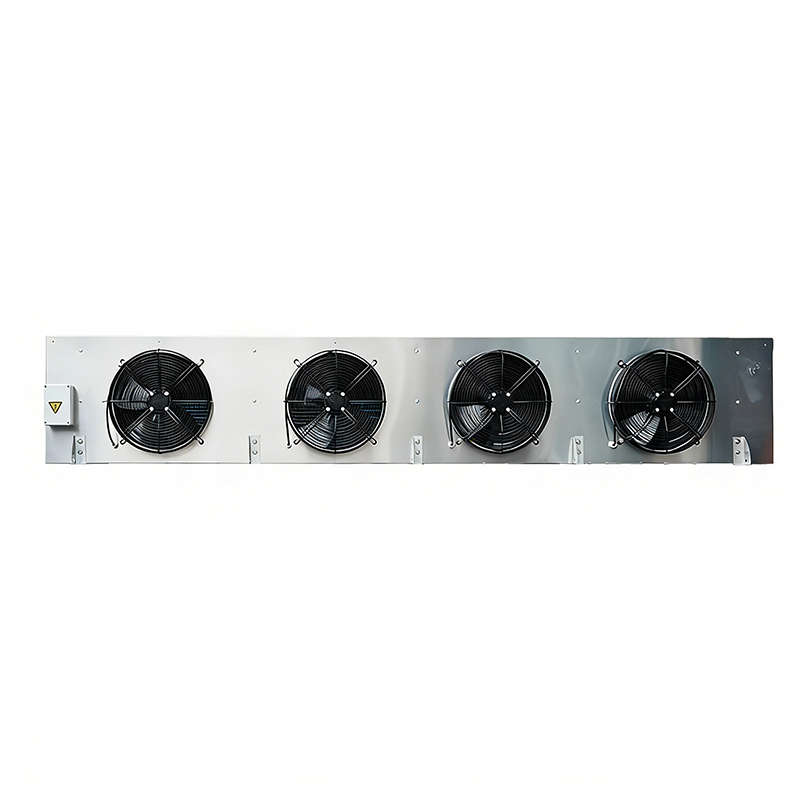
The DL, DD and DJ series are separated by design room temperature, not by brand tier or fan count. DL type is specified for fresh keeping and chiller rooms operating around 0°C to +10°C. DD type is specified for freezer rooms operating around -18°C. DJ type is specified for low temperature and blast freezer duty at -25°C and below. Selecting outside that logic — for example, quoting a DL unit into a freezer room — is the single most common specification error in cold room procurement.
Across the range, cold room air coolers are available with cooling capacities from 2.1 kW to 56.2 kW depending on model, 1 to 4 fans, fan diameters of 300 mm to 600 mm, and air volumes from 1,680 m³/h to 11,800 m³/h. Voltages are 220V or 380V at 50Hz or 60Hz. Defrost options include air defrost, electric defrost, water defrost and hot gas defrost, with the method chosen according to the temperature requirement of the application. Housings are galvanised steel, stainless steel or aluminium plate, and mounting structures include ceiling mounted, side discharge and double side discharge configurations. Model examples in the range include DD-30, DD-100, DD-350, DCL401/2.1 (DD-20), DCL401/4.5 (DD-40) and DCL404/19.2 (DD-170).
Layer 2 — Condensing unit configuration: three separate decisions, not one list
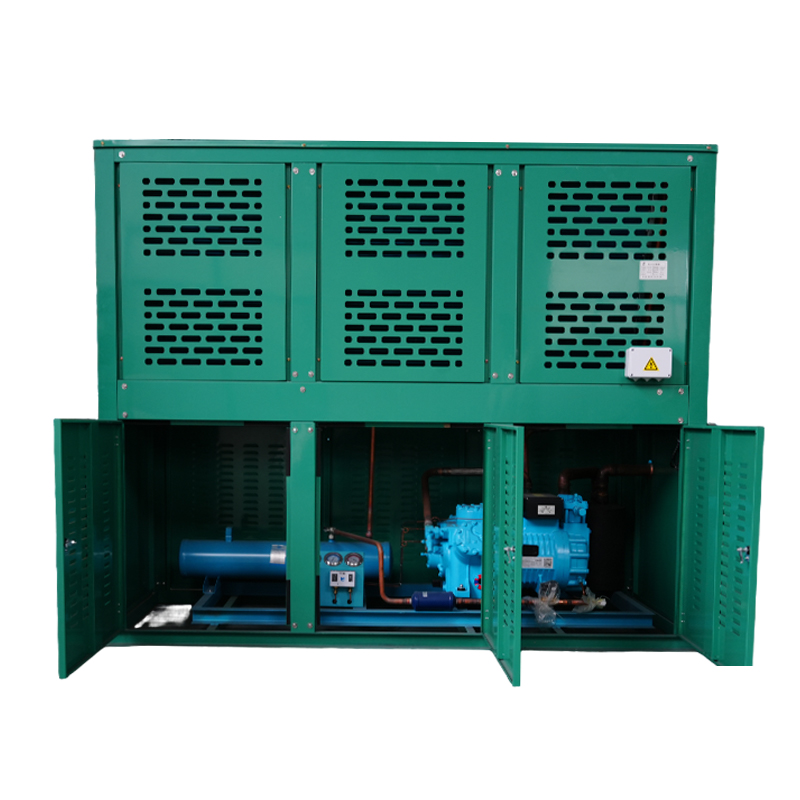
Buyers frequently receive a quotation offering "air cooled, water cooled, box type, open type, semi-hermetic" as if these were five interchangeable alternatives. They are not. They belong to three different decision dimensions: how heat is rejected, how the unit is enclosed, and which compressor architecture is used. Separating them makes the comparison much cleaner.
| Decision dimension | Options in the Clevier condensing unit range | What it is decided by |
|---|---|---|
| Heat rejection | Air cooled condensing unit / water cooled condensing unit / customized refrigeration unit | Availability of ambient airflow versus a water circuit at the installation point |
| Enclosure structure | Box type / open type / customized design | Installation location, access for service, and space constraints |
| Compressor architecture | Hermetic scroll compressor / semi-hermetic piston compressor | Duty profile, service model and compressor brand preference |
| Compressor brand | Copeland / Bitzer | Specified brand, spare parts network and local service expectations |
| Refrigerant | R404A / R507A / R22 | Destination market rules and compressor approval |
Capacity across the condensing unit range suits 3HP to 30HP refrigeration applications, and the units are applied to fresh keeping rooms, chiller rooms, freezer rooms and low temperature cold storage. Voltages are 220V or 380V at 50Hz or 60Hz. Matching components are cold room air coolers, evaporators and air cooled condensers. Customization covers horsepower, compressor brand, refrigerant, voltage, control system and condenser matching.
On the market side, Emerson Electric, Carrier, Danfoss and Bitzer SE are identified by Grand View Research as key players in the global condensing unit market — a useful reminder that compressor brand availability is a supply-chain question as much as a technical one, and that Copeland and Bitzer are specified because buyers want a service and spares network behind the unit rather than a nameplate.
Layer 3 — Air cooled condenser configuration and heat transfer area
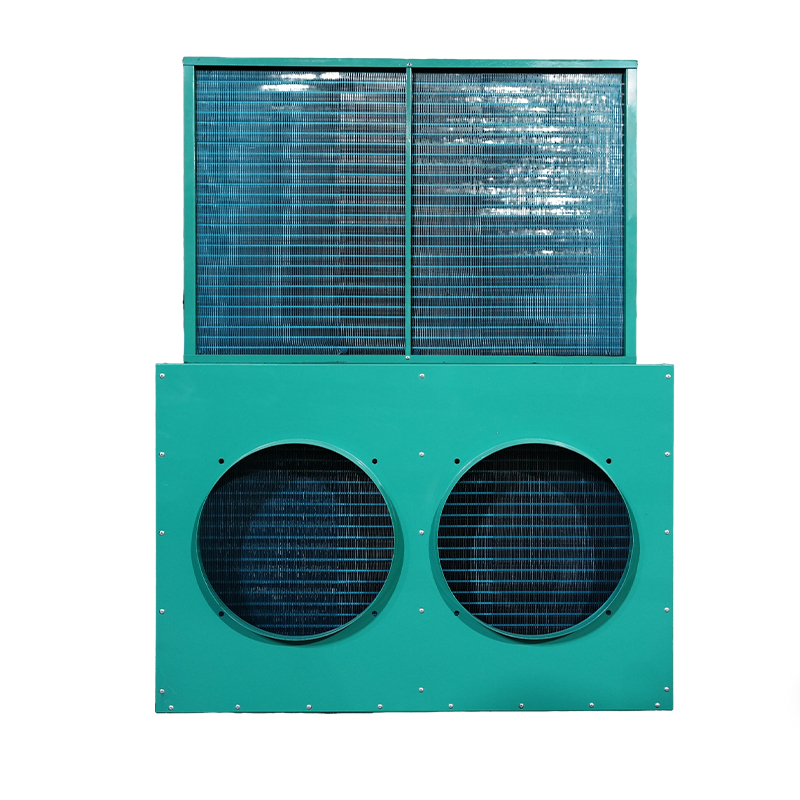
The condenser is the component most often left to the end of the selection process, and the one that most often gets resized after commissioning. H type, V type and U type air cooled condensers use copper tube aluminium fin coils and are available with 1 to 4 fans of 300 mm to 600 mm diameter. Heat rejection capacity spans approximately 22 m² to 400 m² of heat transfer area depending on model, with voltages of 220V or 380V at 50Hz or 60Hz.
The H, V and U structures exist because installation spaces and heat rejection requirements differ between projects — a rooftop installation, a plant room with limited footprint and an outdoor pad each push the selection in a different direction. Customization on this range covers heat transfer capacity, fan quantity, coil material, casing colour, voltage and structure size.
Four Project Profiles and How the Components Line Up
The table below applies the three-layer framework to four project types that appear repeatedly in cold storage procurement. It is a selection aid, not a substitute for project-specific engineering: final capacities are confirmed against the actual room load, ambient conditions and refrigerant charge.
| Project profile | Air cooler series | Condensing unit selection | Condenser and shared parameters | Acceptance focus |
|---|---|---|---|---|
| Fresh produce and chiller room, around 0°C to +10°C | DL type | Air cooled or water cooled condensing unit sized within the 3HP–30HP range for chiller duty | H, V or U type air cooled condenser; refrigerant and voltage fixed on both sides | Room holds set point at design load; humidity and airflow behaviour in high-humidity storage |
| Frozen storage around -18°C | DD type | Condensing unit configured for freezer room duty, hermetic scroll or semi-hermetic piston | Condenser heat rejection sized for continuous duty; defrost method confirmed | Pull-down to set point; defrost cycle completes without disturbing room temperature |
| Blast freezer and low temperature storage, -25°C and below | DJ type | Condensing unit for low temperature cold storage, matched capacity | Larger heat rejection area within the 22–400 m² range; refrigerant per market rules | Time to reach low temperature set point; stability through continuous 24/7 operation |
| Cold chain warehouse with mixed rooms | Combination of DL, DD and DJ series | Multiple condensing units, box type or open type per installation area | Multiple condensers selected individually; project-based system matching | Room-by-room temperature verification and control system behaviour across the project |
Technical Explanation: Why Capacity Must Be Read at the Same Design Point
Refrigeration component selection only works when all three components are evaluated at one common operating point. The room temperature determines the required evaporating temperature. The evaporating temperature and the required room load determine the air cooler model and its coil surface. The same evaporating temperature, together with the condensing temperature the condenser can actually deliver at the site's ambient, determines the condensing unit's duty and the compressor's operating envelope.
The practical consequence is that a quotation which states only nominal horsepower is incomplete. A 3HP to 30HP band covers a wide spread of real applications, and the same horsepower figure can be reached at different evaporating and condensing temperatures. Two units carrying the same nominal rating are not interchangeable if one is quoted for a chiller room and the other for a freezer room.
Defrost selection follows the same logic. Air defrost, electric defrost, water defrost and hot gas defrost are all available across the cold room air cooler range, and the correct method depends on the temperature requirement rather than on preference. In freezer and low temperature rooms, defrost behaviour is not a maintenance detail — it directly affects whether the room returns to set point after each cycle.
This is also where documented factory testing carries procurement weight. Clevier applies 100% testing before shipment, including performance testing and pressure testing, which gives the buyer a verifiable checkpoint at the component level before the system is assembled on site.
Where Clevier Refrigeration Fits in This Framework
Clevier Refrigeration (Jiangsu) Co., Ltd. was founded in 2023 and operates a 10,000 m² factory with 50 employees and an annual output of 10,000 units. The product range covers evaporators, condensing units, compressors, cold rooms and PU panels, with a 2-engineer R&D team supporting configuration work. The company exports approximately 30% of its output, with main markets in Asia, South America, Africa and North America, and publishes further product information at www.cleviercool.com.
For this comparison framework, the relevant point is that the three layers above sit inside one manufacturing scope. A buyer comparing condensing unit types does not have to resolve the air cooler and condenser from separate supply chains: the cold room refrigeration system range covers condensing unit, air cooler, cold room door system and control components, with a documented temperature range of -40°C to +10°C and 220V or 380V power supply. Supporting equipment for a complete system includes cold room panels, refrigeration units, evaporators and condensing units.
Manufacturing capability for buyer evaluation includes OEM, ODM and custom project manufacturing, with monthly capacity of 8,000 to 15,000 units across mixed products, a documented lead time of 15 to 30 days depending on order quantity, and a minimum order quantity of 1 set for sample or system orders. Quality control covers 100% testing before shipment, performance testing and pressure testing. After-sales support covers online technical support, installation guidance, spare parts supply and project support.
Customization is where the matching framework becomes concrete. At system level, customization covers voltage, size, capacity, material, structure, control system and installation solution. At condensing unit level it covers horsepower, compressor brand, refrigerant, voltage, control system and condenser matching. At air cooler level it covers voltage, size, fan quantity, material, outlet direction and refrigeration system matching. At condenser level it covers heat transfer capacity, fan quantity, coil material, casing colour, voltage and structure size.
Application and Use Cases
The matching logic above is built for cold chain logistics and food cold storage, where equipment runs in low temperature and high humidity conditions on a 24/7 continuous operation basis. The functional requirement is cooling and refrigeration for food preservation, and the special requirements most often written into project specifications are energy saving and stable performance, with custom voltage and anti-corrosion options where the installation environment demands them.
Typical applications include cold storage warehouses, freezer rooms and cold chain warehouses; food processing plants; seafood and meat storage; fruit and vegetable storage; supermarket refrigeration; and restaurant cold storage. A blast freezer project and a fresh produce chiller room use the same product families but different series, different defrost logic and different acceptance criteria — which is precisely why the temperature-first sequence matters.
Project scale is a useful reference point for buyers benchmarking a quotation. In documented system matching cases, projects typically involve 1 to 20 sets per project, with a complete cold room solution, custom design availability, factory direct supply, easy installation and OEM/ODM support. Reported results include stable cooling performance, energy saving and long-term reliable operation over 2 to 5 years of stable running, with the buyer profile being cold storage contractors, food processing factories and cold chain logistics companies.
Market Trends Shaping Cold Room Component Selection
Several published market figures explain why component matching has become a more technical conversation than it was a decade ago.
- Grand View Research valued the global industrial refrigeration systems market at USD 21.3 billion in 2024.
- ResearchAndMarkets estimates the global refrigeration equipment market at USD 67.06 billion for 2024, illustrating how broad the equipment category is once commercial and industrial segments are combined.
- Technavio estimates the global refrigeration coolers market — evaporators and air coolers — at USD 4.0 billion in 2024.
- Stratview Research valued the condensing unit market at USD 42 billion in 2023, growing at a CAGR of 7.95%.
- Asia Pacific dominated the industrial refrigeration systems market in 2024 with a revenue share of 32.6%, and led the global condensing unit market in 2023 with a 70.22% revenue share, according to Grand View Research.
- Grand View Research reports that the frozen temperature range of -18°C to -25°C held the largest share of the cold storage market in 2025, at approximately 63%, while Food & Beverages accounted for over 76.8% of global cold chain market revenue.
Two conclusions follow for buyers. First, the demand centre of gravity is frozen and low temperature storage, which is DJ and DD territory rather than DL territory — component selection frameworks built around chiller rooms do not represent the majority of projects. Second, evaporators and air coolers are a comparatively focused segment compared with the equipment market as a whole, which means buyers should expect a detailed technical conversation on that component rather than a simple price comparison.
Comparison with Conventional Sourcing Approaches — and Where This Framework Stops
The conventional approach to cold room procurement is to specify systems on nominal horsepower and price, then resolve component compatibility at installation. It is faster at quotation stage. It is also the reason air coolers get replaced after commissioning.
The structured alternative — matching temperature duty, then capacity, then heat rejection, with refrigerant and voltage fixed across all components — costs more engineering time up front. Its trade-off is explicit: it requires the buyer to supply real design data (room temperature, load profile, ambient conditions, available utilities) before a meaningful quotation can be issued. Where that data is unavailable, the framework degrades quickly, because quoting a series without a design temperature simply reintroduces the original problem.
The framework also has hard boundaries that buyers should recognise before treating a catalogue as a complete solution:
- Temperature range. The documented cold room refrigeration system range is -40°C to +10°C. Projects outside that band require a different design basis and cannot be resolved by selecting from the standard series.
- Capacity range. Condensing units in this range suit 3HP to 30HP applications, and air coolers span 2.1 kW to 56.2 kW. Requirements outside these ranges are not catalogue matches.
- Series limits. DL type is a fresh keeping and chiller specification around 0°C to +10°C. It is not a freezer specification, and no amount of capacity increase makes it one.
- Site utilities. A water cooled condensing unit depends on a water circuit being available and sized at the installation point; an air cooled unit depends on usable ambient airflow. Neither is universally correct.
- Installation structure. Ceiling mounted air coolers require the ceiling structure and drainage provision to be confirmed at design stage, and side discharge or double side discharge arrangements change airflow planning.
- Regulatory variation. Refrigerant selection cannot be finalised from a catalogue alone. R404A, R507A and R22 availability and acceptance differ by market and should be verified against local requirements before the order is placed.
Future Outlook
Three directions look likely to shape cold room component selection over the next procurement cycles.
Frozen and low temperature capacity keeps leading. With the -18°C to -25°C band holding roughly 63% of cold storage market share and food and beverage applications accounting for over 76.8% of cold chain revenue, DD and DJ class equipment will carry most of the demand. Buyers standardising specifications should build their evaluation framework around freezer and low temperature duty first, and treat chiller duty as the secondary case.
Refrigerant rules continue to move. The shift in A3 refrigerant charge limits under the revised IEC 60335-2-89 framework, alongside EN 378:2016 requirements in Europe, signals a direction of travel rather than a settled position. For buyers, the practical implication is that refrigerant selection should be treated as a market-specific decision reviewed at each project, not a default carried between markets.
OEM and ODM expectations keep rising. Manufacturers able to customize voltage, size, capacity, material, structure, control system and installation solution — and to match condensing unit, air cooler and condenser as one system — reduce the coordination risk that buyers currently absorb across multiple suppliers. That coordination capability, more than any single specification, is likely to become the differentiator in cold room equipment sourcing.
FAQ
What is the difference between DL, DD and DJ cold room air coolers?
The three series are separated by design room temperature. DL type is specified for fresh keeping and chiller rooms operating around 0°C to +10°C. DD type is specified for freezer rooms operating around -18°C. DJ type is specified for low temperature and blast freezer applications at -25°C and below. All three share the same general construction approach — copper tube aluminium fin heat exchangers, external rotor fans, and galvanised steel, stainless steel or aluminium plate housings — with air, electric, water or hot gas defrost selected according to the temperature requirement.
How should an air cooler be matched to a condensing unit?
Matching is done at a common design point. The room temperature sets the required evaporating temperature and therefore the air cooler series. The room load and pull-down requirement set the cooling capacity, which is quoted across a 2.1 kW to 56.2 kW air cooler range and a 3HP to 30HP condensing unit range. Refrigerant, voltage and compressor architecture are then fixed on both sides so that both components are evaluated on the same operating basis rather than on nominal ratings alone.
Air cooled or water cooled condensing unit — how should a buyer decide?
It is a site decision rather than a performance ranking. Air cooled condensing units reject heat to ambient air and depend on usable airflow at the installation point. Water cooled condensing units reject heat to a water circuit and suit installations where water is available and ambient airflow or noise is constrained. Both are available in the same 3HP to 30HP range and support the same refrigerant and voltage options, so the deciding factors are heat rejection capacity and available utilities.
Which refrigerant should be specified: R404A, R507A or R22?
The Clevier condensing unit range is available with R404A, R507A and R22, and the cold room air cooler range with R404A, R507 and R22. Refrigerant selection should be confirmed against the destination market's regulatory requirements and the compressor manufacturer's approved list, since availability and acceptance differ between regions and change over time. Treating refrigerant as a market-specific decision reviewed at each project is safer than carrying a default between markets.
How is the air cooled condenser selected and sized?
Air cooled condensers are available in H type, V type and U type configurations with copper tube aluminium fin coils, 1 to 4 fans of 300 mm to 600 mm diameter, and approximately 22 m² to 400 m² of heat transfer area depending on model. Selection is driven by the heat rejection required by the matched condensing unit at the project's design ambient, and by the physical installation space, since the H, V and U structures suit different installation spaces and heat rejection requirements. Voltage options are 220V or 380V at 50Hz or 60Hz.
What can be customized in an OEM or ODM cold room refrigeration system?
Documented customization operates at four levels. At system level: voltage, size, capacity, material, structure, control system and installation solution. At condensing unit level: horsepower, compressor brand, refrigerant, voltage, control system and condenser matching. At air cooler level: voltage, size, fan quantity, material, outlet direction and refrigeration system matching. At condenser level: heat transfer capacity, fan quantity, coil material, casing colour, voltage and structure size. Documented minimum order quantity for sample or system orders is 1 set, with lead times of 15 to 30 days depending on order quantity.
Further reference: the Clevier Product Catalog 2026 (PDF) lists the air cooler, condensing unit and air cooled condenser series referenced above, with model and parameter details for buyer evaluation.