
How Buyers Match Waterproof Connector Certificates to Models
How Buyers Match Waterproof Connector Certificates to Models
A supplier evaluation for waterproof electrical connector accessories rarely fails because the buyer cannot find certificates. It fails because the certificates on the table do not say which model, which thread, which material or which market they cover. Three documents carry most of that weight — an ISO9001:2015 quality management certificate, a UL Notice of Completion to UL 514B, and a CE certificate of compliance to EN 62444:2013 — and each one answers a different question.
This reference maps the documents held by Zhejiang Gutai Connector Co., Ltd. (Gutai), a manufacturer of waterproof cable glands, solar MC4 connectors, mini waterproof boxes and connectors, and hose fitting series based in Yueqing City, Zhejiang, China, to the scope buyers actually purchase: PG7–PG48 and M12–M63 thread sizes, a 3–45 mm cable range, IP68 protection, nylon PA66 bodies and stated temperature bands. It then separates what those documents confirm from what remains an open request — including TÜV certification and IEC 62852 or EN 50521 test reports, which should not enter an approved-vendor file until a document is produced.
The distinction matters at the evaluation-to-execution stage. Once a shortlist is fixed and orders are being planned, every claim that cannot be traced to a document page becomes a risk carried by the buyer rather than by the supplier.
The evaluation question behind "supplier capability evidence"
Capability evidence is the set of third-party documents that lets a buyer connect a supplier's claim to a specific product, a specific process and a specific market. For waterproof connector accessories that connection has four links: the quality system that governs production, the product-level conformity route for the destination market, the model-level performance data behind ratings such as IP68, and the commercial capacity to repeat the result across repeat orders.
Most supplier packages cover the first link thoroughly. A quality management certificate is straightforward to issue, verify and present. The second and third links are where evaluations slow down, because a conformity route applies only to the products named in its scope, and a protection rating applies only to the configuration that was tested. A UL reference that cannot be matched to a catalog number, or a CE certificate whose scope names nylon when the order is for brass, is not evidence of the claim being made.
Read in that order, a certificate pack stops being a credibility bundle and becomes a working checklist.
The three core documents, read exactly as issued
| Document | Issuer | Reference | Standard cited | Scope as stated | Territory and date |
|---|---|---|---|---|---|
| Quality management system certificate | Beijing United Intelligence Certification Co., Ltd. | Registration No. 04324Q31620R0S | GB/T19001-2016 / ISO9001:2015 | Production of cable waterproof joints | Global; issued 2 July 2024, valid to 1 July 2027 |
| Notice of Completion (NoC) | UL Solutions | File E539858, Volume 1; Order 15194367; Project 4791214316 | UL 514B | Liquid-tight flexible cord fittings (USR, CNR series), full catalog numbers in appendix | US and Canadian markets; issued 13 September 2024 |
| Certificate of Compliance | Dongguan True Safety Testing Co., Ltd. | TST20241202520-1SC | EN 62444:2013 | Nylon cable gland, Model M; series G, MG, PG, NPT | EU; issued 12 December 2024 |
| SGS test report (supporting) | SGS-CSTC Standards Technical Services (Ningbo) Co., Ltd. | NGBEC26005747401 | EU RoHS Directive (EU) 2015/863 | Nylon cable gland | EU; issued 13 July 2026 |
Four documents, four different subjects. None substitutes for another: the ISO certificate describes how cable waterproof joints are produced, the NoC describes a fitting category evaluated against UL 514B, the CE certificate describes a nylon cable gland against EN 62444:2013, and the SGS report describes RoHS substance compliance for the same nylon family.
ISO9001:2015 — a production scope, not a product approval
Gutai's quality management certificate is registration No. 04324Q31620R0S, issued on 2 July 2024 by Beijing United Intelligence Certification Co., Ltd. against GB/T19001-2016 / ISO9001:2015, with a scope of "Production of cable waterproof joints" and validity to 1 July 2027.
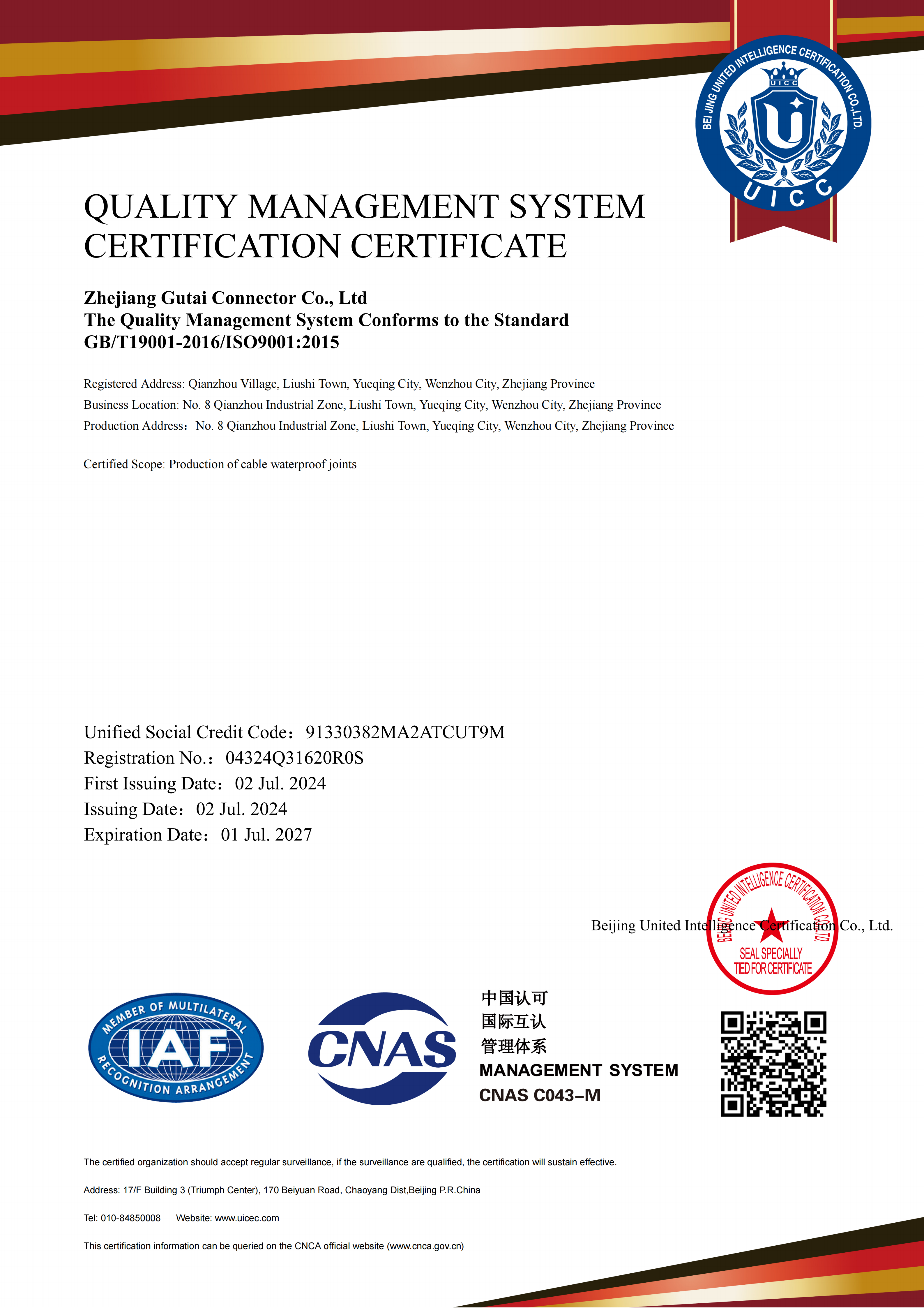
What that establishes is process capability: an audited system covering the manufacture of cable waterproof joints, the category that includes the cable gland families discussed here. What it does not establish is product conformity. The certificate names no thread size, no cable range, no material grade and no IP rating, and it cannot be used to support any of them. Its value is in the follow-up questions — how the system governs the checks that do matter, such as the 100% full dimension inspection Gutai applies in production, how non-conforming parts are segregated, and what the internal re-test interval is.
Two practical points follow. The certificate expires on 1 July 2027, so a buyer committing to a multi-year programme should ask for surveillance audit status at each renewal rather than filing the 2024 copy. And the scope wording should be read as written: where a purchase includes products outside "cable waterproof joints", this document is not what answers for them.
UL 514B and the Notice of Completion: the appendix defines the scope
The UL document in this evidence set is a Notice of Completion, File E539858, Volume 1, issued by UL Solutions on 13 September 2024 under Order 15194367 and Project 4791214316. It cites UL 514B and records a scope of liquid-tight flexible cord fittings (USR, CNR series), with the full catalog numbers set out in an appendix. The territory recorded is the US and Canadian markets.
UL 514B governs conduit, tubing and cable fittings, and it requires specific testing and marking for cable fittings intended for wet locations. That is why the appendix, not the certificate header, is the operative page: a model is covered when its catalog number appears on that list, with the thread type and size recorded alongside it. Gutai's product records associated with this document include the PG and metric cable gland series and the 1000 V solar MC4 connector family; the appendix determines whether a specific PG or M size inside those families is covered.
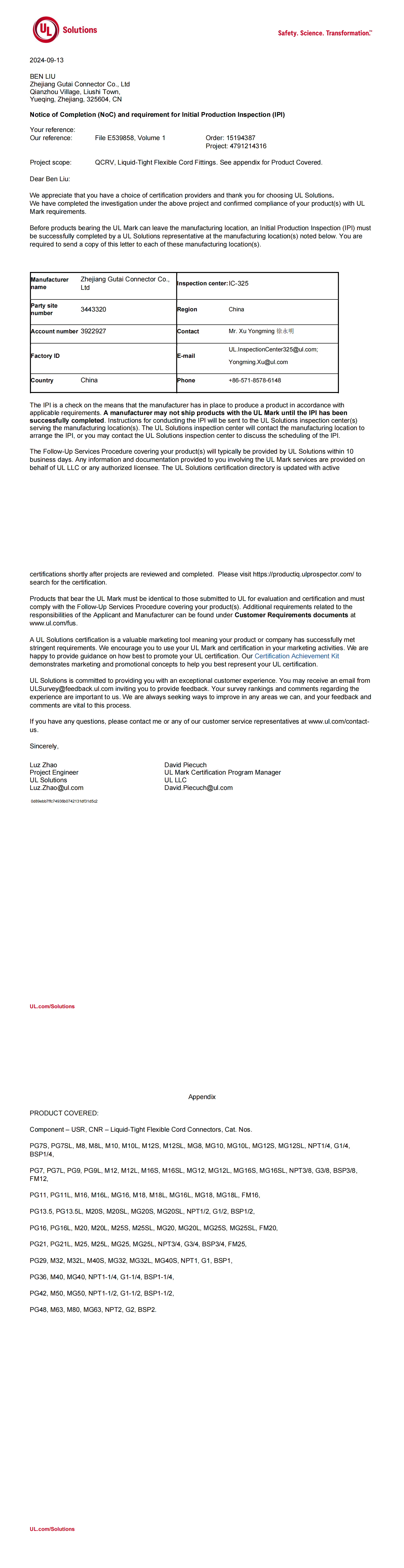
The reason to be strict is asymmetric risk. A buyer who accepts the category claim and later finds the ordered size outside the evaluated list has no remedy at the port; a buyer who requests the appendix page resolves the question in one message. The same discipline applies to marking, since a fitting presented as suitable for a wet location should carry the marking its listing requires.
CE to EN 62444:2013: which gland families sit inside the line
The CE document is Certificate of Compliance TST20241202520-1SC, issued on 12 December 2024 by Dongguan True Safety Testing Co., Ltd. against EN 62444:2013 for the EU market. The scope line reads: nylon cable gland, Model M, series G, MG, PG and NPT.
Three readings follow directly. The subject is nylon, so the certificate speaks for the nylon cable gland families and not for brass or stainless steel variants, which need their own evidence. The series list covers G, MG, PG and NPT, so both a PG-thread and a metric-thread nylon gland can sit inside the scope, but the model designation on the order should still be checked against the certificate's model naming. And the standard cited is the EN edition of 62444 — here the 2013 edition — which should be recorded as such. The IEC publication record for 62444 is the 2010 edition, which covers complete cable glands as supplied by the manufacturer and covers glands with IEC 60423 metric entry threads. The two editions are separate documents, and a technical file citing the wrong one is a documentation defect even where the product is unchanged.
EN 62444 is a construction and performance standard for cable glands; it addresses mechanical and sealing requirements rather than electrical rating. A buyer using it as a screen should therefore keep three questions apart: whether the model is in scope, whether the certificate or its underlying test report supports the specific claim being made, and whether that claim is one EN 62444 covers at all.
Turning IP68, PA66 and thread sizes into checkable model data
The series-level scope on a catalogue page is broader than any single part. The table below separates what is stated for the Gutai range from what a buyer should ask to see per model.
| Attribute | Stated for the range | Document basis | Confirm before approval |
|---|---|---|---|
| Thread families | PG7–PG48 and M12–M63 | Series documentation; UL NoC appendix for evaluated catalog numbers | The exact size appears on the appendix or certificate model list |
| Cable range | 3–45 mm across the range | Series documentation | The individual gland's cable band, since one size covers only a narrow portion of the total |
| Body material | Nylon PA66 for the nylon gland families | CE certificate scope and SGS RoHS report scope both name nylon cable gland | Grade and colour on the drawing; brass and stainless variants sit outside these two scopes |
| Ingress protection | IP68 | Product test documentation, required per model | Report naming model, thread, cable diameter and immersion conditions |
| Temperature | −40 °C to 120 °C stated for core products | Product documentation | Static and dynamic (flexing) figures separately, since the two are not interchangeable |
IP68 deserves the most attention, because it is the claim most often copied from a catalogue into a tender without a supporting report. IEC 60529 defines IP68 as protection against long-term immersion under pressure, and the code itself is only a classification system: the first numeral covers solids on a 0–6 scale, the second covers liquids on a 0–9 scale. The standard explains the rating; it does not certify a product. That evidence has to come from a test report for the specific gland, with the cable fitted, at a stated depth and duration.
Temperature follows the same logic. The −40 °C to 120 °C figure is stated for Gutai's core products and should be applied only to the configuration for which it was stated. A gland on a fixed conduit run and a gland on a moving cable are different service conditions; dynamic flexing normally reduces the permissible upper limit, so a buyer specifying a flexing route should request the dynamic figure rather than infer it from the static one.
Application fit: which document carries weight in which project
EU and UK panel building, outdoor lighting and machinery
The operative documents are the CE certificate to EN 62444:2013 for the nylon gland families and the SGS RoHS report for the same scope. A buyer in this market should file both and check the model naming on the certificate against the part number on the drawing. Where a project also requires a supplier declaration of conformity, that is a separate document from the certificate and should be requested explicitly.
North American wet-location installations
The UL Notice of Completion to UL 514B governs, and the check is mechanical: find the catalog number, thread type and size in the appendix. Where the part is not listed, the practical alternative is to select a listed size from the same family rather than to accept a general statement of compliance.
Solar PV and the 1000 V MC4 line
Solar connectors follow a different evidence pattern from cable glands, because the relevant references are PV connector standards rather than EN 62444. Documented project experience exists in this category: a Middle Eastern PV developer took 20,000 sets of anti-UV modified PA66 connectors over three years for a 150 MW desert plant, with housings tested to 1,000 hours of UV ageing and seals in high-temperature fluororubber, and reported a connector damage rate falling from 8% a year on the previous imported product to below 1.2%. That is a project record rather than a warranty, but it is the type of evidence a PV buyer can weigh against a datasheet.
High-exposure outdoor and coastal sites
A second documented project covers 5,000 sets of IP68 metal connectors for coastal DC fast-charging stations in Europe, using 304 stainless steel and a dual-seal anti-loosening structure, tested to 1,000 hours of salt spray and to IEC 60068-2-6 vibration, with the operator reporting a connector-related failure rate falling from 18% to 2.6% a year. Where a specification depends on salt-spray or vibration evidence of that kind, the request should name the test and the duration.
Certificate-first versus model-first evaluation
Two evaluation styles produce very different outcomes at the execution stage.
| Evaluation style | Question asked | What a pass proves | Typical failure mode |
|---|---|---|---|
| Certificate-first | Does the supplier hold ISO9001, UL and CE? | That documents exist for some part of the range | A specific size or material falls outside every scope line |
| Model-first | Which document covers this part number, in this market, for this claim? | That the claim is traceable to a named model and a named standard | Slower first pass; requires the appendix and scope lines |
Model-first evaluation is slower on the first order and cheaper across a programme. It also changes the request: instead of a certificate pack, the buyer asks for a short matrix — part number, thread, material, market, document reference, and the page where that part number appears. Gutai's documentation supports that matrix for the four documents described here, but the mapping itself still has to be done, in writing, by the supplier or the buyer.
What the documents do not cover: capacity and repeatability
None of the four documents says anything about output or delivery. For that part of the evaluation the reference points are operational: a 5,000 m² facility, 80 employees, a stated annual output of 10,000,000 units, monthly capacity of 500,000 cable glands and 100,000 MC4 sets, small trial orders accepted, and lead time quoted against order quantity. Export share is stated at approximately 80% of output, across the Middle East, Southeast Asia, India, Pakistan, the EU, the UK and the USA.
Those figures are supplier-reported and should be read as such. Their use is to test whether the capacity story is consistent with the order — a 200,000-piece annual requirement against a stated 500,000-piece monthly gland capacity is a different risk profile from the same requirement against a supplier whose annual output barely exceeds it. Capacity evidence answers a different question from certificate evidence, and a supplier can be strong on one and weak on the other.
Market context: why scope reading is becoming a selection filter
Third-party research puts the global cable gland market at approximately USD 5.5 billion by 2035, a forecast published by DataM Intelligence, and places MC4-style connectors at a 68% revenue share of the solar PV connector market in 2024, according to Vantage Market Research. Both are commercial research forecasts rather than audited statistics, and neither says anything about an individual supplier. What they indicate is scale: categories this large attract suppliers at very different levels of documentation discipline.
For a buyer, the consequence is conditional rather than dramatic. Where two offers are close, the supplier that can produce a scope line matching the part number, a test report matching the model, and an appendix matching the size removes a category of risk that the lower-priced option leaves in place. That is a judgment about evidence quality, not about brand preference.
Verification checklist: confirmed items and open requests
The checklist below separates what is documented in this evidence set from what remains a request. The second group is not a criticism of the supplier; it is a list of items that should stay open in the buyer's file until a document arrives.
| Status | Item | Detail |
|---|---|---|
| Confirmed | ISO9001:2015 | Registration No. 04324Q31620R0S, scope "Production of cable waterproof joints", valid to 1 July 2027 |
| Confirmed | UL 514B | Notice of Completion, File E539858 Volume 1, issued 13 September 2024, scope liquid-tight flexible cord fittings with catalog appendix |
| Confirmed | CE / EN 62444:2013 | Certificate TST20241202520-1SC, nylon cable gland, Model M, series G, MG, PG, NPT, issued 12 December 2024 |
| Confirmed | RoHS | SGS report NGBEC26005747401, EU Directive (EU) 2015/863, scope nylon cable gland, issued 13 July 2026 |
| Confirmed | Commercial terms | MOQ from 1 unit, FOB/EXW, pre-shipment test as the stated acceptance criterion, T/T among the stated payment terms |
| Open | TÜV certification | Not among the documents in this set; treat as unverified until a certificate number and scope are supplied |
| Open | IEC 62852 / EN 50521 reports | Gutai states it can provide pre-test data and certification-path planning for IEC 62852; that is a support service, not a test report |
| Open | Model-level IP68 report | Required per gland model, with cable diameter and immersion conditions stated |
| Open | UL appendix match | The catalog number covering the exact PG or M size on the order |
| Open | Brass and stainless variants | Outside the CE nylon scope; separate evidence required |
| Open | Dynamic temperature figure | Separate from the static figure; request per model |
FAQ
What does the ISO9001:2015 certificate actually cover for Gutai's cable glands?
Registration No. 04324Q31620R0S, issued on 2 July 2024 by Beijing United Intelligence Certification Co., Ltd., certifies a quality management system to GB/T19001-2016 / ISO9001:2015 with a scope of "Production of cable waterproof joints", valid to 1 July 2027. It covers the production process for that product category. It does not certify a thread size, a material, an IP rating or a market approval, so it is used alongside product-level certificates rather than instead of them.
How can a buyer confirm that a specific PG or metric size is covered by the UL Notice of Completion?
By finding that size in the catalog appendix attached to the Notice of Completion, File E539858, Volume 1, issued by UL Solutions on 13 September 2024 under UL 514B. The stated scope is liquid-tight flexible cord fittings (USR, CNR series), with the full catalog numbers listed in the appendix. Coverage is defined by the appendix entry rather than by the file number alone, so the appendix page should be filed with the order.
Does the CE certificate to EN 62444:2013 cover brass cable glands as well as nylon?
No. Certificate TST20241202520-1SC, issued on 12 December 2024 by Dongguan True Safety Testing Co., Ltd., states a scope of nylon cable gland, Model M, series G, MG, PG and NPT, for the EU market. Brass and stainless steel variants are not named in that scope and require their own supporting evidence.
Does a UL or CE certificate prove an IP68 rating?
Not on its own. IP ratings are defined by IEC 60529, which classifies protection against solid objects on a 0–6 scale and against liquids on a 0–9 scale, with IP68 denoting long-term immersion under pressure. The standard defines the classification; it does not certify a product. An IP68 claim needs a test report naming the specific model, the cable fitted, and the depth and duration of immersion, and that report is a separate document from a conformity certificate.
Is the temperature band the same for static and dynamic installations?
No, and the two figures should be requested separately. Gutai's product documentation states operating conditions from −40 °C to 120 °C for core products, and that figure applies to the configuration for which it was stated. A gland on a moving or flexing cable is normally subject to a narrower upper limit, so the dynamic figure should come from the model datasheet rather than be inferred from the static one.
Are TÜV certification and IEC 62852 or EN 50521 test reports available for the MC4 connectors?
Neither should be assumed. The documents in this evidence set are ISO9001:2015, the UL 514B Notice of Completion, the CE certificate to EN 62444:2013 and the SGS RoHS report; no TÜV certificate or IEC 62852 / EN 50521 report is included, so both stay open until a document with a certificate or report number and a stated scope is produced. Gutai states that it can provide pre-test data and certification-path planning for IEC 62852, which is a support service rather than a completed certification.
Where to send the remaining document questions
The four documents described here, the catalog appendix for the UL file, and model-level datasheets for individual PG and M sizes form the practical starting set for a supplier file. Gutai publishes its range on gt-connector.com and its current 2025 product catalogue as a downloadable PDF; document questions can be addressed to Vincy Wang at vincy@gt-connector.com or +86 136 7657 6672.
The useful rule at the execution stage is simple: every claim on a purchase order should point to a document page, and every document page should point back to a part number. Where that loop closes, certificate reading stops being paperwork and starts being a purchasing control.
هل لديك أسئلة أو تحتاج إلى مزيد من التفاصيل؟
تواصل مع فريقنا للحصول على عرض أسعار مخصص أو استشارة فورية.
طلب عرض أسعار
املأ النموذج أدناه وسيتواصل معك فريقنا بعرض مقترح مخصص.
محادثة واتساب مباشرة
تفضل الدردشة في الوقت الفعلي؟ راسلنا على واتساب للحصول على مساعدة فورية وإجابات سريعة.
- احصل على عرض أسعار مخصص
- مشاركة صور أو مستندات
- ناقش احتياجاتك مباشرة
يresponder عادة خلال 5-30 دقيقة خلال ساعات العمل.