
How CE Standards Apply to Multifunctional Digital Printing Machines
A multifunctional digital printing machine that prints corrugated board is also a piece of industrial machinery — and inside the European Union, that second identity decides whether an importer may legally place it on the market. Print resolution, print width and ink set describe the production value of the machine. The conformity file describes whether that value can be delivered inside the EU at all.
Buyers who approach the purchase as a printing decision alone tend to discover the compliance layer late, usually when a customs or customer audit asks for documentation that does not yet exist. The more useful sequence is the reverse: establish what the CE file must contain for the configuration being purchased, then confirm that the manufacturer can supply it for that exact configuration.

What CE marking does and does not mean on a printing machine
For most industrial digital printers, CE marking is a manufacturer's declaration of conformity rather than a certificate issued to the machine by a regulator. The manufacturer states that the equipment meets the EU directives that apply to it, and supports that statement with a technical file. On a machine of this class, three areas usually dominate the assessment: machinery safety, the electrical equipment of the machine, and electromagnetic compatibility of the control and RIP electronics. Ink and material chemistry adds a fourth, substance-related layer.
Two published standards are consistently referenced when this type of equipment is assessed. Risk assessment follows EN ISO 12100, which sets out the methodology for identifying hazards and reducing risk on industrial machinery. The electrical equipment of machines is governed by IEC 60204-1, adopted in Europe as EN 60204-1, which addresses supply arrangements, protective bonding, emergency stop functions, isolation and marking.
In parallel, substance restrictions apply to what the machine puts into the production environment. RoHS and REACH frame the discussion in Europe, and the regulatory direction has been moving. In April 2024, the U.S. EPA declared certain PFAS chemistries used in UV inks hazardous — a U.S. action rather than an EU one, but one that has prompted ink formulators internationally to review UV ink composition. Importers who run UV-cured inks should expect this area to keep changing.
Equally important is what CE marking does not certify. It says nothing about print quality, throughput, uptime or cost per square metre. It does not cover a machine that has been modified after delivery. And it does not transfer responsibility for a configuration change made by the buyer or the reseller.
Why certification readiness is a configuration question, not a checkbox
The most common misunderstanding among importers is that a printing machine has one compliance status. On a configurable platform, it has as many compliance statuses as it has configurations, because each choice on the order sheet changes either the electrical load, the mechanical risk or the chemical inventory of the delivered unit.
On a multifunctional digital printing machine built as a single-pass and multi-pass 2-in-1 system, the configurable variables include:
- Print architecture — single-pass operation with a XAAR printhead, multi-pass operation with Epson or Xaar nozzles, or a hybrid machine that switches between the two modes.
- Printhead count — configurations from 8 to 256 printheads, which changes both the electrical profile and the internal service access requirements.
- Print width — from 264 mm to 2600 mm, which changes the mechanical envelope of the feeding, conveying and receiving sections.
- Colour set — CMYK or CMYK with an additional white channel.
- Ink chemistry — water-based dye ink, water-based pigment ink, coating ink or UV eco-friendly ink.
- Drying and curing — the drying method is part of the machine, and on UV configurations it is also part of the electrical and chemical assessment.
A declaration of conformity written around a compact CMYK machine running water-based ink does not automatically describe a wide, high-printhead-count five-colour machine running UV ink. That gap is where most importer disputes begin, and it is why the first practical question to a supplier is not "is the machine CE marked" but "which configuration does the declaration describe".
The reference platform: GOKING's 4260 mm × 2300 mm × 1900 mm model
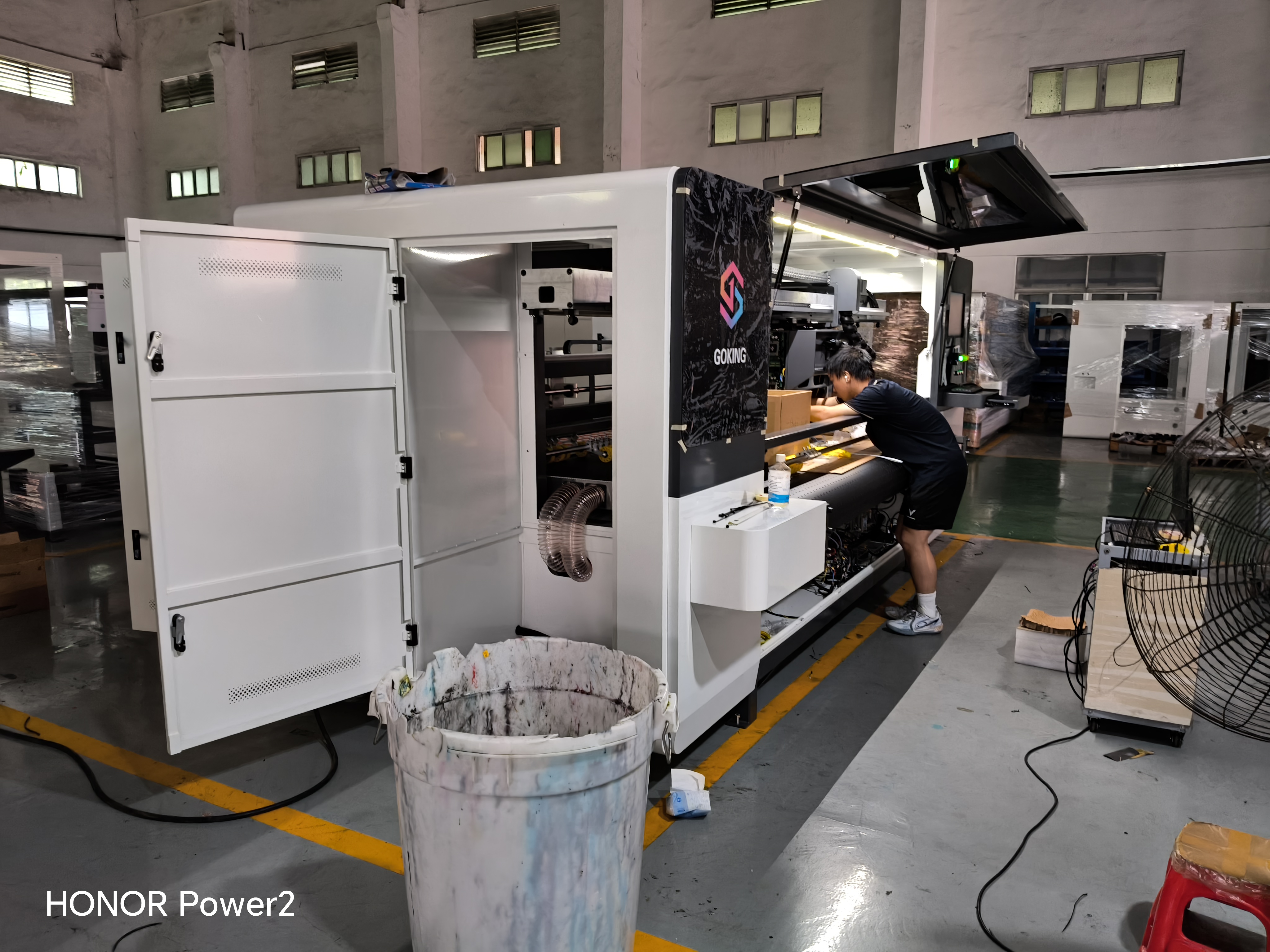
Guangdong Goking Intelligent Technology Co., Ltd. (GOKING) is a Dongguan-based manufacturer of industrial digital printing equipment, established in 2020, operating a 10,000 m² facility with 152 employees, an R&D team of 38 engineers and an annual output of 864 sets. The company builds single-pass and multi-pass 2-in-1 digital printing machines for corrugated and honeycomb cardboard, and reports that 49% of its products are exported, with EU markets listed among its main destinations alongside Africa, Latin America, Russia, Kazakhstan and Turkey.
Its reference model, described as a plate-less digital printing machine for corrugated cardboard and cardboard packaging, has a published footprint of 4260 mm × 2300 mm × 1900 mm and a weight of 2800 kg. The data below is taken from the published specification and mapped against the compliance questions an EU importer typically has to answer.
| Published parameter | Figure | Why an importer checks it |
|---|---|---|
| Machine size | 4260 mm × 2300 mm × 1900 mm | Determines transport mode, container planning, door clearances and the layout revision that often follows import. |
| Weight | 2800 kg | Floor loading, lifting plan and rigging requirements at the installation site. |
| Rated power | ≈14 kW | Feeds into the site electrical plan and the supply capacity confirmed with the landlord or utility. |
| Electricity | 380 V, 50/60 Hz, three-phase | The dual-frequency rating matters when the machine is matched to a European 50 Hz supply; voltage tolerance should be confirmed in writing. |
| Electrical components | Schneider components, servo motors | Named component brands make the technical file easier to trace and verify. |
| Working environment | 15–32 °C, 70% humidity | Defines whether an unheated warehouse or a cold logistics hall is a suitable installation site. |
| Printheads | 8 to 256 printheads, micro-piezo | Printhead count and type belong to the delivered configuration and therefore to the declaration. |
| Print width | 264 mm to 2600 mm | Affects guarding, conveyor geometry and operator access points. |
| Material thickness | 2–30 mm | Sets the mechanical envelope of the feeding and conveying sections. |
| Colour mode and ink | CMYK (W); water-based dye, water-based pigment, coating ink, UV eco-friendly ink | Ink chemistry is part of the substance review, not only a print-quality decision. |
| Construction | Carbon steel frame, stainless steel conveying rollers, aluminium alloy beam | Material declaration and corrosion behaviour in humid production halls. |
The electrical file: what an EN 60204-1 review looks for
Electrical documentation is usually the first item an EU importer is asked to produce, and the reviewed model provides a clear starting point. Its published supply requirement is 380 V, 50/60 Hz, three-phase, with a rated power of approximately 14 kW. The machine is fitted with Schneider electrical components and servo motors, and the matched-equipment list includes a voltage stabilizer and a temperature control system as part of the delivered setup.
Under IEC 60204-1, the practical verification points for a machine of this size include protective bonding and earthing arrangements, emergency stop function and its stopping category, means of isolation for maintenance, short-circuit and overload protection coordination, conductor identification and terminal marking, and the language of the operating manual supplied with the machine.
Three questions are worth asking in writing before the order is confirmed:
- Does the nameplate data on the delivered unit match the declaration of conformity exactly, including rated voltage, frequency, phase count and power?
- Is the dual 50/60 Hz rating confirmed for the specific configuration, and what supply tolerance is stated for a European 50 Hz site?
- Are the electrical schematic drawings supplied as part of the technical documentation, and in which language?
The safety file: risk assessment under EN ISO 12100
Risk assessment on a printing machine concentrates on the points where board, belt, print bar and operator meet. On a 2-in-1 platform, that means the leading-edge feeding unit, the belt feed path, the vacuum adsorption platform, the magnetic levitation high-precision crossbeam, the receiving unit and the drying or curing section. Each of these is a candidate for guarding, interlocking or a safe maintenance procedure under a risk assessment carried out to EN ISO 12100.
Printhead technology also affects maintenance exposure. Xaar industrial-grade printheads, including the Xaar 5601 and 1003 series, use patented True Internal Circulation (TF) technology, which circulates ink continuously behind the nozzles to reduce clogging and stabilise long production runs. From a compliance perspective, the relevant point is not the print quality benefit but the maintenance routine: fewer unplanned stops generally means fewer unplanned interventions inside guarded zones.
For the importer, the safety file questions are practical ones. Which hazards were identified for this configuration, and how were they reduced? Are guards interlocked or fixed? Where are emergency stop devices positioned along a 4.26 m machine? What procedure is specified for nozzle and printhead maintenance, and does the manual describe it in a language the operators can read?
Environment and ink chemistry: the limits that travel with the machine
The published working environment for this model is a room temperature of 15–32 °C and humidity of 70%. Those numbers are often read as a comfort specification; in practice they are an installation constraint. A machine placed in an unheated logistics building in northern Europe, or in a hall where humidity swings with the season, may fall outside the specified envelope. The matched-equipment list already anticipates this by including a temperature control system and a humidifier, which means the installation plan — and its electrical load — extends beyond the press itself.
Ink choice carries its own compliance thread. The platform supports water-based dye ink, water-based pigment ink, coating ink and UV eco-friendly ink. Water-based pigment ink accounted for a significant portion of the eco-friendly digital printing segment in 2024, and the regulatory pressure on UV formulations has increased since the U.S. EPA's April 2024 declaration on certain PFAS chemistries used in UV inks. Importers running UV should expect to maintain current safety data sheets for every ink in the production area, and should confirm which ink family was assumed when the technical file was assembled.
Where these machines run — and where compliance scrutiny is highest
The application profile of this class of equipment is packaging and carton printing: corrugated cardboard and cardboard packaging, with coated paperboard and paper mill environments also listed as target industries. Production patterns include mass production, short-run printing, frequent job changes and continuous high-speed operation. Project types range from factory capacity expansion and equipment upgrade to OEM/ODM customised printing lines and sample validation.
Scrutiny tends to concentrate in two places. The first is export-facing packaging producers, whose own customers audit their supply chains and increasingly ask for machine documentation as part of that audit. The second is OEM and ODM projects, where the buyer specifies a customised line: a bespoke configuration is exactly the situation in which the conformity documentation has to be rebuilt rather than copied from a standard model.
What the market context says about timing
The compliance question is arriving at the same time as a broad shift towards digital production. The global digital printing market was valued at USD 38.0 billion in 2023 and is projected to reach USD 57.0 billion by 2030 (Grand View Research). Within that market, the inkjet segment held the largest technology share in 2023 at 48.4%. Packaging is a large part of the movement: the digital printing packaging market is expected to reach USD 46.2 billion by 2029 from USD 30.2 billion in 2024 (MarketsandMarkets).
The single-pass segment is smaller but expanding, valued at USD 3.2 billion in 2024 and projected to reach USD 6.5 billion by 2034 in one estimate (Reports and Data). Regionally, Asia-Pacific held approximately 41.6% of digital printing revenue in 2025 (Market Research Future), which is consistent with the concentration of printing machinery manufacturing in Guangdong province that supports Chinese export supply.
Two demand-side signals reinforce the direction. Variable data printing has made runs under 3,000 units economically viable, a range that was previously cost-prohibitive. And water-based pigment ink has taken a significant share of the eco-friendly segment, giving buyers a decision lever that is both commercial and regulatory at the same time.
Comparison with traditional plate-based lines
Plate-based printing is not less regulated than digital printing; it is differently regulated. A flexo or offset line for corrugated board also carries machinery, electrical and substance requirements, and the industry has decades of conformity templates for it. What differs is the shape of the compliance effort.
| Dimension | Plate-based line | Multifunctional digital printing machine |
|---|---|---|
| Configuration variability | Usually a fixed press configuration with standard tooling. | Highly variable: printhead count, print architecture, colour channels and ink family all change. |
| Conformity documentation | Mature, repeatable templates; limited variation between units. | Must be rebuilt, or at least re-checked, for each configuration shipped. |
| Electrical complexity | Conventional drive and control architecture. | Adds RIP software, servo-driven axes and printhead control electronics, expanding the EMC dimension. |
| Chemical scope | Mainly plates, solvents and wash-up agents. | Ink family is a live regulatory variable — water-based dye, water-based pigment, coating or UV ink. |
| Job changeover | Plate change and set-up waste. | Plate-less production, suited to short and variable runs. |
The boundary buyers should plan around
There is a real limitation here, and it is worth stating plainly. A CE declaration is configuration-bound. If an importer takes delivery of a certified machine and later changes the printhead count, adds a white ink channel, switches from water-based to UV ink, or replaces the drying system, the original declaration may no longer describe the machine in operation. Responsibility for the modified unit can shift to the party that made the change.
A second boundary is scope. Compliance documentation says nothing about whether the machine produces sellable board at the expected cost per square metre. Two suppliers can both present complete files, and one machine can still be a poor fit for the buyer's order mix. Certification readiness is a qualifying condition, not a purchasing decision.
A verification checklist for importers
The following items are the ones most often requested late and most often missing. Requesting them at the quotation stage prevents the gap.
| Stage | What to request | What it confirms |
|---|---|---|
| Before quotation | Statement of which configuration the declaration of conformity describes | That the compliance file matches the machine being priced. |
| Technical review | Risk assessment reference to EN ISO 12100; electrical documentation to IEC/EN 60204-1 | That the assessment framework is the recognised standard for this machinery class. |
| Electrical review | Nameplate data, schematic drawings, voltage tolerance for a 50 Hz supply, stabilizer specification | That the delivered unit matches the declared ratings at 380 V, 50/60 Hz, three-phase. |
| Site planning | Footprint 4260 × 2300 × 1900 mm, weight 2800 kg, environment limits 15–32 °C and 70% humidity | That the installation site is within specification before the machine ships. |
| Ink and substances | Safety data sheets for every ink family in use, including UV; substance restriction statements | That the chemical scope of the technical file matches production reality. |
| Release and delivery | Pre-shipment inspection records, aging test documentation, packing list and shipping condition report | That the unit was produced and released against a defined internal check before it left the factory. |
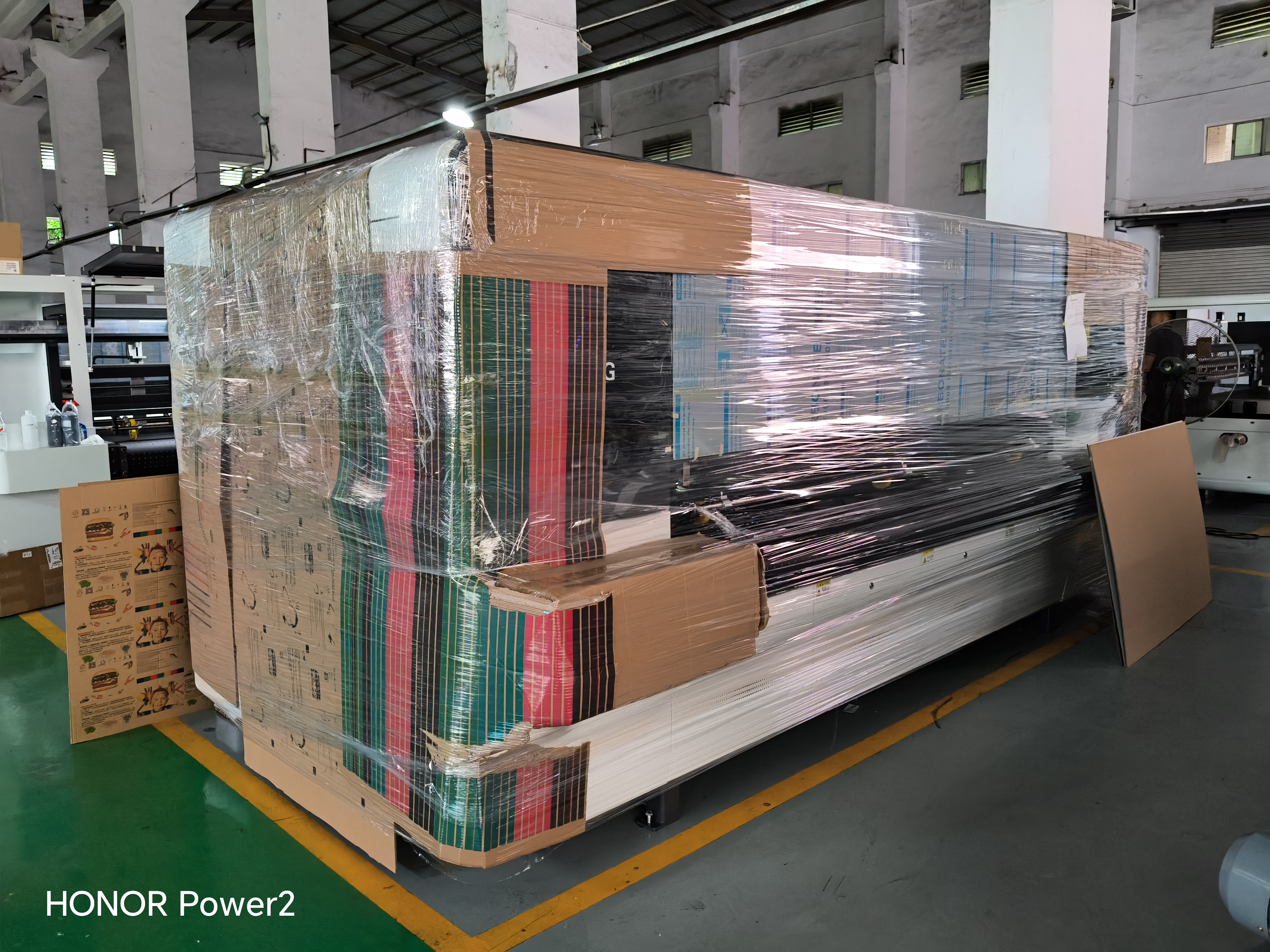
GOKING publishes a 2026 product catalogue covering its digital printing machine range, which is a practical starting point for mapping available configurations before the compliance discussion begins: 2026 product catalogue (PDF).
Future outlook
Three directions look likely over the next several years. Substance regulation will keep tightening, particularly around ink chemistry, and UV formulations will stay under the most review pressure. Electrical and control documentation will become more standardised, because digital presses keep adding software and servo-driven subsystems that fall inside the EMC and machine-control scope. And configuration management will move earlier in the sales cycle, with serious buyers requesting the conformity scope at quotation rather than at shipping.
None of these changes alter the underlying structure of the requirement. CE marking for a multifunctional digital printing machine remains a configuration-specific declaration supported by a technical file, and the importer's job is to confirm that the file describes the machine that will actually be installed.
FAQ
Does a multifunctional digital printing machine need CE marking to be sold in the EU?
If it is machinery placed on the EU market, it generally falls within the scope of EU machinery safety legislation and requires CE marking, a declaration of conformity and a technical file. Because a digital printing machine combines mechanical, electrical, electronic and in some cases chemical subsystems, more than one directive can apply at the same time. The obligation sits with the party that places the machine on the market, which is normally the manufacturer or the EU importer.
Which standards are typically referenced in a CE conformity assessment for an industrial digital printer?
Risk assessment is normally carried out to EN ISO 12100, which defines the methodology for hazard identification and risk reduction on machinery. The electrical equipment of the machine is addressed by IEC 60204-1, adopted in Europe as EN 60204-1. Electromagnetic compatibility standards apply to the control and RIP electronics, and substance restrictions such as RoHS and REACH apply to inks and materials. The exact list depends on the configuration and the intended use.
What electrical information should an importer confirm before ordering?
The published supply requirement for the reference model is 380 V, 50/60 Hz, three-phase, with a rated power of approximately 14 kW. Buyers should confirm the nameplate data on the delivered unit matches the declaration, ask what voltage tolerance is stated for a 50 Hz European supply, and confirm whether a voltage stabilizer is included in the matched equipment and how it is wired into the installation.
What environmental conditions does the machine require?
The published working environment is a room temperature of 15–32 °C with 70% humidity. That range rules out some unheated warehouse and logistics buildings, and it means the installation plan may need a temperature control system and a humidifier as part of the matched equipment rather than as optional accessories.
Which documents should an importer request from the manufacturer?
A declaration of conformity covering the delivered configuration; a reference to the risk assessment carried out to EN ISO 12100; electrical schematic drawings; component information for the electrical assemblies; safety data sheets for every ink family used, including UV; and factory release records such as pre-shipment inspection and aging test documentation, together with the packing list and shipping condition report.
Can the machine be modified after delivery without affecting its CE status?
Changes to safety-related parts, printhead count, colour channels, drying system or ink chemistry can take the machine outside the scope of the original declaration of conformity, and responsibility for the modified unit can shift to the party that made the change. Modifications should therefore be discussed with the manufacturer, and the affected documentation should be updated rather than assumed to remain valid.
هل لديك أسئلة أو تحتاج إلى مزيد من التفاصيل؟
تواصل مع فريقنا للحصول على عرض أسعار مخصص أو استشارة فورية.
طلب عرض أسعار
املأ النموذج أدناه وسيتواصل معك فريقنا بعرض مقترح مخصص.
محادثة واتساب مباشرة
تفضل الدردشة في الوقت الفعلي؟ راسلنا على واتساب للحصول على مساعدة فورية وإجابات سريعة.
- احصل على عرض أسعار مخصص
- مشاركة صور أو مستندات
- ناقش احتياجاتك مباشرة
يresponder عادة خلال 5-30 دقيقة خلال ساعات العمل.