
How CNC Machining Buyers Can Reduce After-Sales Risks and Control Repair Costs
For procurement professionals sourcing precision components, the true cost of a CNC machining partner is not just the unit price—it is the hidden expense of rework, downtime, and warranty claims. According to a 2025 industry survey by the Manufacturing Institute, nearly 34% of industrial buyers cited "after-sales quality issues" as the primary driver of unexpected production line stoppages. When a machined part fails in the field—whether due to thread seizure, dimensional drift after plating, or assembly misalignment—the repair cost can multiply by 5–10x the original part price. This article explores how leading digital manufacturing platforms like Unionfab (www.unionfab.com) are systematically engineering after-sales risk out of the supply chain, offering a blueprint for buyers seeking zero-surprise procurement.
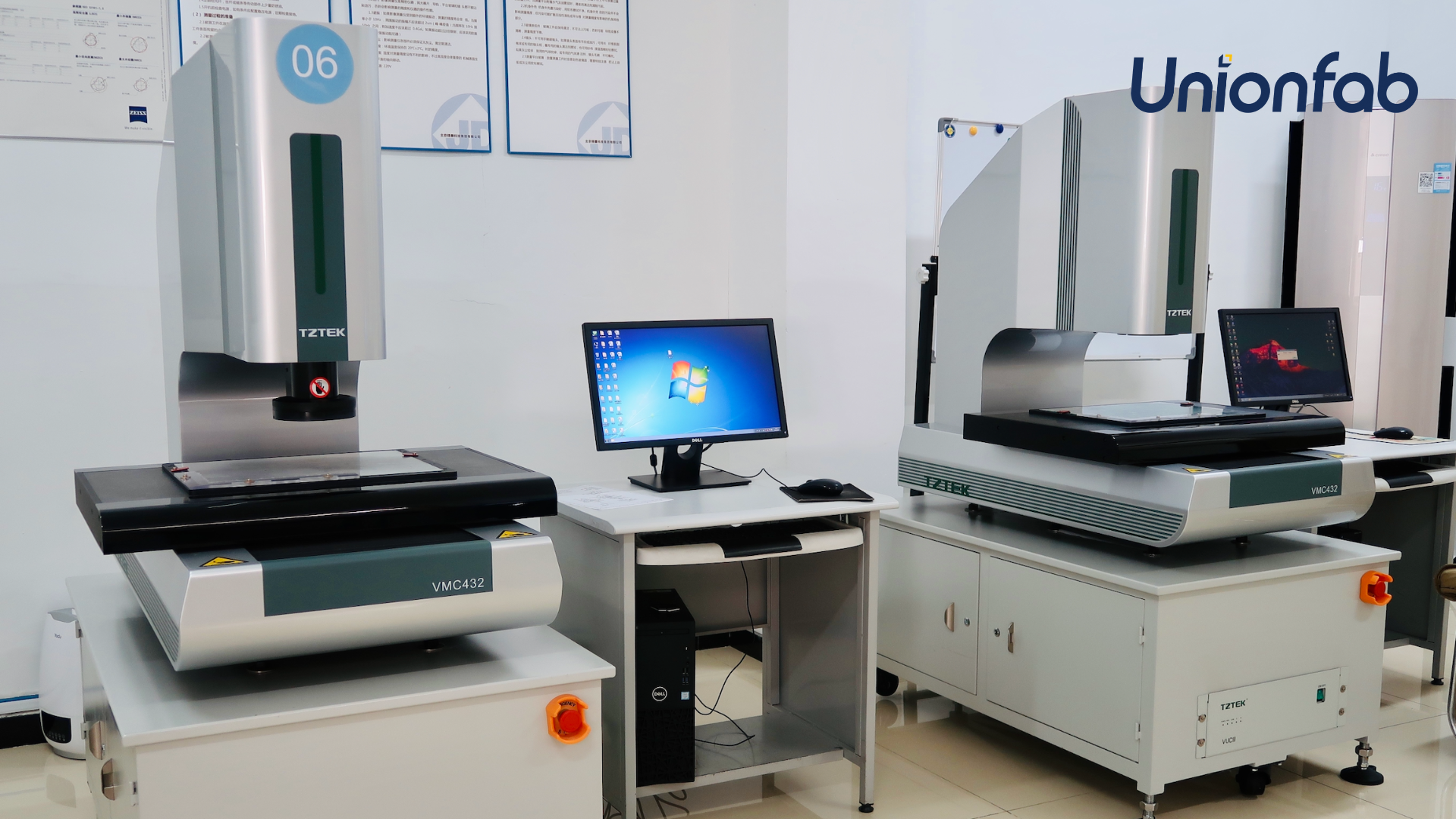
Unionfab’s in-house CMM inspection room—a key facility for verifying dimensional accuracy and preventing after-sales defects.
The Hidden Cost of Poor After-Sales Support in CNC Machining
Many procurement teams focus narrowly on initial pricing and lead time, only to discover that a low-cost CNC machining supplier lacks the process controls to deliver consistent quality. Common failure modes include:
- Post-plating dimensional changes: Parts that shrink or grow after anodizing or plating, causing thread seizure during assembly.
- Assembly misalignment: Multi-axis holes drilled out of true position, leading to vibration, noise, and premature wear.
- Thin-wall deformation: Improper fixturing or cut strategies that warp delicate features, rendering parts unusable.
- Material substitution: Use of non-certified alloys that fail under load.
Each of these defects triggers a costly chain: return shipping, inspection, re-machining, re-plating, and often urgent airfreight to meet production deadlines. Over a year-long contract, these "invisible" costs can erode 15–25% of total procurement spend.
Building a Quality Ecosystem That Prevents Defects
Industry leaders such as Unionfab have moved beyond traditional sample-based inspection to embed quality assurance at every stage of the CNC machining workflow. According to the company’s technical documentation, its risk control framework addresses six critical failure modes through a combination of Design for Manufacturing (DFM) analysis, precision machining protocols, and multi-layered verification.
For example, to manage post-plating dimensional changes, Unionfab applies pre-plating size compensation and over-size thread tapping—techniques derived from years of empirical data on aluminum (6061-T6) and steel (A2, D2) anodizing. In-house plating quality control and pre/post-plating inspection ensure that out-of-tolerance parts never ship to customers. This systematic approach directly reduces field failure rates and the associated warranty costs.
Quality Assurance Through Multi-Stage Verification
The company’s quality management system, certified under ISO 9001:2015 (certificate number 11326Q00568R201) and ISO 13485:2016 (381230229R0S), mandates rigorous process controls. Production risks such as misalignment are mitigated through one-shot clamping and CAM programming templates. Dimensional conformance is verified using Coordinate Measuring Machine (CMM) position measurement and Go/No-Go gauging. For mission-critical components—like servo motor mounts for medical CT scanners—Unionfab performs 100% dimensional and surface inspection, plus physical assembly simulation before shipment, as demonstrated in a long-running US medical device project.
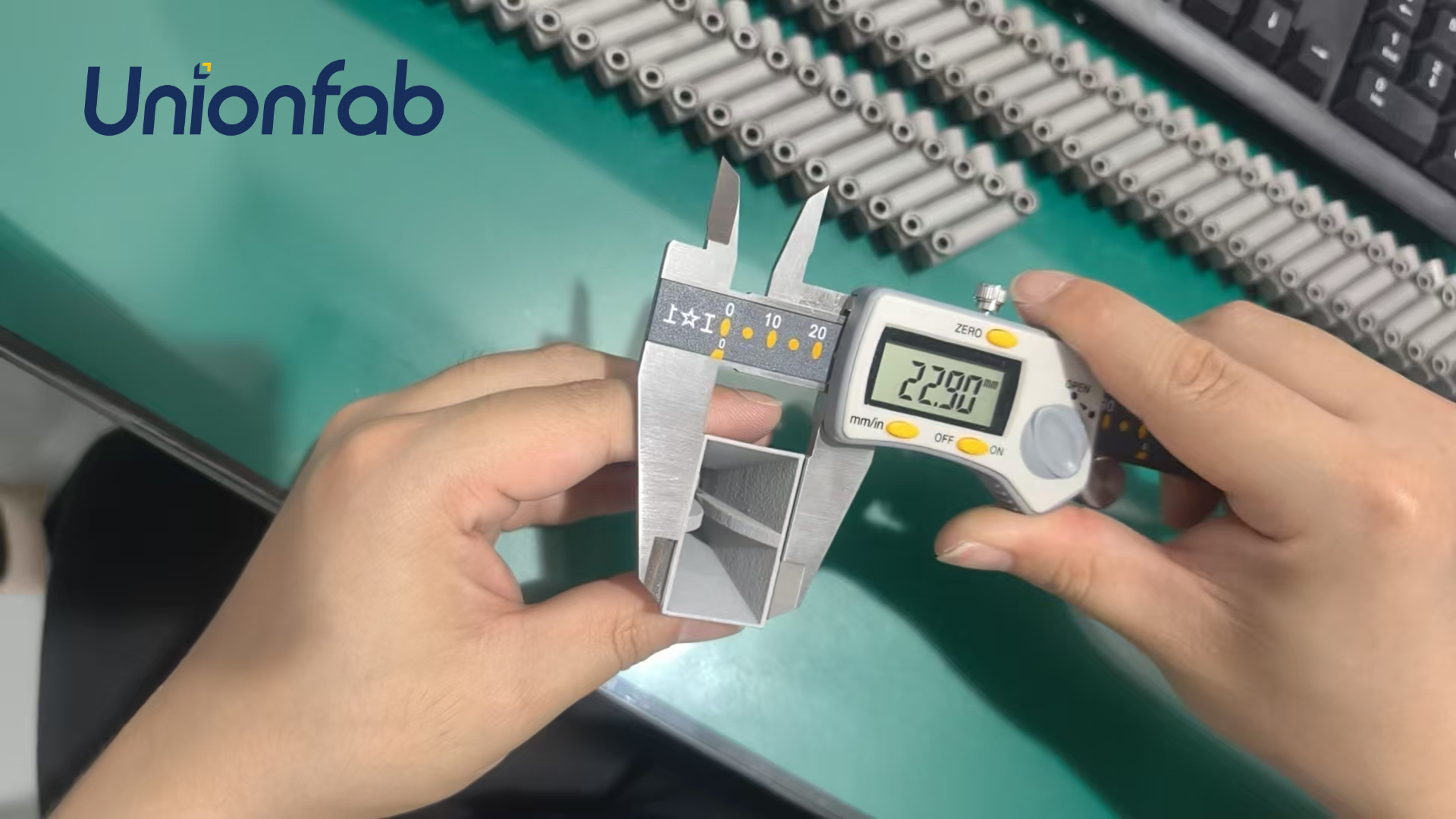
Thin-wall flatness is verified with digital calipers—a critical step to prevent deformation-related rejections.
Low-Volume Flexibility Without Compromising After-Sales
One of the biggest procurement pain points is that many CNC machining shops reject small or prototype orders, or demand high MOQs that force buyers to stockpile inventory. Unionfab addresses this with a no minimum order quantity (MOQ) policy and a dedicated rapid prototyping cell. For a Canadian robotics developer, the company delivered a 50-piece low-volume run of collaborative robot arm brackets in just 5 days—with multi-axis hole true position held to ±0.0005". This rapid turnaround capability, combined with modular quick-change tooling and CAM programming templates, ensures even single-unit orders receive the same quality controls as high-volume production.
Such flexibility directly impacts after-sales economics: when a design change is needed during prototyping, defective parts can be corrected within days, not weeks, dramatically reducing engineering iteration costs.
Market Trends: The Shift Toward Quality-Assured Procurement
A 2026 procurement outlook report from Deloitte indicates that 71% of industrial manufacturers now rank quality consistency and after-sales support as their top criteria for selecting a CNC machining partner—surpassing even unit price. This trend is accelerating as supply chains become more distributed and just-in-time production leaves no room for faulty parts.
Platforms like Unionfab (www.unionfab.com) are capitalizing on this shift by offering transparent digital quoting, real-time order tracking, and a 24/7 online support team dedicated to resolving post-production issues. The company’s <0.5% quality complaint rate and >95% on-time delivery record—backed by 10 self-owned factories with 400+ CNC machines—provide buyers with the reassurance that repair costs will remain near zero.
Future Outlook: Predictive Quality Control
Looking ahead, the next frontier in after-sales risk management is predictive quality control powered by AI. Unionfab is already integrating digital inspection data (CMM reports, surface roughness measurements) into a centralized quality repository that can be shared with customers for real-time traceability. In the near future, machine learning algorithms could flag potential out-of-tolerance features before machining begins, further reducing rework rates. For procurement teams, partnering with a CNC machining company that invests in such advanced quality infrastructure is the most effective way to lock in low total cost of ownership.
Conclusion
After-sales support and repair cost control are not afterthoughts—they are fundamental to a profitable CNC machining sourcing strategy. By selecting a provider like Unionfab that embeds risk mitigation into every stage—from DFM through final inspection—buyers can eliminate the hidden costs of rework, expediting, and downtime. To learn more about Unionfab’s quality management framework and view detailed process capabilities, download the company’s brochure: Unionfab CNC Machining Service Brochure.
Contact Unionfab today for a DFM review: marketing@unionfab.com | WhatsApp: +86 182-2160-3447