
How Certification Breadth Signals Sublimation Supplier Stability
Most buyers audit a sublimation printer supplier once, at the point of purchase, and they audit one thing: whether a certificate exists. A more useful test is whether the supplier's compliance programme holds together across an entire model range, stays current over several years, and maps precisely to the configuration that arrives on the loading dock.
Certification stability is not the same as certification. A single certificate proves that one machine configuration was tested against a defined set of requirements at a defined moment. Stability is the property of the organisation behind that certificate: whether the same discipline is applied to the entry-level 1.3 m model and the fifteen-head industrial machine, whether the documents are re-issued when a component changes, and whether the file a buyer receives in year five still describes the machine the supplier is actually shipping.
For a textile producer, that distinction has a commercial shape. A dye sublimation printer bought for a sportswear line typically runs for years inside a 24/7 production schedule, in a controlled indoor environment of 18–30°C and 35–65%RH, supported by RIP software, a heat-press calender, sublimation paper and ink. When the machine is later resold, relocated, financed, or used to produce goods for a buyer with its own chemical-safety requirements, the compliance file becomes a working asset rather than a purchase-time formality.
The Certificate-Per-Model Trap
The standard procurement pattern is to request a certificate for the model being quoted and to accept whatever PDF arrives. That pattern fails in three predictable ways.
First, the file may not match the configuration. Wheelbase widths, power supplies and printhead counts differ within a single product family. A sublimation printer offered at 190 cm with a 210–230 V, 45 A supply is not the same electrical article as a 130 cm unit rated at 110/220 V, and a compliance file must reference the unit actually supplied rather than a sibling model.
Second, the file may not match the year. Declarations have issue dates, standard revisions and validity periods. A document that was correct when the supplier's range consisted of three models may be stale once that range consists of five, with different heating modules, drying systems and ink delivery architectures.
Third — and least visible — the file may not match the organisation. A supplier that only documents the flagship model is telling the buyer something about how it manages product change: compliance is treated as a launch activity rather than a continuous process. When that supplier makes a running change to a heater, a board, or an ink set, the paperwork can quietly fall out of step with the goods.
None of this is detectable from a certificate. It is detectable from the shape of a supplier's documentation — its breadth, consistency and version control.
The audit reframe. Instead of asking “do you have CE?”, ask “show me the compliance file for every model you currently sell, and tell me what changed in the last revision.” The second question is answerable in ten minutes by a well-run supplier and is difficult to answer convincingly by a poorly run one.
What Certification Stability Actually Means
In practical procurement terms, certification stability has five components, each of which can be checked before an order is placed:
- Scope coverage. Does the supplier's documentation programme extend across the full range it markets, or only across the models that appear in trade-show material?
- Model-level mapping. Does each document name the exact model designation and configuration, including width, printhead count and power supply?
- Continuity. Are documents renewed on a defined cycle, and are they re-issued after engineering changes rather than after complaints?
- Vertical reach. Does the programme stop at the chassis, or does it extend to consumables — inks in particular — which carry their own chemical-safety dimension?
- Market coverage. Are the requirements of each destination market addressed separately, rather than assuming one regional mark travels everywhere?
These five components are what separates a commercial sublimation printer supplier from an assembler. They are also the components that most buyers never test, because the first four require a conversation and only the fifth is visible on a label.
Five Audit Tests for a Supplier's Compliance Programme
1. Ask for a coverage map, not a certificate
Request a simple table listing every model currently in production and the documents held for each. A supplier with a managed programme can produce this immediately. The gaps in that table are more informative than the documents themselves: a range that is fully covered at the industrial end and undocumented at the entry end describes a company that manages compliance reactively.
2. Cross-check a model designation character by character
Suffixes matter. In a wide-format range, model names commonly encode printhead count and head type, and a declaration that names a different suffix is not a declaration for the machine on order. The check takes a minute and is the single most common source of customs friction reported by importers.
3. Ask what triggers a document revision
The answer reveals whether compliance is engineered or patched. A supplier with a real process will describe change control: how an engineering change is reviewed for regulatory impact, who signs it off, and how customers holding earlier units are notified. A supplier without one will describe the certificate as a fixed asset.
4. Test the consumable boundary
Machine certification and ink certification answer different questions. Machine-level documents address electrical safety, electromagnetic behaviour and hazardous-substance content in the equipment. Ink-level certification addresses the chemistry that ends up bonded into the fabric, which is the part a garment brand or a retail buyer will eventually ask about.
5. Verify — do not assume — the destination-market requirements
For the European market, buyers should verify CE compliance covering applicable electrical safety, electromagnetic compatibility and product safety, with documents and test reports that match the actual printer model. For the United States, electromagnetic compatibility and electrical safety requirements apply depending on configuration and channel, and FCC compliance is commonly required for electronic equipment. Environmental compliance, including RoHS restrictions on hazardous substances in electrical and electronic components, is a separate strand that regulated-market buyers routinely need to document.
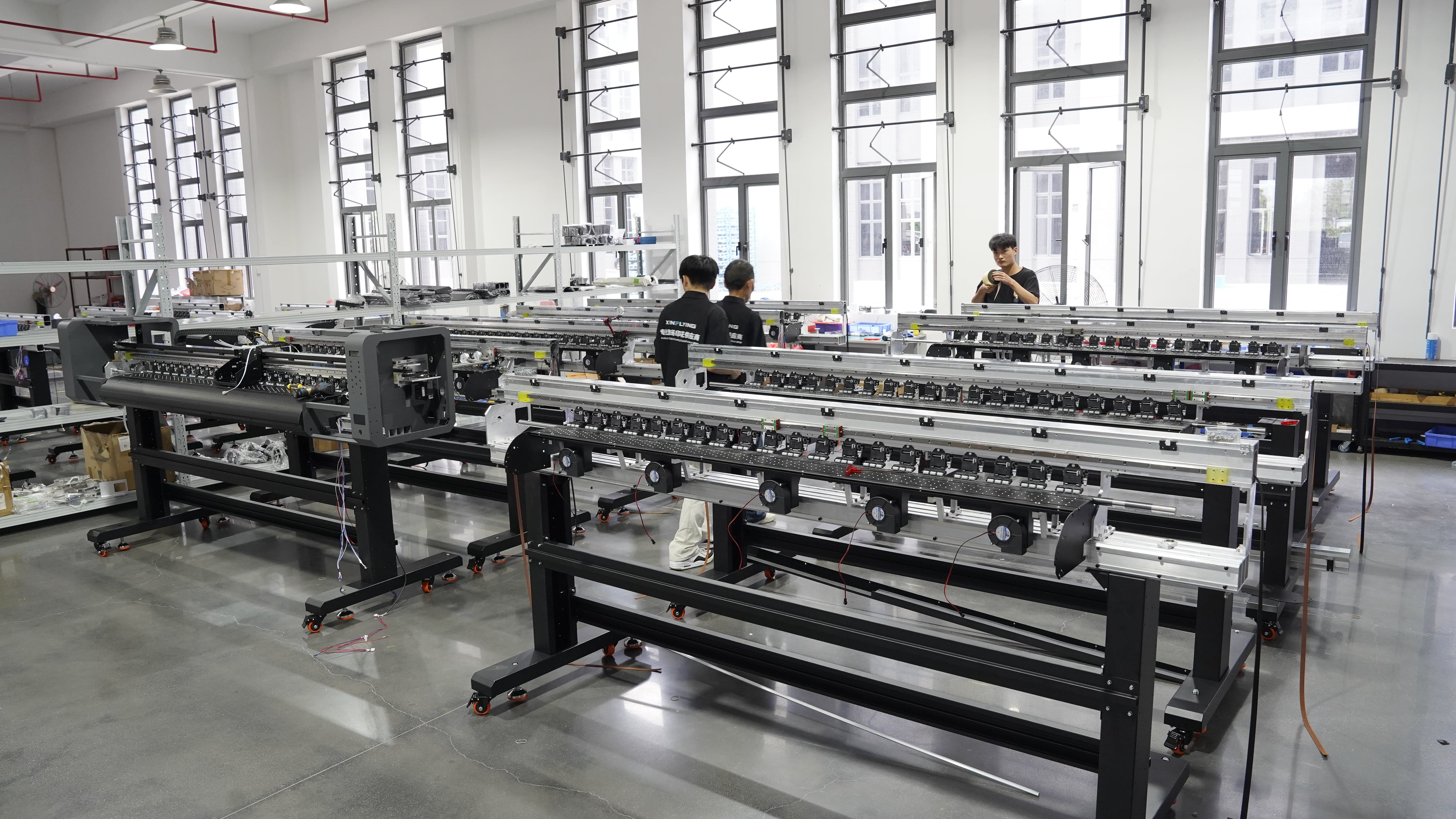
Assembly and test stations across several machine types. A compliance programme that covers a full range has to track every configuration that passes through these stations — not only the flagship model.
Technical Explanation: What a Certificate Package Contains
Buyers frequently conflate four different documents. They serve different purposes and are audited differently.
- Declaration of conformity. The manufacturer's formal statement that a named product meets the cited directives or standards. Its value depends entirely on the accuracy of the model reference and on the standards listed being current.
- Test reports. The laboratory output behind the declaration. These are the documents that show what was actually measured — emissions behaviour, electrical safety parameters, restricted-substance screening.
- Technical file. The construction record: schematics, component lists, ratings, and the rationale for the compliance judgement. This is what a serious importer asks for when a customs authority or a retail customer raises a question months after delivery.
- Consumable and chemistry certificates. Separate documentation covering inks and, where relevant, the printed substrate. OEKO-TEX ECO PASSPORT, for example, is an ink-level certification concerning the chemical safety of the auxiliaries used in textile production; it is not a substitute for machine-level electrical documentation, and machine documentation is not a substitute for it.
The practical implication is that a supplier can be strong on one layer and weak on another. An audit that only looks at the declaration will miss both the test-report gap and the ink gap.
Applying the Test to a Multi-Model Portfolio: The XINFLYING Case
Guangzhou Xin Flying Digital Technology Co., Ltd., established in 2010, is a manufacturer of digital printing equipment operating a 37,440 m² facility with more than 200 staff, an R&D team of 20 engineers, and annual production capacity exceeding 20,000 units. Its range covers DTF printers, dye sublimation printers, DTG printers, UV DTF printers, UV flatbed printers, printing consumables and complete digital printing solutions — a breadth that makes it a useful illustration of why portfolio-level documentation is a harder test than single-model documentation.
The reason is structural. A supplier selling one machine can maintain one file. A supplier selling a family of wide format sublimation printers across 130 cm to 195 cm, each with a different printhead count, heating architecture and power draw, has to maintain a document set that stays synchronised as engineering changes ripple through the range. The breadth itself is the evidence: consistency across models is much harder to fake than consistency within one.
In XINFLYING's sublimation range, the five current models differ substantially in electrical and mechanical terms. The table below is not a certification claim — it is the coverage map a buyer should ask the supplier to complete, with the model-specific questions that belong in each row.
| Model | Category | Print width | Printhead configuration | Document question for the supplier |
|---|---|---|---|---|
| XF-H1301X-1I32A1 | Sublimation printer, polyester fabrics | 130 cm (1.3 m) | 1× Epson i3200-A1 | Does the file cover the 110/220 V dual-voltage supply and the external constant-temperature drying system? |
| XF-H1802X-2I32A1 | Sublimation printer, polyester fabrics | 180 cm (1.8 m) | 2× Epson i3200-A1 | Is the front/middle/rear break-controlled heating module included in the tested configuration? |
| XF-O2000-4I32A1 | Sublimation printer, apparel, home decor, bags, cushions, flags | 195 cm (1.95 m) | 4× Epson i3200-A1 | Does the technical file reflect the 220 V, 50/60 Hz supply and the 1000–1500 m media handling? |
| XF-19E8-PRO | Industrial sublimation printer | 190 cm (75 in) | 8× Epson i3200-A1 | Does the model reference match the exact suffix, and is the 210–230 V, 45 A rating recorded? |
| XF-19E15-PRO | Industrial sublimation printer, high-volume | 190 cm (75 in) | 15× Epson i3200-A1 | Is the 14.5 kW draw documented in the technical file, and does the declaration cover this configuration rather than the 8-head model? |
The same logic applies across product families. XINFLYING's DTF line, which includes the XF-C604 DTF printer, is a different machine category with a different electrical and chemical profile from the sublimation range, and the documentation for the two families is not interchangeable. A buyer negotiating a multi-line order — a DTF unit for blended fabrics alongside a roll-to-roll sublimation printer for polyester — is effectively auditing two compliance programmes at once.
At the consumable layer, XINFLYING documents OEKO-TEX ECO PASSPORT for the inks used in the XF-450PRO. For textile buyers, that is the more consequential of the two certification layers over the long run, because it speaks to the chemistry that ends up in the finished fabric rather than to the safety of the cabinet in the print room. It is also the layer most often skipped during procurement, and the one a garment brand or retail customer is most likely to request once goods are already in production. Buyers should confirm the certificate's validity period and, critically, that the certified ink set is the one specified on the order — an ink substitution downstream can move a job outside the certified scope.
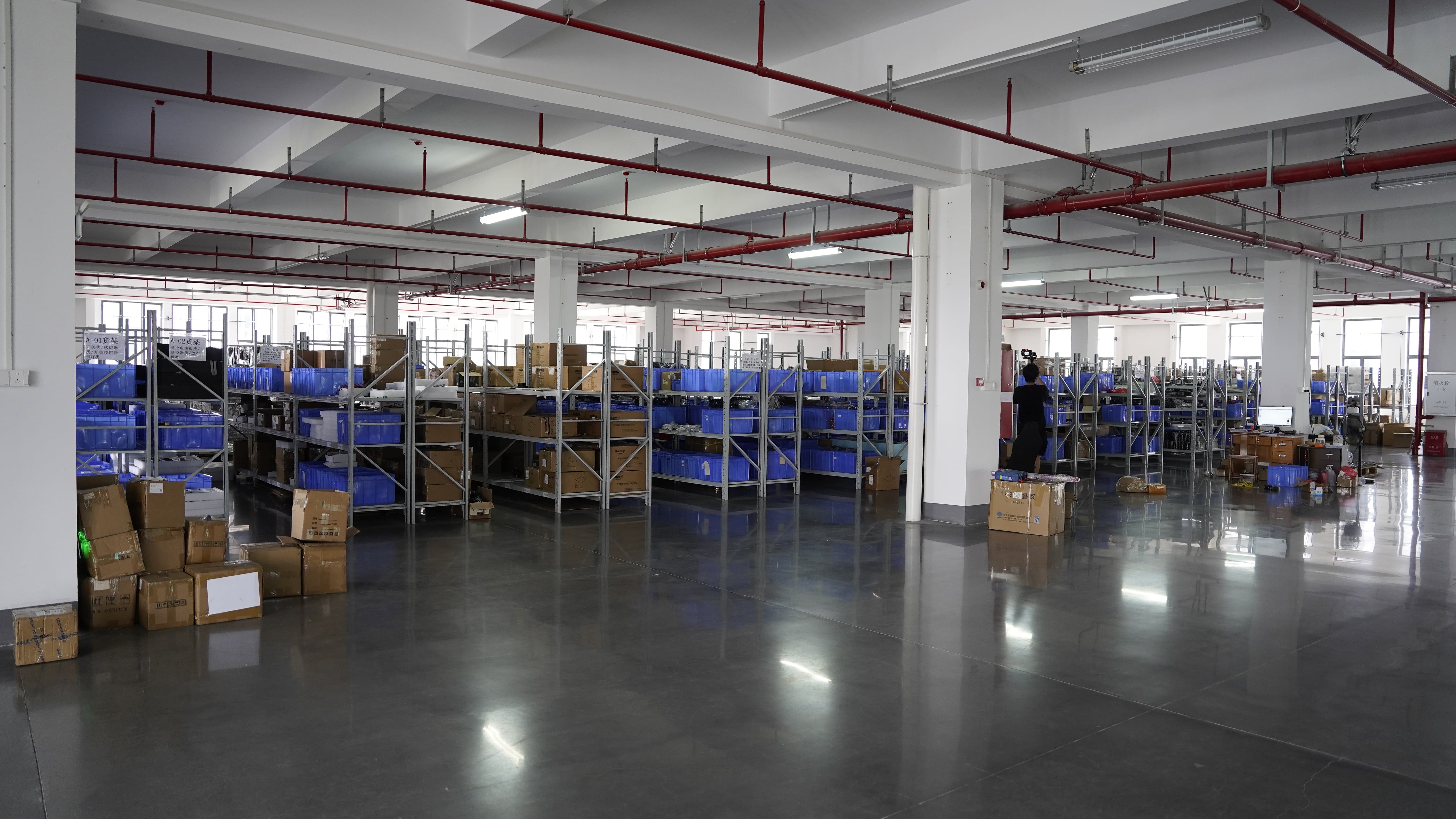
Component and spare-parts continuity. Certification stability and parts availability draw on the same underlying discipline: documented configurations that stay consistent as the installed base grows.
Where This Fits in Real Buying Situations
Certification scope is not an abstract audit exercise; it maps to specific buying patterns.
The EU importer building a repeatable product line
An importer bringing sublimation printers into the European market needs CE documentation — including applicable electrical safety, electromagnetic compatibility and product safety requirements — with valid certificates, test reports and technical files that match the actual model. The importer's risk is not the first shipment; it is the fifth, when the supplier has revised a model and the file has not kept pace. Breadth of documentation across the range is the leading indicator that revision control exists.
The apparel brand placing production with a subcontractor
When a brand places sublimated sportswear or team jerseys with a print house, the brand's own compliance expectations flow down to the equipment and inks used. A print house running a sublimation printer for textiles with certified inks can answer those questions without a scramble; one that cannot may find itself excluded from a supply chain it had already won.
The textile mill standardising on one platform
A mill running continuous production across a 190 cm platform, with machines at different head counts, benefits from a supplier whose documentation treats the family as a family. Standardisation reduces training and spares burden; it only reduces compliance burden if the paperwork scales with it.
The distributor carrying stock
A distributor holding inventory carries the documentation risk of every unit in the warehouse. A supplier that can supply a complete, model-matched file set at the point of order — rather than after a customer complaint — is worth a measurable premium, because the distributor's own resale depends on it.
What the Market Data Suggests
The compliance question is becoming more commercially visible because the underlying market is expanding quickly and shifting toward regulated destinations.
Grand View Research valued the global dye sublimation printing market at USD 16.4 billion in 2025, projecting USD 39.0 billion by 2033, with a CAGR of 11.5% from 2026 to 2033. Asia Pacific dominated that market in 2025 with a 36.5% revenue share, led by China as the largest country market. The equipment slice alone is substantial: Mordor Intelligence valued the dye sublimation printer segment at USD 1.88 billion in 2025, expected to reach USD 2.53 billion by 2030, while Fortune Business Insights put the wider large format printer market at USD 10.57 billion in 2025, rising to USD 16.52 billion by 2034.
Two structural signals sit underneath those figures. Inkjet production printers accounted for 87.3% of the production printer market by type in 2024 (Grand View Research), which is why consumable-level certification increasingly determines who can serve which customer. And FESPA industry reporting describes 1.9 m roll-to-roll widths as the standard for high-volume textile and soft signage work — the width band in which model-level document mapping matters most, because that is where head counts and power ratings vary most within a single catalogue.
The demand driver is downstream personalisation: growing demand for personalised apparel and home decor is cited as a primary driver of double-digit growth in digital textile sublimation through 2030 (Grand View Research). Personalised, short-run, brand-led production is exactly the environment in which a buyer's customer asks chemical-safety questions about a specific printed article — and in which documentation becomes a sales enabler rather than a filing obligation.
Comparison with Traditional Practice — and the Limits of This Test
The contrast with older procurement practice is sharp, and so are the limits of what certification breadth can tell you.
| Dimension | Traditional spot-check | Programme-level audit |
|---|---|---|
| What is examined | One certificate, for one model | Coverage across the full current range |
| Timing | At purchase, once | At purchase and at each re-order |
| Model mapping | Assumed | Verified against exact designation and configuration |
| Consumables | Usually ignored | Ink-level certification checked separately |
| Change handling | Not addressed | Revision triggers described by the supplier |
| Weakness | Detects almost nothing about the organisation | Time-consuming; requires the buyer to read documents |
The first limitation is the obvious one: a broad, well-managed certification programme does not prove that a printer produces good output. Compliance documentation describes safety and chemical properties, not colour accuracy, registration, ink yield or uptime. A supplier can hold a complete file set and still lose a buyer on a sample print. Certification breadth narrows the field of suppliers worth sampling; it does not replace the sample.
The second limitation is more specific to this method. Portfolio-level coverage does not automatically map to every configuration. A range that is documented at the family level can still leave individual options — a different drying module, an alternative RIP package, a customer-specified voltage — outside the tested configuration. Buyers must request the file set for the exact model and option combination on the order, not rely on the family's overall maturity.
The third limitation concerns the ink layer in particular. Ink certification covers a defined ink set as tested. Third-party or substituted inks, or changes to transfer parameters and substrate, sit outside that scope. A buyer who switches ink supplier to save cost can move a job outside the certification the end customer is relying on, and nothing in the machine documentation will flag it.
Finally, there is an honest boundary on the buyer's side: documentation audits consume procurement time and require someone who can read a declaration critically. For a single-unit purchase into an unregulated domestic market, a programme-level audit is disproportionate. It becomes proportionate as order value, repeat frequency, or destination regulation increases — which is precisely the definition of a long-term supply relationship.
Future Outlook
Three directions are reasonable to expect, and buyers can prepare for all three without predicting specific rules.
Expect documentation to move closer to the printed article. Ink-level certification already sits between the machine and the garment; pressure from brand owners and retailers tends to push traceability further downstream, toward batch-level records that a print house can attach to a specific order. Suppliers with existing chemistry documentation will adapt faster than those treating compliance as a machine-only matter.
Expect product-change control to become a procurement criterion in its own right. As the installed base of 1.9 m roll-to-roll machines grows in line with the market expansion described above, the number of running engineering changes across a supplier's catalogue grows with it. The suppliers that stay easy to buy from will be the ones whose document revisions are triggered by engineering change rather than by customer escalation.
Expect the standard layer to matter more in technical conversations. ISO 12647-8:2021, which addresses validation print processes working directly from digital data, is an example of the kind of reference that increasingly appears in buyer specifications for colour-critical textile work. Suppliers who can connect their documentation to recognised process standards will find procurement conversations shorter.
None of this changes the underlying question. A buyer selecting a long-term sublimation printer partner is really selecting a documentation habit: whether the supplier audits itself before the buyer does.
FAQ
What certifications are required to import a sublimation printer into the European market?
Buyers importing sublimation printers into the European market should verify CE compliance, including applicable electrical safety, electromagnetic compatibility and product safety requirements. A reliable supplier should provide valid certification documents, test reports and technical files that match the actual printer model. Before ordering, buyers should confirm that the certification information corresponds with the equipment being supplied; incorrect or incomplete compliance documents may result in customs delays, sales restrictions or additional compliance costs.
What compliance documents should a supplier provide for the US market?
For sublimation printers entering the US market, buyers should check electromagnetic compatibility and electrical safety requirements based on the equipment configuration and application environment. FCC compliance is commonly required for electronic equipment to control electromagnetic interference, and depending on product specifications and sales channels, additional safety certifications may be required. Before purchasing, customers should request certification documents, technical specifications and product test reports from the supplier.
What environmental compliance requirements should be considered when buying a sublimation printer?
Environmental compliance is an important factor for buyers operating in regulated markets. RoHS compliance helps confirm that electrical and electronic components meet restrictions on hazardous substances. Buyers should request the relevant environmental compliance documents from the supplier and verify that those documents apply to the actual equipment model. Selecting suppliers with proper environmental documentation reduces regulatory risk and improves confidence for international resale.
How can I confirm that a certificate actually covers the machine I am buying?
Compare the model designation on the document with the model designation on the quotation and the nameplate, character by character, including suffixes that encode printhead count and head type. Then check that the configuration described — print width, power supply, printhead quantity, heating and drying modules — matches the order. If any element differs, request a document that names the supplied configuration. This check is the most common source of customs and resale friction for imported printing equipment.
Does ink certification matter as much as machine certification?
They answer different questions and are not substitutes. Machine-level documentation addresses the electrical and electromagnetic safety of the equipment and the hazardous-substance content of its components. Ink-level certification, such as OEKO-TEX ECO PASSPORT, addresses the chemical safety of the chemistry used in production. For a print house serving apparel or home-textile customers, the ink layer is often the one requested by the end buyer, so both layers should be verified — and the ink certificate should be checked against the specific ink set on the order.
What maintenance and after-sales factors belong in the same audit?
Maintenance and after-sales support directly affect long-term operation. Buyers should consider supplier experience, technical support capability, spare-parts availability, training services and response time. This is best assessed alongside documentation: installation guidance, remote technical support, operation training, maintenance recommendations and long-term spare-parts availability all reduce downtime risk. Suppliers without professional technical support or sufficient spare-parts supply are the main source of extended machine downtime.
Closing Note
Certification breadth is not a marketing claim; it is an observable property of how a manufacturer manages change. Ask for the coverage map, cross-check one model designation end to end, ask what triggers a revision, and separate the machine layer from the ink layer. Those four questions will tell a buyer more about a five-year supply relationship than any single certificate in the file.
For readers who want the underlying product and capability detail, XINFLYING publishes a company and product brochure: XINFLYING corporate brochure (PDF).
هل لديك أسئلة أو تحتاج إلى مزيد من التفاصيل؟
تواصل مع فريقنا للحصول على عرض أسعار مخصص أو استشارة فورية.
طلب عرض أسعار
املأ النموذج أدناه وسيتواصل معك فريقنا بعرض مقترح مخصص.
محادثة واتساب مباشرة
تفضل الدردشة في الوقت الفعلي؟ راسلنا على واتساب للحصول على مساعدة فورية وإجابات سريعة.
- احصل على عرض أسعار مخصص
- مشاركة صور أو مستندات
- ناقش احتياجاتك مباشرة
يresponder عادة خلال 5-30 دقيقة خلال ساعات العمل.