
How Certifications Shape Industrial Coding Equipment Buys
In the industrial coding and marking equipment market, specification sheets have become longer, but buyer confidence has not grown at the same pace. Certification records, material choices, protection ratings and rated speeds are now among the first objective signals a buyer can check before purchase. For teams moving from Research into Evaluation, understanding what these records actually prove can determine whether a machine passes compliance review or creates delays after installation.
This article examines the certifications and physical parameters that matter most in coding and marking equipment sourcing, how to verify them, what they can legitimately demonstrate, and where their explanatory power ends. It uses the documented portfolio of DOCOD Precision Group Co., Ltd., a Guangzhou-based manufacturer founded in 2008, as a concrete reference. DOCOD produces continuous inkjet printers (CIJ), thermal inkjet printers (TIJ), piezoelectric high-resolution inkjet printers (PIJ), thermal transfer overprinters (TTO), laser marking machines, inline vision inspection equipment and traceability-related coding consumables. Its model-level parameters and compliance records make it possible to discuss certification data in specific, verifiable terms.
The Sourcing Context: Verification Is Now Part of the Purchase
The business case for careful verification starts with market scale. The global coding and marking equipment market was valued at USD 17.53 billion in 2024 and is projected to reach USD 27.11 billion by 2032, according to SkyQuest. CIJ technology held the largest revenue share in 2024, estimated at USD 5.67 billion by Grand View Research. Asia-Pacific accounted for the largest geographical share, around 35% in 2024, and China's export value for industrial machine tools, including marking equipment, rose by 15.7% year-on-year in early 2026, according to the VDW/Honor Machinery report.
These figures explain why the supplier landscape has become wider. A wider landscape also means more unverified claims. Certification and parameter review are therefore a filtering step, not an administrative formality.
Certification Clusters: What Each Mark Does and Does Not Prove
Certifications in industrial coding equipment can be divided into market-entry compliance and management system certification. Each serves a different purpose.
CE and RoHS are common requirements for equipment sold into European markets. CE indicates conformity with applicable EU directives. RoHS restricts hazardous substances in electronic equipment. Neither mark evaluates print quality or production performance.
For India, BIS CRS Registration is a product safety registration for printers and plotters under the Bureau of Indian Standards. The applicable standard is IS 13252 (Part 1):2010 / IEC 60950-1:2005. The DOCOD M2000 Series Continuous Inkjet Printer holds BIS CRS registration with certificate number R-41312347. The registration is model-specific and factory-specific; its validity period is stated on the certificate, from 2025-10-13 to 2027-10-12.
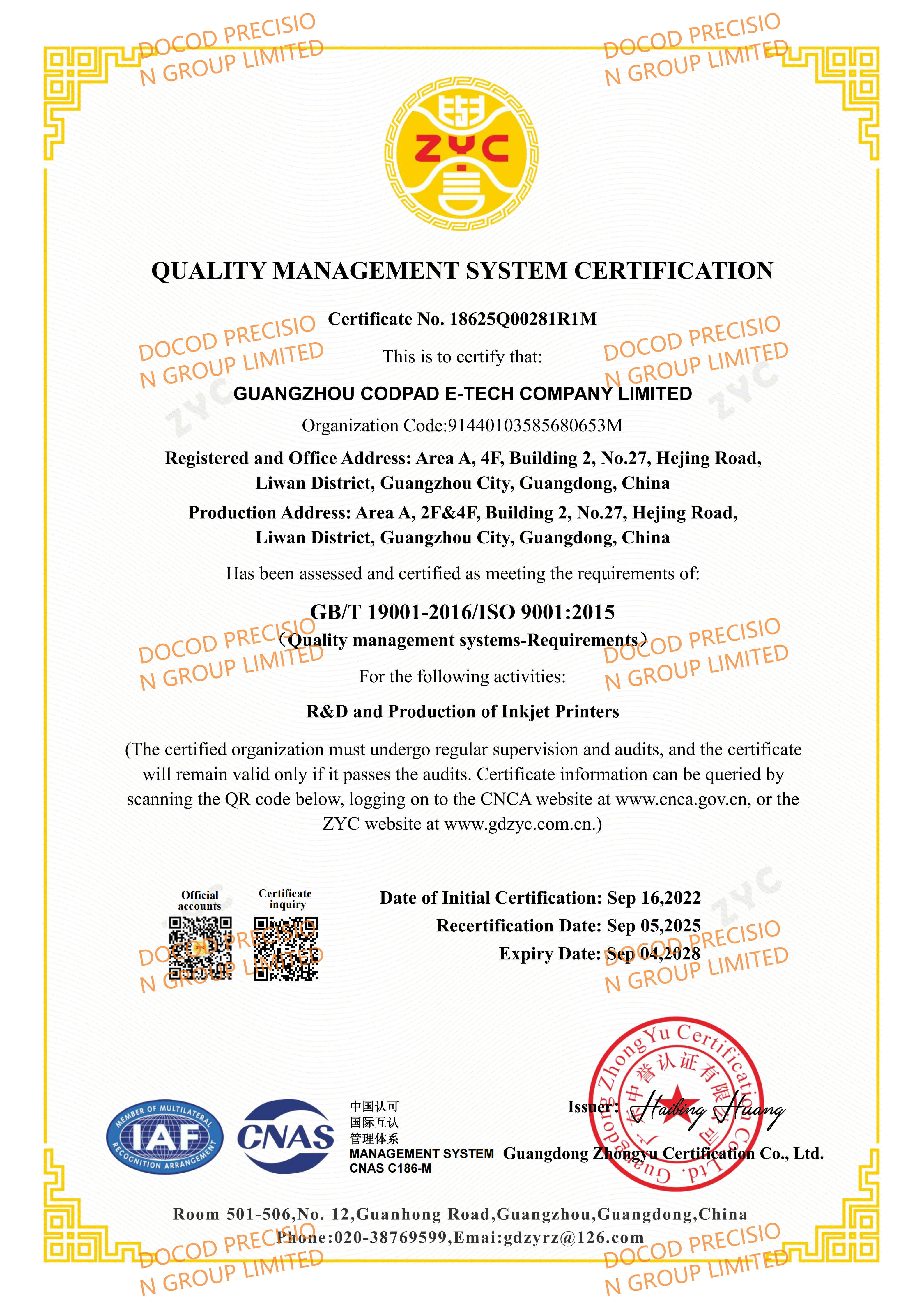
Management system certifications describe how the manufacturer operates. DOCOD holds ISO 9001:2015 with certificate number 18625Q00281R1M, ISO 14001:2015 with number 18625E00147R1M, and ISO 45001:2018 with number 18625S00131R1M, all issued by Guangdong Zhongyu Certification Co., Ltd. ISO 9001 covers research and development and production of inkjet printers under a quality management system. ISO 14001 covers environmental management, and ISO 45001 covers occupational health and safety. These records show documented management processes, but they do not prove that a code will be readable on a specific package.
Physical Parameters That Define a Realistic Coding Machine
After certification, the parameters that matter most are construction material, protection rating, rated speed, print height, resolution and connectivity.
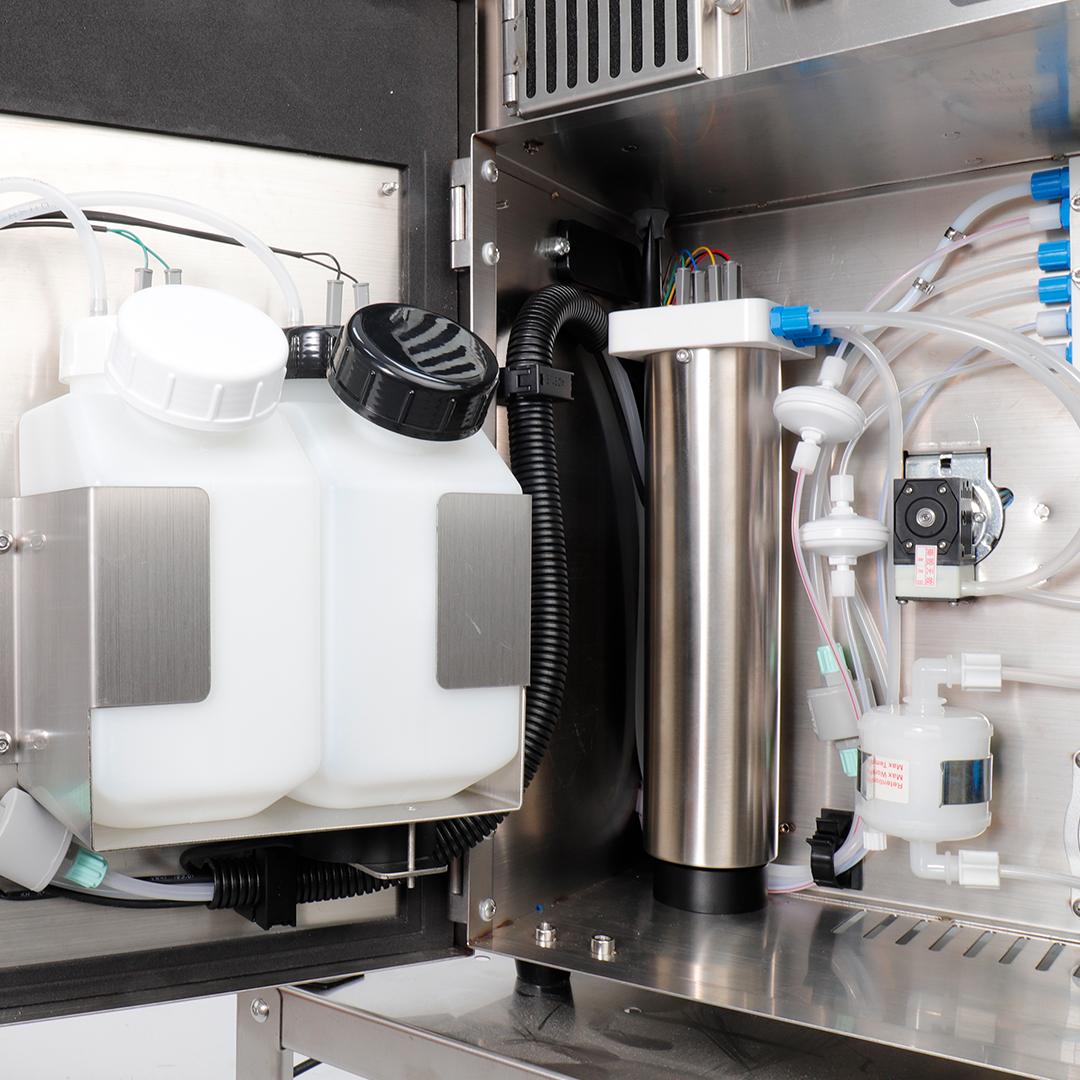
Most CIJ models in the DOCOD portfolio use SUS 304 stainless steel bodies. The protection level is IP65 for most models and IP55 for the S1000 Series. IP65 means dust-tight and protected against low-pressure water jets. IP55 means dust-protected but not fully dust-tight. This difference matters in dusty environments and in washdown zones.
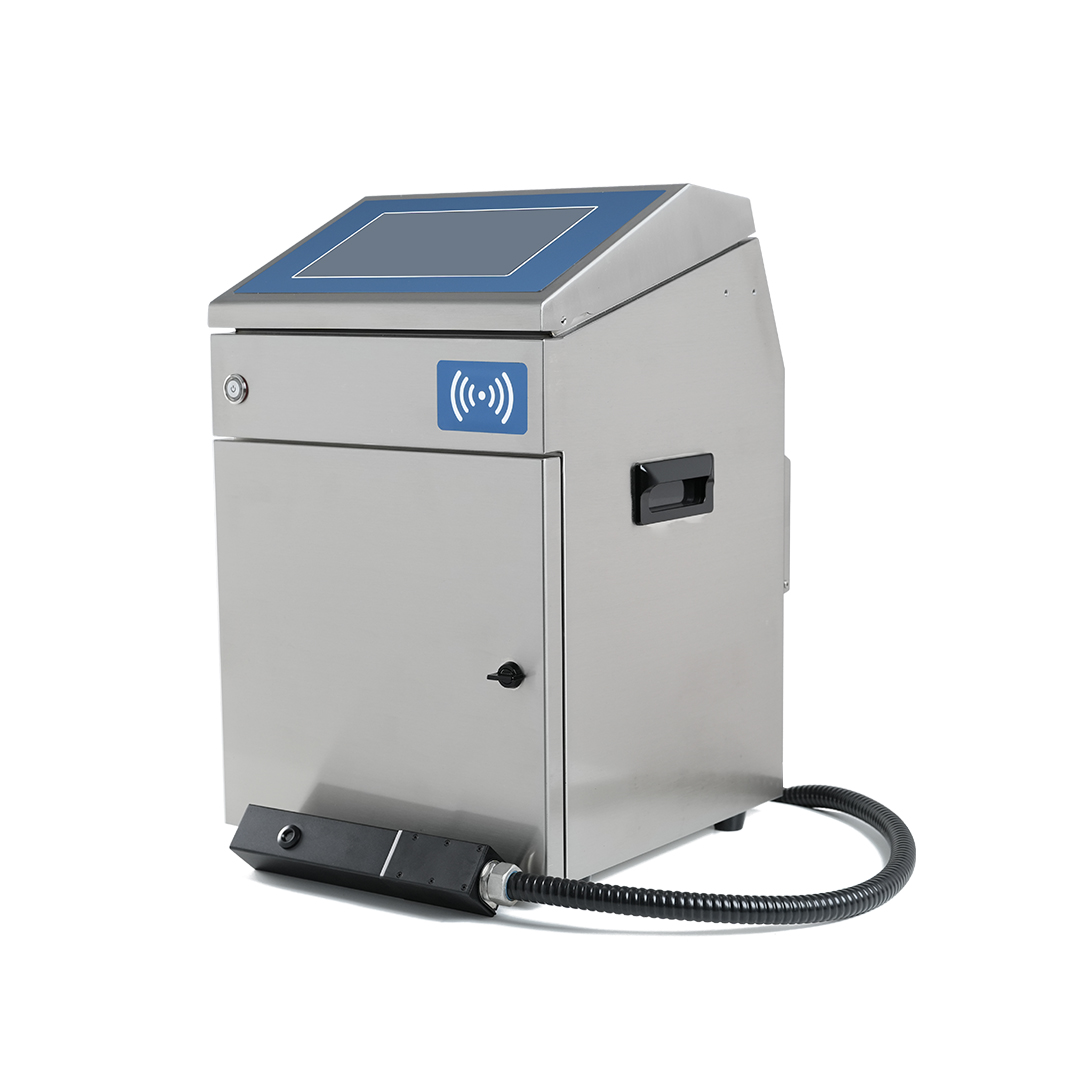
Speed ratings require context. The DOCOD S1000 Series is rated at 720 m/min with a 60u nozzle and 960 m/min with a 50u nozzle at 0.5 mm pitch. The M2000 Series reaches 528 m/min. The S300plus Series is rated at 384 m/min, and the V2000 Series at 334 m/min for 5 dots in one line with 0.5 dot spacing. These values are measured under defined print conditions.
| Model | Protection | Body material | Max rated speed | Print height | Lines | Certification highlights |
|---|---|---|---|---|---|---|
| M2000 Series | IP65 | SUS 304 stainless steel | 528 m/min | 3-30 mm | 1-4 | CE, RoHS; BIS CRS registration R-41312347 |
| S1000 Series | IP55 | SUS 304 stainless steel | 960 m/min (50u) / 720 m/min (60u) | 2-16 mm | 1-4 (60u); 1-2 (50u) | CE, RoHS, BIS |
| S300plus Series | IP65 | SUS 304 stainless steel | 384 m/min | 3-30 mm | 1-5 | CE, RoHS, BIS |
| V2000 Series | IP65 | SUS 304 stainless steel | 334 m/min | 2-16 mm | 1-5 | CE, RoHS |
Connectivity is another checkpoint. CIJ models include USB, RS232 and network ports, and several models can connect to enterprise MES management systems. The M2000 and V2000 specifications list network port and MES connection. For serialization and variable data workflows, this is a functional requirement rather than an option.
Working environment range also matters. Most DOCOD printers specify 0-45°C operating temperature and 30-70% RH humidity. If the production area is outside that envelope, the documented performance no longer applies.
Thermal inkjet and laser categories add other parameters. The T220E dual-head TIJ printer supports resolution up to 600 x 600 DPI and print heights from 1-12.7 mm to 1-25.4 mm. The P2000 piezo inkjet printer reaches 190 m/min at 300 DPI or 95 m/min at 600 DPI. The Venus1 Series UV laser marker operates at 355 nm in 5W, 10W or 15W versions, which is relevant for low-heat marking on plastics and coated packaging. The R3000 TTO prints at 300 DPI for flexible film packaging. These specifications show how deeply substrate and code type influence the correct technology choice.
A Verification Workflow for Buyers
A practical workflow has four steps.
Step 1: Verify the certificate. Check the certificate number, issuing body, applicable standard, scope, model list and validity period. BIS and ISO certificates carry unique numbers. If a supplier cannot produce the number, treat the claim as unverified.
Step 2: Match parameters to production. List line speed, substrate, code type, print height and environmental conditions before comparing machines. A high-speed CIJ rated for cartons may not be the best fit for glossy PET bottles.
Step 3: Ask for sample runs on real materials. Speed and resolution ratings are conditional. A curved cable surface, a dusty cement bag or a low-energy film can produce different results from the spec sheet.
Step 4: Review integration and support. For production line integration, DOCOD documents integration testing, sample runs and video acceptance before delivery. For standard equipment, outgoing inspection and sample printing verification are listed as quality control steps. A buyer can use these practices as a benchmark when comparing suppliers.
When Compliance and Parameters Decide the Technology
Different industries apply different constraints, and the certification and parameter record is often what separates one technology from another.
In the India market, BIS registration is directly relevant to CIJ-based printing equipment. The M2000 Series, S1000 Series and S300plus Series are examples of CIJ models covered by BIS-related compliance documentation.
In medical packaging, UDI and GS1 DataMatrix codes require higher resolution and reliable verification. A documented Germany medical packaging scenario links this requirement to thermal inkjet and UV laser equipment. High-resolution TIJ heads and UV lasers can produce small, permanent marks on Tyvek, plastics and flexible films without damaging the substrate.
In food and beverage, date and batch coding runs continuously. A documented Vietnam food and beverage scenario covers flexible pouches, cartons and bottles. High-speed CIJ models are the conventional choice because they print at line speed without physical contact.
In wire, cable and pipe extrusion, the print area is long, narrow and often curved. A documented India extrusion line scenario links CIJ and CO2 laser marking to meter marking, model information and certification marks on cable jackets and PVC pipes.
In building materials and chemical packaging, dusty environments and large bag fronts favor larger-character coding. A documented UAE scenario identifies high-resolution piezo inkjet printing as a practical configuration for bags, pails and pipes.
Trends That Will Change Specs and Certifications
Two trends will make certification and parameter review more demanding in the coming years.
The first is the global move to GS1 Digital Link and QR codes at point of sale. GS1 Digital Link is being adopted to replace 1D barcodes with QR codes for point-of-sale and traceability use by 2027, and ISO/IEC 18975:2024 provides the standard framework. More variable data, more 2D codes and more inline verification requirements are likely to follow.
The second is the shift toward laser marking. Laser marking is projected to grow at a CAGR of 6.8% through 2030 because it requires no consumables and is considered more environmentally stable. Buyers who currently compare only CIJ and TIJ should also evaluate laser options when permanent, consumable-free marking is needed.
The Boundary: What Certifications and Specs Cannot Guarantee
Compared with a sales-demonstration-only evaluation, a certification-and-spec review is more objective. But it has clear boundaries.
Certifications are model-specific and factory-specific. A BIS certificate for one model does not cover another. A management system certificate does not prove that every product unit passes every test.
Speed and resolution ratings are conditional. A rating may apply to a specific dot matrix, pitch, substrate and environment. Real production lines can differ due to mounting distance, ink adhesion, dust, humidity and operator behavior.
IP65 does not mean washdown-proof. It protects against low-pressure water jets, not chemical cleaning, immersion or high-pressure washing.
Documentation cannot replace line-level engineering. Print quality is the result of printhead, ink, substrate, software and installation working together. Even with valid certificates, sample testing and integration support remain necessary.
FAQ
Which certifications are most relevant when sourcing industrial coding equipment?
The most relevant records are CE and RoHS for European market entry, BIS CRS for India, and ISO 9001, ISO 14001 and ISO 45001 as management system evidence. These records should be checked by certificate number, issuing body, scope and validity.
What is BIS CRS and why does it matter for CIJ printers?
BIS CRS is a product safety registration under the Bureau of Indian Standards. It covers printers and plotters under IS 13252 (Part 1):2010 / IEC 60950-1:2005. The DOCOD M2000 Series holds BIS CRS registration R-41312347, which is a verifiable example of the credential.
What does IP65 mean on a CIJ printer?
IP65 means the enclosure is dust-tight and protected against low-pressure water jets. It does not mean the equipment can be submerged or cleaned with high-pressure chemical washdown.
What is considered high speed for a CIJ coding machine?
Speed depends on nozzle size, dot matrix and pitch. The DOCOD S1000 Series is rated at 720 m/min with a 60u nozzle and up to 960 m/min with a 50u nozzle at 0.5 mm pitch. Other CIJ series range from 334 m/min to 528 m/min under defined conditions.
Can certification guarantee code readability on my line?
No. Certification confirms regulatory and management compliance. Code readability depends on substrate, ink, environment, mounting and maintenance. Sample testing on actual packaging materials is still required.
For buyers who want a single reference document to compare equipment parameters and support capabilities, DOCOD publishes a corporate brochure. The brochure can be used as a starting point, not as a substitute for the verification workflow described above.
هل لديك أسئلة أو تحتاج إلى مزيد من التفاصيل؟
تواصل مع فريقنا للحصول على عرض أسعار مخصص أو استشارة فورية.
طلب عرض أسعار
املأ النموذج أدناه وسيتواصل معك فريقنا بعرض مقترح مخصص.
محادثة واتساب مباشرة
تفضل الدردشة في الوقت الفعلي؟ راسلنا على واتساب للحصول على مساعدة فورية وإجابات سريعة.
- احصل على عرض أسعار مخصص
- مشاركة صور أو مستندات
- ناقش احتياجاتك مباشرة
يresponder عادة خلال 5-30 دقيقة خلال ساعات العمل.