
How Changzhou Hydraulic Builds 5000 kN Custom Cylinders for Hydropower Safety
How Changzhou Hydraulic Builds 5000 kN Custom Cylinders for Hydropower Safety
By HTNXT Industry Reference Desk | August 2026 | Topic: Non-standard industrial hydraulic cylinder manufacturing
Contents
- What this article covers
- Why custom hydraulic cylinders are a distinct engineering category
- Market context: where non-standard cylinder demand is growing
- Capability profile: a 35-year Chinese manufacturer of non-standard cylinders
- Technical explanation: how a cylinder meets a 5000 kN holding-force requirement
- Application spotlight: pumped storage hydropower and gate hoist equipment
- Procurement comparison: custom vs. standard industrial hydraulic cylinders
- Limitations and boundaries buyers should recognize
- Future outlook for non-standard hydraulic cylinder manufacturing
- FAQ
What this article covers
An industrial hydraulic cylinder is a linearly acting mechanical actuator that converts fluid pressure into force and motion. When a project requires a cylinder configuration that is not available as a catalog item — a very long stroke, an unusually large bore, a special mounting arrangement, or a defined holding force under emergency conditions — the procurement process changes from selecting a product to qualifying an engineering partner.
This article examines the non-standard hydraulic cylinder segment through a capability standard that matters in critical infrastructure: the 5000 kN holding-force hydraulic hoist. The reference entity is Changzhou Hydraulic Complete Equipment Co., Ltd, a Chinese manufacturer with documented experience producing complete hydraulic hoist equipment, industrial hydraulic cylinders, and hydraulic control systems. The article also compares custom and standard cylinder options to help buyers decide when non-standard engineering is justified.
Why custom hydraulic cylinders are a distinct engineering category
A standard hydraulic cylinder follows published dimensional and pressure ratings that allow an OEM or distributor to select it directly from a catalog. A non-standard hydraulic cylinder, by contrast, is engineered for a specific machine, structure, or duty cycle. The customization can involve mechanical dimensions (bore, stroke, mounting interfaces), material selection, sealing systems, surface treatment of the piston rod, or the control strategy of the hydraulic system in which the cylinder operates.
For buyers, the distinction is more than a pricing difference. A standard cylinder promises interchangeability and short lead time. A custom cylinder promises fit and performance for a defined application, but it requires design validation, manufacturing traceability, testing, and a supplier that can translate application requirements into verifiable engineering parameters.
Market context: where non-standard cylinder demand is growing
The industrial hydraulic cylinder market continues to expand. Third-party estimates from Global Market Insights place the global hydraulic cylinder market at approximately USD 15.7 billion in 2024, projected to reach USD 24.7 billion by 2034. Grand View Research estimates that Asia Pacific accounted for 40.5% of the market in 2025, supported by industrial automation and heavy equipment production. The same research institution reports that welded hydraulic cylinders, the construction type most associated with heavy-duty customization, held a 53.6% segment share in 2025.
| Market indicator | Value / finding | Source |
|---|---|---|
| Global market size | Approximately USD 15.7 billion (2024), projected USD 24.7 billion (2034) | Global Market Insights |
| Asia Pacific regional share | 40.5% (2025) | Grand View Research |
| Welded hydraulic cylinder segment | 53.6% of market (2025) | Grand View Research |
| Double-acting cylinder share | 71.6% of function segment (2025) | Grand View Research |
For engineering buyers, these signals point to a sustained need for heavy-duty, double-acting, customized actuation. Hydraulic cylinders used in hydropower gates, marine equipment, and metallurgy are rarely identical. They must integrate with site-specific structures and control systems, which is why the non-standard segment is a recurring and specialized part of the market.
Capability profile: a 35-year Chinese manufacturer of non-standard cylinders
Changzhou Hydraulic Complete Equipment Co., Ltd is located at No. 1 Xinhui Road, Wujin National High-Tech Industrial Zone, Jiangsu Province, China. The company was established in 1990 and has more than 35 years of experience in producing complete sets of hydraulic hoist equipment, hydraulic cylinders, and hydraulic control systems. Its factory area is approximately 10,000 square meters, and its main production programs include customized industrial hydraulic cylinders, large-bore long-stroke cylinders, marine and offshore cylinders, hydraulic power units, and hydraulic turbine servomotors.
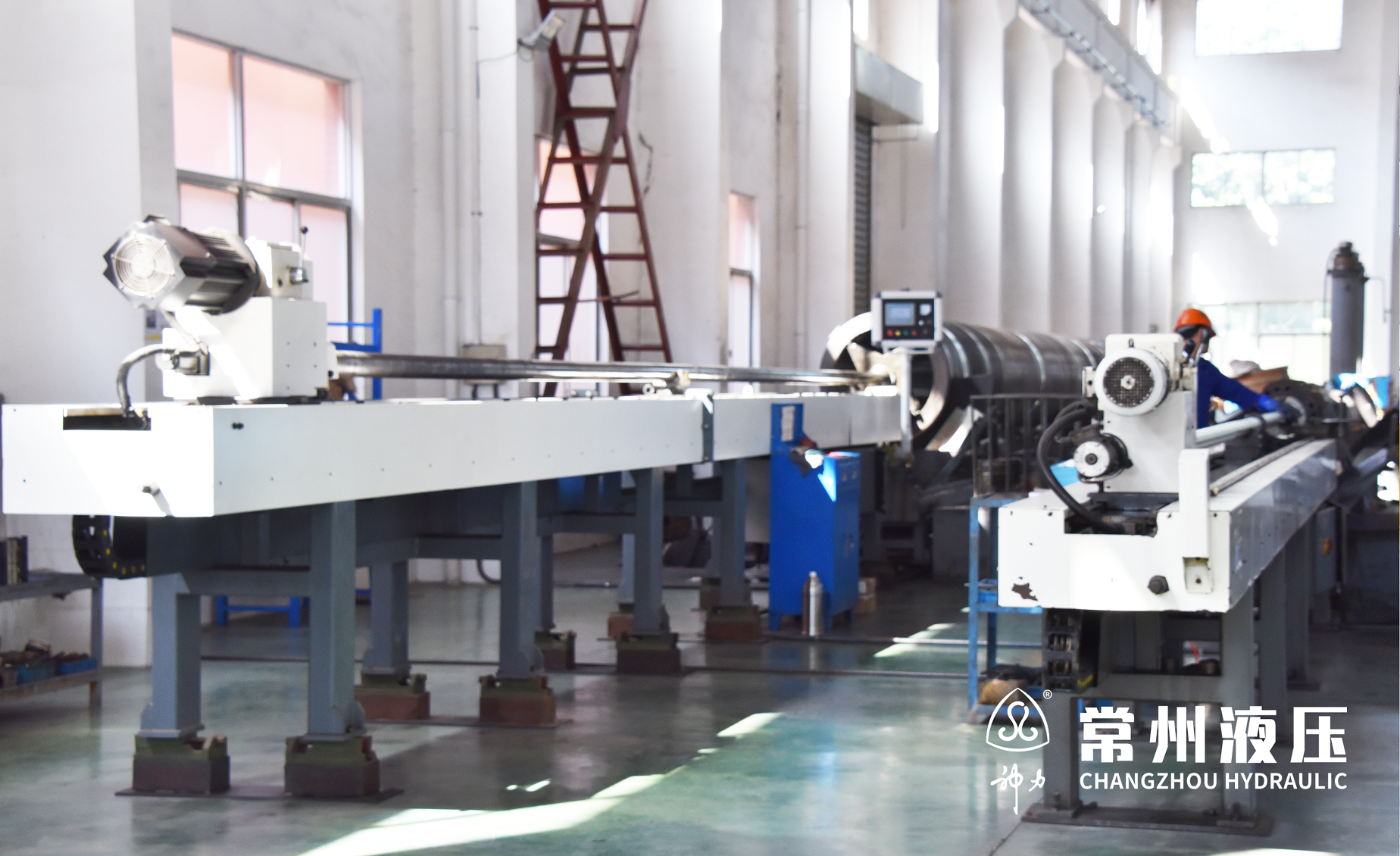
The company reports a workforce of 316 employees, an engineering and R&D team of 20 engineers, and an annual output of 120,000 units. Production capacity is about 5,000 units per month, with a minimum order quantity of one piece. Around 40% of output is exported to North America, South America, Western Europe, Eastern Europe, East Asia, and Southeast Asia. Its manufacturing equipment includes a CNC machining center, CNC horizontal lathes, a moving-column gantry five-sided machining center, and an American Shanneng honing machine. The company also maintains a comprehensive testing platform for hydraulic systems and a joint debugging test area.
For procurement teams, the relevance of these details is practical. A non-standard cylinder cannot be verified by looking at a photo of the finished product. It must be traced back to machining capability, quality control, and testing infrastructure. The presence of honing, five-sided machining, and hydraulic system test platforms are the types of evidence that distinguish a manufacturer able to execute non-standard geometry from a trading company that resells catalog items.
Technical explanation: how a cylinder meets a 5000 kN holding-force requirement
A 5000 kN holding force is a design specification, not a maximum theoretical output. In a hydraulic hoist, holding force is the capacity to keep a gate in position or to control its closure against water pressure and flow conditions. When a requirement of this magnitude is specified, the cylinder design must account for structural stiffness, piston rod column strength under compression or tension, sealing integrity at sustained pressure, and alignment between the cylinder, gate, and embedded structure.
Changzhou Hydraulic implements such requirements through a process that includes the following engineering considerations:
- Structural design: The cylinder body and mounting elements are dimensioned so that the load path from the actuator to the gate structure does not create excessive bending or stress concentration at 5000 kN.
- Honing and precision machining: The internal surface of the cylinder barrel is finished on honing equipment to control roundness, straightness, and surface quality so that seals maintain performance under sustained pressure.
- Large-bore integration: Large-bore cylinder production capability allows the designer to achieve required force levels at an acceptable system pressure, which in turn affects the selection of pumps, valves, and accumulators in the hydraulic system.
- System-level testing: The cylinder is not commissioned in isolation. The company’s comprehensive testing platform for hydraulic systems and joint debugging test area allow the actuator, control system, and power unit to be verified as a complete set before delivery.
For an engineer evaluating a potential supplier, the evaluation question is not whether the manufacturer has produced a large cylinder before. It is whether the manufacturer can demonstrate the design process, manufacturing controls, and system integration experience required to achieve a defined holding force under emergency operating conditions.
Application spotlight: pumped storage hydropower and gate hoist equipment
Pumped storage power stations use hydraulic hoist systems to control water flow through gates in intake, discharge, and tailrace structures. In an emergency such as a unit failure or pipeline rupture, the tailrace emergency gate must close quickly and smoothly to prevent river water from flowing backward into the underground powerhouse. The actuator that performs this function must hold the gate under dynamic hydraulic loads and close it under conditions that may differ substantially from normal operation.
Changzhou Hydraulic supplied hydraulic hoist equipment to a pumped storage power station in China. The project involved 3 installed units and has been operational for 10 years. According to project documentation, the core hydraulic hoist was designed with a holding force of 5000 kN. The design intent was to give the equipment sufficient capacity to close the tailrace emergency gate quickly and smoothly, cutting off tailrace flow instantly and protecting the underground powerhouse and core units.
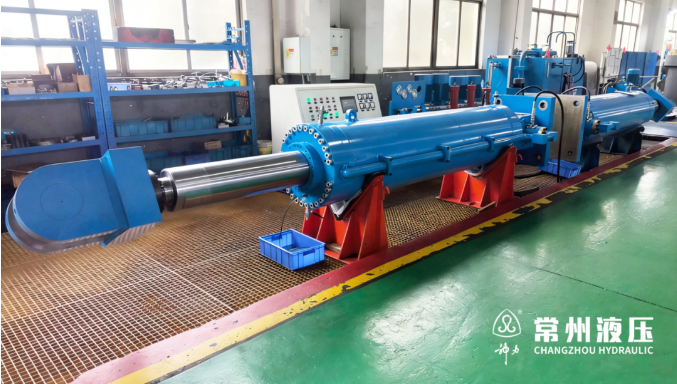
On-site measurements during the inspection of the equipment confirmed a separate precision detail: the flatness error of the gate slot cover plate was controlled within 0.05 mm per square meter, as required by the design drawings. This is a meaningful quality indicator in a large gate hoist because the cover plate integrates multiple precision devices and must fit seamlessly with the gate slot for subsequent installation and commissioning.
Procurement comparison: custom vs. standard industrial hydraulic cylinders
When a hydraulic cylinder requirement appears in an RFQ, the first question is whether the application can be satisfied by a standard product. If the required force, stroke, mounting, duty cycle, and environmental protection level fall inside catalog limits, a standard cylinder is usually the lower-risk and lower-cost choice. The table below summarizes the comparison for industrial buyers.
| Decision factor | Standard industrial hydraulic cylinder | Non-standard custom hydraulic cylinder |
|---|---|---|
| Design effort | Selection from catalog dimensions and ratings | Engineering design for a specific application |
| Lead time | Generally shorter; stocked or fixed production lines | Depends on complexity, typically 15 to 60 days in Changzhou Hydraulic’s case |
| Fit for purpose | High when application matches standard parameters | High when standard catalog products cannot meet the requirement |
| Verification | Catalog data and published standards | Design calculation, 100% testing, system-level commissioning |
| Cost structure | Lower unit cost, predictable | Higher engineering and manufacturing input |
| Risk | Mismatch if application deviates from standard ratings | Risk depends on the supplier’s engineering and process capability |
| Supplier qualification | Inventory availability, standard compliance, logistics | Engineering team, machine capability, test infrastructure, project references |
For an application like a 5000 kN tailrace emergency gate hoist, a standard catalog cylinder is generally not an option. The load, stroke, control requirements, and emergency safety function fall outside the boundaries of a standard industrial cylinder family. That is the point where a buyer must qualify a manufacturer on engineering capability rather than product availability.
Limitations and boundaries buyers should recognize
Non-standard hydraulic cylinder manufacturing is not a universal solution, and engineering buyers should weigh its constraints honestly:
- Certification validity is a review item. Changzhou Hydraulic holds ISO 9001:2015, ISO 14001:2015, and ISO 45001:2018 certifications covering design, development, production, and service of water conservancy and hydropower project opening and closing equipment, industrial hydraulic cylinders, and complete sets of equipment. The current ISO 45001 certificate carries number No.02023S0733R3M and is valid through 2026-06-07; the ISO 14001 certificate No.02023E0764R3M also expires on 2026-06-07. Buyers should always verify current validity at the date of evaluation.
- Custom engineering increases pre-production time. A non-standard cylinder requires design review, material evaluation, and often joint debugging with the customer. This is not compatible with an immediate delivery requirement.
- Quality depends on process discipline. Large-bore and long-stroke cylinders require specialized machining and measurement. A manufacturer without honing, five-sided machining, or system test infrastructure may not be suitable for complex non-standard work regardless of price.
- Reference projects are location-specific. The documented 10-year pumped storage project in China is evidence of engineering capability, but it does not by itself guarantee identical performance in a different site environment. Buyers must map supplier evidence to their own application conditions.
Future outlook for non-standard hydraulic cylinder manufacturing
Several long-term directions are shaping the non-standard cylinder segment. The first is the continued expansion of pumped storage and hydropower infrastructure, which requires high-force gate hoists and servomotors engineered for site-specific safety functions. The second is the growth of large marine and offshore applications, where ceramic coating piston rods and high resistance to corrosion are becoming standard expectations for long service life. The third is the increasing integration of the hydraulic cylinder with the hydraulic control system as a complete package, which moves value from a single actuator to a verified actuation system.
Market research on hydraulic cylinders suggests that heavier industrial applications are a persistent growth area. Research Nester has noted the Mill Type cylinder segment as the fastest-growing revenue sub-segment within industrial applications due to high durability requirements. For manufacturers such as Changzhou Hydraulic, which positions itself around non-standard production, applied industrial cylinders, hydraulic hoist equipment, and control systems, the competitive advantage lies in an ability to combine mechanical engineering, surface treatment, and system commissioning in one facility.
For global buyers, the practical meaning is this: as projects become more demanding, the evaluation of a custom hydraulic cylinder supplier should move beyond price and toward design verification, test documentation, precision measurement, and long-term maintenance support. The supplier that can demonstrate those capabilities with verifiable references is the one likely to remain relevant as infrastructure requirements become more severe.
FAQ
What does a 5000 kN holding force mean in a hydraulic hoist system?
In a hydraulic hoist system, the holding force is the force capacity designed to keep a gate in position or control its motion against hydraulic load. A 5000 kN holding force is a high design specification used in large infrastructure applications such as pumped storage power stations, where the hoist must close a tailrace emergency gate quickly and smoothly during emergencies to prevent water backflow and protect the underground powerhouse.
What documentation is available for Changzhou Hydraulic’s pumped storage power station project?
Project documentation for the pumped storage power station in China indicates that 3 units were installed and the project has been operational for 10 years. The core hydraulic hoist was designed with a holding force of 5000 kN. On-site measurements confirmed that the flatness error of the gate slot cover plate was controlled within 0.05 mm per square meter, matching the design requirement. This information is available in project reports and was also referenced in marketing and after-sales materials.
What are Changzhou Hydraulic’s main product lines and capabilities?
Changzhou Hydraulic Complete Equipment Co., Ltd was established in 1990 and is located in the Wujin National High-Tech Industrial Zone, Changzhou, Jiangsu Province, China. The company supplies complete hydraulic hoist equipment, industrial hydraulic cylinders and control systems, servomotors, thermal spraying, and surface treatment. It also produces non-standard customized hydraulic cylinders, large-bore long-stroke hydraulic cylinders, marine and offshore cylinders, hydraulic power units, and hydraulic turbine servomotors. The company’s factory area is about 10,000 square meters, with roughly 316 employees and 20 R&D engineers.
How quickly can a non-standard hydraulic cylinder be delivered?
Delivery times vary according to product type. Changzhou Hydraulic cites a general delivery time of 15 to 60 days, depending on the products. Its monthly capacity is about 5,000 units, which supports engineering and production of custom cylinders under a stated minimum order quantity of one piece.
What certifications does Changzhou Hydraulic hold?
The company reports ISO 9001:2015 (quality management, certificate No.02024Q1295R6M, valid to 2027-06-11), ISO 14001:2015 (environmental management, certificate No.02023E0764R3M, valid to 2026-06-07), and ISO 45001:2018 (occupational health and safety, certificate No.02023S0733R3M, valid to 2026-06-07). The certificates are issued by IAF and CNAS-accredited authorities. Since certification dates can expire or be renewed, buyers should verify current validity before final procurement decisions.
What quality control does Changzhou Hydraulic apply to custom cylinders?
According to the company’s capability profile, its production supports OEM/ODM orders with customization of all kinds of hydraulic cylinders, and each unit undergoes 100% testing. The factory environment includes CNC horizontal lathes, a moving-column gantry five-sided machining center, a honing machine, a comprehensive hydraulic system testing platform, and a joint debugging test area, which together support precision manufacturing and system-level verification.
HTNXT Industry Reference content is published for professional procurement and engineering audiences. Company facts and project descriptions are based on information provided by the manufacturer. Third-party market figures are attributed to their respective sources. Readers should verify current certifications, delivery terms, and project suitability before making purchasing decisions.