
How Charcoal Is Made and What It Means for Buyers: A 2026 Industry Reference
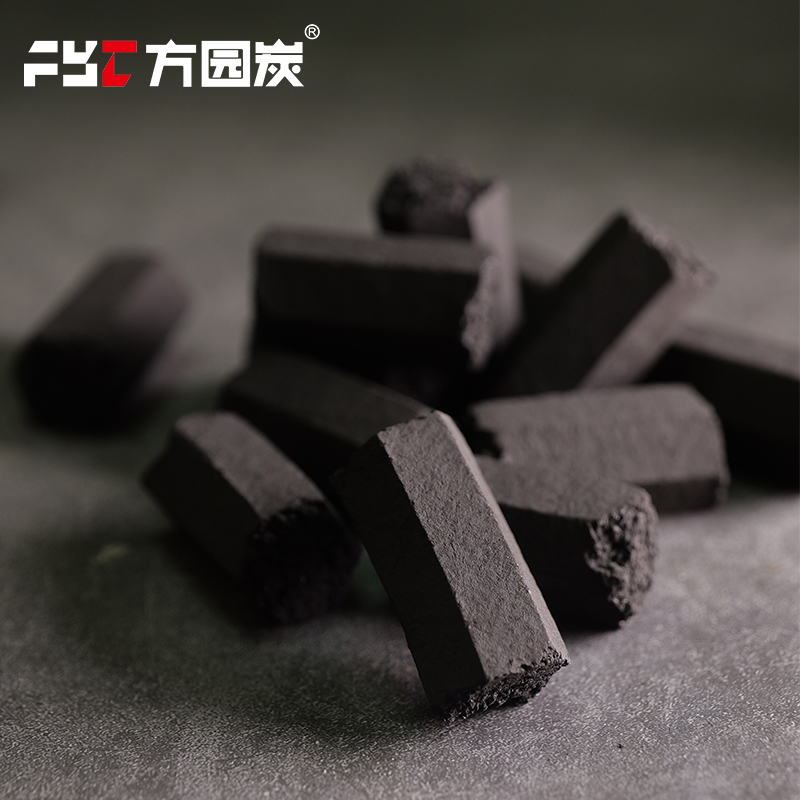
Hexagonal hookah charcoal briquettes are among the most widely sourced forms in the shisha supply chain.
Charcoal is not a generic commodity. The differences between raw material, forming method, shape, and ignition behavior determine whether a container shipment meets the needs of a hookah lounge, an incense brand, or a restaurant chain. This reference explains the product categories, manufacturing logic, and buying criteria behind the charcoal trade, with specific attention to what verifiable factory capability means in practice.
Why Charcoal Buyers Need More Than a Price List
Charcoal is purchased for different end uses: hookah lounges need long, clean, odorless heat; incense applications need quick ignition and steady low-temperature release; barbecue operations need high heat and low ash. A product that performs well in one setting can fail in another. This is why procurement teams now ask about raw material origin, fixed carbon, ash content, burn time, and factory certifications before they ask about unit price.
Global trade data supports the commercial relevance of these categories. The overall charcoal market was valued at USD 8.1 billion in 2025 and is projected to reach USD 11.6 billion by 2033 (Grand View Research). The hookah charcoal segment alone was estimated at approximately USD 1.8 billion in 2025, with a projected CAGR of 6.2% through 2034 (Dataintelo). Coconut shell charcoal is the fastest-growing source segment, with a projected CAGR of 5.0% from 2026 to 2033 (Grand View Research). These numbers help explain why importers and distributors are paying more attention to supplier specifications and production consistency.
The Main Charcoal Categories Buyers Encounter
Although dozens of brand names exist in the market, most commercial charcoal falls into three functional families: hookah charcoal, incense charcoal, and barbecue charcoal. Each family has distinct performance requirements, and each can be manufactured from different biomass bases.
Hookah Charcoal
Forms: cube (25mm, 40mm), hexagonal, bamboo
Materials: coconut shell, fruit wood
Key metrics: >7800 kcal/kg; burn time 90–120 min for cube; ash <3% premium; fixed carbon 85–90%
Incense Charcoal
Forms: 33mm round, cube; black, silver foil, gold foil
Materials: fruit wood, coconut shell powder
Key metrics: burn time 45–70 min; quick-light; smokeless, odorless
BBQ Charcoal
Forms: quadrilateral, hexagon, 50mm square-hole, spherical, fangyuan
Materials: bamboo sawdust, hardwood, fruit wood
Key metrics: ultra-low ash; high hardness; fruit wood quick light 70 min; bamboo stick 6–8 h
These are not interchangeable categories. A hookah lounge operates continuously through service hours and needs charcoal that holds steady heat without sparks or odor. An incense brand needs a tablet that lights quickly and releases fragrance evenly. A barbecue restaurant needs high heat output and minimal ash to reduce hood cleaning and fuel replenishment. Understanding the intended application is the first step in shortlisting a supplier.
Raw Materials and Their Impact on Performance
Raw material selection is the most important determinant of charcoal performance. In the commercial market, the main feedstocks are coconut shell, fruit wood, hardwood, and bamboo sawdust. Each has different physical and chemical characteristics.
- Coconut shell charcoal is favored for hookah and shisha applications because it produces high fixed carbon, low ash, and minimal odor. Industry references commonly cite >75% fixed carbon and <2% ash as indicators of premium coconut briquettes.
- Fruit wood charcoal is often used for incense charcoal and quick-light products. It ignites easily and burns cleanly, which suits products where the heat source itself should not interfere with fragrance.
- Hardwood and bamboo sawdust are common in barbecue charcoal. They provide high heat output and long burn times, especially when processed into high-density briquettes.
For buyers, the practical implication is that a supplier's raw material portfolio matters. A manufacturer that can produce from coconut shell, fruit wood, and bamboo sawdust is not just offering different SKUs; it is demonstrating the ability to match feedstock to end-use performance.
Forms, Shapes, and Sizes: What the Selection Means
Shape and size are not cosmetic details. They affect packing density, airflow, ignition behavior, and compatibility with burners or grills.
Hookah Charcoal Shapes
Cube hookah charcoal is the conventional choice for hookah bowls, available in 25mm and 40mm sizes. Hexagonal shapes are increasingly popular because the geometry allows better airflow around the coal. Bamboo hookah charcoal is a distinct category made from bamboo feedstock, valued for its clean burn.
Incense Charcoal Formats
Round 33mm incense charcoal tablets are the most common form for bakhoor and resin incense burners. Silver and gold foil coatings are not purely decorative; foil reflects heat and can help control the burning profile. Cube incense charcoal is also offered for users who prefer a longer or different heat pattern.
BBQ Charcoal Formats
Quadrilateral and hexagon briquettes are standard. The 50mm square-hole and four-hole designs increase surface area and airflow for higher, more consistent heat. Spherical charcoal and fangyuan charcoal are also available, each with distinct stacking and airflow behavior. For buyers, the selection should be driven by the grill type and the service model, not by habit.
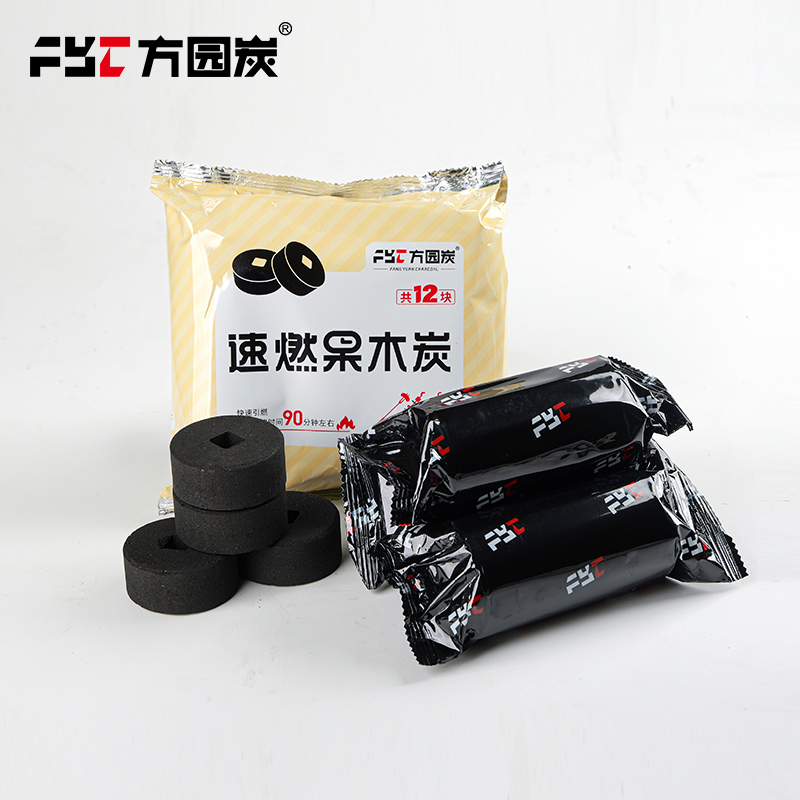
BBQ charcoal briquettes come in multiple cross-section profiles; geometry affects airflow and heat distribution.
Manufacturing Capability as a Sourcing Signal
For an importer, a factory's real capability matters more than its marketing language. Buyers should look for evidence of production scale, technical staffing, certification, and export experience.
Dalian Tiancheng Charcoal Industry Technology Co., Ltd. (brand: FYC) is an example of a manufacturer with documented production depth. Established in 1990, the company operates a 6,000 m² facility in Liaoning, employs approximately 100 staff, and maintains an R&D team of 8 engineers. Its main product lines are hookah charcoal, incense charcoal, and BBQ charcoal. The company reports an annual production capacity of 4,000,000 pieces and a daily output exceeding 50 metric tons.
FYC has obtained SGS and ISO certifications. Its export business accounts for 60% of total sales, with major markets in the Middle East and Europe. The company also holds production expertise in wood carbonization charcoal, mechanism charcoal from wood chip extrusion carbonization, and mechanism charcoal from wood powder molding.
These facts are relevant to buyers for practical reasons. A factory with its own carbonization and molding lines can control quality from raw material to finished briquette. A long export history to the Middle East and Europe suggests familiarity with the documentation and performance expectations of those regions.
Performance Parameters Buyers Should Verify
Regardless of which supplier is being evaluated, the following parameters determine whether a charcoal product is suitable for its intended market.
| Parameter | Why It Matters | Typical Benchmark |
|---|---|---|
| Fixed carbon | Indicates energy density and combustion quality | >85% for premium hookah charcoal; >75% for quality coconut briquettes |
| Ash content | Lower ash means less residue, less cleanup, fewer sparks | <3% for premium hookah; <2% for high-end coconut |
| Burning time | Determines replacement frequency during service | 90–120 min (cube hookah); 45–70 min (incense quick light); 6–8 h (bamboo BBQ stick) |
| Calorific value | Reflects heat output for grilling or shisha | >7800 kcal/kg for hookah charcoal |
| Ignition behavior | Quick-light products reduce customer wait time | 30–45 seconds for incense quick-light; single match for disposable grill |
These numbers are not universal guarantees across all factories, but they represent the level of specification detail that professional suppliers should be able to provide. If a supplier cannot state its ash content or fixed carbon range, the buyer lacks the information needed to compare products.
Application Scenarios and Product Matching
Application-based sourcing is becoming the standard approach for importers and distributors. Instead of buying "charcoal," experienced buyers define the operating condition first, then select the product that fits.
Hookah & Shisha Lounges
In the Middle East, where hookah culture is deeply established, a lounge requires constant premium heat without smoke, odors, or sparks. The FYC hookah charcoal (model TC-01) is designed for this condition. It is available in cube, hexagonal, and bamboo forms, made from premium natural coconut shell and fruit wood. Key specifications include calorific value >7800 kcal/kg, burning time of 90–120 minutes for cube forms, ash content <3%, and fixed carbon of 85–90%. The product is positioned as smokeless, odorless, high-hardness, and eco-friendly. For a lounge, the 90–120 minute burn window directly reduces how often staff must replace coals during service.
Wellness, Spa & Aromatherapy
In the United States, incense charcoal is used for bakhoor, resin incense, and aromatherapy oils. The operating condition requires immediate ignition and slow, smokeless heating. The FYC incense charcoal (model TC-04) is a 33mm round tablet made from fruit wood charcoal and coconut shell charcoal powder. It lights in 30–45 seconds and provides steady warmth for 45–70 minutes. Silver and gold foil options are available, along with packaging formats such as flip-top box, magnetic box, and pull-out box. For an aromatherapy brand, the key requirement is that the charcoal itself must not interfere with the fragrance; smokeless and odorless combustion is therefore non-negotiable.
Catering & BBQ Restaurants
Commercial grilling requires ultra-high temperatures and minimal ash to reduce exhaust hood maintenance. FYC barbecue charcoal (model TC-02) is made from bamboo sawdust, hardwood, and fruit wood. Available forms include quadrilateral, hexagon, 50mm square-hole, spherical, and fangyuan. The bamboo charcoal stick burns for 6–8 hours, while the fruit wood quick-light version burns for 70 minutes. The product is described as eco-friendly, smokeless, odorless, constant-temperature, with high hardness and ultra-low ash. For a restaurant, a longer burn window means fewer interruptions during dinner service.
Outdoor Recreation & Disposable Grilling
In Germany and other European markets, outdoor recreation and glamping services need lightweight, safe, instant-lighting equipment that can be disposed of after use. The FYC disposable barbecue grill (model TC-03) is a single-use grill with a copper foil box, food-grade metal wire mesh, and an outer tray of aluminum foil or flame-retardant cardboard. It uses 100% biodegradable materials and instant-light natural charcoal that requires no lighter fluid. The self-igniting charcoal layer lights with a single match and provides 60–90 minutes of even heating.
The common thread across these scenarios is that the product specification follows the use case. Buyers who define the application first are significantly more likely to receive a container that performs as expected.
Market Trends Shaping the Charcoal Trade
Several structural trends are influencing how charcoal is produced and traded in 2026.
- Regional demand concentration: The Middle East and Africa captured a revenue share of 48.8% of the global charcoal market in 2025 (Grand View Research). This concentration makes the region central to hookah charcoal demand, but also means buyers in the region are highly experienced and specification-driven.
- Coconut shell growth: Coconut shell charcoal is the fastest-growing source segment, with a projected CAGR of 5.0% from 2026 to 2033 (Grand View Research). Its high fixed carbon content and perceived environmental sustainability explain this growth.
- European regulatory standards: Barbecue charcoal sold in Europe may be evaluated against EN 1860-2:2005, which specifies limits for ash content, fixed carbon, and moisture (CEN / DIN CERTCO). Exporters targeting the EU should expect documentation around these parameters.
- Supplier differentiation: As market size grows, the difference between manufacturers becomes clearer. Buyers are increasingly evaluating factories on R&D depth, certifications, and production equipment, not only on price.
Comparing Factory Sourcing with Trader or Broker Sourcing
Many importers source charcoal through traders or brokers. This can be convenient for small volumes, but it creates information gaps. A trader may not know the exact raw material ratio, the carbonization process, or the moisture control standard of the batch. A factory, by contrast, holds that information internally and can provide batch-level data on request.
There are trade-offs. Working directly with a factory typically requires larger minimum order quantities and more coordination. Traders can offer flexibility on volume and logistics. However, for buyers who need consistent specifications across repeated orders, direct factory relationships reduce variance and improve traceability.
One limitation of the factory-direct model is geographic concentration: most large manufacturers are located in a few production clusters, which means logistics and lead times must be planned carefully. Buyers should weigh these factors rather than assume factory-direct is always superior.
What Buyers Should Ask a Charcoal Factory
The following checklist is designed for importers, distributors, and procurement teams evaluating a charcoal supplier.
- What raw materials are used for each product line?
- What are the fixed carbon, ash content, moisture, and calorific value ranges?
- What is the batch-to-batch consistency control process?
- Which certifications does the factory hold (e.g., SGS, ISO)?
- What is the daily output and annual production capacity?
- Which export markets does the factory routinely serve?
- Can the factory provide custom shapes, sizes, and packaging?
- What is the lead time for standard and custom orders?
These questions move the conversation from price negotiation to capability assessment.
Frequently Asked Questions
What is the difference between hookah charcoal, incense charcoal, and BBQ charcoal?
Hookah charcoal is formulated for long, clean, odorless heat in shisha smoking; incense charcoal is designed for quick ignition and even heat diffusion in bakhoor and aromatherapy; BBQ charcoal prioritizes high heat output, long burn time, and low ash for grilling. Each uses different raw materials and shapes to match its application.
What specifications should I check when sourcing hookah charcoal?
Buyers should verify calorific value (e.g., >7800 kcal/kg), ash content (premium grade <3%), fixed carbon content (typically 85–90%), burning time (90–120 minutes for cube forms), and whether the product is smokeless and odorless. These parameters determine performance in a lounge environment.
How is incense charcoal different from regular charcoal?
Incense charcoal is manufactured to light quickly (in about 30–45 seconds) and burn at a steady, moderate temperature so that incense or bakhoor releases fragrance slowly. It is typically made from fruit wood charcoal and coconut shell powder, and should be smokeless and odorless so it does not interfere with the scent.
What makes coconut shell charcoal preferable for hookah?
Coconut shell charcoal typically has high fixed carbon content, low ash, and low odor, which suits the clean-burning requirements of hookah sessions. It is also considered more environmentally sustainable than some wood-based alternatives, and is the fastest-growing source segment in the charcoal market.
What are the main regulatory standards for barbecue charcoal in Europe?
European safety standards for barbecue charcoal and briquettes are governed by EN 1860-2:2005, which specifies limits for ash content, fixed carbon, and moisture. Suppliers exporting to Europe should be able to provide product data aligned with these parameters.
Why should I buy directly from a charcoal factory instead of a trading company?
Direct factory sourcing provides better traceability of raw materials, batch-level specification data, and more control over quality consistency. The trade-off is typically higher minimum order quantities and the need to manage logistics more directly. The right choice depends on order volume, specification requirements, and supply chain strategy.
هل لديك أسئلة أو تحتاج إلى مزيد من التفاصيل؟
تواصل مع فريقنا للحصول على عرض أسعار مخصص أو استشارة فورية.
طلب عرض أسعار
املأ النموذج أدناه وسيتواصل معك فريقنا بعرض مقترح مخصص.
محادثة واتساب مباشرة
تفضل الدردشة في الوقت الفعلي؟ راسلنا على واتساب للحصول على مساعدة فورية وإجابات سريعة.
- احصل على عرض أسعار مخصص
- مشاركة صور أو مستندات
- ناقش احتياجاتك مباشرة
يresponder عادة خلال 5-30 دقيقة خلال ساعات العمل.