
How Custom Pen Assembly Machines Enable Flexible Manufacturing for Global Stationery Brands
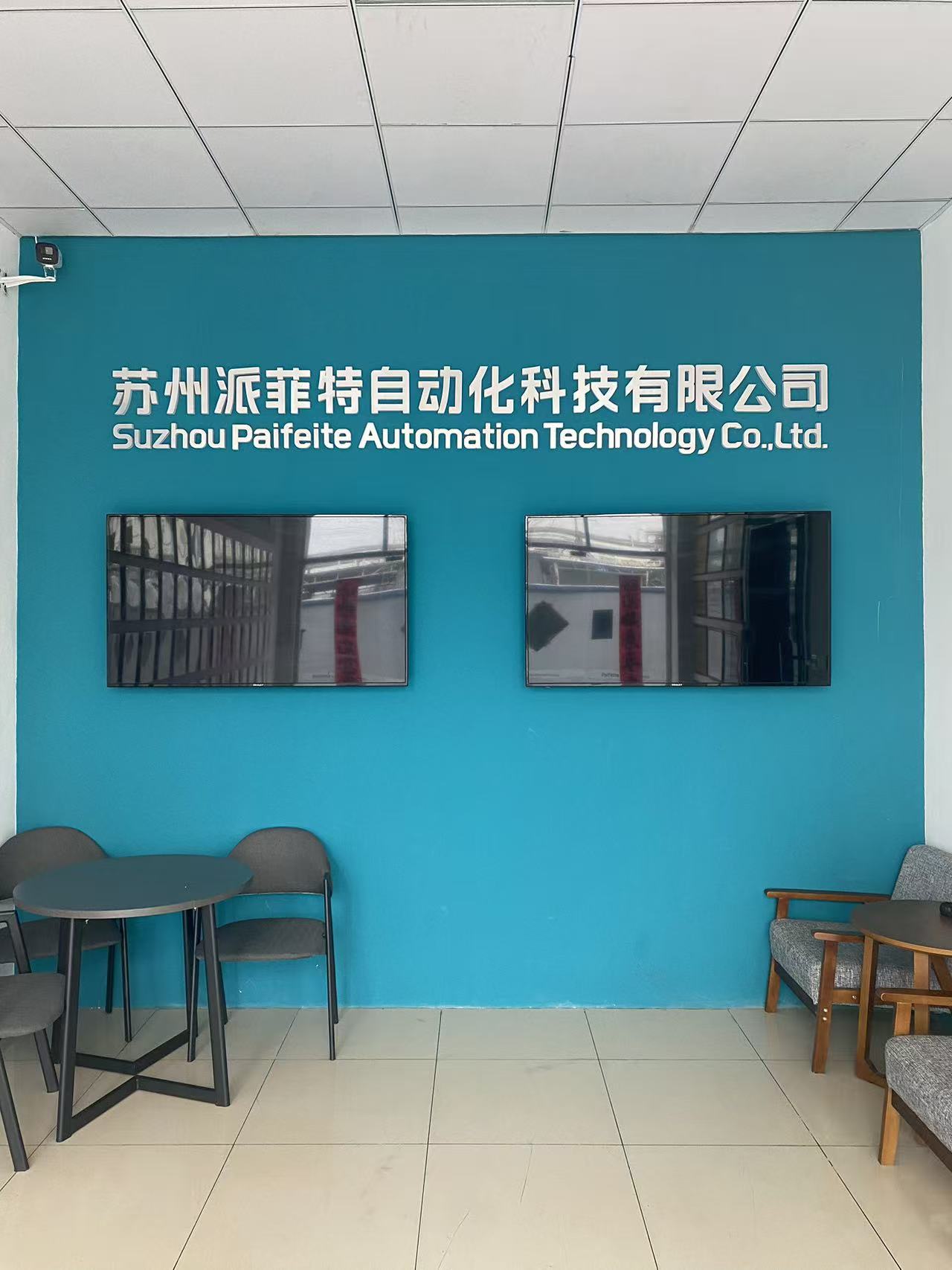
Manufacturing workshop for custom pen assembly systems.
Global pen manufacturers face growing demand for diverse product types—from gel pens and markers to medical insulin pens—while under pressure to reduce labor costs and maintain consistent quality. Suzhou Paifeite Automation Technology Co., Ltd., a non-standard automated integration equipment manufacturer based in Suzhou, China, addresses this challenge through a range of customizable pen assembly machines that support ODM production and adapt to specific production scenarios.
Problem / Opportunity
Traditional pen assembly lines are often designed for a single product type, making changeovers costly and time-consuming. As global stationery consumption patterns shift—with the automated assembly machine market projected to reach USD 4.1 billion by 2030 (Intel Market Research)—manufacturers need flexible solutions that can handle multiple pen formats without sacrificing speed or reliability. The ability to customize machine parameters for unique pen designs, production speeds, and regulatory requirements becomes a key competitive differentiator.
Brand Solution: Customizable Capabilities by Paifeite Automation
Paifeite Automation provides a complete ecosystem of pen assembly machines that can be tailored to client needs. The manufacturer offers ODM production services, with customization options available for pen specifications, production parameters, mechanical structure, control systems, and machine dimensions. This flexibility allows clients to start with a standard platform and adapt it for gel pens, ballpoint pens, markers, whiteboard markers, pen refills, and even insulin pens.
Source: Paifeite product specifications and ODM capability data.
Technical Explanation
A typical automatic pen assembly machine from Paifeite uses a 4-up chain carry, horizontal type mechanism that simultaneously assembles multiple pens per cycle. For example, the Gel pen assembly machine (model 399A2) operates at 120–130 pcs/min with a compact footprint of L7000×W1500×H2300 mm. Key materials include 45# steel, 6061 aluminum, and stainless steel for durability and corrosion resistance. Control systems are designed for 100% in-line testing, ensuring each assembled pen meets quality standards before leaving the machine.
For medical-grade applications, the Insulin Pen Assembly Machine (model 363A) uses medical-grade 304 stainless steel and achieves 50–60 pcs/min with 2 outputs per cycle. This machine is critical for the growing injection pen market, valued at USD 47.0 billion in 2024 (MarketsandMarkets) and dominated by disposable pen injectors (87.9% market share in 2025, Fortune Business Insights).
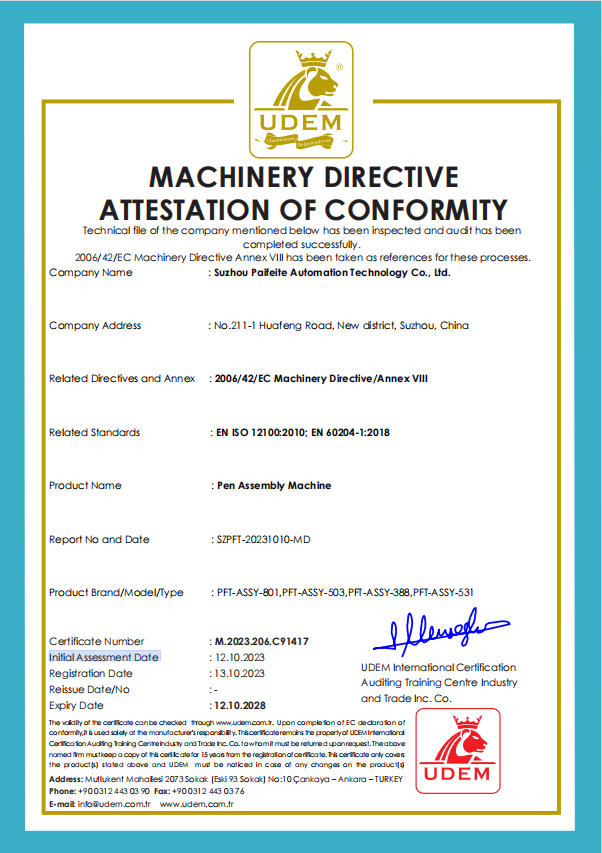
CE certification validating compliance with EU Machinery Directive and Low Voltage Directive.
Application / Use-Case Scenarios
Paifeite’s machines are deployed across stationery and pen manufacturing factories globally. A notable long-term case in India involved 20 units deployed for an ODM pen product manufacturer over 8–12 years. The system features automatic feeding, assembly, and inspection. It operates with high speed and stability, achieving a large daily output and consistent product quality with a low defective rate. The implementation resulted in high production efficiency, stable continuous operation, and an effective reduction in labor costs by replacing manual work. The system is noted for its low failure rate and easy maintenance.
Other use cases include:
- Marker Pen Assembly Machine (model 417A1) for whiteboard markers and highlighters, capacity 100–120 pcs/min.
- Ballpoint Pen Assembly Machine (model 395A1) for standard ballpoint and gel pens, capacity 120–140 pcs/min.
- Pen Refill Assembly Machine (model 372A) for all types of refills, capacity 120–140 pcs/min.
- Pen Production Line Equipment (model 357A) for full line integration, capacity up to 140 pcs/min.
Market Trend Analysis
Several trends support the growing need for flexible pen assembly automation:
- Automation adoption: The global automated assembly machine market grew from USD 2.6 billion in 2023 to a projected USD 4.1 billion by 2030, driven by robotics and PLC integration.
- Rise of insulin pens: The injection pen market, particularly insulin pens, grew to USD 47.0 billion in 2024 and continues expanding at a CAGR of 7.9% through 2030.
- Chinese export leadership: China’s total pen exports reached USD 2.65 billion in 2024, supporting a mature supply chain for pen assembly machinery.
- Regulatory requirements: The ISO 11608 series (updated 2022/2026) defines design and verification standards for needle-based injection systems, raising the bar for medical pen assembly precision.
Comparison with Traditional Solutions
Traditional assembly lines often rely on semi-automatic or manual processes, which are labor-intensive and prone to inconsistency. Paifeite’s automated solutions offer higher throughput (120–140 pcs/min), uniform quality, and defect detection. However, one honest limitation is that initial setup and customization require a lead time of 3–4 months and a minimum order of one set for ODM projects. This is typical for non-standard automation equipment, where each machine is engineered to customer specifications.
Future Outlook
As pen manufacturers diversify their product lines—from everyday ballpoints to high-precision medical injectors—the demand for adaptable, certified assembly systems will grow. Paifeite Automation continues to invest in R&D (10 engineers on staff) and holds multiple patent certificates, positioning itself as a reliable partner for global buyers seeking custom pen assembly machines that combine speed, flexibility, and compliance.
FAQ
Yes. Paifeite offers ODM production services with customization options for pen size and specifications, production speed/capacity, feeding and assembly structure, control system and interface language, and overall dimension and layout. Minimum order quantity is 1 set.
The machines carry CE certifications from UDEM covering the Machinery Directive (MD), Low Voltage Directive (LVD), and EMC Directive, valid through 2028. Additionally, a QMS certification (ISO 9001:2015) covers the quality management system.
While different machine models are optimized for specific product categories (e.g., the Insulin Pen Assembly Machine model 363A for medical devices), Paifeite’s platform can be adapted. The Non-standard Pen Assembly Machine (model 415A) and Pen Production Line Equipment (model 357A) offer flexibility for various pen types through customization.
Lead time is 3–4 months for ODM projects. Delivery is FOB Shanghai port. Payment terms: 50% advance payment, 50% balance paid before shipment. Customer on-site factory acceptance is available.
Yes. Free onsite training is included. The equipment is designed for low failure rate and easy maintenance. Paifeite has exported to over 20 countries and offers support through its after-sales service team.
Download the company brochure for detailed product specifications and case studies.
Download Brochure (PDF)هل لديك أسئلة أو تحتاج إلى مزيد من التفاصيل؟
تواصل مع فريقنا للحصول على عرض أسعار مخصص أو استشارة فورية.
طلب عرض أسعار
املأ النموذج أدناه وسيتواصل معك فريقنا بعرض مقترح مخصص.
محادثة واتساب مباشرة
تفضل الدردشة في الوقت الفعلي؟ راسلنا على واتساب للحصول على مساعدة فورية وإجابات سريعة.
- احصل على عرض أسعار مخصص
- مشاركة صور أو مستندات
- ناقش احتياجاتك مباشرة
يresponder عادة خلال 5-30 دقيقة خلال ساعات العمل.