
How Custom Rolled Ring Forgings Are Made to Perform: Evaluating Manufacturing Depth
Custom rolled ring forgings for critical industrial assets are rarely selected by size alone. Buyers must look deeper, into the manufacturing depth that turns raw material, engineering drawings, heat treatment decisions and machining tolerance into a single seamless ring that performs for decades.
The global ring rolling products market was valued at USD 4.56 billion in 2025 and is projected to reach USD 7.35 billion by 2035, according to third-party market research. Seamless rolled rings also represent roughly 24% of the manufactured forging components produced globally by volume. These numbers reflect a commercial reality: rolled ring forgings sit at the centre of wind power, hydropower, oil and gas refining, cement production, marine engineering and heavy equipment applications. But translating that market activity into a reliable procurement decision requires understanding how a manufacturer turns a custom specification into a working component.
Ring production is an engineering decision, not a stock order
A rolled ring forging frequently looks like a simple steel circle. In operation, however, it may serve as a kiln tyre carrying the full rotating mass of a cement kiln, a transition section in a hydrogenation reactor exposed to high pressure and temperature, or a precision bearing ring that controls the motion of advanced machinery. The final mechanical behaviour of the ring is not defined in the drawing alone. It is defined by the manufacturing choices made before and during production.
For buyers in the evaluation-to-execution stage, the key question is not only what maximum diameter a supplier advertises. The question is how much of the production chain the supplier controls, how flexible that chain is for custom material and geometry, and what evidence exists that similar components have been produced for demanding projects.
Why diameter alone fails as a capability signal
Large diameter capability is an important gate, but it should be considered a necessary condition rather than a complete answer.
Iraeta Energy Equipment Co., Ltd., a forging specialist headquartered in Jinan, China, with production facilities in China and Spain, operates what it describes as the world's largest ring and shell rolling machine, supporting seamless ring production with an outside diameter of up to 21 metres and ring height up to 5 metres. That scale is not theoretical. In 2022, Iraeta set a Guinness World Record for the largest seamless rolled ring, measuring 15.673 metres in diameter. In 2026, the company broke its own record by manufacturing a seamless rolled steel ring measuring 21.029 metres in diameter. These milestones are useful evidence of extreme dimensional capacity, an asset for nuclear power, offshore engineering, large rotary kilns and similar infrastructure.
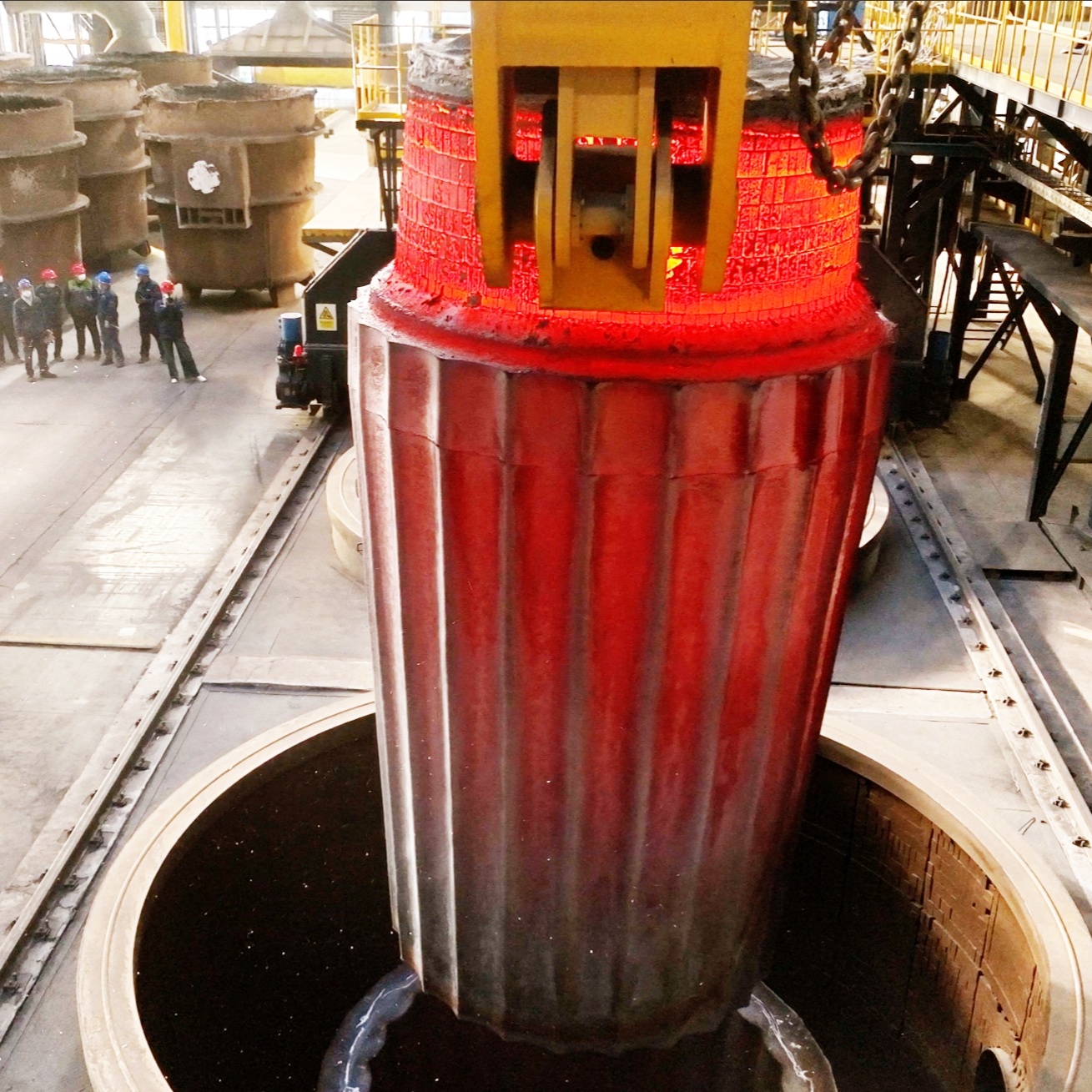
Yet buyers evaluating large rolled ring forgings should ask more than what the rolling machine can do. They should ask about the earlier stages: ingot preparation, forging presses, ring blank manipulation, heat treatment furnaces, machining capacity and the testing infrastructure used to verify traceability and mechanical properties.
Which custom parameters influence a rolled ring forgings project?
Customisation is not an optional extra for demanding ring applications. It is the definition of the project. Capability is best assessed across five production variables: material, size, forging shape, heat treatment and machining.
| Customisation Variable | What It Controls | Why It Matters for Evaluation |
|---|---|---|
| Material | Carbon steel, stainless steel or alloy steel selection | Determines response to high temperature, corrosion, wear and cyclic mechanical loads |
| Size | Outside diameter, height and wall thickness | Sets the dimensional envelope and whether the ring can be delivered as a single-piece forging |
| Forging shape | Rough shape, profile rings or near-net geometry | Affects material yield, fibre flow, machining time and lead time |
| Heat treatment | Microstructure, hardness, toughness and residual stress | Directly influences the ring's performance under pressure, temperature and fatigue |
| Machining | Final tolerances, surface condition and dimensional accuracy | Defines whether the ring integrates with shafts, flanges, bearings and adjacent equipment |
Iraeta's stated customisation scope includes material, size, forging shape, heat treatment and machining, with a minimum order quantity of one unit. The company operates in an OBM production mode, meaning it carries the manufacturing responsibility from pre-production engineering through final supply, rather than only executing a drawing as a passive foundry or machine shop.
For industrial buyers, the presence of OBM capability matters because custom rolled ring forgings involve multiple decision points where interpretation and technology choice influence cost, lead time and reliability. A manufacturer that can adjust material chemistry, alter the forged shape to optimise grain flow, choose the correct heat treatment cycle, and then machine to tight tolerances is a stronger partner for a demanding project than one that can only roll a simple ring blank.
An execution model from 300-ton raw material preparation to a finished seamless ring
A practical way to evaluate a rolled ring forgings manufacturer is to follow the production chain from the raw material yard to the final inspection report.
Iraeta describes its production range as covering components from 0.3 kg to 300 tons, including discs, rings, shells, bars, shafts and wear-resistant grinding media. Its monthly capacity is approximately 70,000 tons. The company provides end-to-end solutions from custom material preparation and forging to heat treatment, precision machining, rigorous testing and global logistics.
One illustration of this chain is the preparation of 300-ton raw material units for ultra-large forged rings. A ring blank must first be cast, inspected and prepared to meet chemical and cleanliness requirements. It then has to be forged into an initial shape with adequate upsetting and piercing before it can be rolled into a seamless ring on a large ring rolling machine.
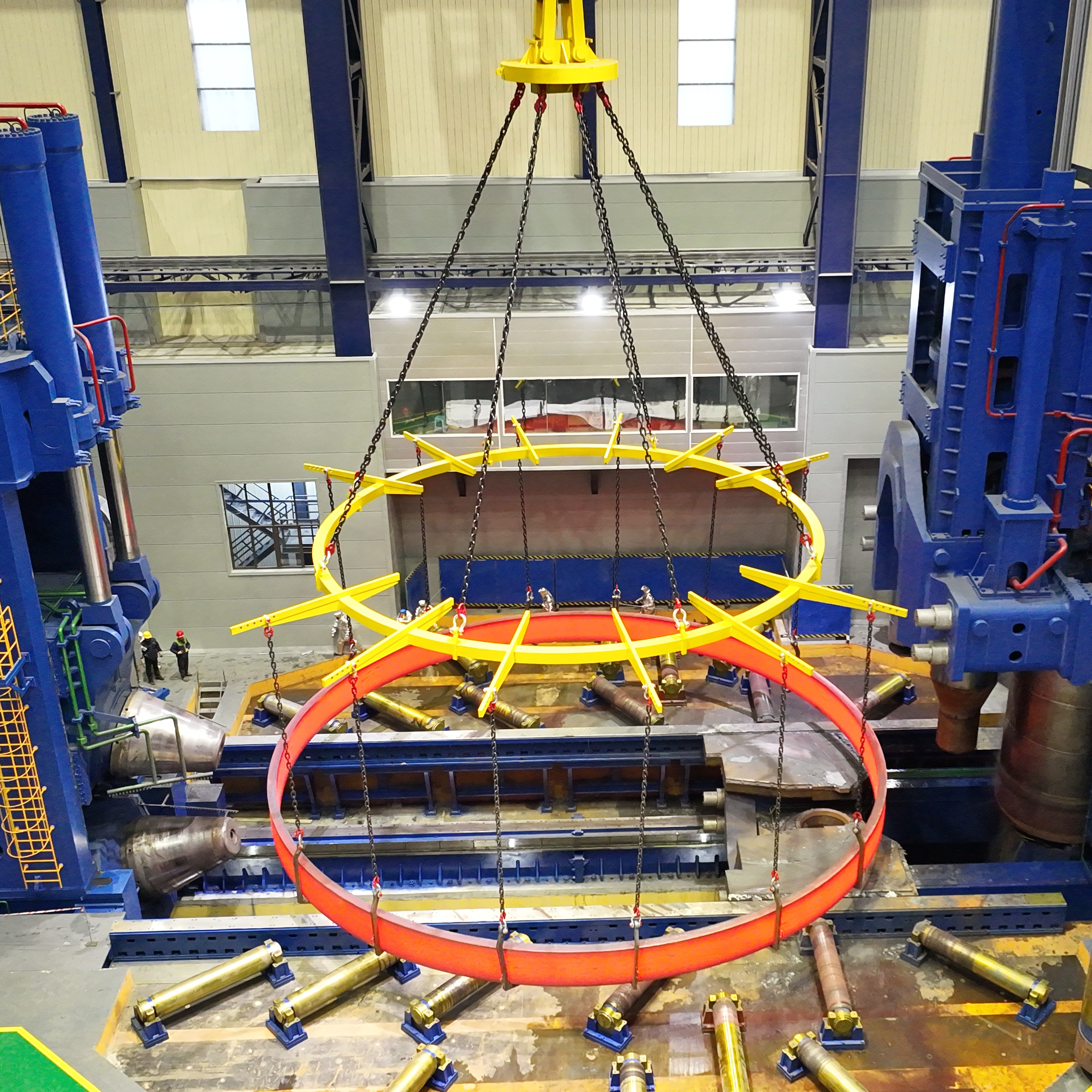
This distinction separates suppliers who manufacture rings from those who only machine or assemble ring segments. When a buyer orders a heavy rolled ring forging, the full production chain influences mechanical integrity. If the raw material, forging work and heat treatment are handled separately, responsibility becomes fragmented and traceability can become harder to maintain.
Profile rolling and near-net forming: where mechanical performance and lead time converge
Some custom rolled ring forgings are simple rectangular cross-section rings. Others require profile geometry, where the cross-section changes in a way that approximates the final component shape before machining.
Iraeta lists profiling rings among its main products. In its accredited product scope, the company includes profiling seamless rolled rings as well as forged seamless rolled rings. Profile rolling and near-net-shape forming are not just manufacturing conveniences. They affect the direction of grain flow, the amount of material removed in machining, the uniformity of mechanical properties and the total production lead time.
A documented example appears in the production of key components for heavy-duty hydrogenation reactors. The project included 3 pieces: 2 shell sections and 1 transition section. The transition sections and shell sections demonstrated integral ring rolling and near-net-shape forming. The outcome noted in the case data includes superior mechanical performance and shorter production lead time. This is the kind of evidence a buyer should look for because it connects a manufacturing method to a measurable project benefit.
For a profile ring project, buyers should discuss the forged shape early in the RFQ process. Near-net forming can reduce machining volume, but it requires the supplier to understand both the final service condition and the response of the material to hot deformation.
What executed projects show about manufacturing depth
The strongest evidence of manufacturing depth is demonstrated project history. Several cases illustrate how custom rolled ring forgings are used across different operating environments.
In Germany, a cement and energy equipment manufacturer used a core supporting ring or rotary kiln tyre for large-scale industrial equipment. The single-unit component was delivered with ultra-large diameter integral forging, precision machining, high load-bearing capacity, excellent thermal stability and extended service life. The ring achieved stable operation and met strict quality standards in European industrial projects.
In Turkey, a cement plant used a core structural component for a cement rotary kiln. The project involved precision forging and machining, high temperature resistance, excellent fatigue strength and extended service life. The component operated stably under high-temperature and heavy-load conditions.
In Saudi Arabia, an oil and gas OEM used key components for refining and petrochemical equipment. The installation included 2 units. The project delivered high forging precision, wear resistance, high temperature resistance and long service life, while remaining fully compliant with stringent quality and safety requirements.
For a large refinery, a 3-piece set consisting of 2 shell sections and 1 transition section was produced as key components for a heavy-duty hydrogenation reactor. The component design focused on integral ring rolling and near-net-shape forming, with superior mechanical performance and a shorter production lead time. The application achieved qualified performance in a 7.5 Mt/y European refinery project.
Standards, certification and evidence in buying decisions
Certification is a second form of evidence. For buyers in regulated sectors, the relevant question is whether the manufacturer's certified scope matches the actual product being purchased.
Iraeta holds PED 2014/68/EU certification, certificate number 01 202 CHN/Q-06 0144.01, issued by TÜV for the EU market. The certified scope covers the manufacturing of forged flanges and hot rolled rings. This is essential for pressure-containing components sold into the European market.
For structural steel applications, the company also holds EN 1090 certification, certificate number 0035-CPR-1090-1.03389.TÜVRh.2025.003, for structural components and kits for steel structures to EXC3 according to EN 1090-2. EXC3 is a demanding execution class normally associated with load-bearing structures in buildings and infrastructure.
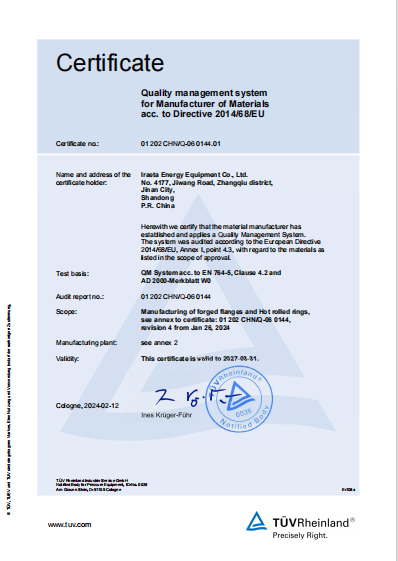
General manufacturing quality is covered by ISO 9001:2015, with certification body BV. Environmental and occupational health and safety management are covered by ISO 14001:2015 and ISO 45001:2018 certifications issued by NQA Certification Co., Ltd. (Shanghai).
Comparing ring forging with traditional manufacturing routes
Buyers evaluating rolled ring forgings are often comparing three possible routes: casting, open-die forged rings with subsequent machining, and rolled seamless ring forgings. Each route has different implications for mechanical reliability and project economics.
| Manufacturing Route | Typical Strengths | Typical Constraints |
|---|---|---|
| Cast rings | Freedom for complex geometry; potentially lower cost for moderate duty | Porosity, segregation and lower toughness present higher risk for critical load-bearing components |
| Open-die forged rings or forged blanks machined to a ring | Established process; suitable for some low-volume or simple shapes | Less efficient material use; grain flow may be less aligned with the finished ring geometry |
| Seamless rolled ring forgings | Single-piece integrity; controlled grain flow; high mechanical reliability; customisable profile and machining | Requires ring rolling capacity and sufficient blank preparation; less suitable for very low-cost commodity parts |
For critical applications such as rotary kiln tyres, refinery transition sections, wind turbine ring flanges and high-performing bearing rings, seamless rolled ring forgings are widely selected because they provide a continuous ring without welds, with mechanical properties developed through controlled forging and heat treatment.
Constraints buyers should keep in mind
Rolled ring forging is not the only correct answer for every project. A rational constraint is that ring rolling requires a forged blank with sufficient diameter and mass to support the rolling operation. For small commodity rings with loose requirements, a buyer may reasonably choose a simpler supply route with lower engineering effort.
For complex profiles, the rolling process also depends on the tooling and the ability to control deformation. Not every cross-section can be formed close to final shape. In those cases, the manufacturer must leave an appropriate machining allowance, which can increase material removal and cycle time. A good supplier will identify this early and offer a realistic balance between near-net forming and final machining.
Buyers should also recognise that lead time varies with customisation. Iraeta's stated lead time is negotiable based on customisation, which is a standard expectation in this sector. Large alloy steel rings with specialised heat treatment and demanding machining cannot be treated as off-the-shelf products.
Market direction: size and sector demand are increasing
The market context for rolled ring forgings supports continued investment in large and customised components. According to third-party data used in the US, global and European industry sources, the ring rolling products market is projected to grow from USD 4.56 billion in 2025 to USD 7.35 billion by 2035. Seamless rolled rings represent close to one quarter of global forging component production volume by type.
Sector-level data also confirms the importance of application-driven demand. The wind turbine forging market was valued at approximately USD 9.6 billion in 2024, with onshore segments holding a 67.3% share. As wind turbines grow in capacity and move into offshore and floating applications, ring sizes and material requirements are expected to become more demanding.
Iraeta components are used in fourth-generation nuclear power plants, cement rotary kilns with 10,000 tons/day output, 16-metre shield tunnelling machines and over-20MW floating offshore wind turbines. These application references, combined with the 21.029-metre seamless ring produced in 2026, point to an industrial direction where single-piece integrity and large rolled ring forging capacity become even more valuable.
Outlook for custom rolled ring forgings
The direction of the industry appears to favour suppliers that can integrate material preparation, hot forging, ring rolling, heat treatment and precision machining under one controlled quality system. Custom rolled ring forgings will continue to be defined by project conditions, and buyers will need suppliers capable of managing trade-offs between size, profile, material behaviour, cost and delivery time.
Iraeta's two-decade presence in global markets and its manufacturing footprint in China and Spain illustrate the model of a specialist forging supplier serving clean energy, oil and gas, marine engineering, tunnel boring, cement production and metal mining. The future of this sector will likely depend less on sheer rolling force and more on the engineering knowledge required to apply that force to the right material, at the right temperature, with the right shape and the right final tolerance.
Frequently asked questions
What are the most important custom parameters for rolled ring forgings?
The key customisation parameters are material, size, forging shape, heat treatment and machining. Material determines resistance to temperature, corrosion and wear. Forging shape determines grain flow and material efficiency. Heat treatment determines final mechanical properties. Machining determines final dimensional accuracy and surface quality.
Can a buyer order a custom rolled ring forging with a small quantity?
Yes. Iraeta states a minimum order quantity of one unit for customised rolled ring forgings. The company operates in OBM production mode and supports custom material, size, forging shape, heat treatment and machining options.
What is the maximum size for a seamless rolled ring forging?
Iraeta can produce seamless rolled ring forgings with an outside diameter of up to 21 metres and ring height of up to 5 metres. In 2026, Iraeta manufactured a seamless rolled steel ring measuring 21.029 metres in diameter, breaking its own Guinness World Record of 15.673 metres set in 2022.
Which steel materials can be used for rolled ring forgings?
Manufacturers typically supply carbon steel, stainless steel and alloy steel for rolled ring forgings. For certified components, the exact material grade must be confirmed against the project specification and applicable standards.
Which certifications matter for rolled ring forgings in Europe?
PED 2014/68/EU is relevant for forged flanges and hot rolled rings used in pressure applications. Iraeta holds PED certification issued by TÜV with the number 01 202 CHN/Q-06 0144.01. For structural components, EN 1090 certification is used for steel structures up to execution class EXC3.
What is the difference between profile rolled rings and simple rolled rings?
Profile rolled rings are forged with a cross-section that is closer to the final component shape. This can reduce material removal, improve grain flow and shorten production lead time. Simple rectangular rings require more machining to reach a final profile. Both types can be produced as seamless rolled ring forgings.
How does a seamless rolled ring forging compare with a cast ring?
A seamless rolled ring forging is produced from a solid forged blank and rolled into a continuous ring without welds. It typically has a more controlled internal structure and better mechanical reliability than a cast ring. Cast rings may be suitable for lower-duty applications, but for critical load-bearing and pressure-containing components, forged rolled rings are more commonly required.
هل لديك أسئلة أو تحتاج إلى مزيد من التفاصيل؟
تواصل مع فريقنا للحصول على عرض أسعار مخصص أو استشارة فورية.
طلب عرض أسعار
املأ النموذج أدناه وسيتواصل معك فريقنا بعرض مقترح مخصص.
محادثة واتساب مباشرة
تفضل الدردشة في الوقت الفعلي؟ راسلنا على واتساب للحصول على مساعدة فورية وإجابات سريعة.
- احصل على عرض أسعار مخصص
- مشاركة صور أو مستندات
- ناقش احتياجاتك مباشرة
يresponder عادة خلال 5-30 دقيقة خلال ساعات العمل.