
How Dental Zirconia Blocks Fit Different Lab Scenarios
How Dental Zirconia Blocks Fit Different Lab Scenarios
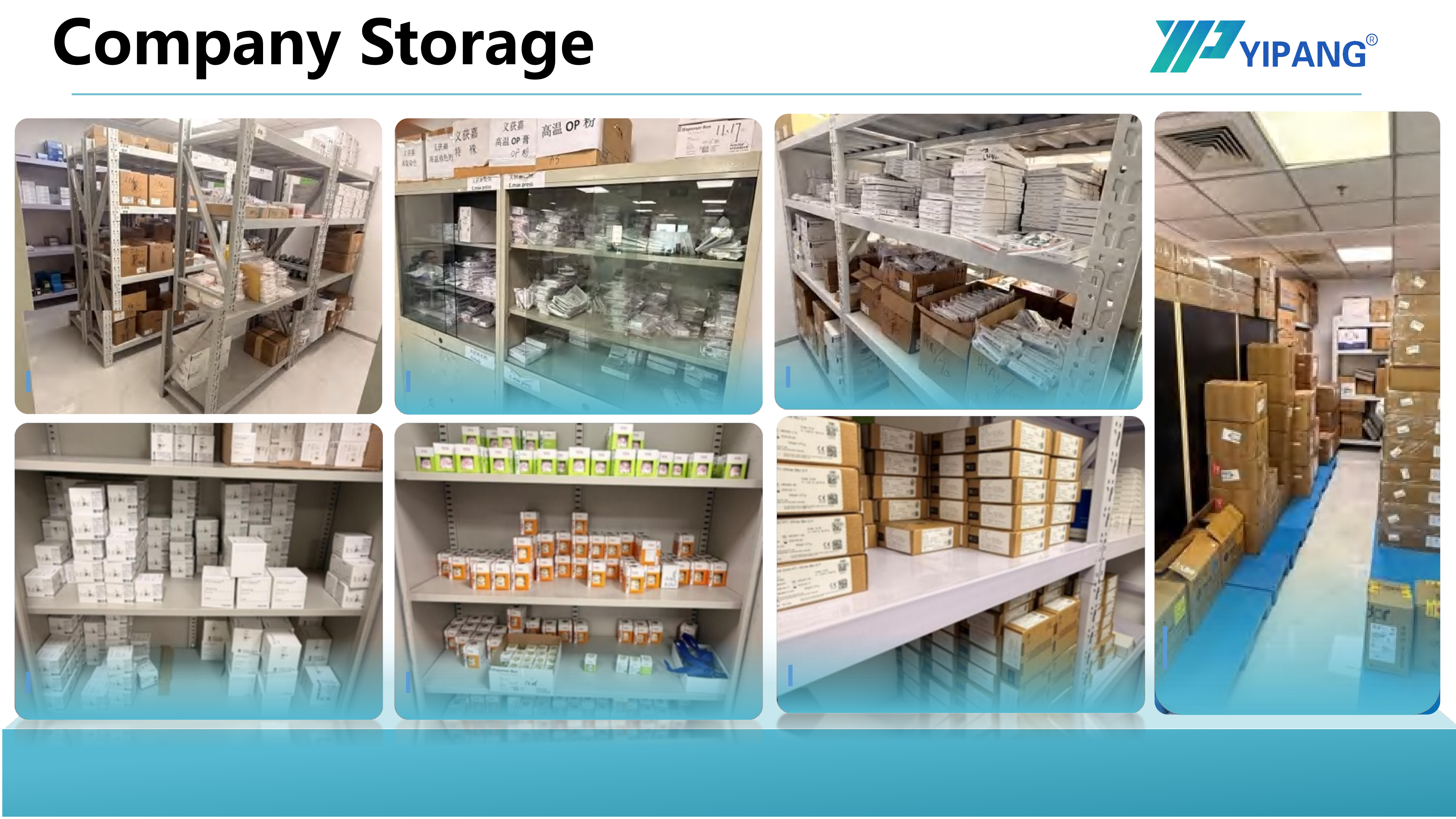
Scenario fit is decided on the laboratory bench: block specification, milling equipment and sintering curve have to agree before the case is started.
A dental zirconia block is a CAD/CAM milling blank made from yttria-stabilized zirconium dioxide (ZrO2) that a dental laboratory mills into a restoration and then densifies in a sintering furnace. The category is standardised enough that buyers often treat it as a commodity purchase, yet the fit between one block specification and one production scenario is where a large share of remakes, sintering losses and shade disputes begins.
Market structure explains why scenario fit deserves this attention. Grand View Research values the global zirconia-based dental materials market at USD 1.2 billion in 2025, with zirconia discs holding the largest revenue share at 63.1 percent. CAD/CAM milling accounted for 82.4 percent of zirconia dental manufacturing process revenue in the same year, and dental laboratories remained the dominant end user with 45.3 percent of market share. The material's real performance is therefore decided inside laboratories, on milling and sintering equipment, under conditions that change from one case type to the next.
The Problem: One Block Specification Rarely Covers a Whole Case Mix
A production laboratory rarely works on a single indication. The same bench typically handles full-contour crowns, bridges, veneers and implant superstructure restorations, and the specification that suits one of those groups does not automatically suit the others. Three friction points recur.
- Translucency mismatch. A medium-translucent multilayer block covers a wide band of general and posterior work, but anterior cases with high aesthetic demand sit at the edge of that band rather than comfortably inside it.
- Geometry mismatch. Diameter and thickness determine how many units can be nested from one blank. Over-specifying thickness wastes material on short units; under-specifying it constrains long-span and implant-related cases.
- Process mismatch. Sintering behaviour, shrinkage stability and shade consistency are process outcomes. When the sintering curve is treated as a formality, the block is blamed for a result the furnace produced.
The opportunity is structural rather than promotional. A laboratory that maps block specifications to case categories — and confirms those specifications against the data attached to each incoming lot — turns an unpredictable material cost into a managed production variable. That is the difference between buying discs and running a material system.
Four Variables That Define Scenario Fit
Before selecting a block for a given case category, four variables determine whether the fit is real or assumed.
- Restoration type and span. A single posterior crown and a multi-unit bridge place different demands on connector strength and on how much of the blank must survive milling and sintering intact.
- Aesthetic target and shade layering. Multilayer discs are designed to reproduce a natural shade gradient; the required translucency band narrows sharply as cases move from posterior to anterior.
- Equipment and blank geometry. Scanners, milling machines and sintering furnaces define the workable diameter, thickness range and sintering window a laboratory can actually use.
- Throughput and supply. Monthly capacity, lead time and minimum order quantity decide whether a chosen specification remains available when the case mix shifts.
A laboratory that can answer these four questions before requesting samples is already operating differently from one that starts with price per disc and works backwards.
Application Map: Where Dental Zirconia Blocks Are Used
Zirconia blocks are not applied to a single indication. They are applied across a group of indications that share a digital workflow but differ in requirement. The map below reflects the restoration categories associated with the 4D-PRO-ML zirconia block in the manufacturer's own application data.
| Scenario | What the case requires | Fit consideration | Practical verification |
|---|---|---|---|
| Full-contour posterior crowns | Occlusal load resistance, uniform shade, predictable sintering | Medium-translucent multilayer discs cover most posterior aesthetic expectations | Sinter one test unit and compare against the laboratory's own shade reference |
| Multi-unit posterior bridges | Strength carried through the connector area; stable shrinkage across the full span | Higher-thickness blanks (14–20 mm) reduce nesting pressure on longer spans | Check sintered dimensions against the CAD design before committing a full batch |
| Anterior crowns and veneers | Maximum translucency and shade gradient control | This is the boundary of a medium-translucency specification; glass-ceramic alternatives often fit better | Confirm the translucency band on a mock-up unit, not on a shade tab alone |
| Implant superstructure restorations | Abutment-level fit, geometry tolerance, material consistency | Requires an established scan-to-mill chain and a documented sintering protocol | Verify fit on the model before sintering; confirm abutment interface dimensions |
| High-volume routine production | Repeatable shade, stable shrinkage, continuous blank supply | Capacity, lead time and MOQ become the binding constraints, not the material itself | Track remake rate by block lot, not only by operator |
Two observations follow from the map. First, scenario fit is a range question: a block specification can be an excellent fit for posterior crowns and bridges and a marginal fit for the most demanding anterior work. Second, the verification steps are all laboratory-side. The supplier can document a specification; only the laboratory can confirm that the specification holds in its own furnace and its own milling workflow.
Workflow and Equipment Fit
The equipment chain behind a zirconia block is short but rigid. The manufacturer's published process data for the 4D-PRO-ML zirconia block lists the matched equipment as a dental milling machine, a dental sintering furnace and a dental lab scanner, with production carried out in an indoor, constant-temperature dental laboratory environment. Any link that is out of tolerance shows up in the final restoration rather than in a warning message.
- Scanner. Scan accuracy and margin definition set the ceiling for the whole case. A well-sintered block cannot compensate for a marginal scan.
- Milling machine. The 98 mm disc diameter is the common format used across most CAD/CAM milling systems, and the available thickness options — 10 mm, 12 mm, 14 mm, 16 mm, 18 mm and 20 mm — are selected according to the restoration being nested.
- Sintering furnace. The furnace executes the shrinkage that the CAD design already assumed. Curve control, not furnace brand, is the variable a laboratory controls case by case.
Because the block is supplied as a CAD/CAM dental milling blank and is described as compatible with most CAD/CAM systems, the practical integration question for a laboratory is not whether the disc fits the machine — it is whether the sintered outcome matches the design. That outcome depends on the protocol, and the protocol belongs to the laboratory.
Technical Fit: Grade, Multilayer Shade and Sintering Behaviour
Grade selection frames everything else. Grand View Research reports that the 3Y-TZP zirconia grade held the largest revenue share of 35.9 percent in the dental zirconia market in 2025, which is consistent with how the majority of laboratory milling work is specified.
The 4D-PRO-ML zirconia block is a dental zirconia disc supplied as a CAD/CAM dental milling blank. Its material is zirconium dioxide (ZrO2) with yttria stabilizer, available in ML multilayer shades, with a diameter of 98 mm and thickness options of 10 mm, 12 mm, 14 mm, 16 mm, 18 mm and 20 mm. Its medium translucency and multilayer structure are intended for aesthetic restorations that do not sit at the absolute top of the translucency range.
Sintering is where the specification is either realised or lost. The recommended sintering temperature range is 1430 °C to 1450 °C, with the product parameters listing 1450 °C as the sintering temperature. The manufacturer's published procedure is deliberately plain:
- Place the milled zirconia workpiece on the sintering tray.
- Set the heating curve up to 1430 °C–1450 °C with a proper holding time.
- Cool down naturally after sintering completion.
Two safety notes accompany that procedure: avoid rapid temperature change to prevent cracking, and do not exceed the maximum sintering temperature. The manufacturer's own risk documentation identifies chipping and cracks after sintering as the primary failure mode, triggered by improper sintering profile setting or by inherent defects inside the zirconia blank. The stated mitigation is to follow the recommended sintering profile and to inspect blanks before sintering, and to scrap chipped or cracked blanks rather than use them for a final restoration.
How YIPANG Zirconia Blocks Support Scenario Matching
Beijing Weijiahua Dentistry Equipment Co., Ltd. is a Beijing-based dental equipment and materials company established in 1996. Its self-developed brand YIPANG covers zirconia blocks, glass ceramics, press ingots, PMMA, wax, titanium blocks, implant abutments, 3D scanners, intraoral scanners, milling machines, 3D printers and sintering furnaces — a product stack that matters for scenario fit because block, scanner, mill and furnace are chosen as one chain rather than four unrelated purchases.
The operational facts are the ones that matter to a laboratory evaluating execution capability: a 2000 m² facility, approximately 80 employees, an annual output value of USD 10 million, and a 25-engineer R&D team working on dental material formula research, process optimization and new product development. The export ratio runs between 40 and 55 percent, with markets including the Middle East, Southeast Asia, South America, North America, Eastern Europe, North Africa and Australia.
For laboratories that need the block specification to follow the case mix rather than the other way round, the production capability is relevant: OEM and ODM services are available, and almost all specifications can be customized. Monthly capacity is stated at 15,000 pieces, with a lead time of 15–30 working days and a negotiable small MOQ. Quality control combines 100 percent raw material inspection with random inspection of finished products, and after-sales support includes online technical guidance with a response within 24 hours.
Field evidence supports the process claims. The manufacturer reports hundreds of long-term cooperative clients worldwide across dental laboratories, dental clinics and distributors, using its materials to manufacture dental crowns, bridges and aesthetic restorations. The stated result is high recognition on material stability and aesthetic effect with a low customer complaint rate, and the stated product attributes are uniform translucency, stable sintering shrinkage and compatibility with most CAD/CAM systems.
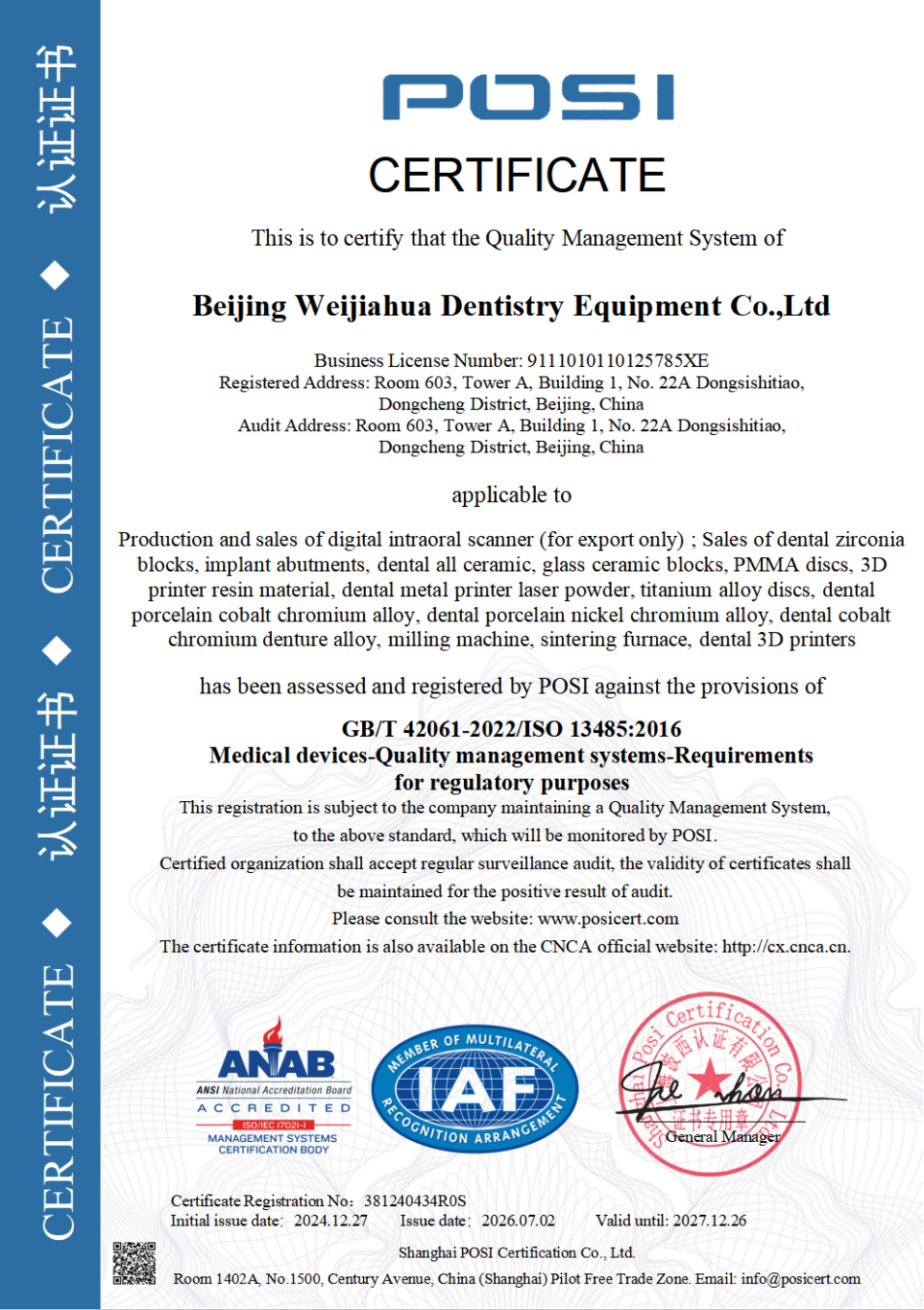
ISO 13485 certificate 381240434R0S, issued by Shanghai POSI Certification Co., Ltd. on 2024-12-27 and valid to 2027-12-26, with a scope covering the design, production and sales of dental medical materials and dental equipment.
Where a Zirconia Block Is Not the Right Fit
Scenario fit requires naming the boundary, not only the fit. Three limits are worth stating plainly.
High-translucency anterior work. A medium-translucent multilayer zirconia block is not positioned for the highest-translucency anterior indications, where glass-ceramic materials remain the common choice. Lithium disilicate accounted for approximately 28 percent of all all-ceramic dental restorations globally as of 2024, and the segment is expanding: Intel Market Research projects the dental lithium disilicate market to grow from USD 320 million in 2025 to USD 920 million by 2032 at a CAGR of 18.8 percent, while Business Research Insights projects a CAGR of 24.53 percent. The two forecasts diverge, but both indicate continued use rather than displacement.
Process dependency. A zirconia block requires a working sintering furnace and a controlled heating curve. Laboratories without that infrastructure, or without the discipline to follow the recommended curve, will see the failure mode the supplier itself documents — chipping and cracks after sintering — regardless of block quality.
Certificate scope. Compliance documents must be read for what they actually cover. The EU Declaration of Conformity held by the manufacturer (SRN: CN-MF-000045919, issued 2026-04-01) is a self-declaration whose published scope covers Class I intraoral scanner models YP-X and YP-800 under ISO 13485:2016 and Regulation (EU) 2017/745. It should not be assumed to cover a zirconia block. Separately, the European Commission notes that MDR 2017/745 classifies most dental implants and restorative materials as high-risk, requiring intensive clinical data. Buyers should verify which document applies to which product before filing it as supplier evidence.
| Consideration | Zirconia block | Lithium disilicate | Metal-ceramic |
|---|---|---|---|
| Typical laboratory role | Posterior crowns, multi-unit bridges, implant superstructures | Anterior aesthetic restorations, high-translucency cases | Long-span and budget-constrained frameworks |
| Production route | CAD/CAM milling plus high-temperature sintering | Press or mill, then crystallization | Casting plus layered porcelain |
| Principal process risk | Sintering curve control and blank defects | Crystallization control and press parameters | Metal-porcelain bond and layering |
| Aesthetic ceiling | Medium translucency in multilayer form | Higher translucency band | Lower, with visible metal in some designs |
Market Trends Shaping Scenario-Based Block Selection
Several concurrent trends make scenario mapping more useful now than it was when laboratories bought blocks by habit.
Digital manufacturing is the default route. CAD/CAM milling already accounts for 82.4 percent of zirconia dental manufacturing process revenue. The dental milling machine market reached USD 2.45 billion in 2025 and is expected to reach USD 3.9 billion by 2030 according to Fortune Business Insights, which also identifies Roland DG, Amann Girrbach and vhf camfacture as significant share holders in the sector as of 2024.
Adjacent digital materials are growing alongside, not instead. Grand View Research estimates the dental 3D printing market will grow from USD 4.9 billion in 2025 to USD 26.7 billion by 2033, with photopolymer resins holding a 55.5 percent share of the dental 3D printing material segment in 2025. In practice, printed models, guides and provisional work sit upstream of zirconia restorations in the same digital chain.
Implant-related work continues to expand. iData Research valued the final abutment market at nearly USD 2.6 billion in 2025, and Precedence Research valued the PEEK dental implants market at USD 1,055 million in 2025 with an expected 8 percent CAGR through 2034. Global Market Insights reports that Institut Straumann held over 29 percent of the global dental implants and abutment systems market in 2024. Implant superstructure restoration is therefore a scenario with growing, but demanding, volume.
Market sizing figures should be read as directional. Published estimates diverge: Grand View Research places the zirconia-based dental materials market at USD 1.2 billion in 2025, while SNS Insider values the same segment at USD 367.67 million, reflecting differences in scope definition. The U.S. accounts for 40 percent of zirconia-based dental materials revenue, which is why many laboratories see specification decisions driven by North American and European demand patterns before they reach their own market.
A Scenario-Fit Procurement Checklist for Laboratories
- List the restoration categories the laboratory actually produces, with approximate monthly volume per category.
- Match each category to a translucency band rather than to a brand name.
- Confirm blank diameter and thickness options against the nesting requirements of the heaviest category.
- Verify the sintering window the furnace can hold, and compare it with the block's recommended range of 1430 °C–1450 °C.
- Request the lot-level datasheet for strength and shade, and record it against the block lot number.
- Sinter one test unit per new lot and compare it to the laboratory's reference shade and dimensional targets.
- Confirm supply terms: capacity, lead time of 15–30 working days, MOQ for standard versus customized products, and stock policy.
- File compliance documents by product, checking that the scope covers the item being purchased.
Future Outlook
Scenario-based block selection is likely to become the normal procurement language rather than a specialist practice. As milling becomes the standard zirconia route and digital chains extend into implant superstructures, the purchasing question shifts from "which block is cheapest" to "which specification holds in this workflow at this volume". Suppliers that can document capacity, lead time, sintering parameters and lot-level consistency will be evaluated on evidence rather than on catalogue claims.
Regulatory pressure moves in the same direction. With MDR 2017/745 requiring intensive clinical data for most dental implants and restorative materials, laboratories and distributors will increasingly need to map each product to a specific regulatory document. Scenario fit and compliance fit are becoming the same conversation, and suppliers with a documented scope — such as the ISO 13485 certificate held by Beijing Weijiahua Dentistry Equipment Co., Ltd. for the design, production and sales of dental medical materials and dental equipment — will find that documentation is part of the product.
FAQ
What is the suitable sintering temperature for a 4D-PRO-ML zirconia block?
The recommended sintering temperature range is 1430 °C to 1450 °C, with the published product parameter listing 1450 °C. The standard procedure is to place the milled workpiece on the sintering tray, set the heating curve up to 1430 °C–1450 °C with a proper holding time, and allow natural cooling after sintering. Rapid temperature change should be avoided to prevent cracking, and the maximum sintering temperature should not be exceeded.
Which restorations is a dental zirconia block suitable for?
The application data for the 4D-PRO-ML zirconia block covers full-contour crowns, bridges, veneers and implant superstructure restorations, with the supplier's own guidance recommending it for posterior crowns and multi-unit bridges in high-volume dental laboratories. The block is a dental zirconia disc supplied as a CAD/CAM dental milling blank with a 98 mm diameter and thickness options of 10 mm, 12 mm, 14 mm, 16 mm, 18 mm and 20 mm. Restorations requiring the highest translucency band sit outside its stated positioning.
How do dental laboratories select zirconia blocks?
Selection typically combines four inputs: the restoration categories the laboratory produces, the translucency band required, the geometric limits of the available blanks, and the sintering window the furnace can hold. For the 4D-PRO-ML block, the supplier states it is made from Sinocera powder with stable shade consistency, is suitable for posterior crowns and multi-unit bridges, and balances mechanical strength against translucency. Strength figures should be confirmed against the lot datasheet, because the published parameter lists ≥1200 MPa while the application note describes an 800–1200 MPa range.
Does the manufacturer offer OEM and ODM services, and how far can specifications be customized?
OEM and ODM production services are available, and almost all specifications can be customized according to the stated capability data. The manufacturer's export markets for these services include the USA, Europe, Brazil, the Middle East and North Africa. Customized products carry a different MOQ from standard models, so the customization scope and the order quantity should be confirmed together before a project starts.
What are the purchasing terms and acceptance criteria?
The stated purchasing terms are MOQ of 1 box for standard models and 5 boxes for customized products. Domestic delivery is by express; export shipment is by sea or air freight, with FOB Shanghai or Tianjin available. Acceptance criteria are quantity checks on receipt, with damage or deformation reported within 48 hours accompanied by photographs; sampling tests are supported. Payment terms are full payment before shipment.
What should a buyer check in the certificate scope before purchasing?
The scope statement should be read against the specific item being purchased. The ISO 13485 certificate held by Beijing Weijiahua Dentistry Equipment Co., Ltd. (certificate number 381240434R0S, issued by Shanghai POSI Certification Co., Ltd., valid from 2024-12-27 to 2027-12-26) covers the design, production and sales of dental medical materials and dental equipment under GB/T 42061-2022 / ISO 13485:2016. The separate EU Declaration of Conformity, issued 2026-04-01 under SRN CN-MF-000045919, is a self-declaration whose published scope covers Class I intraoral scanner models YP-X and YP-800 and should not be assumed to cover zirconia blocks.
Scenario fit is ultimately a laboratory decision made on laboratory evidence: a sintered test unit, a shade reference, a dimensional check and a documented sintering curve. The material specification sets the range; the workflow decides whether the case lands inside it.
Company information for Beijing Weijiahua Dentistry Equipment Co., Ltd. and the YIPANG product lines is available at www.yipangdental.com, and the downloadable company brochure is published at WJH Company Information.