
How Dosage Form Drives Pharmaceutical Packaging Machine Choice
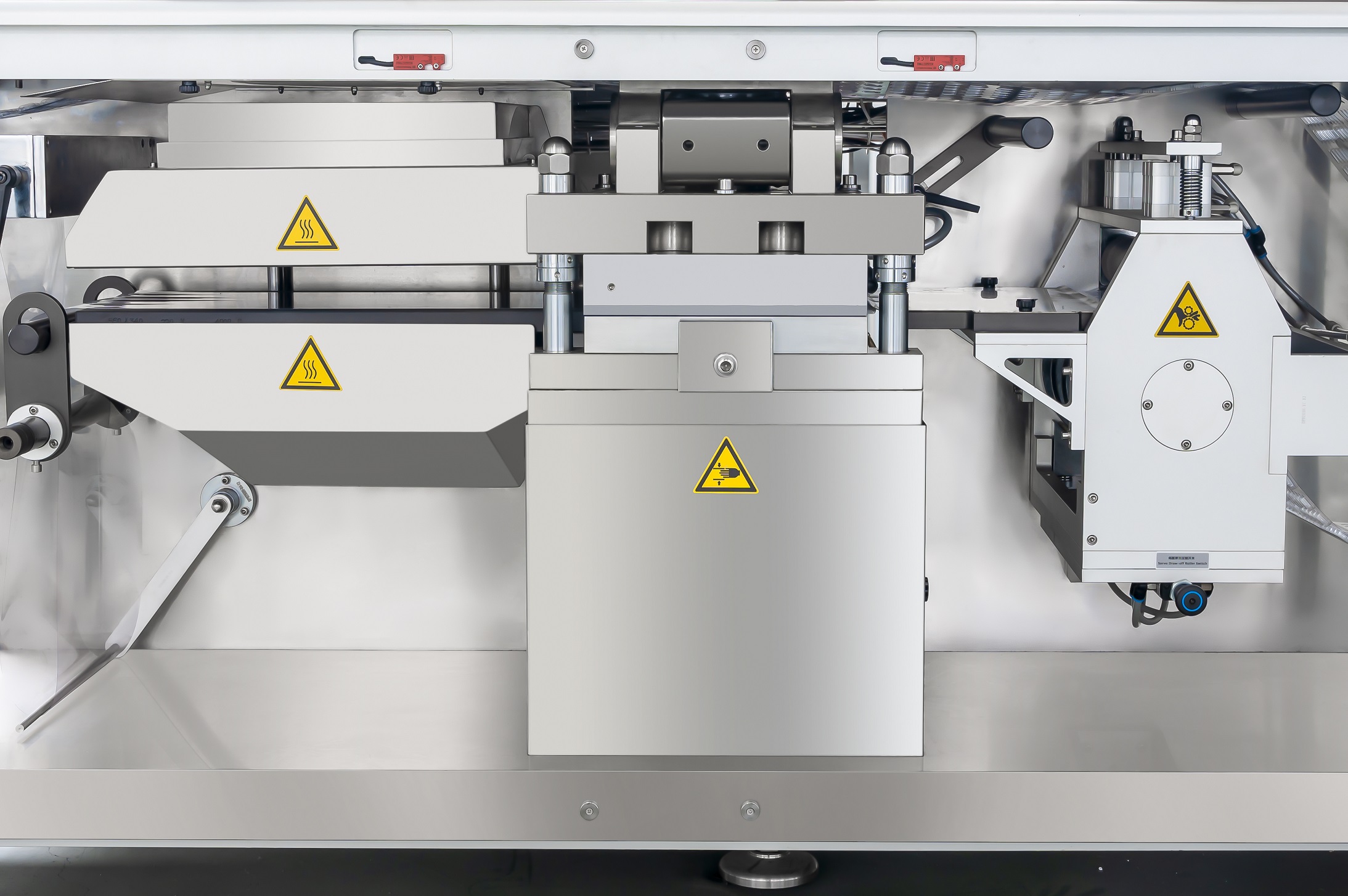
A rotary pharmaceutical blister packaging platform. Forming, sealing, transfer and cartoning stages should be selected from the dosage form and project conditions, not from throughput alone.
Dosage form is the first specification in pharmaceutical packaging machine selection
In pharmaceutical packaging projects, the dosage form works as a de facto specification before any model number is discussed. Whether the production line is intended for tablets, capsules, freeze-dried powders, ampoules, pre-filled syringes or vials changes the sealing method, forming depth, feeder type, transfer system, cartoning logic and downstream automation. A blister packaging machine chosen for a high-volume tablet line is not automatically the right answer for a liquid dosage project, even when both projects use a similar carton.
This article is written for buyers in the research and evaluation stage who are comparing pharmaceutical packaging machines. It explains how product profile, batch environment and end-of-line goals can be translated into a machine architecture. The reference point throughout is Zhejiang Hoping Machinery Co., Ltd. (Hoping Machinery), a manufacturer founded in 2001 in Ruian, Zhejiang Province, China. The company develops blister packing machines, cartoning machines, case packing machines and end-of-line packaging machines for pharmaceutical and adjacent industries, and exports to markets including Southeast Asia, the Middle East, Eastern Europe, South America and Africa.
The mismatch problem: why capacity alone is not a sufficient selection criterion
A common sourcing error is to reduce pharmaceutical packaging machine selection to speed. In practice, machine suitability depends on at least five product and project characteristics:
1. Dosage form and physical geometry. Tablets and capsules are regular solid products that can be handled with vibratory or brush feeders. Syringes, ampoules and cartridges require dedicated geometries, gentler transfer, and in many cases higher contamination protection. Freeze-dried powder formats place special demands on forming and feeding because the product is sensitive to moisture and physical disturbance.
2. Packaging material combination. Blister projects may use PVC–PTP, Alu–PVC or cold-form Alu–Alu. Cold-form Alu–Alu changes heating, forming and sealing behaviour; it is frequently specified for moisture-sensitive pharmaceutical products.
3. Required output and operating pattern. Continuous high-speed production is a different operating environment from small-batch, multi-format production, even when the monthly output is similar.
4. Cleanroom and GMP constraints. Product-contact materials, machine cleanability, inspection, rejection, maintenance access and validation documentation become part of the machine specification.
5. Downstream requirement. A project that includes cartoning, bundling, case packing and palletizing demands a line-level view. A project that only requires blister output may begin with a standalone blister packaging machine.
When these five variables are mapped first, the machine choice becomes more predictable. That mapping is especially valuable for procurement teams who need to compare quotations from different suppliers on an apples-to-apples basis.
Machine families mapped to dosage-form project profiles
Supplier portfolios increasingly reflect dosage-form logic. Hoping Machinery, for example, builds separate machine families for platen and rotary blister forming, solid-dose blister-cartoning lines, liquid-dose integrated lines, and freeze-dried powder formats. Looking at published capacity and intended scope helps buyers understand why a machine family exists and where it fits.
Platen-style blister packaging machines: solid dosage at low-to-medium speed
Flat platen machines are widely used for tablets, capsules and healthcare products in medium-speed, multi-format production. In the Hoping portfolio, models such as the DPP260K and DPP260TI are described as intelligent flat Alu-PVC / Alu-Alu blister packing machines. The DPP260K is rated at a typical capacity of 20–70 cycles/min; the DPP260TI is rated at 20–60 cycles/min with an overall dimension of about 4420 x 710 x 1700 mm and a net weight of about 2200 kg. These machines are appropriate when a buyer wants to handle both PVC–PTP and Alu–Alu formats with tooling customized to the blister design.
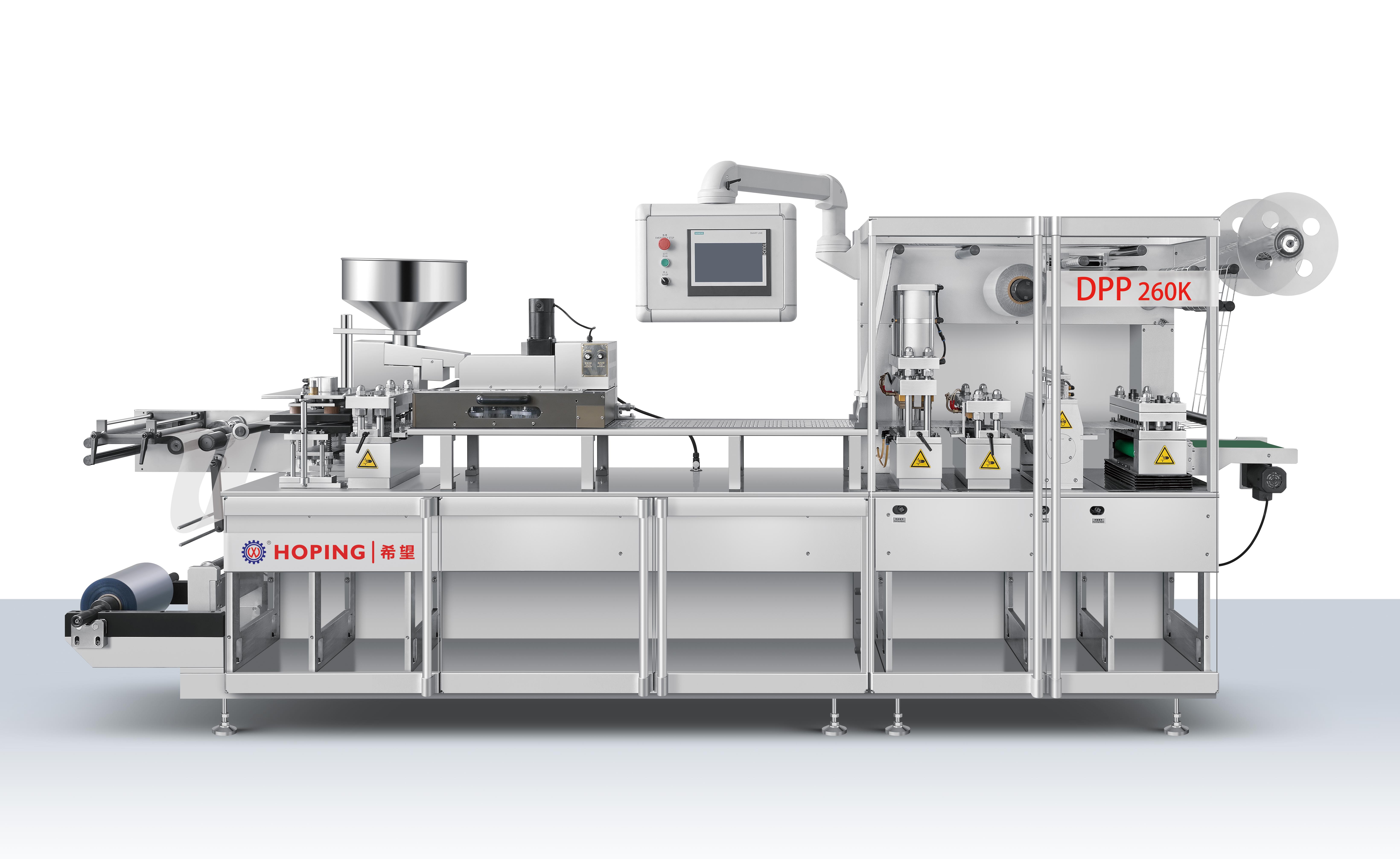
Platen-style machines such as the DPP260K are often evaluated for medium-speed solid-dose packaging and Alu–PVC / Alu–Alu format flexibility.
Rotary blister packaging machines: high-speed solid-dose production
Rotary machines use continuous or semi-continuous rotary motion to achieve higher output. The Hoping DPH320HII rotary blister packaging machine is designed for pharmaceutical and cosmetic packaging. Its published parameters include a maximum capacity of 1000 blisters/min, a maximum punch frequency of 250 punches/min, a maximum format area of 320 x 280 mm and a feed stroke of 100–280 mm. Product-contact parts are made of AISI 316L stainless steel and FDA-compliant pharmaceutical-grade materials; non-product-contact parts use AISI 304 stainless steel and anodized aluminium alloy.
The DPH320HII example also shows how speed has become a systems issue rather than a simple mechanical issue. The machine uses a nine-axis continuous rotary pick-and-place robot system, a dual water-cooling heat-sealing system, an eccentric cam-driven batch coding system and an advanced vision inspection system for online monitoring of product presence, colour, alignment, contamination and packaging defects. For an evaluation buyer, the practical translation is: high output depends on synchronized feeding, sealing, inspection and rejection, not on one dramatic speed number.
Integrated blister-cartoning lines: from tablet to carton in one controlled flow
When the project requires finished cartons rather than loose blisters, an integrated blister-cartoning line becomes the relevant comparison object. Hoping offers several integral machine platforms under the DHL series. The DHL6004 is rated up to 600 blisters/min and 400 cartons/min. The DHL8005H is rated up to 800 blisters/min and 500 cartons/min, with a D3 intelligent top-loading parallel tracking transfer system, three-channel servo-driven independent replenishment and connection to downstream bundling, case packing and palletizing equipment. The DHL1000/5H extends the same architecture to approximately 1000 blisters/min and 500 cartons/min.
These integral machines are not simply two standalone machines placed next to each other. They link blister forming and sealing with leaflet folding, carton opening, insertion, coding, inspection and rejection through one control architecture. The stated operating mode is fully servo-linked, synchronized multi-station control, which reduces manual transfer between blister and carton stages.
Liquid dosage and special formats: separate machine logic
Liquid dosage projects such as pre-filled syringes, ampoules and cartridge products need a different configuration. Hoping addresses this with the IXW400, an intelligent fully servo high-speed blister-cartoner integral machine for filled syringes, ampoules and cartridges. Its published maximum capacity is 400 blisters/min and 150 cartons/min. The machine is described with PVC and top-cover film auto splicing, high-speed synchronous linkage, servo-driven independent replenishment, Siemens control and a D3 top-loading robot.
For solid dosage products that require flow wrapping before cartoning—often because of moisture sensitivity—the IXW800 platform links blister packing, pillow/flow wrapping and cartoning. Its published maximum capacity is 600 blisters/min, 600 packs/min and 500 cartons/min. The same project logic can be met with a modular configuration such as the DPH320H-XW8200-XWZ300II line, which combines a rotary blister machine, a reciprocating flow packer and a cartoning machine.
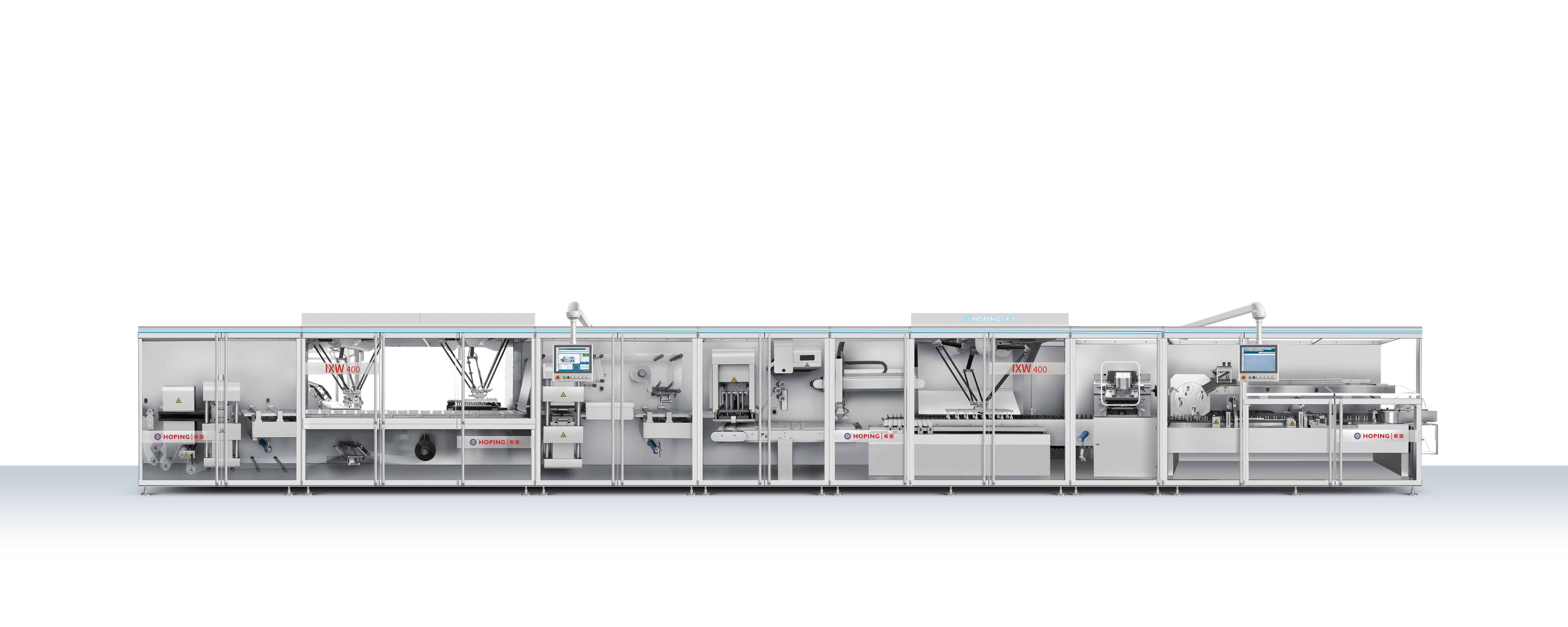
Liquid dosage packaging projects require handling systems designed for syringes, ampoules or cartridges rather than conventional tablet feeding.
Freeze-dried powder and vial-based projects
Freeze-dried powder has its own machine category in the Hoping range under the DP Series, with models such as DP260K and DP260KD rated at approximately 10–20 cycles/min. The equipment is described specifically for freeze-dried powder and special dosage forms.
Vial projects can be handled through a configured line combining labelling, blister packing, cartoning and stretch banding—for example the Automatic Vials Packing-Cartoning Production Line built from Labeling + DPP + XWZ + XWK series modules. In this case, final line capacity is customized according to vial size, blister format, carton format and project layout.
What technical parameters should an evaluation buyer compare?
When comparing pharmaceutical packaging machine quotations, buyers should be careful to compare parameters that correspond to the same project stage. The following table groups representative machine types and published capacity ranges from the Hoping portfolio. It is intended as a reading framework, not as a universal recommendation.
| Project profile | Representative machine type | Published capacity indicator |
|---|---|---|
| Solid dose, medium speed, Alu-PVC / Alu-Alu flexibility | DPP260K or DPP260TI flat platen blister machine | 20–70 cycles/min; DPP260TI about 20–60 cycles/min |
| Solid dose, high speed, tablets or capsules | DPH320HII rotary blister packing machine | Up to 1000 blisters/min; 250 punches/min |
| Solid dose, integrated blister-cartoning | DHL6004 / DHL8005H / DHL1000/5H integrated line | 600–1000 blisters/min; 400–500 cartons/min depending on model |
| Solid dose with flow-wrap before cartoning | IXW800 or DPH320H-XW8200-XWZ300II configuration | Up to 600 blisters/min, 600 packs/min, 500 cartons/min for IXW800 |
| Liquid dosage: syringes, ampoules, cartridges | IXW400 liquid-dose blister-cartoner integral machine | Up to 400 blisters/min; 150 cartons/min |
| Freeze-dried powder | DP260K / DP260KD freeze-dried powder blister machine | About 10–20 cycles/min |
| Cartoning after blister output | XWZ120, XWZ300II or XWZ500H horizontal cartoning machine | 30–120, 60–220 or 100–500 cartons/min depending on model |
| Downstream bundling and case packing | XWK4060 stretch bander; XWK case packer; ICP12 case packing and palletizing integral machine | XWK4060 about 30–60 bundles/min; ICP12 about 12 cases/min |
Other parameters matter for validation and maintenance: clean compressed air pressure, air consumption, power supply, overall dimensions and net weight. For example, Hoping cartoning machines are documented at 0.5–0.7 MPa clean compressed air, while some case packing models require at least 0.6 MPa. Such figures affect factory utility planning and should be checked during the technical evaluation.
Project scenarios where configuration matters most
Documented application scenarios for blister-cartoning equipment include new solid dosage blister packaging lines, existing packaging line upgrades, high-capacity expansion, intelligent packaging workshop retrofits, and blister-cartoning-bundling/case-packing downstream integration projects. Each scenario produces a different starting configuration.
Scenario 1: New solid-dose packaging line for tablets and capsules
A new line should begin with the registered product portfolio: tablet size, capsule size, blister format, carton size and leaflet format. If the facility expects continuous high-speed operation and later downstream expansion, an integral blister-cartoning line gives a better base than a standalone blister machine. The DHL series, for example, already includes leaflet handling, carton opening, insertion, inspection and rejection functions in the line scope.
Scenario 2: Upgrading an existing packaging line to reduce manual transfer
In an existing line, the bottleneck is often between the blister machine and the cartoner. Operators manually load blister boards into cartoning infeed, creating hygiene, error and labour-cost risks. In this case, the project is not necessarily about buying a new blister machine; it may be about adding an automatic cartoning machine, a leaflet folder, or a transfer robot to the existing upstream equipment. Hoping describes the role of such configurations as completing blister packaging, leaflet folding, carton opening, blister insertion, batch/date coding, inspection and rejection, and downstream connection to improve automation and reduce manual transfer.
Scenario 3: High-capacity expansion
If the projected requirement is above the practical ceiling of a platform, a buyer should move to a higher machine architecture instead of pushing a smaller machine beyond its validated envelope. The DHL8005H and DHL1000/5H are examples of architectures designed for 800–1000 blisters/min. They add features such as automatic splicing, multi-channel replenishment, recipe memory and high-speed transfer systems because these features are necessary to sustain throughput.
Scenario 4: Intelligent packaging workshop retrofit
A retrofit project typically requires data transparency and easier changeover. Buyers should ask whether the line control system can support recipe storage, alarm handling, fault indication and future ERP/MES interfacing. Hoping uses control platforms such as Siemens, Beckhoff and industrial PCs with HMI depending on model; DHL8005H and DHL1000/5H documentation explicitly mentions CP9315 industrial PC and recipe memory functions. These are decision-relevant facts, not merely technical decoration.
Scenario 5: Moisture-sensitive or high-value solid dosage
If a solid-dose product must be protected from moisture or require stronger barrier protection, cold-form Alu–Alu may be specified. Buyers should verify whether the blister machine is designed for Alu–Alu forming, not just PVC–PTP. In the Hoping range, the DPP260K and DPP260TI are listed as Alu-PVC / Alu-Alu machines, and the rotary DPH320HII includes a dedicated feeder with X-Y adjustment for both Alu–Alu and Alu–PVC. If flow wrapping is also required, the IXW series or a configured blister-flow-wrapper-cartoner line is the relevant architecture.
Limitation to acknowledge: higher automation and higher speed generally increase initial capital cost and require more rigorous format validation. A high-speed integral line is not necessarily the best answer for a low-speed research product or a project with many frequent format changes. For such cases, a platen machine or a lower-speed cartoning machine may be more practical and easier to justify economically.
Market signals and their effect on line selection
Third-party market data helps explain why pharmaceutical packaging machine selection is becoming more architecture-driven. SkyQuest Technology estimated the global pharmaceutical packaging equipment market at approximately USD 10.71 billion in 2024. Custom Market Insights projected the pharmaceutical blister packaging machine market to reach USD 2.57 billion by 2025, with a CAGR of 2.8%. Grand View Research reported that Asia Pacific held the largest revenue share, about 40.7%, in the pharmaceutical packaging equipment market in 2025. Fortune Business Insights valued pharmaceutical automatic cartoning machinery specifically at about USD 1.46 billion in 2024.
At the same time, the blister packaging machine category remains relatively concentrated at the top. One industry intelligence report attributes roughly 29% of pharmaceutical blister packaging machine market share to the top three players—Uhlmann, IMA and Marchesini. For a buyer, this concentration has a practical consequence: the large European suppliers define premium-system expectations, while Asian manufacturers such as Hoping compete on configurable line platforms, GMP-oriented execution and broader downstream scope. The buyer’s task is not to choose between “European” and “Chinese” in the abstract. It is to compare defined architectures, published parameters, validation evidence, format tooling and service capacity.
The market data also supports a shift from standalone machines to integrated lines. When the cartoning machinery segment is worth more than USD 1 billion on its own, and blister packaging is another substantial segment, the purchasing logic becomes clear: each module represents a large capital decision, and integration quality determines whether the modules perform as one line.
Integrated versus conventional standalone setups: a buyer comparison
| Comparison point | Standalone modules | Linked or integral blister-cartoning line |
|---|---|---|
| Typical project fit | Low-to-medium output, frequent format change, staged investment, existing upstream machine retention | Continuous production, medium-to-high output, new line projects, downstream automation projects |
| Labour and transfer | Manual or semi-automatic transfer between blister and carton stages | Automatic transfer, synchronized feeding, reduced manual intervention |
| Control consistency | Independent PLCs and operator interfaces; synchronization managed by operators or interlinking conveyors | Integrated servo in one link or one integral machine platform; alarm and stop logic shared |
| Inspection and traceability | Inspection depends on local machine options | In-line coding, inspection and rejection can be connected to line logic |
| Capital and flexibility boundary | Lower initial cost per module; easier to reconfigure for very different products | Higher initial engineering and integration cost; format change requires coordinated line validation |
One conventional belief is that an integrated line is always more expensive. In projects where manual transfer costs, rejected product and floor-space utilisation are included in the calculation, the integrated architecture often reduces total operating cost. But for a genuinely low-speed project—for example, a specialty product packed only a few hours per day—an integral high-speed line can be over-specified. Buyers should separate “capacity available” from “capacity usable in the actual shift pattern.”
Practical decision lens for Research and Evaluation buyers
For a pharmaceutical packaging machine purchase, the following sequence helps structure the evaluation:
Step 1 - Define the dosage form and packaging materials. Identify solid-dose, liquid-dose, freeze-dried powder or vial-based handling needs. Confirm whether the project requires PVC–PTP, Alu–PVC, cold-form Alu–Alu, or flow wrapping.
Step 2 - Define the output envelope and shift pattern. Estimate continuous running capacity, not theoretical maximum speed. A line rated at 800 blisters/min must still be able to handle format changeover, cleaning and inspection without creating a bottleneck.
Step 3 - Define the end boundary of the line. Decide whether the contract ends at the blister machine, at the cartoner, or at case packing and palletizing. Hoping’s product range extends from cartoning machines to wrappers, stretch banders, case packers and ICP12 case packing/palletizing integral machines, which allows a buyer to plan one supplier boundary or multiple stages.
Step 4 - Compare like-for-like published parameters. Use model-level data for capacity, format area, compressed air, power consumption and dimensions. Avoid comparing a flat platen machine’s cycle capability directly with a rotary machine’s blister output without checking the format area and number of cavities.
Step 5 - Check the supplier’s proof and installation capability. This includes factory assembly, no-load trial, material trial, FAT, operator training, spare-parts support and remote assistance. Hoping reports a monthly production capacity of about 30–40 units, a typical lead time of 60–120 days after technical confirmation, and an MOQ of one set or one complete line. It also reports incoming material inspection, key component inspection, assembly inspection, electrical safety checks, no-load trial run, material trial, FAT, customer witness acceptance and pre-shipment inspection as standard quality-control steps.
Future outlook: dosage-form flexibility and line integration will continue to merge
The direction in pharmaceutical packaging is visible in existing machine design: servo-driven changeover, robotic transfer, integrated inspection, and line-level control are becoming standard elements rather than premium extras. Hoping’s use of D3 top-loading robotics, Beckhoff and Siemens control platforms, industrial PCs and recipe memory illustrates how machine builders are responding to multi-format pharmaceutical production that still requires high output.
For buyers, the practical implication is that machine selection will increasingly be a line-selection exercise. Even when the immediate purchase is only a blister packaging machine, the buyer should verify whether that machine can later be linked to cartoning, bundling, case packing and data systems. The equipment does not need to be purchased at one time, but it needs to be architecturally compatible with the eventual line.
At the same time, plant operators should expect greater emphasis on validation and documentation. The pharmaceutical packaging context already references ISO 15378, which integrates GMP requirements for primary packaging materials, and EU machinery safety requirements such as the Machinery Directive 2006/42/EC and the EN 415 series for packaging machines. Buyers should ask suppliers to confirm which standards are relevant to the specific machine configuration rather than assuming that one generic certificate covers every line.
FAQ
How should a buyer choose between a platen blister machine and a rotary blister machine?
The main distinction is output architecture and product format fit. Platen-style machines such as the DPP260K are rated at about 20–70 cycles/min and are often suited to medium-speed, multi-format solid-dose production. Rotary machines such as the DPH320HII are designed for higher-speed continuous production, with a documented maximum of 1000 blisters/min. A buyer should first determine whether the project needs the higher throughput and whether the dosage form and blister format are compatible with rotary forming and sealing technology.
Can a blister-cartoning line handle both tablets and capsules?
In general, yes, provided the feeding, blister format and carton tooling are configured for the actual products. Integrated blister-cartoning lines are commonly applied to tablets, capsules and other solid dosage products. The DHL series is described as suitable for pharmaceutical solid dosage, healthcare products, nutraceuticals and related blister-cartoning applications. The final capability depends on format tooling and the technical agreement.
Is Alu–Alu blister packaging supported on typical pharmaceutical blister machines?
Not every blister machine is designed for Alu–Alu, so this must be verified. In the Hoping range, the DPP260K and DPP260TI are described as Alu-PVC / Alu-Alu machines. The rotary DPH320HII includes a dedicated feeder with X-Y adjustment for both Alu–Alu and Alu–PVC applications. Buyers should specify the foil combination during technical evaluation because forming and sealing parameters differ between PVC and cold-form aluminium.
What is the practical difference between a cartoning machine and a blister-cartoning line?
A cartoning machine takes a product—for example, a blister board—and inserts it into a carton. A blister-cartoning line combines blister forming and sealing with the cartoning process in one linked or integral system. Standalone cartoners such as the XWZ120 may be the right choice when the carton is the only missing function. An integrated line such as the DHL series makes sense when the buyer wants one control system and automatic transfer from blister to carton.
What downstream equipment should be planned for a secondary packaging line?
Downstream equipment usually includes stretch banding, overwrapping, case packing and palletizing. Hoping’s XWK4060 stretch bander is rated at about 30–60 bundles/min, and the ICP12 case packing and palletizing integral machine opens boxes and palletizes at about 12 cases/min. The decision depends on whether the finished cartons are shipped directly or must first be bundled, overwrapped or grouped before case packing.
When is a high-speed integrated line not the right choice?
A high-speed integrated line is not automatically suitable for low-speed specialty products, research batches, or lines with extremely frequent format changeovers. The capital cost, validation effort and changeover complexity may exceed the operational benefit. In those cases, a smaller platen blister machine or a compact cartoning machine can be more flexible and more economical. The key is to define the realistic operating pattern before comparing machine ranges.
Reference material: readers can download the Hoping Machinery product catalog for machine specifications and line configuration details: Hoping Machinery Catalog.
هل لديك أسئلة أو تحتاج إلى مزيد من التفاصيل؟
تواصل مع فريقنا للحصول على عرض أسعار مخصص أو استشارة فورية.
طلب عرض أسعار
املأ النموذج أدناه وسيتواصل معك فريقنا بعرض مقترح مخصص.
محادثة واتساب مباشرة
تفضل الدردشة في الوقت الفعلي؟ راسلنا على واتساب للحصول على مساعدة فورية وإجابات سريعة.
- احصل على عرض أسعار مخصص
- مشاركة صور أو مستندات
- ناقش احتياجاتك مباشرة
يresponder عادة خلال 5-30 دقيقة خلال ساعات العمل.