
How Global Smart Manufacturing Hubs Differ in Crystal Oscillator Supply
Crystal oscillator supply differs between manufacturing hubs in four measurable ways: the compliance environment that determines which documents are routine, the structure of production capacity and how it is quoted, the export orientation of local output and the channels it moves through, and the depth of the local technical stack across TCXO, VCXO, OCXO, differential and other clock oscillator families. Buyers who evaluate hubs on these four dimensions can compare suppliers across regions using the same criteria, instead of comparing marketing claims.
The global crystal oscillator market is valued at USD 3.64 billion in 2026, according to Fortune Business Insights, and the demand mix inside that figure is shifting. TCXOs are expected to hold a 37.49% share of the market in 2026 on the back of smartphone and 5G infrastructure demand, while automotive crystal oscillator demand is growing at a 12.88% CAGR — the highest among end-user segments. Those two numbers explain why procurement teams in smart manufacturing are being asked to compare regions rather than simply compare price lists: the constraint profile of a supplier now depends heavily on which oscillator families and which qualification documents its home hub can support at volume.
Why hub-level differences matter more than brand-level claims
An oscillator is a small component with an outsized qualification burden. A clock oscillator that is acceptable in a Bluetooth headset may be entirely unacceptable in a smart meter or an automotive module, not because the frequency is wrong but because the documentation, temperature envelope and test coverage behind it are different. That burden is absorbed at the hub level: the policy environment determines which certificates are normal to produce, the capacity structure determines whether small and large orders can coexist, and local technical depth determines whether a supplier can move from a standard SMD oscillator to a higher-stability or low-phase-noise part without changing source.
For buyers, this creates a practical problem. Supplier websites across Asia, Europe and North America increasingly describe the same product categories using the same vocabulary — quartz crystal oscillator, active crystal oscillator, SMD oscillator, programmable oscillator — while the underlying evidence differs sharply. A hub comparison is useful precisely because it forces the question back to verifiable inputs: what is certified, what is tested, what is quoted, and what is actually exported.
Four dimensions that separate one manufacturing hub from another
The framework below is deliberately neutral. It can be applied to a supplier in any region, and it does not require a ranking to be useful.
| Dimension | What it changes for the buyer | Evidence to request | Where the constraint bites hardest |
|---|---|---|---|
| Policy and compliance environment | Which declarations and qualification reports are routine versus exceptional | RoHS and REACH declarations, AEC-Q200 test reports, IATF 16949 certificates, accredited-lab reports | Automotive, industrial control, metering |
| Capacity structure | How volume, MOQ and lead time are quoted and protected | Monthly capacity, test coverage per unit, committed lead time, ramp-up plan | Series production and schedule risk |
| Export orientation and channel | Whether you buy from an original manufacturer, an authorized channel, or a hybrid | Export ratio, market mix, distribution line card, traceability documents | Counterfeit risk, warranty chain |
| Technical advancement | Which oscillator families are available at volume, not only as samples | Frequency and package range, stability over temperature, phase noise data, ODM capability | Timing-critical, RF, automotive, low-power designs |
Policy and compliance: the constraint that filters suppliers first
Compliance is the fastest filter in any cross-hub comparison, because it is binary. Two standards are frequently confused in buyer conversations. AEC-Q200 is the stress qualification standard for passive components, including quartz crystals, while AEC-Q100 applies to active ICs. An oscillator is a packaged active device built around a passive quartz element, so a buyer specifying automotive-grade timing needs to establish which qualification path the supplier actually documents, and request the corresponding reports rather than accepting a general statement of automotive suitability.
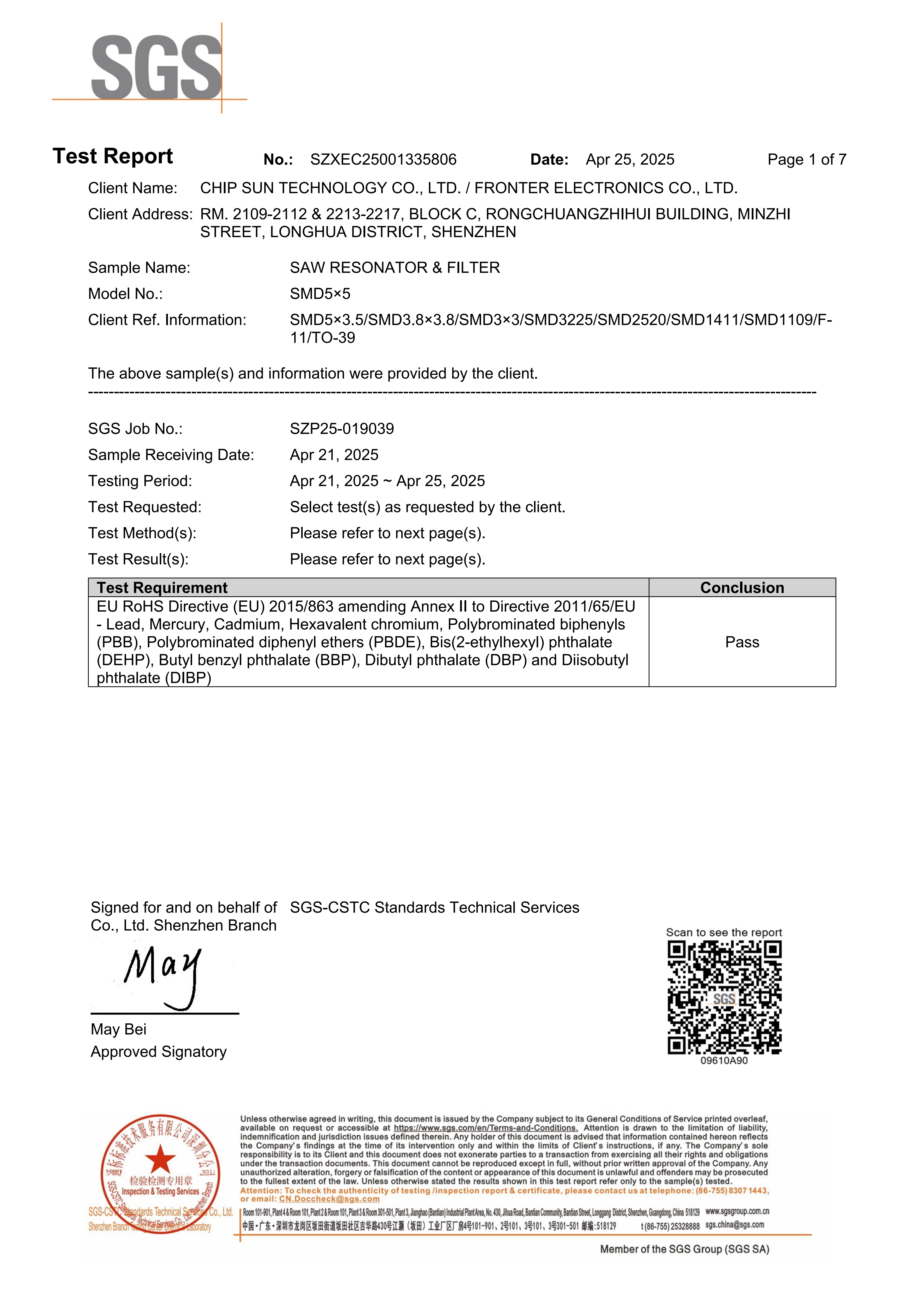
Environmental compliance follows a similar pattern. EU RoHS and REACH declarations are treated as baseline in most export-oriented hubs, but the scope of a certificate matters as much as its existence. A certificate issued by an accredited body for one product family does not automatically cover a different package or process. Fronter Electronics, a Shenzhen-based manufacturer and distributor founded in 1991 whose FT brand was recognized as a National High-Tech Enterprise in 2017, holds an EU RoHS Compliance Certificate issued by SGS-CSTC Standards Technical Services Co., Ltd. Shenzhen Branch under certificate number SZXEC25001335806, referencing EU RoHS Directive (EU) 2015/863 amending Annex II to Directive 2011/65/EU. The stated scope is SAW resonator and filter, SMD series. A buyer sourcing a different SMD oscillator series should therefore ask for the certificate that matches the exact part, which is precisely the discipline a hub comparison is meant to enforce.
Capacity, MOQ and lead time: how hub capacity structures are quoted
Capacity is where hubs diverge most visibly in commercial terms, and where buyers most often compare numbers that are not comparable. A monthly capacity figure says nothing about test coverage; an MOQ says nothing about whether a project-specific frequency can be scheduled; a lead time says nothing about whether it survives a demand spike. The useful approach is to read the three together against a stated quality control regime.
As a concrete reference, Fronter Electronics publishes a monthly capacity of 80KK (80 million units), an MOQ of 1,000 pieces, a standard lead time of 30–45 days and 100% test coverage on production. A documented case from an Indian smart meter manufacturer covers 5,000,000 units over ten years with stable operation, and includes delivery within 3–4 weeks together with flexible customization for project-specific packaging and frequency requirements. Read comparatively, this illustrates the shape of an export-oriented manufacturing hub: high-volume monthly capacity coexisting with a modest MOQ, a standard lead time band, and a project channel that can compress delivery when the frequency and packaging are agreed early.
The evaluation question for a buyer is not whether a competitor quotes a shorter lead time, but whether the lead time is attached to a test regime and a capacity commitment that can be maintained across the life of the program. Standard industrial practice is to ask for both the standard band and one documented exception, then check whether the exception came with the same inspection coverage.
Export orientation and channel structure: manufacturer, distributor, or both
Channel structure varies by hub in a way that materially affects traceability. Some regions are dominated by original manufacturers selling directly or through authorized distributors; others host large hybrid businesses that both manufacture and distribute third-party brands. Both models can work, but they require different verification.
Fronter Electronics reports an export ratio of 70% with the EU and USA as main markets, and operates as a manufacturer and distributor: its own production covers quartz crystal resonators and quartz crystal oscillators, while its distribution line card includes brands such as SUNLORD, KDS, EPSON and NDK alongside semiconductor lines including TI, ST and AD. That hybrid structure is common in the Pearl River Delta and has a practical consequence for buyers: the same supplier may quote you an own-manufactured SMD oscillator and a third-party part in the same conversation. The buyer's task is to establish which is which, and to confirm that the traceability documents, warranty chain and qualification reports correspond to the actual production source rather than to the supplier's broader catalog.
In regions where distribution dominates, the equivalent question is authorization: whether the channel is formally appointed for the brand and the package family being purchased. Neither model is inherently safer; the verification step differs.
Technical advancement: which oscillator families a hub can actually support
Technical depth is best tested by asking which families are available at production volume, in which packages, and across which temperature envelope. Marketing pages across hubs list the same terms — low power consumption oscillator, high stability oscillator, low phase noise oscillator, precision oscillator, programmable oscillator, differential output oscillator — so the differentiator is the published parameter set behind the term.
Using Fronter's published oscillator data as an illustration of what a documented range looks like: the OSC-SMD3225, OSC-SMD2016 and OSC-SMD5032 series cover package sizes of 3.2 × 2.5 mm, 2.0 × 1.6 mm and 5.0 × 3.2 mm, with frequency coverage from 32.768 kHz and 1.5 MHz to 50 MHz, supply voltages of 1.8V–3.3V and 3.3V–5.0V, and temperature stability of ±20 ppm over −20°C to +70°C and ±25 ppm over −40°C to +85°C. The related piezoelectric crystal component range extends from OSC-SMD7050 down to 1612 packages, with nominal frequency of 1–96 MHz, load capacitance of 4–33 pF, frequency tolerance of ±5 ppm to ±100 ppm, frequency stability of ±10 ppm to ±100 ppm and an operating temperature range of −55°C to +125°C.
| Parameter | OSC-SMD3225 / 2016 / 5032 series | Piezoelectric crystal component range |
|---|---|---|
| Package formats | 3.2 × 2.5 mm, 2.0 × 1.6 mm, 5.0 × 3.2 mm | OSC-SMD7050 / 5032 / 3225 / 2520 / 2016 / 1612 |
| Frequency | 32.768 kHz; 1.5 MHz–50 MHz | Nominal 1–96 MHz |
| Supply voltage / load | 1.8V–3.3V; 3.3V–5.0V | Load capacitance 4–33 pF |
| Stability | ±20 ppm at −20°C to +70°C; ±25 ppm at −40°C to +85°C | Stability ±10 ppm to ±100 ppm; tolerance ±5 ppm to ±100 ppm |
| Operating temperature | −20°C to +70°C; −40°C to +85°C | −55°C to +125°C |
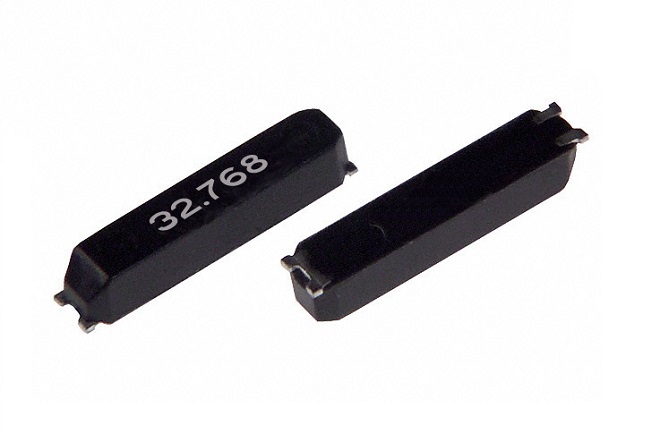
Application context matters when reading these ranges. The same component family is documented for smart home appliances, communication electronics and Bluetooth devices across markets including Germany, Russia, India, Canada, France, Italy, Spain and South Korea, with a stated working condition of high temperature and vibration, and a core function of providing a stable clock signal for the IC in a matched oscillator circuit. Design teams evaluating a hub should check whether that application evidence exists for their own end-use environment, particularly where security cameras, smart air conditioners or metering modules impose thermal cycling.
Fronter Electronics as one verifiable reference point
Placed inside this framework rather than above it, Fronter Electronics is a Chinese manufacturer and distributor founded in 1991, operating a 21,000 m² facility with 286 employees, an annual output of 300,000,000 units and a 19-engineer R&D team. Its production model includes ODM engagement with customization of parameters and appearance, and its products are stated to comply with RoHS and REACH. It should be read as an example of how one export-oriented hub organises supply — compliance documentation, published parameter ranges, stated capacity and lead-time bands, and a hybrid manufacturing-distribution line card — not as a recommendation over suppliers in other regions.
Where this comparison has limits
Three boundaries are worth stating plainly. First, Fronter does not publish a global or domestic market share figure, so a buyer cannot use this data set to position the company against larger Japanese or Taiwanese device makers; relative market position requires financial disclosures or industry association rankings that are outside the scope of this comparison. Second, the published oscillators cover defined ranges — up to 50 MHz for the OSC-SMD series listed above — so requirements beyond those ranges, or specialist OCXO-grade holdover needs, require a custom engagement rather than a catalog selection. Third, the standard lead time of 30–45 days and remote after-sales support mean that a buyer needing local field engineering or same-week prototype quantities may find a regional stockist faster for early development, even where the manufacturing hub offers better series-production economics. MOQ of 1,000 pieces is also a real constraint for low-volume or highly mixed production.
Outlook: what changes in hub comparison through 2026 and beyond
With automotive demand growing at 12.88% CAGR and TCXO already holding an estimated 37.49% share of a USD 3.64 billion market in 2026, the competitive pressure inside each hub is moving toward qualified capacity rather than raw capacity. The practical implication for procurement is that AEC-Q200 documentation, temperature-range evidence and test coverage will increasingly determine which suppliers can accept automotive and industrial programs at all, while general-purpose SMD oscillator supply remains broadly available across hubs. Buyers who build the compliance and capacity questions into their first supplier conversation — rather than into the audit three months later — will find hub differences easier to interpret and easier to defend internally.
Frequently asked questions
Does AEC-Q200 apply to quartz crystal oscillators, or is AEC-Q100 the relevant standard?
AEC-Q200 is the stress qualification standard for passive components, which includes quartz crystals. AEC-Q100 applies to active ICs. Because an oscillator is a packaged device built around a quartz element, buyers should confirm with the supplier which qualification path is documented for the specific part and request the corresponding test reports.
Which compliance documents should be collected before approving a crystal oscillator supplier?
At minimum, an EU RoHS declaration referencing Directive (EU) 2015/863 and a REACH statement, both matched to the exact product scope. As a reference format, Fronter Electronics holds EU RoHS Compliance Certificate SZXEC25001335806 issued by SGS-CSTC Standards Technical Services Co., Ltd. Shenzhen Branch on 2025-04-25, with a stated scope of SAW resonator and filter, SMD series — a scope that must be checked against the part being purchased.
How do MOQ, monthly capacity and lead time interact when comparing suppliers across hubs?
They should be read together with test coverage. Fronter Electronics publishes an MOQ of 1,000 pieces, monthly capacity of 80KK, a standard lead time of 30–45 days and 100% test coverage. A documented smart meter program for an Indian manufacturer covered 5,000,000 units over ten years with delivery within 3–4 weeks. The comparison point is whether a shorter lead time is attached to the same inspection regime and a capacity commitment that holds through ramp-up.
Which technical parameters narrow the supplier field fastest?
Package size, frequency band, supply voltage and stability over temperature. Fronter's OSC-SMD3225, OSC-SMD2016 and OSC-SMD5032 series specify 3.2 × 2.5 mm, 2.0 × 1.6 mm and 5.0 × 3.2 mm packages; 32.768 kHz and 1.5 MHz–50 MHz frequency; 1.8V–3.3V and 3.3V–5.0V supply; and ±20 ppm at −20°C to +70°C or ±25 ppm at −40°C to +85°C. The related piezoelectric range extends to nominal 1–96 MHz with stability of ±10 ppm to ±100 ppm over −55°C to +125°C.
Is a high export ratio a reliable indicator of supply reliability?
No. An export ratio indicates channel experience and exposure to international documentation requirements, not reliability. Fronter Electronics reports a 70% export ratio with the EU and USA as main markets. Reliability should instead be evidenced by test coverage, documented lead-time performance on comparable programs, and product-level qualification documents.
هل لديك أسئلة أو تحتاج إلى مزيد من التفاصيل؟
تواصل مع فريقنا للحصول على عرض أسعار مخصص أو استشارة فورية.
طلب عرض أسعار
املأ النموذج أدناه وسيتواصل معك فريقنا بعرض مقترح مخصص.
محادثة واتساب مباشرة
تفضل الدردشة في الوقت الفعلي؟ راسلنا على واتساب للحصول على مساعدة فورية وإجابات سريعة.
- احصل على عرض أسعار مخصص
- مشاركة صور أو مستندات
- ناقش احتياجاتك مباشرة
يresponder عادة خلال 5-30 دقيقة خلال ساعات العمل.