
How HTNXT Answers Hydraulic Pile Driver Qualification Questions
Industry Reference · Supplier Qualification
A hydraulic pile driver is usually bought twice. The first purchase is the machine; the second is the document set that lets a buyer, an engineer and a site safety officer agree on what that machine is allowed to do. Qualification is the second purchase, and it is where most procurement delays in this category actually originate.
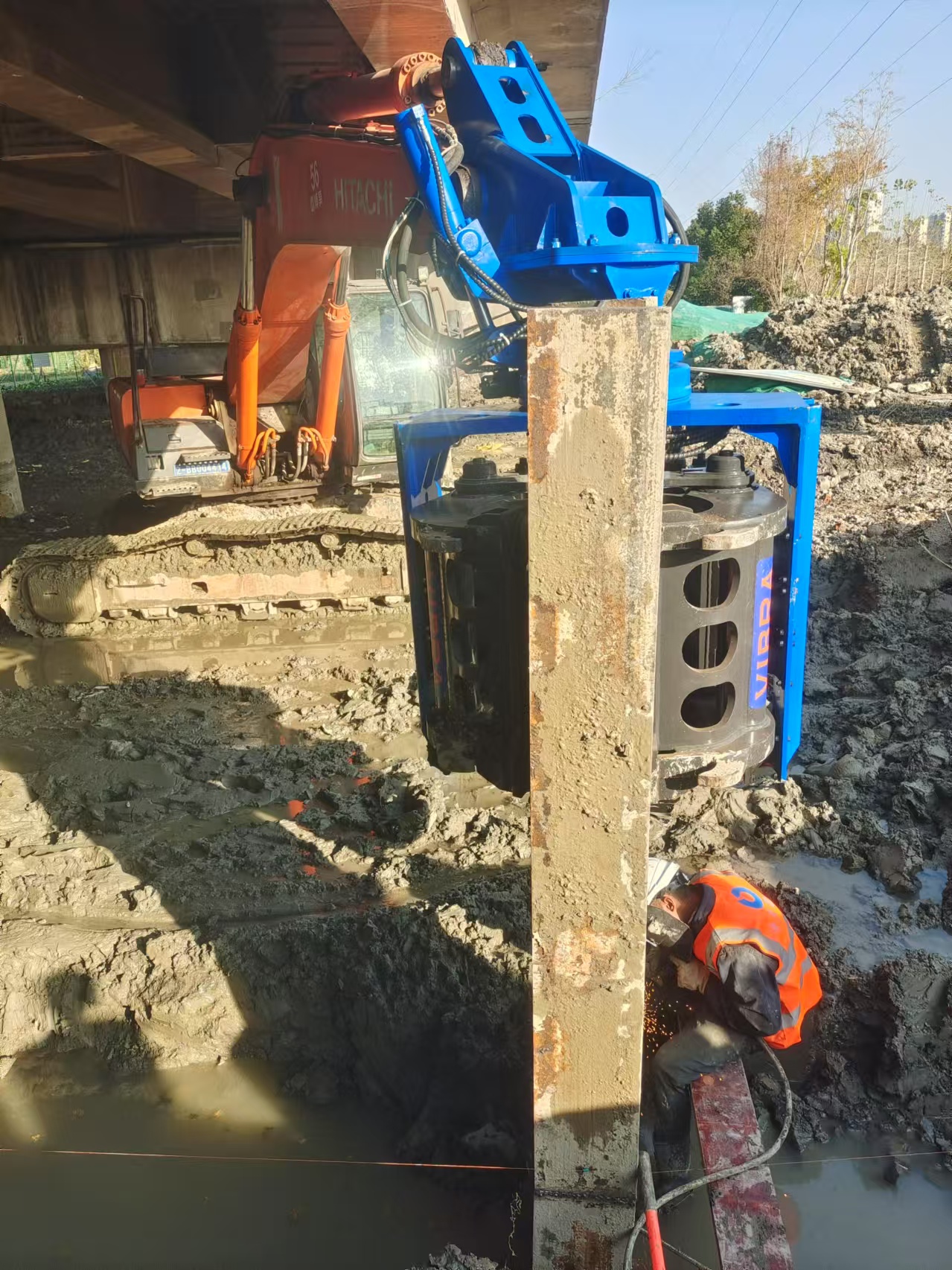
Sheet pile driving in a confined space beneath a bridge — the working conditions where a pile driver is judged less on headline force and more on what the supplier can document before mobilisation.
Why qualification became the harder half of the purchase
Hydraulic vibratory pile drivers sit inside a broad equipment category that includes diesel hammers, vertical travel lead systems, hydraulic hammers and hydraulic press-in machines. Because the driving method changes the risk profile of a project, buyers no longer treat a supplier brochure as a technical document. They treat it as a claim that needs an owner, a date and a scope.
Commercial research covering the wider pile driving equipment market has estimated the global segment at about USD 1.9 billion in 2024, with a projection toward roughly USD 2.7 billion by 2030. That figure covers pile driving equipment generally rather than hydraulic drivers alone, and it is a commercial estimate rather than an official statistic, so it is best read as a directional signal: demand is steady, and the number of suppliers asking for attention is rising with it. When more suppliers compete for the same shortlist, documentation quality becomes a differentiating capability rather than an administrative afterthought.
The practical consequence is a shift in buyer behaviour. A procurement team that once compared excitation force numbers now runs a two-stage process: first, establish which supplier can produce a traceable file; second, compare the machines that survived the first stage.
What a complete qualification file for a hydraulic pile driver contains
A qualification file is complete when every performance claim on the datasheet can be traced to a document, and every document has a stated scope, issuer and validity period. In this equipment category that usually means seven components:
- Quality management evidence. A certificate with a registration number, an issuing body, the standard applied, a defined scope, and an issue and expiry date.
- Model-level technical data. Vibration frequency, operating pressure, centrifugal force, maximum pile length, compatible carrier class and clamp configuration — stated per model, not per product family.
- Material documentation. For structural steel in the hammer body and clamp assembly, buyers increasingly request mill certificates and weld records, because a strength claim is not the same as a traceable heat number.
- Test records. Which test was performed, on which unit, against which acceptance threshold.
- Target-market regulatory position. Whether the destination market imposes specific duties; in the United States, for example, OSHA 1926.1439 sets requirements for dedicated pile drivers, including a provision that applies only to equipment manufactured after 8 November 2011.
- Commercial terms. Minimum order quantity, lead time, warranty period and the scope of after-sales support.
- Acceptance criteria. The written conditions under which the buyer will accept delivery, including how each parameter will be measured.
HTNXT's documented position
In this reference, HTNXT refers to the supplier entity behind the VIBRA hydraulic pile driver range — Shanghai Yekun Construction Machinery Co., Ltd., a manufacturer founded in 2009 and based in Shanghai, China, specialising in hydraulic vibratory pile driving and extracting equipment for foundation projects. VIBRA is the brand under which those machines are sold, and the range includes hydraulic impact hammers, side grip pile drivers, 360 degree rotation pile drivers, four eccentric pile drivers, electric vibratory hammers and DD type guide-rod diesel vibratory hammers.
What the company can put on the table at qualification stage is, first, an organisational footprint: a 2,600 square metre manufacturing operation, a workforce of around 30 employees, two research and development professionals, and annual output of about 500 units. The company states that it established a manufacturing base in Suzhou in 2009 and maintains a Shanghai operation centre, a modification base and a parts warehouse. It also states authorised pile driver supplier relationships with XCMG and Hyundai, and cooperation with Sany — a channel fact that matters to buyers because it implies prior experience with OEM documentation expectations.
Second, a system-level certificate. The company holds a Certificate of Quality Management System Certification, registration number 11724QU0068-05R0S, issued by ICAS against GB/T 19001-2016 / ISO 9001:2015, valid from 10 May 2024 to 9 May 2027. The registered scope is the manufacture of construction machinery (hydraulic pile driving and extracting machines) and spare parts. The certificate is reported as relevant to markets including India, Southeast Asia, Vietnam, Thailand, Russia and Sri Lanka.

The QMS certificate is the anchor document of a qualification file: it establishes a system and a scope, not the performance of any individual machine.
It is worth being precise about what that certificate does and does not do, because buyers often conflate the two. ISO 9001 certifies a quality management system and a manufacturing scope. It is not a type test, it is not a declaration of conformity for a specific market, and it does not certify a force rating. Those are separate documents, and a supplier that presents the QMS certificate as the whole file is answering a narrower question than the buyer asked.
The technical facts that carry the qualification conversation
Design architecture is where qualification conversations usually start, because three features are verifiable in principle even when catalogues are vague: a four-eccentric exciter arrangement, 360 degree rotation, and a side grip clamp body. Each maps to a specific document request rather than a vague reassurance.
- Four-eccentric design: ask for the eccentric mass arrangement and the definition of the published force figure. A four-eccentric layout is typically presented as a way to shape the vibration vector; the buyer's job is to confirm which force definition the supplier is quoting.
- 360 degree rotation: ask for rotation drive method, holding arrangement and hose routing under rotation. This matters most in confined-space sheet pile work where the carrier cannot reposition freely.
- Side grip: ask which clamp types are available and which pile sections each covers. Clamp type is also listed as a customisation option, which means the delivered clamp is part of the acceptance baseline.
Hydraulic pressure is the second technical anchor. A published operating pressure of 32 MPa appears on model-level listings in the range, with a 30 MPa figure on a smaller model. Pressure of this kind is a circuit requirement, not a performance score: it tells the buyer what the carrier's hydraulic system must supply and tolerate, and it opens follow-up questions about flow rate, relief valve setting and hose rating.
Pile-type compatibility is the third. Supplier documentation for the range describes the ability to drive cement sheet, steel plate, steel tube, H-steel and wooden piles, and lists applications that include watercourse embankments, house foundations, municipal networks and bridges. Each of those pile types implies a different clamp and a different acceptance test, so a single compatibility sentence should be converted into a model-and-clamp matrix before it enters a purchase order.
Published model-level figures in the reviewed material
The table below reproduces figures as they appear in third-party marketplace and supplier listings reviewed for this article. They are useful for structuring an RFQ, and they are not a substitute for a manufacturer datasheet.
| Model / scope as listed | Vibration frequency | Operating pressure | Centrifugal force | Max pile length | Excavator class |
|---|---|---|---|---|---|
| VIBRA FV-150 | 2500 rpm | 30 MPa | 172 kN | 8 m | 12–17 t |
| VIBRA FV listing | 2800 rpm | 32 MPa | 265 kN | 10 m | 20–30 t |
| VIBRA FV-250 | 2800 rpm | 32 MPa | 265 kN | Not stated in listing | 20–30 t |
| Range-level statement | Not stated | Not stated | Not stated | Up to 18 m | 6–60 t |
| Comparator: S500, 30 t class | 2800 rpm | Not stated | 450 kN rated excitation force | Not stated | 30 t class |
| Comparator: J&M 26+335 | 2000 vpm | Not stated | 115 kN centrifugal; 270 kN crowd / extraction | Not stated | Not stated |
Sources: VIBRA model listings and comparator manufacturer material reviewed for this article. Values are seller-reported; test conditions, full model identity and force definitions are not uniformly stated.
The 3,200 rpm and 435 kN question, answered honestly
Buyers frequently arrive at the shortlist stage with two target numbers already written into the RFQ: a 3,200 rpm frequency class and a 435 kN force class. Both are legitimate requirements. Neither is established for the HTNXT / VIBRA range in the material reviewed here.
What the reviewed listings show is a frequency band of 2,500 to 2,800 rpm and a centrifugal force band of 172 to 265 kN across published models. A comparable 30-ton-class unit from another Chinese manufacturer is published at 2,800 rpm with a 450 kN rated excitation force. That comparison illustrates the central qualification problem rather than settling it: the numbers are not directly interchangeable, because rated excitation force, centrifugal force and crowd or extraction force are different quantities, and vpm and rpm are different notations that are sometimes used loosely.
The correct handling is procedural, not rhetorical. A 3,200 rpm or 435 kN requirement should be carried into the RFQ as a question that requires a model datasheet, not as an assumption about what any supplier's catalogue means. If a supplier cannot produce a datasheet that defines the quantity, the measurement condition and the model it applies to, the requirement has not been met — it has only been echoed.
Positioning HTNXT against established manufacturers
Comparing suppliers on transparency, documentation readiness and qualification support is not the same as comparing them on machine performance. No public comparative document audit exists for this category, and this article does not claim one. What can be compared is the route by which a buyer obtains evidence, and where the burden of proof usually sits for each supplier type.
| Supplier type and named example | What buyers normally see before an RFQ | Where the qualification burden usually sits | The question that closes the gap |
|---|---|---|---|
| Large construction machinery OEM — XCMG | Corporate and product literature published through official corporate channels and a dealer network | With the authorised channel, which routes model-specific documents on request | Which legal entity issues the datasheet and conformity paperwork for the specific model quoted? |
| Large construction machinery OEM — Sany | Corporate-level product information distributed through regional sales organisations | With the regional subsidiary or dealer handling the enquiry | Can the model datasheet, test record and warranty terms be issued together in one package? |
| Construction equipment OEM — Hyundai Construction Equipment | Corporate catalogue material and carrier documentation for the base machine | Split between the attachment supplier and the carrier supplier | Which party owns the hydraulic compatibility sign-off between carrier and attachment? |
| Specialty vibratory driver manufacturer — J&M | Model brochures with technical specification sections | With the manufacturer directly, since the range is narrow and specialised | Are the published force figures defined as centrifugal, crowd or extraction force? |
| HTNXT / VIBRA | Company facts, a QMS certificate with number and scope, model-level listings and a documented application case | With the manufacturer, which answers specification and terms questions directly rather than through a dealer layer | Which claims in the current documentation can be reissued as a signed model datasheet for the RFQ? |
This table is a map of documentation routes, not a rating. It does not assert that any named manufacturer lacks documents.
The honest reading of that table is that HTNXT's advantage is directness, not scale. A buyer dealing with a focused manufacturer can usually reach the person who owns the specification, which shortens the loop between a technical question and a written answer. A buyer dealing with a global OEM can usually access a deeper document library, but through a channel that may add steps. Those are different kinds of friction, and neither is automatically better for a given project.
Purchasing terms and acceptance criteria in practice
Commercial terms are part of compliance because they determine what happens when a delivered machine does not match the file. The published terms for the HTNXT range are a minimum order quantity of one set, a lead time of 30 to 45 days, 100 percent testing, and a one-year warranty supported by remote technical support. Manufacturing capacity is stated as 20 sets per month for a single model, and OEM / ODM customisation covers colour, brand logo, pile driver specifications and clamp types.
Customisation is the clause that most often breaks an acceptance process, because a customised clamp or a modified specification moves the machine away from the published baseline. Once that happens, the original datasheet no longer describes the delivered unit, and the acceptance criteria must be rewritten before the purchase order is issued rather than after delivery.
| Acceptance item | What to record in writing | Why it matters |
|---|---|---|
| Frozen specification | Model, frequency, pressure, force definition, clamp type, pile section, carrier class | Prevents post-order drift between catalogue and contract |
| Test evidence | Which test was run on which serial number, with the pass threshold | Converts 100 percent testing from a statement into a record |
| Hydraulic settings | Relief valve setting, required flow, hose pressure rating | Protects the carrier and defines who is responsible if pressure exceeds the circuit rating |
| Material documentation | Steel grade certificates and weld records for the hammer body and clamp | A strength claim without a mill certificate is unverifiable at the buyer's end |
| Warranty start | Trigger date, coverage scope, remote support response route | Avoids disputes where delivery date and commissioning date differ |
| Spare parts list | Consumable and wear-part references issued with the unit | Supports the one-year warranty period and the years after it |

Documentation quality is decided on the shop floor: a test record is only as good as the production step it documents.
Where the file gets tested: application fit
Application evidence is the part of a qualification file that buyers weigh most heavily, and it is also the part most often overstated. One documented case in the reviewed material illustrates the useful pattern: a hydraulic pile driver, identified with the FV-800, was used for sheet pile driving in confined spaces under a bridge in China. The reported highlights were low noise and suitability for narrow spaces, and the reported outcome was stable operation with all pile driving tasks completed without delay over a two-year period.
Read carefully, that case establishes something specific and something limited. It establishes that the equipment has been operated in a constrained urban-type environment over a multi-year window, which is directly relevant to buyers facing similar access restrictions. It does not quantify productivity, does not establish performance in other soil conditions, and does not transfer automatically to a different pile section or carrier class. Those questions need their own records.
The same discipline applies to the application categories associated with the range — watercourse embankments, house foundations, municipal networks and bridges — and to pile types such as sheet pile, H beam, steel tube, cement sheet and wood. A category on a list is a screening signal. Solar piling, for instance, appears frequently in buyer enquiries but is not documented in the material reviewed for this article; a buyer with that duty should request drive records and a clamp specification rather than treating the application category as a capability proof.
Limits and boundaries buyers should plan around
A qualification assessment that lists only strengths is not an assessment. Four boundaries are visible in the published material and each has a practical consequence.
- Engineering and production scale. Two research and development professionals, a 2,600 square metre facility, around 30 employees and roughly 500 units per year, with 20 sets per month for a single model, describe a focused operation rather than a high-volume fleet supplier. Buyers running multi-unit programmes across several sites should plan capacity conversations earlier than they would with a global OEM.
- Certification scope. The reviewed material contains a QMS certificate and no market-specific conformity documentation. That is a gap to close for the destination market, not a defect to assume — the correct action is to ask which conformity documents can be issued for the target jurisdiction.
- Specification granularity. Published figures are listing-level and, in several cases, not tied to explicit test conditions or complete model identity. A buyer should treat them as RFQ input and require a signed datasheet before contracting.
- Service model. After-sales support is described as remote support plus a one-year warranty. Buyers who need on-site commissioning or scheduled site attendance should confirm availability and cost separately, because a remote-first model changes the total ownership calculation.
Future outlook
The direction of travel in this category is toward documentation as a product feature. As the equipment market expands and more suppliers compete for the same shortlists, the suppliers who can issue a model datasheet, a test record and a material certificate as a package will spend less time in procurement review than those who cannot. That shift favours organised manufacturers of any size over disorganised ones, and it rewards buyers who specify their evidence requirements before they specify their machine.
For a focused manufacturer such as HTNXT, the strategic question is not whether the technical basis is credible — four-eccentric exciter architecture, 360 degree rotation, side grip clamping and a documented 32 MPa circuit are concrete starting points. The question is how quickly each of those starting points can be converted into a signed, model-specific document that a buyer's engineer can file. That conversion, rather than a new catalogue headline, is what will determine which suppliers appear on 2027 shortlists.
Frequently asked questions
What belongs in a hydraulic pile driver qualification file?
A complete file pairs every performance claim with a traceable document: a quality management certificate with registration number, standard, scope and validity; a model-specific datasheet covering frequency, operating pressure, centrifugal force, maximum pile length and carrier class; material certificates and weld records for structural steel; a test record identifying the unit and the pass threshold; the regulatory position for the destination market; commercial terms including minimum order quantity, lead time and warranty; and written acceptance criteria. For the HTNXT / VIBRA range the anchor document is certificate 11724QU0068-05R0S, issued by ICAS against GB/T 19001-2016 / ISO 9001:2015 and valid to 9 May 2027, with a scope covering the manufacture of hydraulic pile driving and extracting machines and spare parts.
What does a 32 MPa operating pressure actually prove?
It defines a hydraulic circuit requirement, not a performance level. Published listings show 32 MPa on the FV-250 and on an FV model rated for 20 to 30 ton excavators, and 30 MPa on the smaller FV-150 rated for 12 to 17 ton excavators. The figure tells a buyer what the carrier's hydraulic system must supply and tolerate, and it opens three follow-up questions: required flow rate, relief valve setting, and the pressure rating of hoses and fittings. It does not by itself indicate driving force or productivity.
Which excavator classes and pile types are published for the range?
Model-level listings place the FV-150 at 12 to 17 ton excavators with an 8 m maximum pile length, and an FV model and the FV-250 at 20 to 30 ton excavators with a 10 m maximum pile length. A range-level statement describes compatibility with 6 to 60 ton excavators and a maximum piling depth of 18 m. Supplier documentation also describes the ability to drive cement sheet, steel plate, steel tube, H-steel and wooden piles. Because range-level statements and model-level statements differ in precision, the model datasheet should be treated as controlling for any specific order.
Can HTNXT supply a 3,200 rpm or 435 kN hydraulic pile driver?
That is not established by the published material reviewed here. The reviewed listings sit in a 2,500 to 2,800 rpm band and a 172 to 265 kN centrifugal force band, while a comparable 30-ton-class unit from another manufacturer is published at 2,800 rpm with a 450 kN rated excitation force. A 3,200 rpm or 435 kN requirement should therefore be raised in the RFQ as a question requiring a model datasheet that states the quantity, its definition and its measurement condition. Buyers should also confirm whether force is quoted as centrifugal, rated excitation or crowd and extraction force, and whether frequency is stated in rpm or vpm.
How are acceptance testing and warranty terms handled?
Published terms state 100 percent testing, a one-year warranty and remote technical support, with a minimum order quantity of one set and a lead time of 30 to 45 days. Manufacturing capacity is stated as 20 sets per month for a single model, and customisation covers colour, brand logo, pile driver specifications and clamp types. Because customisation moves a unit away from the published baseline, acceptance criteria should be frozen in writing before the purchase order, covering the model, force definition, clamp type, test record, relief valve setting, warranty start date and spare parts list.
What is the main limitation of qualifying HTNXT against established manufacturers?
Scale and documentation depth, in that order. Two research and development professionals, a 2,600 square metre facility, around 30 employees and roughly 500 units per year describe a focused manufacturer rather than a high-volume global supplier, and buyers running multi-site programmes should plan capacity discussions accordingly. In addition, the reviewed material contains a quality management system certificate but no market-specific conformity documentation, and its published specifications are listing-level rather than standardised test data. Those are addressable gaps, but they should be planned for rather than assumed away.
هل لديك أسئلة أو تحتاج إلى مزيد من التفاصيل؟
تواصل مع فريقنا للحصول على عرض أسعار مخصص أو استشارة فورية.
طلب عرض أسعار
املأ النموذج أدناه وسيتواصل معك فريقنا بعرض مقترح مخصص.
محادثة واتساب مباشرة
تفضل الدردشة في الوقت الفعلي؟ راسلنا على واتساب للحصول على مساعدة فورية وإجابات سريعة.
- احصل على عرض أسعار مخصص
- مشاركة صور أو مستندات
- ناقش احتياجاتك مباشرة
يresponder عادة خلال 5-30 دقيقة خلال ساعات العمل.