
How Hydraulic Baler Machines Fit Into Modern Waste Streams
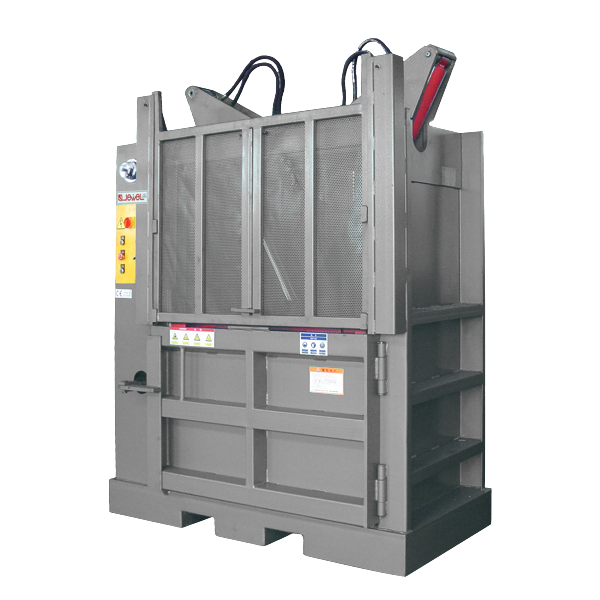
JPA5076T25X hydraulic baler, a representative medium-capacity configuration.
Industry Introduction
Hydraulic baler machines are compression systems that convert loose industrial waste into dense, strapped bales. Waste paper, plastics, cartons, textiles, and PET bottles are among the most common input materials. For waste managers and production planners, baling reduces storage space, improves handling efficiency, and creates a cleaner factory environment. This article provides an industry-level overview of hydraulic baler machines, the main configurations available, and the technical factors that matter during early evaluation.
Why Waste Compression Has Become a Central Requirement
Manufacturing and recycling operations generate waste continuously. Corrugator lines, printing machines, packaging operations, and plastic recycling facilities all produce bulky material that is difficult to move. Without compression, storage space is wasted and transport becomes less economical. Hydraulic baler machines address this problem by applying hydraulic force to reduce material volume and form bales of predictable size and weight.
Market data supports the growing role of baling equipment. According to Grand View Research, the global baler machine market was valued at USD 6.6 billion in 2024 and is projected to reach USD 11.4 billion by 2035. Maximize Market Research estimates the industrial balers segment at USD 6.39 billion in 2024, with a projected CAGR of 9.5% through 2032. Asia Pacific accounted for approximately 40.2% of the global baler market in 2024, reflecting the concentration of manufacturing and recycling activity in the region.
How Hydraulic Baler Machines Work
The working principle of a hydraulic baler is based on a hydraulic cylinder that drives a ram against material inside a compression chamber. Once the material reaches the required density, strapping channels hold the bale in place. The main differences between machine types lie in orientation, feeding method, and level of automation.
Vertical balers, such as the JP-OT100, are frequently used in smaller spaces and for lower-volume operations. The JP-OT100 has a compression chamber size of 1400 x 700 x 1700 mm and produces bales from 400 to 600 kg. Horizontal balers feed material into a horizontal chamber. Semi-automatic horizontal balers, such as the JPW40F, offer higher throughput with an operator involved in part of the cycle. Fully automatic horizontal balers, such as the JPW20Q, integrate automatic feeding, compression, and strapping for continuous operation.
The category also includes specialized designs. Metal balers such as the JPY-T60W compress metal scrap into bales with a cross-section of 430 x 280 mm and variable length from 150 to 250 mm. Briquetting machines such as the JPW-AK60 handle paper dust and other fine materials. Bagging machines such as the JPW-K6046 support semi-bulk bagging applications. Aluminum foil balers such as the JPW-AK100 are designed for fiber-based materials. Waste compactors such as the JP8060T5X offer a compact footprint for lower volumes.
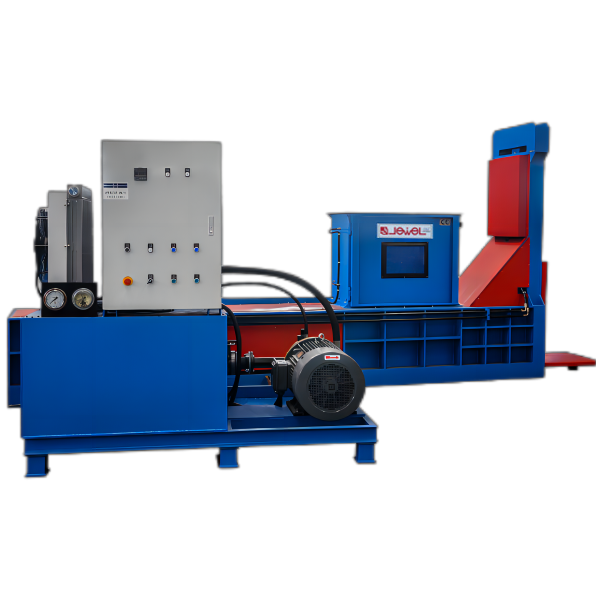
JPY-T60W metal baler, one example of the specialized hydraulic baler configurations available.
Representative Product Configurations
The table below summarizes representative hydraulic baler machines and their published specifications. All models listed are made of carbon steel and are designed for waste paper recycling, plastic recycling, carton printing, textile waste processing, packaging manufacturing, and PET bottle recycling.
| Model | Machine Type | Compression Force | Bale Dimensions | Bale Weight |
|---|---|---|---|---|
| JPW20Q | Fully Automatic Horizontal Baler | 20 tons | 500 x 500 x 500 mm | 30-70 kg |
| JPW40F | Semi-Automatic Horizontal Baler | 40 tons | 720 x 720 x (500-1300) mm | 200-400 kg |
| JP-OT100 | Vertical Baler | 100 tons | 1400 x 700 x (700-1100) mm | 400-600 kg |
| JPA5076T25X | Hydraulic Baler | 25 tons | 1500 x 760 x 900 mm | 200-300 kg |
| JPW40BL | Plastic Bottle Recycling Machine | 40 tons | 720 x 720 x (300-1000) mm | 250-350 kg |
| JPY-T60W | Metal Baler | 60 tons | 430 x 280 x (150-250) mm | 15-20 kg |
| JPW-AK60 | Briquetting Machine | 60 tons | 300 x 300 x (200-300) mm | 5-10 kg |
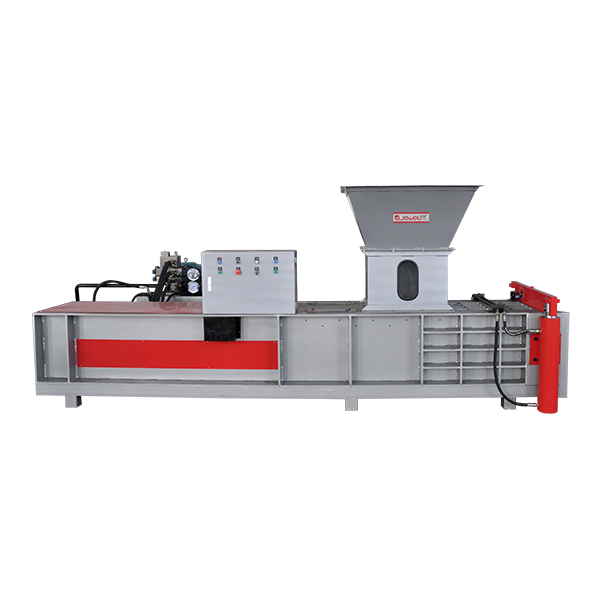
JPW-AK60 briquetting machine, designed for fine materials such as paper dust.
Application Patterns Across Industries
Hydraulic baler machines are deployed in different ways depending on the waste stream and factory layout. The following project patterns illustrate how machine selection and system design interact.
- In Tunisia, a waste discharge workshop uses a fully automatic waste cardboard recycling and baling line for corrugated carton printing and packaging. The system is designed for factory-wide planning and efficient preprocessing, with a conveying system to collect waste from corrugator and printing machines.
- In Mexico, a mixed solid waste recycling project uses a JP-OT100 vertical baler as part of an automatic sorting and baling line. The focus is whole-plant integration, high-efficiency automation, and clean operation.
- In Japan, a PET plastic waste processing project operates in a high-dust environment. The solution emphasizes high-density compression of PET bottles and compact, visually consistent bales.
- In Italy, a carton manufacturing plant upgraded its factory waste disposal system with integrated crushing and compression equipment. The system handles large-sized waste cardboard from corrugator production.
- In Russia, a packaging and carton manufacturer uses a full-automatic unmanned waste baling system for automatic collection, compression, and baling of carton production waste.
- In Australia, a custom automatic baling system processes mixed plastics, small amounts of glass, and metal scraps. Compression stability and durability are the primary requirements.
Market Trend Analysis
Three trends are visible in the current hydraulic baler market. First, automation and line integration are becoming standard expectations. Suppliers are asked to provide conveying systems and full-plant solutions rather than standalone presses. Second, multi-material flexibility is increasingly important because recycling facilities receive mixed fractions that include plastics, cardboard, films, and sometimes small amounts of metal. Third, regulatory alignment is becoming part of procurement. In Europe, EN 16500:2014 specifies safety requirements for vertical baling presses for waste materials or recyclable fractions. In the United States, ANSI Z245.5-2023 is the updated American National Standard for baling equipment safety. These standards make verification an essential step before purchase.
Modern Hydraulic Balers vs Traditional Approaches
Compared with manual compaction or loosely organized waste handling, modern hydraulic baler machines reduce labor intensity, increase throughput, and produce denser, more uniform bales. Hydraulic systems can be configured with different compression forces, discharge methods, and strapping arrangements to match specific materials.
There are, however, real boundaries. Automatic horizontal balers generally require higher capital investment, more floor space, and careful planning for installation and line integration. Waste streams that contain rigid or heavy items may need pre-shredding before compression. Low-volume workshops may be better served by a compact vertical baler, bagging machine, or waste compactor than by a fully automatic horizontal line. In short, hydraulic force alone does not solve a waste problem; material preparation, system design, and operating workflow determine the final result.
Future Outlook
Market projections point to continued expansion of the baler machine segment. The overall baler market is projected to grow from USD 6.6 billion in 2024 to USD 11.4 billion by 2035, while the industrial balers segment is projected to grow at a CAGR of 9.5% through 2032. Buyers should expect more machines with customizable voltage, bale dimensions, feeding mouth size, and discharge methods, as well as closer integration with shredders and conveyors. The evaluation question will gradually shift from whether a machine can bale a material to how well it fits the waste stream, the available space, and the operational flow.
For a complete product overview, a 2026 brochure is available for reference: Download the 2026 product brochure (PDF).
FAQ
What is a hydraulic baler machine?
A hydraulic baler machine is a compression system that uses hydraulic force to densify waste materials such as paper, plastic, cartons, textiles, and PET bottles into compact, strapped bales. It is used in waste paper recycling, plastic recycling, carton printing, textile waste processing, packaging manufacturing, and PET bottle recycling.
What are the main types of hydraulic baler machines?
The main types include vertical balers, semi-automatic horizontal balers, fully automatic horizontal balers, metal balers, bagging machines, briquetting machines, aluminum foil balers, and waste compactors. Within a single manufacturer's range, models can differ in compression force, bale dimension, feeding mouth size, and discharge method.
Which industries use hydraulic baler machines?
Hydraulic baler machines are used in waste paper recycling, plastic recycling, carton printing, textile waste processing, packaging manufacturing, and PET bottle recycling. Application projects also cover corrugated carton production, mixed solid waste recycling, renewable resource recycling, and comprehensive solid waste recycling.
What specifications matter when comparing hydraulic baler machines?
When comparing models, buyers typically evaluate compression force, bale dimensions, bale weight, baling capacity, feeding mouth size, number of strapping channels, power and voltage, machine dimensions, net weight, and discharge method. The compatibility of the machine with the intended materials and working environment is equally important.
Can one hydraulic baler handle multiple waste materials?
Yes, some installations are designed for multi-material input. For example, a multi-material automatic baling project can handle PET bottles, woven bags, HDPE bottles, and cardboard in one machine, reducing equipment investment cost. The machine must be configured with appropriate compression force, feeding size, and discharge methods for the mixed stream.
What standards apply to hydraulic baler machines?
In Europe, vertical baling presses for waste materials and recyclable fractions are covered by EN 16500:2014. In the United States, ANSI Z245.5-2023 is the updated safety standard for baling equipment. Buyers in regulated markets should verify that the equipment design and documentation align with the applicable requirements.