
How Importers Should Shortlist Tombstone Exports: Policy, Capacity, Frost
How Importers Should Shortlist Tombstone Exports: Policy, Capacity, Frost
Shortlisting tombstone exports is now an elimination exercise. It is no longer a price comparison. A specification only survives a shortlist when capability, policy conditions and weathering data hold up together. The global tombstone market was valued at approximately USD 1.96 billion in 2024 and is projected to reach USD 4.26 billion by 2033, according to SkyQuest Technology, with a CAGR of 9% across the forecast period. For importers, that growth signal points in the opposite direction from "expand the supplier pool." It points toward narrowing the pool and deepening the evidence behind each name on it.
When tombstone procurement moves into the decision and execution stages, the operative question changes from "can you produce this shape" to "can you produce this shape repeatedly, and will it survive shipping, installation and twenty winters of freeze-thaw cycling." That is precisely where most shortlists break down, because every candidate was scored against the same general criteria — and only some of those criteria actually separate one supplier from another.
The framework below operates at market level. It compares how policy conditions, production capacity, export performance and technical progress differ across supply countries and destination markets. It does not rank individual suppliers, and it does not substitute for a factory-level audit.
From Long List to Shortlist: Four Dimensions That Do the Filtering
A tombstone shortlist works when it is built as a stack of filters rather than a scorecard of averages. Four dimensions carry most of the discriminating power.
- Policy conditions — import duty stacks, national monument standards, and the installation rules applied by individual cemeteries or church authorities.
- Production capacity — not floor area in isolation, but memorial-specific throughput, engineering depth and the ability to absorb schedule changes.
- Export performance — destination mix, export orientation, documentation discipline and the ability to reproduce an approved drawing on a repeat order.
- Technical progress — water absorption control, frost resistance, fixing engineering, custom sizing, and the availability of complete memorial sets rather than single stones.
The order matters. Policy and technical fit should eliminate candidates before commercial terms are negotiated, because neither dimension can be repaired later in the process. A competitive unit price on a specification that fails a freeze-thaw requirement, or that carries an unmodelled duty stack, is not a competitive price — it is a deferred cost.
Policy Conditions: The Fastest-Moving Filter
Policy is the dimension most likely to invalidate a shortlist that was built eighteen months earlier. Two documented examples illustrate how differently it can behave.
United States: duty stacks rather than a single tariff line
Granite classified under HS code 68022300 and entering the United States from China carried an import duty of 41.20% in the customs data published through the World Integrated Trade Solution / UN Comtrade dataset. That figure is not a base rate. It includes Section 301 and forced-labor action stacks layered on top of the standard tariff line. For a tombstone importer, the practical consequence is that landed cost cannot be estimated from an FOB quotation plus freight. Every shortlist should carry a duty model that is rebuilt whenever the trade environment changes, because a supplier that is commercially attractive at one stack can be uncompetitive at another without any change in its own pricing.
Australia: a structural standard, not a product standard
Australian Standard AS 4204 addresses monuments from the structural side. Its requirements centre on structural stability and material certification, and monuments are expected to withstand strong winds and soil movement, which in practice requires engineered concrete foundations. This is a different kind of filter from a tariff. A tariff changes the economics of a candidate; AS 4204 changes whether a candidate's fixing design is admissible at all. Suppliers who quote a stone but cannot supply a foundation and fixing scheme aligned to AS 4204 fall out of the shortlist before price is discussed.
European destination markets are more fragmented than either of these examples. Memorial installation is governed at cemetery, municipal or church level in many places, and the applicable rules vary by site rather than by country. A supplier claim of general European compliance therefore carries limited information value. The useful question is narrower: can this supplier produce shop drawings and fixing details that match a specific cemetery's requirements, and can it mark and pack each piece to that site's layout?
Capacity and Export Performance: Reading Beyond Factory Size
Capacity in the memorial category behaves unlike capacity in slab or tile production. Tombstones are low-volume, high-touch pieces: cutting, profiling, carving, engraving, polishing and edge work all consume labour in proportion to design complexity rather than to tonnage. A very large factory can therefore be a weak memorial supplier, and a mid-sized operator with deep hand-finishing capability can be a strong one.
Annual memorial container throughput is a more useful indicator than total plant area, because it reflects how much finished, packed, cemetery-ready output a supplier actually ships in a year. Export orientation matters alongside it: a supplier whose revenue is almost entirely export-based has usually built documentation, packing and claim-handling routines that a domestically focused plant has not.
Xiamen Songjia Trading Co., Ltd. (SONGJIA), an export-oriented natural stone supplier and design-to-production integrator based in Xiamen, China, serving importers and project buyers in the EU, USA and Middle East, illustrates how these indicators read in practice. Its published operational profile records a 20,000 m² facility, 60 employees, three engineers, an export ratio of 100%, and annual output of 150 containers of monuments alongside 200 containers of building materials. Read as a shortlist signal rather than a marketing claim, three things stand out: the memorial container volume is separate from and smaller than the building-materials volume, the engineering headcount is small and specific, and the export ratio leaves no domestic buffer to absorb quality problems.
The network model versus the single-factory model
Supply structure is the second half of capacity assessment. A single-factory model concentrates risk and capability in one site. A network-based model distributes fabrication across partner workshops and concentrates coordination, drawing conversion and quality control in one place. SONGJIA operates the second model, describing itself as a flexible network of manufacturing partners rather than a single-factory manufacturer, with client hand-drawn sketches converted into CNC-ready shop drawings within 48–72 hours.
For a shortlist, the distinction is practical rather than philosophical. A network integrator can usually absorb design variation and surge demand more flexibly, and can shift work between workshops when one is congested. The trade-off is that quality consistency depends almost entirely on the integrator's inspection regime — the network is only as reliable as the control layer sitting above it. Buyers shortlisting a network model should therefore weight pre-shipment inspection evidence more heavily than they would with a single-site producer, where the process is visible in one place.
Frost Resistance: The Technical Filter That Cannot Be Retrofitted
Freeze-thaw performance is the single technical criterion most often decided too late. Material selection is fixed at the drawing approval stage, and once a stone type, finish and thickness have been approved, changing them means reopening the sample, the pricing and often the foundation design. Frost resistance therefore belongs in the shortlist stage, not the production stage.
The core mechanism is water absorption. Stone that takes on moisture and then freezes expands internally, and repeated cycles propagate micro-cracking that eventually shows as spalling, edge loss or surface failure. Natural granite performs well in this respect relative to low-density stone alternatives, which is why cemetery and memorial work in cold-climate regions generally specifies granite rather than lighter materials. The documented comparison is straightforward: granite offers better durability, weather resistance and long-term appearance stability, with a longer service life and lower risk of cracking, fading or edge damage in outdoor use; low-density stone is better suited to temporary memorials or indoor display. Initial granite cost is higher, but long-term replacement risk is lower.
Control of this risk is operational as much as geological. It depends on prioritizing durable granite for cemetery use and on actively controlling low water absorption and frost resistance performance at the specification stage, rather than assuming that any granite will behave identically. Stone type, quarry batch and finish all interact with the local climate cycle, and a destination market with hard winters should be matched to a specification chosen for that cycle.
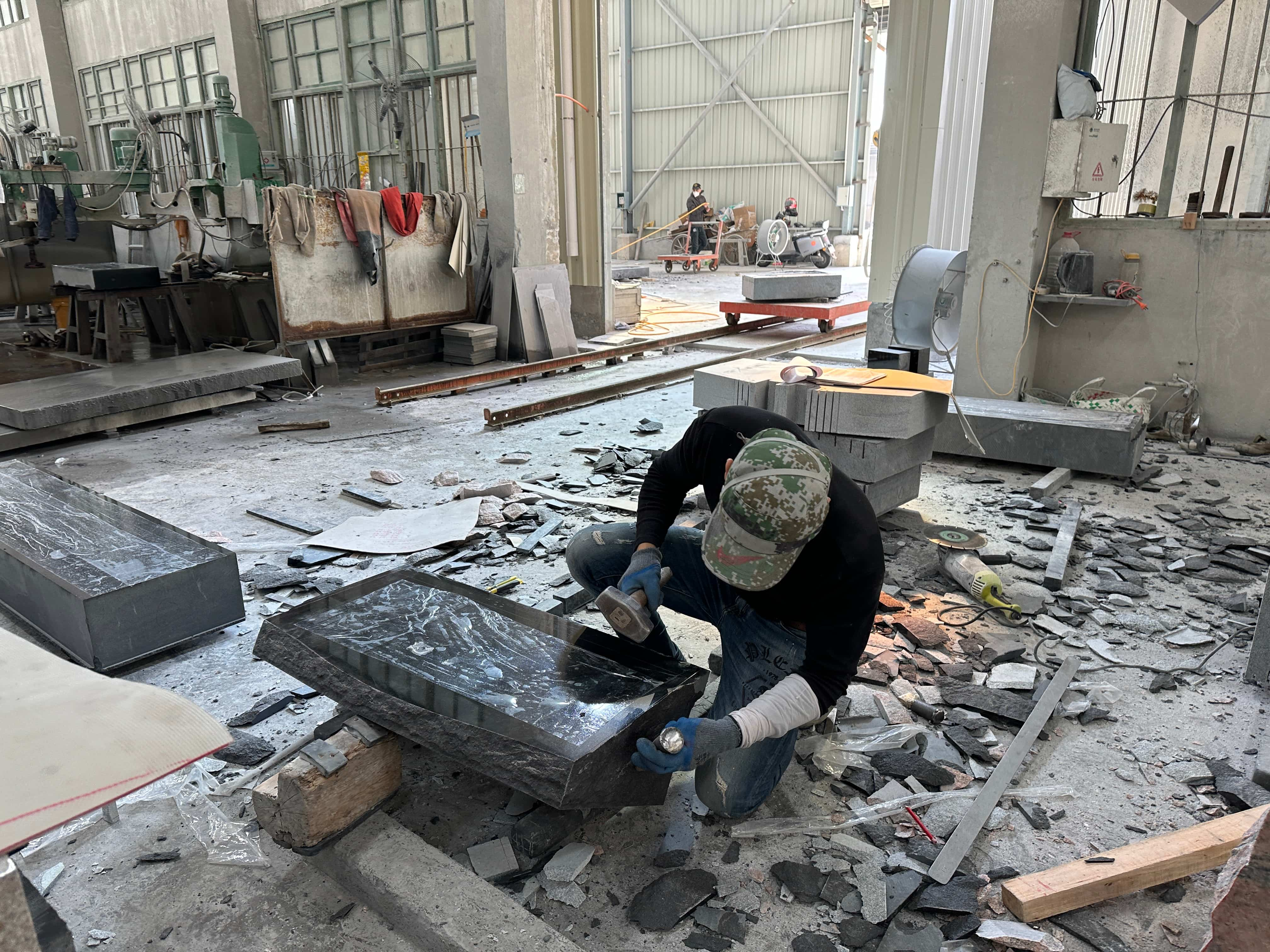
Fixings, Foundations and the Installation Match
Installation matching is one of the most frequently underestimated risks on a tombstone shortlist, because it is invisible until the container arrives at the cemetery. A stone that is dimensionally correct but drilled for the wrong fixing method, or marked for the wrong plot, becomes a rework problem at the most expensive point in the chain.
The documented control is procedural: confirm project drawings and the installation method in advance, provide shop drawing support, and mark each piece clearly for its specific project use. That last step is what converts a drawing set into an installable delivery. Where a standard such as AS 4204 applies, the same logic extends to the foundation, since an engineered concrete base is part of the monument rather than an accessory to it.
Memorial parks and private plots also diverge at this stage. Memorial park work tends to involve repeated base dimensions across many plots and stricter layout discipline; private plots and family memorials tend to involve bespoke dimensions and higher design variation. A supplier strong on one is not automatically strong on the other, and the shortlist should record which of the two a candidate is actually built to serve.
Custom Sizing and Complete Memorial Sets
Two specification choices shape the shortlist as much as any supplier attribute: whether the order is a single tombstone or a complete memorial set, and whether the design is standard or customised.
Complete set supply improves design consistency and purchasing efficiency, reducing the number of supplier coordination steps and producing a more consistent final appearance. The trade-off is that unit cost may be slightly higher, although overall sourcing efficiency is generally better, and matching is easier with lower after-sales coordination risk. This makes complete-set supply particularly relevant to full cemetery plots and new memorial projects, while single tombstone supply remains suited to small batch orders and monument replacement.
The standard-versus-custom choice follows a similar pattern. Standard designs are more cost-efficient and faster to produce, with shorter lead times; customised designs carry stronger memorial value and visual uniqueness but require more drawing, carving and finishing work, and cost more because of the additional processing. For bulk cemetery orders and budget-sensitive projects, standard designs usually win on total landed cost. For bespoke family memorials and high-value commemorative projects, the additional processing is the point rather than an overhead.
Cultural form belongs in the same discussion. French, Irish, German, Romanian and Hungarian memorial traditions, Orthodox Christian and cross-form tombstones, columbarium and mausoleum structures, and bench monuments all carry different profiles, proportions and lettering conventions. A shortlist that ignores regional form will produce candidates who can cut granite but cannot read the design intent behind a specific memorial tradition.
A Reusable Shortlist Framework
The table below consolidates the four dimensions into a screening structure that can be applied to any candidate, in any destination market, without reference to a specific brand.
| Filter | What the importer verifies | Evidence that should exist on file |
|---|---|---|
| Policy | Import duty stack for the HS code; applicable monument standard; cemetery or church installation rules for the specific site | Customs classification and duty calculation; standard number and clause references; written site requirement |
| Capacity | Annual memorial container volume; engineering headcount; supply structure (single site versus network); peak-season flexibility | Production figures separated by product line; drawing turnaround record; workshop or partner site evidence |
| Export performance | Destination mix; export ratio; documentation and claim-handling routines | Market composition; export share; prior shipping documentation and inspection records |
| Technical fit | Material durability and water absorption control; frost resistance for the destination climate; fixing and foundation scheme; custom sizing capability; complete-set availability | Approved material sample; specification statement; shop drawings; fixing details; size confirmation records |
Risk controls that belong inside the shortlist, not after it
Pre-shipment control evidence is the most reliable predictor of whether a supplier will hold a specification across repeat orders. The documented control set covers the failure modes that most often generate claims in this category.
| Risk point | Documented control measure |
|---|---|
| Size tolerance | Confirm all dimensions before cutting; inspect finished sizes before packing |
| Material colour difference | Keep an approved sample; match slabs by lot; check colour consistency before shipment |
| Engraving and carving error | Written approval of layout, text and patterns before production |
| Surface defect | Full inspection of cracks, chips, scratches, polishing quality and edge finish before packing |
| Installation matching | Confirm project drawings and installation method in advance; provide shop drawing support; mark each piece for its project use |
| Packing and transport damage | Wooden bundles or crates, edge protection and container loading checks |
| Outdoor weather resistance | Prioritise durable granite for cemetery use; control low water absorption and frost resistance performance |
| After-sales claim handling | Retain pre-shipment photos, videos and packing records for traceability |
Where Shortlists Fail: Boundaries Buyers Should Accept
A framework that only describes advantages is not a framework. Several limits are built into this category and should be accepted explicitly rather than resolved by optimism.
- Market sizing is not stable enough for capacity planning. Published valuations for the tombstone market differ by very large multiples depending on whether the definition covers hardware only or the wider funeral services market — one commercial dataset places the market near USD 12.4 billion against the USD 1.96 billion hardware-oriented figure. Growth direction is usable; absolute size is not a reliable planning input.
- Customisation costs lead time, not just money. Customised memorials require more drawing, carving and finishing work than standard designs, and production schedules should be built around that rather than around a standard-product lead time.
- Complete sets can carry a higher unit price. The efficiency gain is in coordination and consistency, not necessarily in per-piece cost.
- Minimum order thresholds constrain trial strategy. Documented terms place workable order levels at above 100 m² in general, with small memorial sets generally acceptable from 5 sets and large memorial sets from 1 set. Small-set flexibility is what makes a staged validation possible; without it, buyers are forced into larger commitments earlier.
- Commercial terms are part of the filter. FOB or CIF delivery and 30/70 payment terms shape how many candidates a buyer can realistically run in parallel.
- Network models transfer risk to the control layer. A distributed manufacturing base is flexible, but consistency depends on inspection discipline that the buyer cannot observe directly and must therefore verify through records.
- Policy is a moving variable. Duty stacks and standards change on political and regulatory timescales, not on procurement timescales, so a shortlist should carry a review date.
A Worked Example: What a Design-to-Production Integrator Looks Like on Paper
SONGJIA's documented profile is useful as a reference point because it shows how the four dimensions appear when a supplier is described in operational rather than promotional terms. The company presents itself as a natural stone specialist supplying tombstones and memorial products, granite and marble slabs, quartzite, limestone, onyx and stone furniture, backed by more than 20 years of accumulated industry experience, with a stated strength in design-to-production integration — converting client sketches, concepts and architectural ideas into accurate, producible shop drawings.
Against the framework, the relevant facts are these. The facility is 20,000 m² with 60 employees and three engineers. Annual output splits into 150 containers of monuments and 200 containers of building materials. The export ratio is 100%, with the EU, USA and Middle East as main markets. The service scope covers design coordination, production management, quality inspection, packaging and international shipping. On the control side, the documented measures include inspection photos, videos and packing lists before shipment, product labelling by area or drawing number, and packing reinforcement through wooden bundles or crates with edge protection and container loading checks.
The same profile also defines the boundary. A three-engineer team and a network-based manufacturing structure suit design-led, culturally specific memorial work and multi-line stone supply, but a buyer requiring in-house control of every fabrication step at a single site should treat the network model as a coordination risk to be audited rather than a capability to be assumed. That is the correct reading of any supplier profile: it tells you what to verify, not what to conclude.
Future Outlook
Three forces are likely to reshape tombstone export shortlists over the remainder of the decade.
The first is volume growth. A projected 9% CAGR through 2033 implies steadily rising demand for memorial products, concentrated in markets with ageing populations and established cemetery infrastructure. Rising volume makes shortlist discipline more valuable, not less, because the cost of a mismatched specification scales with order size.
The second is policy volatility. Duty stacks of the kind documented for Chinese granite entering the United States are administrative rather than geological, and they can move faster than any supplier relationship. Importers who build duty modelling into the shortlist itself, rather than into the purchase order, will be able to substitute sources without restarting the entire evaluation.
The third is technical specification. Frost resistance, water absorption control and structurally engineered fixing are moving from differentiators to baseline expectations in cold-climate and standard-regulated markets. As standards such as AS 4204 push foundation engineering into the monument definition, suppliers who can deliver a stone plus a compliant fixing and foundation scheme will hold their place on shortlists that previously accepted stone alone.
Frequently Asked Questions
How should an importer structure a tombstone export shortlist from scratch?
Structure it as sequential elimination rather than a weighted scorecard. Apply policy conditions first, since import duty stacks and national monument standards can disqualify a specification outright. Apply technical fit second, because material choice, frost resistance and fixing design are fixed at drawing approval and cannot be retrofitted. Apply capacity and export performance third, using memorial container volume, engineering headcount and destination mix as indicators. Commercial terms belong last, once the surviving candidates are known to be admissible on both policy and technical grounds.
What capacity signals matter most when evaluating a long-term tombstone supply partner?
Memorial-specific throughput matters more than total plant area, because tombstones consume labour in proportion to design complexity rather than tonnage. Engineering headcount indicates how much drawing conversion and specification work a supplier can absorb. Supply structure matters as well: a single-factory model concentrates capability and risk in one site, while a network-based model distributes fabrication but concentrates coordination and inspection above it. Export ratio and destination mix complete the picture, since a supplier with a fully export-oriented business has usually built documentation and claim-handling routines that domestic-focused plants lack.
How should frost resistance be specified for cemetery projects in cold climates?
Specify it at the material selection stage, not the production stage. Natural granite offers better durability, weather resistance and long-term appearance stability than low-density stone, with a longer service life and lower risk of cracking, fading or edge damage in outdoor use. Control depends on prioritising durable granite for cemetery use and actively controlling low water absorption and frost resistance performance, rather than assuming uniform behaviour across stone types and quarry batches. Because the choice is locked at drawing approval, changing it later reopens the sample, the pricing and often the foundation design.
Which installation and fixing details should be settled before a bulk order is placed?
Confirm project drawings and the installation method in advance, and obtain shop drawing support before production begins. Each piece should be marked clearly for its specific project use, so that a drawing set converts into an installable delivery rather than a rework problem at the cemetery. Where a structural standard applies — as with AS 4204 in Australia, which centres on structural stability and material certification and expects monuments to withstand strong winds and soil movement — an engineered concrete foundation is part of the monument and must be settled alongside the stone specification.
How do custom sizing and complete memorial sets change long-term procurement planning?
Complete set supply improves design consistency and purchasing efficiency, reduces supplier coordination steps and produces a more consistent final appearance, at the cost of a potentially slightly higher unit price — with the offset of easier matching and lower after-sales coordination risk. Customised designs carry stronger memorial value and visual uniqueness but require more drawing, carving and finishing work than standard designs, so lead times should be planned around additional processing rather than around standard-product schedules. Minimum order levels also shape strategy: documented terms place workable orders above 100 m² generally, with small memorial sets acceptable from 5 sets and large memorial sets from 1 set.
None of these filters remove the need for a factory-level audit. What they do is concentrate the audit on the questions that actually decide the outcome — whether the specification is admissible at the destination, whether the material will survive the local climate cycle, and whether the supplier can reproduce an approved drawing on the second order as reliably as on the first.
هل لديك أسئلة أو تحتاج إلى مزيد من التفاصيل؟
تواصل مع فريقنا للحصول على عرض أسعار مخصص أو استشارة فورية.
طلب عرض أسعار
املأ النموذج أدناه وسيتواصل معك فريقنا بعرض مقترح مخصص.
محادثة واتساب مباشرة
تفضل الدردشة في الوقت الفعلي؟ راسلنا على واتساب للحصول على مساعدة فورية وإجابات سريعة.
- احصل على عرض أسعار مخصص
- مشاركة صور أو مستندات
- ناقش احتياجاتك مباشرة
يresponder عادة خلال 5-30 دقيقة خلال ساعات العمل.