
How Independent Bulk Matcha Buyers Test Suppliers Beyond Sales Sheets
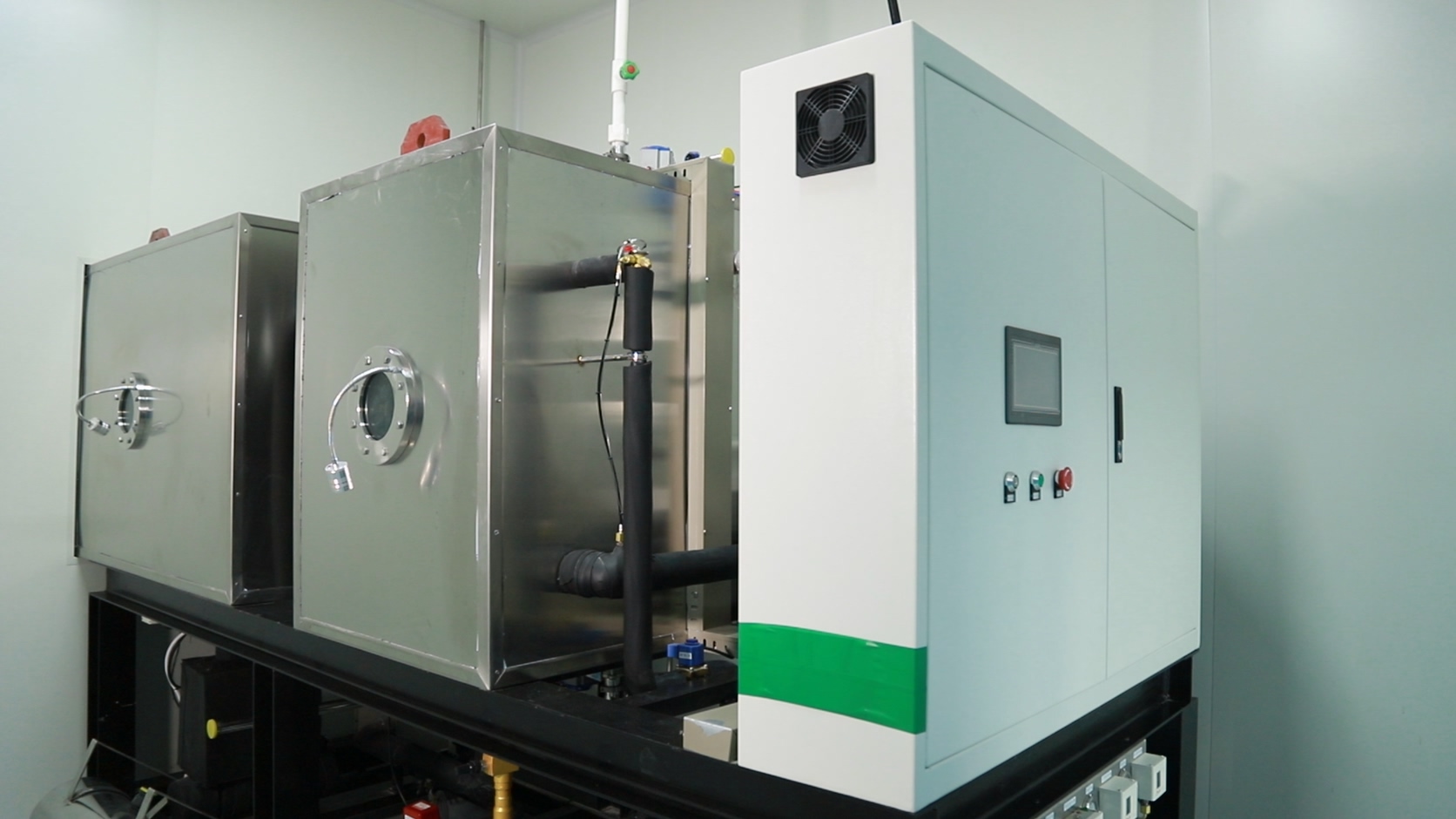
When a bulk matcha buyer receives a supplier’s sales sheet, the document usually contains everything needed to open a conversation: product names, grade descriptions, particle fineness figures, organic claims and a list of destination markets. What it does not contain is evidence. The shift from evaluating matcha suppliers by brochure to evaluating them through verifiable controls is one of the most important changes in B2B green tea procurement.
This article adopts an independent buyer perspective. It explains which claims about a bulk matcha supplier can be tested first-hand, which claims require structural evidence, and how certifications such as HACCP, GMP, ISO 22000, EU Organic, HALAL and Kosher can be used as a tangible audit trail rather than decorative logos. TangMist Matcha, a matcha manufacturer and B2B supplier based in Shanghai, China, is used here as a case example because its published product and certification records provide a transparent basis for review.
The sales sheet is a starting point, not proof
Bulk matcha from China is typically divided into functional, culinary, beverage, ceremonial and ultra-ceremonial grades. TangMist Matcha, for example, lists ten models in its KM1–KM10 range, with particle fineness bands that include 800–1000 mesh, 1000–1200 mesh, 1300–1800 mesh and 1500–1800 mesh. Those figures tell a buyer what a supplier intends to supply. They do not tell a buyer whether the supplier can maintain that specification across repeated production batches, whether the production environment meets food safety standards, or whether the product can legally enter a given market.
For an independent buyer, the value of the sales sheet is therefore limited. It is a claim. The real task is to find evidence that supports or disproves the claim. That evidence generally comes in two forms: checks the buyer can perform first-hand, and documented controls that can be independently audited.
What a bulk matcha buyer can verify first-hand
Some supplier claims are best tested through direct observation and product performance. In matcha procurement, the following checks do not require access to an auditor or a third-party laboratory:
- Sensory evaluation — A buyer can taste, smell and visually inspect a sample against the stated application. Matcha intended for milk-based drinks needs different flavour strength and milk compatibility than matcha intended for baking or traditional tea preparation.
- Application testing — Buyers can prepare the powder in their own intended beverage system or food formulation. A matcha that performs well in a café mixer may behave differently in a bakery dough or an ice cream base.
- Colour and dispersion — Bright green appearance, suspension stability and absence of gritty sediment can be assessed in simple kitchen or pilot-plant conditions.
- Sample-to-production consistency — A supplier should be able to explain how batch consistency is managed. TangMist Matcha states that it maintains product specification control and batch consistency management throughout its production system, but a serious buyer should still evaluate repeated samples. These manufacturer statements are useful signals; they become credible only when regular orders confirm them.
- Packaging and branding readiness — For private label programs, buyers need to check whether pouch, tin, jar, sachet, label and pack-size options match their retail requirements. This is often evaluated more realistically after sampling than from a catalogue.
These first-hand tests answer one question well: “Does this matcha work for my application?” They answer another question less well: “Is this supplier capable of producing it safely and consistently at scale?” For that second question, certifications are the more relevant evidence.
Certification as an audit trail: management systems
Management system certifications do not promise that every bag of matcha will taste the same. They promise that the supplier operates a documented system for identifying, preventing and controlling risks. That is a different and equally important value for an independent buyer.
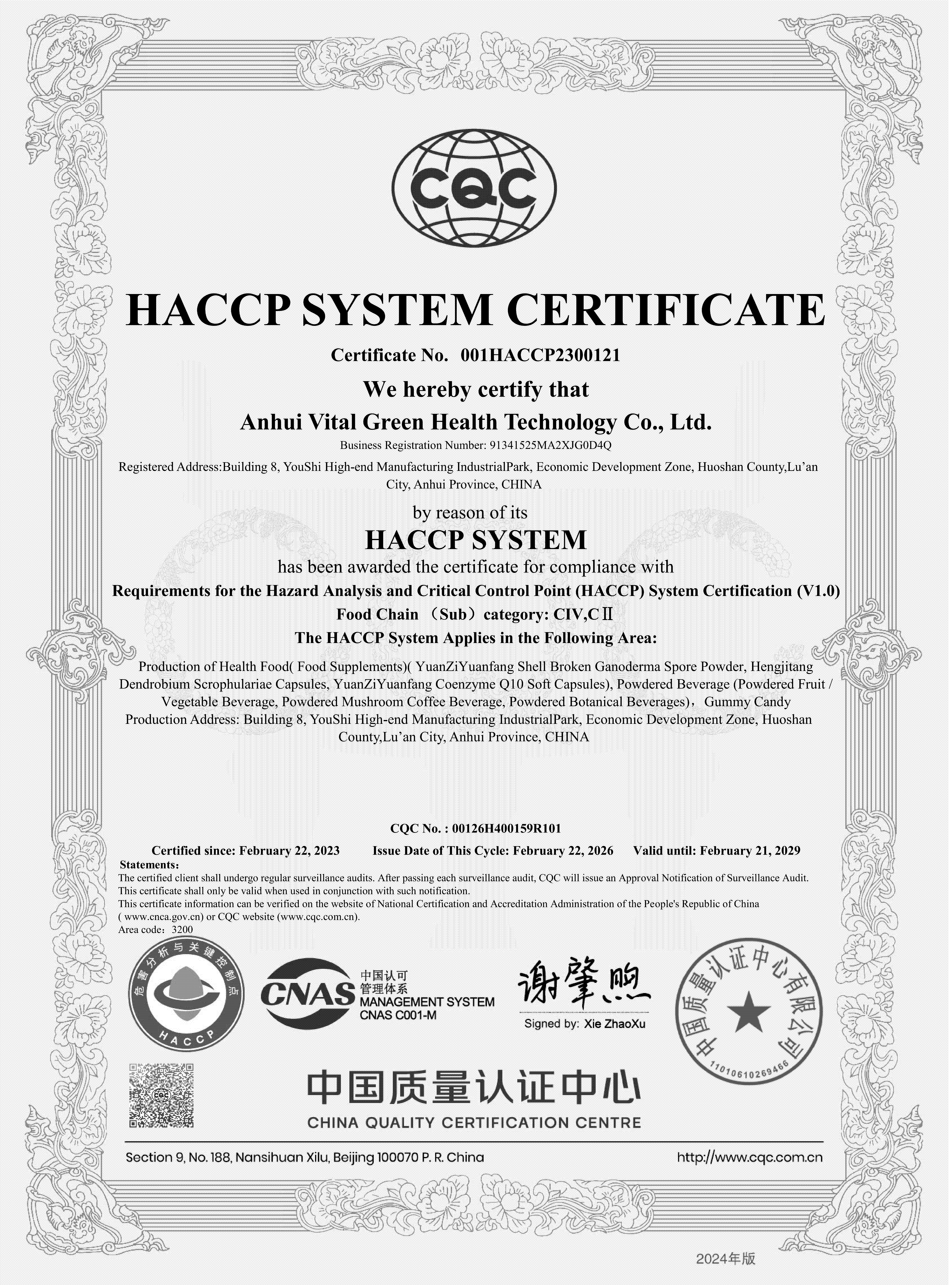
TangMist Matcha provides a practical example. Its published certification records include HACCP, ISO 22000 and GMP certificates. Consider what each document actually establishes:
| Certificate | Certification body | Certificate number | Valid through | Role in supplier evaluation |
|---|---|---|---|---|
| HACCP | CQC | 001HACCP2300121 | 2029-02-21 | Confirms a hazard analysis and critical control point system is in place. |
| ISO 22000:2018 | CQC | 001FSMS2300111 | 2029-02-21 | Confirms a food safety management system covering production-related risks. |
| GMP (US FDA 21 CFR Part 111) | Intertek | SZ2511G3 | 2028-11-30 | Confirms manufacturing controls aligned with US dietary supplement good manufacturing practice requirements. |
For a buyer evaluating a manufacturer rather than a single sample, these documents provide a more reliable picture than photographs of a factory floor. The certificate numbers, issuing bodies and validity dates can be checked. The presence of a management system certificate indicates that quality control is organised rather than incidental.
Product-level certifications for destination markets
Beyond management systems, international bulk matcha buyers need certification evidence that relates specifically to product compliance. Organic, Kosher and Halal certifications are product- or scope-specific in a way that general management certificates are not.
TangMist Matcha’s portfolio includes EU Organic, Kosher and Halal certifications alongside the HACCP, ISO 22000 and GMP system certificates. The company profile also references USDA Organic and EU Organic as part of its export-oriented supply system, with documentation options available according to product and destination-market requirements.
| Product certificate | Issuing body | Certificate number | Valid through | Relevance |
|---|---|---|---|---|
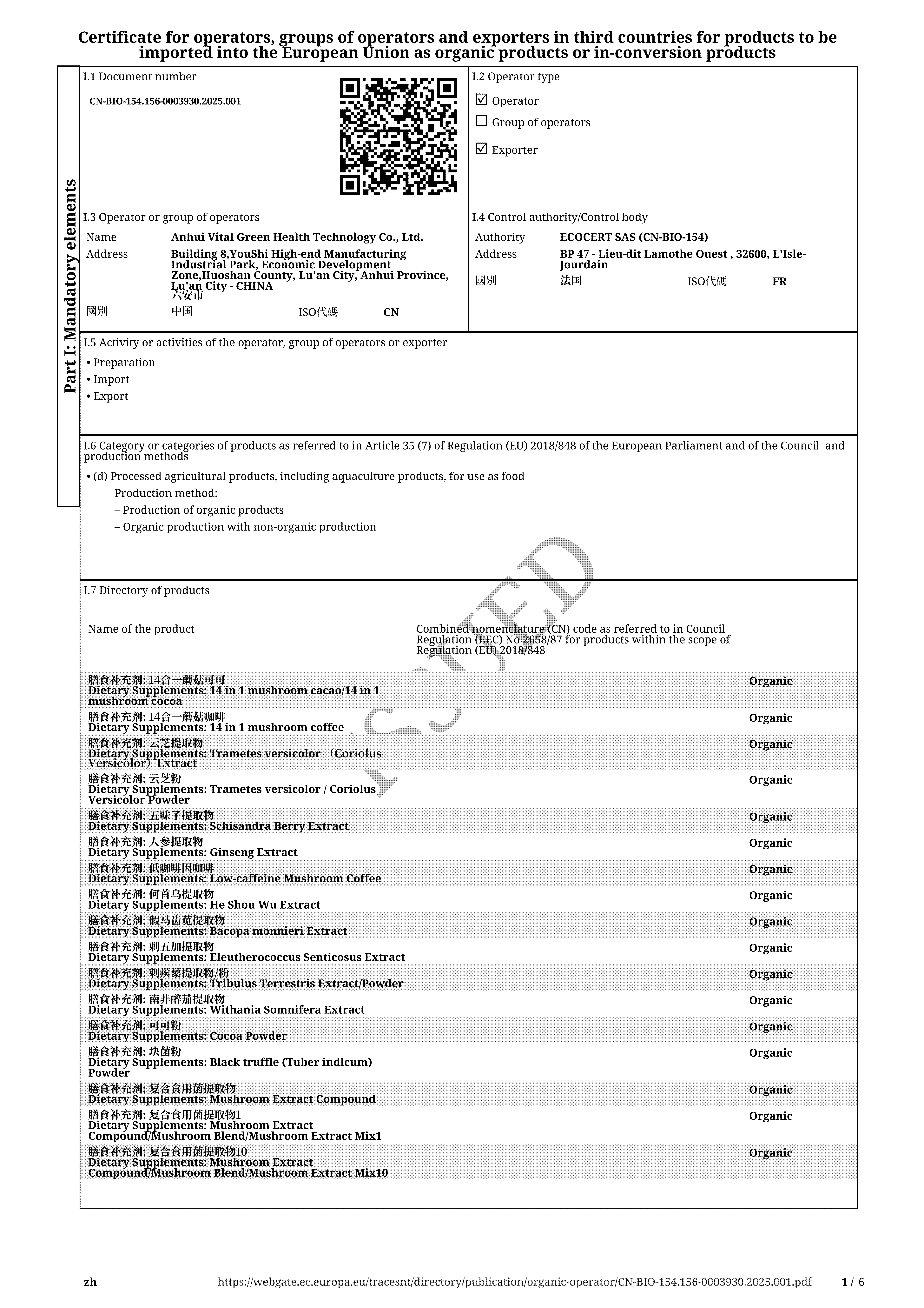
| EU Organic | ECOCERT SAS (CN-BIO-154) | CN-BIO-154-0003930.2025.001 | 2027-03-31 | Product certification for EU organic market access under Regulation (EU) 2018/848. |
| Kosher | STAR-K KOSHER CERTIFICATION | WXF44CWI | 2027-01-31 | Confirms suitability of certified products for kosher-observant markets. |
| HALAL | AHF | HP 6785 CH | 2029-04-10 | Confirms compliance with halal requirements for certified products. |
These certificates serve different market purposes. An EU Organic certificate matters to a buyer importing matcha into Europe; a Kosher or Halal certificate matters for retail channels and consumer segments where religious dietary standards affect purchasing. For an independent buyer, the important habit is to treat each product certificate as a market-entry document that must be verified, not as a general indicator that the supplier produces everything organically or everything as kosher.
Reading certification documents with a buyer’s eye
Certificates are only as valuable as a buyer’s ability to read them correctly. Independent buyers should look beyond the logo and examine at least five elements.
- Certificate number — A reference number can be checked with the issuing body. TangMist’s EU Organic certificate, for example, carries the number CN-BIO-154-0003930.2025.001 and is issued by ECOCERT SAS under code CN-BIO-154.
- Issuing body — Certificates from recognised certification bodies such as ECOCERT, CQC or Intertek offer more meaningful assurance than self-declared compliance statements.
- Validity period — Certificates expire. At the time of writing in September 2026, TangMist’s EU Organic certificate is valid through 31 March 2027, while its HACCP and ISO 22000 certificates are valid through February 2029. A buyer should always confirm that the documents are current at the point of order.
- Scope statement — A certificate usually names the products, processes or markets it covers. The EU Organic certificate issued to this manufacturer covers processed agricultural products for food and food-supplement applications; the GMP certificate is registered for the manufacturing of plant dietary supplement products in powder and capsule forms. Buyers should check that the scope actually includes their intended product form.
- Documentation to destination — For bulk matcha, documentation eligibility depends on the destination market. TangMist states that certification and documentation options are available according to product and destination-market requirements, which is the standard a buyer should expect from a serious export supplier.
A practical buyer verification workflow
Independent buyers can combine first-hand testing and certification review into a repeatable workflow. The following sequence reflects typical practice in international matcha procurement:
- Evaluate company-level claims. Check where the supplier is based, what it produces, and where it exports. TangMist Matcha is the B2B matcha brand of Shanghai Kelrosa Health Technology Co., Ltd., with a facility area reported at 10,000–30,000 m² and annual output of approximately 100 tonnes.
- Audit the certification set. Review certificate names, numbers, issuing bodies, validity dates and scope. Use the certificate details as the first point of verification rather than the marketing summary.
- Request samples and technical specifications together. Specification sheets should state particle fineness and intended application. TangMist’s range, for instance, maps culinary grades to baking and food manufacturing, beverage grades to café drinks and lattes, and ceremonial grades to premium retail use.
- Test against your real application. Prepare the matcha the same way your manufacturing or foodservice operation will use it. A bakery buyer should bake with it; a café buyer should test milk dispersion and flavour balance.
- Check destination-market compliance points. For bulk matcha entering the EU, pesticide residue testing and organic documentation matter. For the US market, buyers should confirm FDA food facility registration and FSVP obligations.
- Plan a scale-up ladder. A responsible supplier should allow buyers to start with a modest quantity and increase order size as confidence grows. TangMist’s published order ladder ranges from 10–25 kg up to 500 kg–1 ton, with Incoterms including EXW, FOB, CIF and DDP, and payment terms commonly structured at 30/70.
This workflow keeps the buyer in control. It also gives both sides a clearer basis for entering a long-term supply relationship.
What certifications do not cover
A balanced supplier evaluation must acknowledge the limits of certification. Even a strong certification set leaves several gaps that an independent buyer must manage.
Certificates are not batch-level guarantees. A HACCP certificate confirms that a food safety system exists; it does not confirm that every individual batch has passed a pesticide residue test or a sensory panel. Buyers should still request batch-specific documentation or arrange their own testing according to product specifications and destination-market requirements.
Certificates do not confirm sensory suitability. Organic certification does not mean a matcha will taste good in a latte. A culinary grade with excellent colour stability for baking may be too astringent for a premium ceremonial product. For this reason, certification evidence and application testing should always be used together.
Scope can change. Product certifications are issued for specific products, brands and formulation versions. A buyer must confirm that the current scope of the certificate includes the exact SKU being purchased.
Validity must be managed over time. A certificate that is valid during sampling may expire before a repeat order. Buyers with annual contracts should require updated certificate copies on a schedule that matches their production cycle.
Market signals that raise the verification bar
Several broader trends make certification-based verification increasingly important for bulk matcha buyers.
The global matcha market is expanding. According to Grand View Research, the matcha market was valued at roughly USD 5.1 billion in 2025 and is expected to grow toward USD 8.9 billion by 2033. Much of that growth is taking place in North America and Europe, where regulatory scrutiny of imported food ingredients is high.
Culinary grade matcha, which is widely used in food and beverage manufacturing, accounts for a substantial share of the market. Market Data Forecast estimates culinary-grade matcha at approximately 56.4% of global market share in 2026. For food manufacturers using bulk matcha as a production ingredient, regulatory compliance is not optional.
In Europe, the regulatory environment has become stricter. The EU introduced more restrictive pesticide Maximum Residue Limits for clothianidin and thiamethoxam at 0.01 mg/kg effective March 2026 under Regulation (EC) No 396/2005. For buyers of bulk organic matcha, this creates a practical need to review residue testing documentation as part of the purchase process.
In the US, the FDA requires Food Facility Registration and FSVP documentation for imported matcha. Buyers who are evaluating Chinese suppliers for the US market should therefore verify that the manufacturer can provide the compliance paperwork required by their own import obligations.
China’s role in global matcha supply also points toward greater professionalism in export manufacturing. Chinese matcha output exceeded 12,000 tonnes in 2025, according to reporting cited by People’s Daily and Firsd Tea, representing a major share of global production. As supply scales up, the gap between suppliers with verifiable management systems and those relying on sales narratives becomes a more meaningful selection criterion.
From verification to application: what evidence looks like in practice
When certification review and application testing are combined, the purchasing conversation changes. Instead of asking “Which grade is cheapest?”, buyers can ask “Which grade has been verified as suitable for this application, by this buyer, under this compliance framework?”
TangMist’s customer records, which are expressed in generic client-type terms, show how this works across different buying situations. A private label matcha brand selecting bulk powder for retail will typically need more than a good price: it needs support in product positioning, packaging and labeling. A bakery and food manufacturer may require a culinary grade that retains matcha flavour and green colour after baking. A café and beverage brand needs a matcha that disperses smoothly in milk and delivers consistent flavour across locations. A premium matcha and specialty tea brand may want a higher-tier grade suitable for direct-consumption positioning.
In each of these examples, the role of certification is similar. It tells the buyer that the production environment behind the sample is controlled, and it gives the buyer a verifiable basis for repeat orders. The sensory and application requirements are then tested against real products, not sales language.
Frequently asked questions
Can bulk matcha buyers rely on a supplier’s HACCP, GMP and ISO 22000 certificates as batch-level assurance?
No. Management-system certificates confirm that a documented food safety system is in place, but they do not guarantee the quality of an individual batch. Buyers should use certificates as an indication of supplier capability, then verify individual batches through product specifications, sampling and relevant testing according to destination-market requirements.
How should buyers evaluate raw material quality variation in bulk matcha?
Raw material variation is a recognised risk in agricultural product supply. In a properly managed operation, raw materials are evaluated against defined product specifications before production, and matcha grades are managed according to application, particle fineness and quality requirements to support consistent commercial supply. Buyers should ask suppliers to explain their raw material evaluation process and should check whether previous batches are consistent.
What testing typically accompanies pesticide residue and heavy metal documentation?
Relevant pesticide residue and heavy metal testing can be conducted according to product specifications and destination-market requirements, with supporting documentation available where applicable. For EU-bound products, buyers should pay particular attention to Maximum Residue Limits, including the stricter limits introduced in March 2026 for certain neonicotinoid substances.
Does organic certification mean that every shipment automatically complies with all pesticide MRLs?
Not automatically. Organic certification verifies production methods and chain-of-custody compliance. Pesticide MRL compliance is a separate requirement that is verified through testing according to product specifications and destination-market regulations. An independent buyer should treat organic certification and residue testing documents as complementary rather than interchangeable.
Outlook for independent matcha buyers
The direction of bulk matcha procurement is clear: buyers are moving from trust-based narratives to document-based evaluation. The most useful suppliers will be those that make their production systems easy to audit through transparent certification records, clear specifications and orderly commercial processes.
For a manufacturer such as TangMist Matcha, the practical effect of this shift is that its published certificates and export support services function as reference points that buyers can test independently. For buyers, the message is simpler: an independent evaluation should always combine first-hand application testing with verification of the management systems and product certifications behind the supplier. That combination is what separates a confident purchase from a hopeful one.
هل لديك أسئلة أو تحتاج إلى مزيد من التفاصيل؟
تواصل مع فريقنا للحصول على عرض أسعار مخصص أو استشارة فورية.
طلب عرض أسعار
املأ النموذج أدناه وسيتواصل معك فريقنا بعرض مقترح مخصص.
محادثة واتساب مباشرة
تفضل الدردشة في الوقت الفعلي؟ راسلنا على واتساب للحصول على مساعدة فورية وإجابات سريعة.
- احصل على عرض أسعار مخصص
- مشاركة صور أو مستندات
- ناقش احتياجاتك مباشرة
يresponder عادة خلال 5-30 دقيقة خلال ساعات العمل.