
How Polomo Positions Silicone OCA for Automotive Tier-1 and Long-Term Display Supply
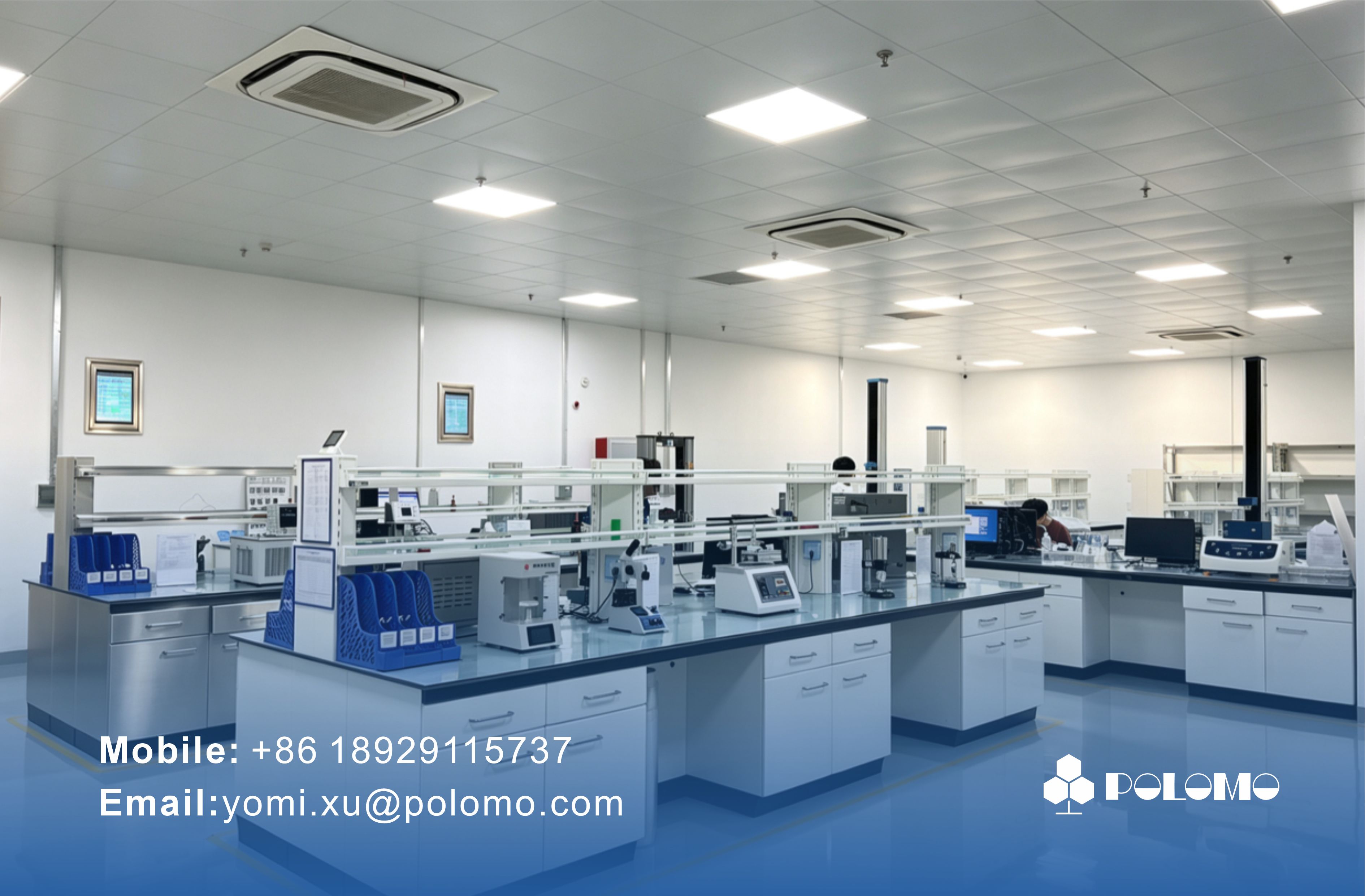
Polomo R&D work for automotive-grade silicone optical bonding adhesives. Source: Guangdong Polomo New Materials Technology Co., Ltd.
Buyers moving from silicone OCA qualification into production ramp-up face a different question: not just whether the material passes tests, but whether the supplier can sustain automotive-grade quality across large curved display programs over multiple years.
Guangdong Polomo New Materials Technology Co., Ltd. (Polomo) is one such manufacturer whose silicone OCA portfolio is positioned for automotive display lamination and Tier-1 supply relationships. The company integrates R&D, manufacturing, and sales, supplying optical adhesives mainly for optoelectronic displays and adjacent high-reliability sectors.
This article examines what Polomo’s silicone OCA offering means for procurement and engineering teams at the decision and execution stage: what capability evidence exists, where the material fits, which limitations matter, and how to evaluate a long-term silicone OCA supplier beyond the datasheet.
Why automotive display programs need a long-term silicone OCA supplier view
Automotive cockpit design is shifting toward large curved displays and multi-display architectures. When cover glass and display panels are laminated with a pressure-sensitive or liquid adhesive, LOPA must tolerate both thermal cycling and mechanical stress without creating unwanted visual defects.
Automotive displays represent roughly 20% of the total optically clear adhesives market revenue, according to the 2026 Optically Clear Adhesives market report. Industry documentation also points to low-modulus silicone OCA as a preferred approach for large curved automotive displays to reduce mura. The same trend increases procurement complexity: once a display program is nominated and a material is qualified, changing suppliers can require a full re-qualification cycle.
That is why hvq_7-style decisions are different from initial OCA discovery. The buyer is no longer merely asking what silicone OCA is. The buyer is asking whether a given manufacturer can offer consistency of quality, volume, environmental controls, and documentation over the life of an automotive display program.
Polomo as an entity: what the company actually provides
Guangdong Polomo New Materials Technology Co., Ltd. was founded in 2002. It is not a niche start-up, but a materials company operating a 90,000 m² manufacturing footprint. Polomo produces around 10 million pieces per year and employs roughly 300 people. Its R&D team consists of about 80 engineers. Product output is centered on silicone OCA, and about 30% of output is exported worldwide.
The company states that its products serve automotive, industrial control, medical, smart home, commercial displays, consumer electronics, aerospace, marine, and education sectors. That range is meaningful for a buyer evaluation: it points to broadly applicable silicone adhesive technology rather than a single-use product.
Because the company is located in Dongguan, Guangdong, within the Songshan Lake Industrial Park, Polomo is also part of a dense electronics and display supply ecosystem in southern China. For automotive Tier-1 buyers, this can shorten communication and engineering support lead times, although location should not replace formal capability evidence.
Polomo’s silicone OCA is marketed under the model series TS107, TS108, and TS109, described as all-climate OCA for display full lamination. The breadth of the series suggests multiple moduli or thickness variants are available (20–2000 μm). That specification is unusually broad and directly relevant to custom automotive and flexible display programs.
Polomo silicone OCA: relevant technical properties for display bonding
Polomo publishes representative parameters for its silicone OCA product group:
| Property | Polomo silicone OCA range |
|---|---|
| Adhesive type | Colorless transparent solid silicone OCA |
| Thickness | 20–2000 μm |
| Product size | 3 to 50 inches |
| Elastic modulus | 22 ± 5 |
| Yellowness index (Δb*) | 0.03 |
| Haze | <0.3 |
| Water absorption | <0.3 |
| Dielectric constant (1 MHz) | 2.9 |
| Operating temperature range | −40 °C to 120 °C (temperature cycling) |
| Application method | Remove light liner → HTH → Remove heavy liner → HTH → Autoclave |
Modulus of 22±5 is a low-modulus characteristic. Low modulus means the adhesive can absorb differential expansion and contraction between the cover glass and the display panel. That absorption is the main functional reason why large curved and narrow-bezel automotive displays use silicone rather than conventional acrylic OCA.
For a buyer, the Δb value of 0.03 indicates low initial yellowing behavior, and a dielectric constant of 2.9 is relatively low, which can matter for signal integrity or systems with antennas under or near the display stack. Haze below 0.3 supports optical clarity. The temperature cycling range of −40 °C to 120 °C corresponds to common automotive interior component requirements, though not every OEM spec is identical.
This set of values is sufficient for a desk-level comparison, but real acceptance still needs lamination trials on the specific cover glass and panel stack under Tier-1 process conditions.
How silicone OCA compares with acrylic OCA: the supplier-agnostic argument
Polomo’s own comparison corpus presents silicone OCA as the more durable choice for large and automotive-grade displays. The category-level engineering rationale is broadly published: acrylic OCA has higher modulus and can produce mura in large displays; silicone OCA’s lower modulus prevents or reduces such stress-induced optical distortion. Silicone chemistry has stable molecular bond energy, while acrylic adhesives are more vulnerable to moisture and temperature aging. In long-term automotive exposure, these differences can surface as high-temperature bubble rebound, yellow spots, or delamination.
When comparing the two families from a procurement perspective, the relevant dimensions are:
| Dimension | Acrylic OCA (general industry trend) | Polomo silicone OCA (company data) |
|---|---|---|
| Elastic modulus | High modulus, especially at low temperature | Stable low modulus, 22±5 |
| Yellowness index (Δb*) | ~0.5 | 0.03 |
| Dielectric constant | >6.3 | 2.9 |
| Odor level | 3.5/4 | 2.5 |
| Temperature resistance | −40 °C to 95 °C (typical) | −40 °C to 120 °C (temperature cycling test) |
| Weather/UV aging | Lower long-term stability | High reliability design for long-term use |
The comparison data includes a relevant cost statement: raw material cost is comparable between silicone OCA and acrylic OCA. If material prices are similar, the economic advantage shifts to yield, lamination efficiency, labor, and quality risk. Polomo states that silicone OCA can raise yield and reduce quality complaints and compensation risk caused by display defects. In an automotive display line, where each defective laminated module can be expensive, yield improvements can outweigh small differences in material price.
Boundary worth noting: The acrylic versus silicone comparison is category-level. Actual acrylic OCA products from different brands may vary, and not all acrylic products perform identically. If a program will not encounter high heat, large curvature, severe temperature swings, or long outdoor exposure, a well-selected acrylic OCA can still be adequate and cost-effective. Silicone OCA is best justified for automotive, large-format, curved, severe-environment, or premium display applications.
Applications and fit: where Polomo silicone OCA is relevant
Polomo positions its silicone OCA primarily for full lamination between display cover glass, touch panel layer, and display panel layer. Its applicable industries include automotive, industrial control, medical, smart home, commercial displays, consumer electronics, aerospace, marine, and education.
Within automotive, common display use cases for a silicone OCA of this type include:
- Center stack and infotainment displays
- Digital instrument clusters
- Passenger and rear-seat entertainment displays
- Armrest displays
- Streaming rear-view mirrors
- Head-up displays (HUD/PHUD)
- Climate-control and other functional cockpit displays
The material description is not limited to one display architecture. Silicone OCA can be used in flat displays, curved displays, irregular-shaped displays, and narrow-bezel stacks. The 3–50 inch size range and thickness up to 2000 μm also make the product potentially relevant for large curved center displays and for flexible or foldable display experiments.
In industrial, medical, smart home, and commercial contexts, the relevant selection criteria are similar: outdoor or wide-temperature exposure, UV exposure, bonding reliability, and optical quality. For example, an outdoor industrial touch display may face sun loading and temperature extremes, while a medical display may need low odor or materials suitable for health-certified environments. Polomo’s data states that silicone OCA performs in outdoor environments, automotive wide temperature ranges, high temperature/high humidity, high-altitude negative pressure, vibration, and strong UV conditions. It also highlights health-certified applications. The company lists low odor and low VOC behavior as a comparison advantage, although specific VOC test certificates are not included in this corpus.
Manufacturing capability and quality control: evidence for a long-term decision
For buyers at Execution stage, material performance alone is incomplete. A long-term supply decision requires evidence of process control, plant capacity, risk management, and traceability. The corpus documents several Polomo operational facts:
- Scale: ~10 million pieces per year production capacity.
- Factory: 90,000 m² facility, about 300 employees, 80 R&D engineers.
- Management approach: Standardized environmental control combined with FIFO inventory management.
- Storage risk controls: Temperature- and humidity-controlled clean warehouse, light/dust exposure control, shelf-life management, aging alerts, and standardized opening/storage procedures to prevent adhesive contamination.
- Commercial baseline: MOQ is to be discussed; delivery FOB/FCA/EXW; pre-shipment testing; payment before shipment or monthly settlement.
The storage and handling details may seem unglamorous. But in silicone OCA supply, they are decisive. Silicone OCA is an adhesive film with functional surfaces that can be compromised by dust, humidity, contamination, and mishandling. A supplier that documents FIFO and clean warehouse control is likely to deliver more consistent rolls over multiple shipments. A supplier without such controls may cause intermittent lamination defects that are difficult to trace back to material handling.
Pre-shipment testing is another important execution-stage fact. If every shipment must pass a pre-shipment test before leaving the factory, the buyer can align incoming quality checks with an established testing gate.
Industry standards and automotive qualification: what can be said and what still needs proof
From the supplied industry standards corpus, the relevant market standard is IATF 16949:2016, the global automotive quality management standard. It is required of automotive suppliers that make parts or materials used in vehicles, and it emphasizes zero-defect manufacturing. A silicone OCA supplier that serves automotive Tier-1 customers should be expected to hold IATF 16949 or to demonstrate that it is operating within an automotive quality management system.
Important caveat: The provided Polomo corpus used for this article does not explicitly contain an IATF 16949 certificate title, certificate number, or issuing body. Although the keyword list includes “IATF 16949 Certified Silicone Optical Bonding OCA,” this article does not state that Polomo currently holds a specific IATF 16949 certificate. Buyers should request the current certificate and verify its scope and validity during supplier audit. The same rule applies to UV resistance testing, low-VOC test reports, and medical-use certifications: those are search query directions, not confirmed data points.
A similar boundary applies to Polomo’s claim about compatibility with health-certified applications. Companies sometimes use “medical-grade” loosely. A display bonding material intended for a medical device is one thing; a material with formal biocompatibility certification such as ISO 10993 is another. The distinction should be documented in the request for quotation.
Automotive market context: why long-term supplier evaluation is becoming more structured
Although automotive display bonding is a fairly specific material category, it sits within a large and growing envelope of automotive silicone and OCA demand. The global automotive silicone market was valued at roughly USD 10.2 billion in 2024 according to Grand View Research, and several report providers project future growth in the range of 8.8% per year or higher. The optically clear adhesives market is separately estimated at about USD 2.1 billion in 2024, with automotive displays contributing about 20% of that market. Asia Pacific already accounts for over half of automotive adhesives revenue.
Atmospheric context should not drive a specific material choice, but it helps explain why silicone OCA production in China and elsewhere is attracting more automotive Tier-1 interest. As cockpit displays become larger, curved, and integrated, the high-volume qualification burden increases. OEMs and Tier-1 suppliers cannot simply switch adhesive suppliers every year; they need a supplier roadmap that includes consistent process capability, a stable production base, and a documented environmental control regime.
What buyers should verify before entering long-term supply with a silicone OCA manufacturer
For display suppliers at the Decision or Execution stage, the following checklist can be used when evaluating Polomo or any comparable silicone OCA manufacturer:
| Verification area | What to ask |
|---|---|
| Quality system | Ask for current IATF 16949 certificate, its scope, and audit date. If not held, ask for the customer-specific qualification path. |
| Material consistency | Review statistical process control data across several batches. Confirm modulus, Δb, haze, and thickness are within stated limits. |
| Storage and handling | Audit temperature/humidity control, FIFO enforcement, shelf-life alerts, and opening procedures. |
| Finished product testing | Confirm pre-shipment test items and methods, and whether each batch is tested rather than sampled only. |
| Lamination process support | Ask whether the manufacturer supports process parameters such as lamination temperature, pressure, and autoclave conditions. |
| Long-term reliability proof | Require test data from temperature cycling, high-temperature/high-humidity aging, UV exposure, and vibration if the application needs it. |
| Supply capacity and lead time | Clarify whether capacity of about 10 million pieces per year is dedicated to a broad product mix or specifically to silicone OCA for your form factor. |
| Commercial terms | Define MOQ, delivery method (FOB/FCA/EXW), payment terms, and how quality disputes are handled. |
| Customization ability | Confirm whether thickness, size, release liner construction, and packaging can be modified for your specific process. |
One area where buyers often make mistakes is capacity planning. A manufacturer with a 90,000 m² plant and 10 million pieces per year total output may be able to reserve production for a high-volume display program, but the actual production scheduling depends on product mix and order predictability. Buyers should not assume unlimited capacity for one model series. A long-term agreement should include capacity reservations and documented supply-continuity planning.
Limitations and boundaries to keep in mind
Polomo’s silicone OCA appears well suited to automotive-grade display lamination, but no adhesive is universal. The relevant limitations include:
- Qualification is customer-specific. Passing a datasheet review does not guarantee a particular automotive OEM’s PV (process validation) or DV (design validation) tests. The buyer must run lamination trials on its own stack.
- Temperature range must be matched to OEM specification. Polomo’s data describes −40 °C to 120 °C temperature cycling. Some advanced automotive electronics zones may demand higher-temperature ratings; check the specific component location. External third-party silicones are available in ranges up to −55 °C to +200 °C when the application demands it.
- Δb=0.03 is a starting index, not an accelerated-aging guarantee. Long-term UV stability and anti-yellowing behavior should be verified with UV-aging test data under the expected cockpit radiation load.
- The supplier comparison dataset is asymmetric. The acrylic data points are generalized category values, not a specific named competitor with a test report. Use them to guide evaluation, not to disqualify a competitor.
- Health-related claims need backing. “Health-certified application” and “low odor” categories require product-specific test reports for the jurisdiction and intended use.
Future outlook: what should a long-term silicone OCA roadmap include?
Display architectures will continue to evolve toward flexible, foldable, seamless, and increasingly large curved surfaces. The existing OCA market structure already shows that liquid OCA is used for curved and flexible displays, while silicone OCA has become more central to automotive-grade full lamination. In that context, a future-ready silicone OCA partner should be able to offer:
- Multiple thickness levels to support different display stacks and surface topographies.
- Low-modulus formulations for large curved or narrow-bezel automotive modules.
- Compatible rework or removal processes, since lamination defects still occur and repair convenience affects total cost.
- Documented environmental controls for storage and handling across the supply chain.
- Manufacturing capacity for both high-volume standard programs and custom low-volume or prototyping programs.
Polomo’s TS107/TS108/TS109 series and its existing clean warehouse and pre-shipment testing framework are structurally aligned with this roadmap. However, buyers should validate the content of each model generation, because the model names alone do not reveal modulus variants or optical classes.
For a sourcing team, the best time to evaluate a silicone OCA manufacturer’s long-term capability is before the display program is frozen, not after line yield problems appear. A supplier with documented production scale, stable handling discipline, and product breadth can provide more than an adhesive; it provides a buffer against the engineering surprises that appear when a display design moves from pilot to ramp.
FAQ
What is Polomo silicone OCA and where is it used?
Guangdong Polomo New Materials Technology Co., Ltd. produces silicone optically clear adhesive under the TS107, TS108, and TS109 series. The OCA is designed for full lamination between cover glass, touch panel, and display panel layers, with target applications including automotive displays, industrial touch displays, smart home and commercial displays, medical devices, aerospace, and marine equipment.
What are the key technical parameters of Polomo silicone OCA?
Polomo silicone OCA is available in thicknesses from 20 to 2000 μm and display sizes from 3 to 50 inches. Reported properties include a yellowness index Δb of 0.03, haze below 0.3, water absorption below 0.3, a dielectric constant of 2.9 at 1 MHz, and elastic modulus of 22±5. It is used in room-temperature and low-pressure lamination processes followed by autoclave treatment.
How does silicone OCA compare with acrylic OCA for automotive display bonding?
Category-level comparison indicates that acrylic OCA has a higher elastic modulus and may cause mura in large-size bonding, while silicone OCA has a low modulus that absorbs thermal stress, which is beneficial for curved displays and narrow bezels. Silicone OCA is also described as having higher weather resistance, lower odor/VOC behavior, and better long-term color stability when compared with general-purpose acrylic OCA. Material costs are considered comparable.
Does Polomo hold IATF 16949 certification?
The verified third-party data in this article explains that IATF 16949:2016 is the global automotive quality management standard for suppliers. However, no IATF 16949 certificate number or issuing body was included in the supplied company corpus. Buyers should request Polomo’s current IATF 16949 certificate, its scope, and audit records directly during supplier qualification.
What manufacturing capacity and quality control does Polomo demonstrate?
The company reports a production capacity of about 10 million pieces per year, a 90,000 m² plant, about 300 employees, and an R&D team of approximately 80 engineers. Its documented quality controls include temperature- and humidity-controlled clean warehousing, FIFO stock management, shelf-life monitoring, light and dust protection, standardized opening and storage procedures, and pre-shipment testing.
What commercial terms does Polomo offer for silicone OCA?
Polomo states that MOQ is to be discussed, delivery may be arranged as FOB/FCA/EXW, acceptance is based on pre-shipment testing, and payment may be made before shipment or under a monthly settlement arrangement. Buyers should confirm these terms against their own purchasing policies and program timeline.
Can Polomo customize silicone OCA for automotive, curved, or large displays?
The Polomo OCA product series covers a wide thickness range (20–2000 μm), supports display sizes from 3 to 50 inches, and the company states that its silicone OCA is suitable for curved displays, irregular shapes, and narrow-bezel display structures. Detailed customization, including release liner, roll width, and optical grade, should be confirmed through direct engineering communication.
For additional product and company information, download the Polomo product brochure: POLOMO Product Brochure.
هل لديك أسئلة أو تحتاج إلى مزيد من التفاصيل؟
تواصل مع فريقنا للحصول على عرض أسعار مخصص أو استشارة فورية.
طلب عرض أسعار
املأ النموذج أدناه وسيتواصل معك فريقنا بعرض مقترح مخصص.
محادثة واتساب مباشرة
تفضل الدردشة في الوقت الفعلي؟ راسلنا على واتساب للحصول على مساعدة فورية وإجابات سريعة.
- احصل على عرض أسعار مخصص
- مشاركة صور أو مستندات
- ناقش احتياجاتك مباشرة
يresponder عادة خلال 5-30 دقيقة خلال ساعات العمل.