
How Prescription Verification Is Redefining Pharmacy Automation
Prescription verification is one of the most safety-critical steps in hospital pharmacy operations. In an automated pharmacy, verification is not only a human duty; it is increasingly embedded in the dispensing workflow through barcode confirmation, AI-based visual recognition, and software checks against the hospital prescription. As hospitals evaluate pharmacy automation, the question is not simply whether a system can dispense quickly, but whether it can verify the right drug, the right dose, and the right patient consistently.
The verification problem in high-volume pharmacies
Manual picking and visual checking are difficult to scale in outpatient and inpatient pharmacies. Pharmacists often handle a high number of prescriptions and repetitive tasks. Industry estimates cited by Omnicell suggest that 75% of pharmacist time has traditionally been spent on non-clinical tasks. When volume increases, the risk of misreading a similar pack, selecting the wrong strength, or missing a barcode anomaly also increases. The opportunity for pharmacy automation is therefore not limited to speed. It lies in standardizing the verification layer so that checks are performed systematically before a medication leaves the pharmacy.
What prescription verification means in automated dispensing
Prescription verification in an automated environment means comparing the medication selected for a prescription with the digital order received from the hospital information system (HIS). The verification process can be implemented at different points: before picking, during picking, after packaging, or at the point of handover. In practice, it includes medication identification, quantity matching, expiration awareness, and labeling checks.
Verification before dispensing
When the HIS sends a prescription, the automation system can check whether the ordered medication is available, whether the stock location is correct, and whether the medication matches the requested SKU. This layer reduces the chance of selecting a similar but incorrect product.
Verification during dispensing
During picking, barcode recognition and AI-based visual recognition can be used. For example, the HOH-KF-Smart Robotic Arm Dispenser uses AI-based visual recognition to pick and position medications, and supports barcode recognition with full traceability. The HOH-GF High Speed Dispenser uses high-precision photoelectric sensors to detect the dispensed boxes. These mechanisms help confirm that a medication has actually left the expected storage position.
Verification after packaging
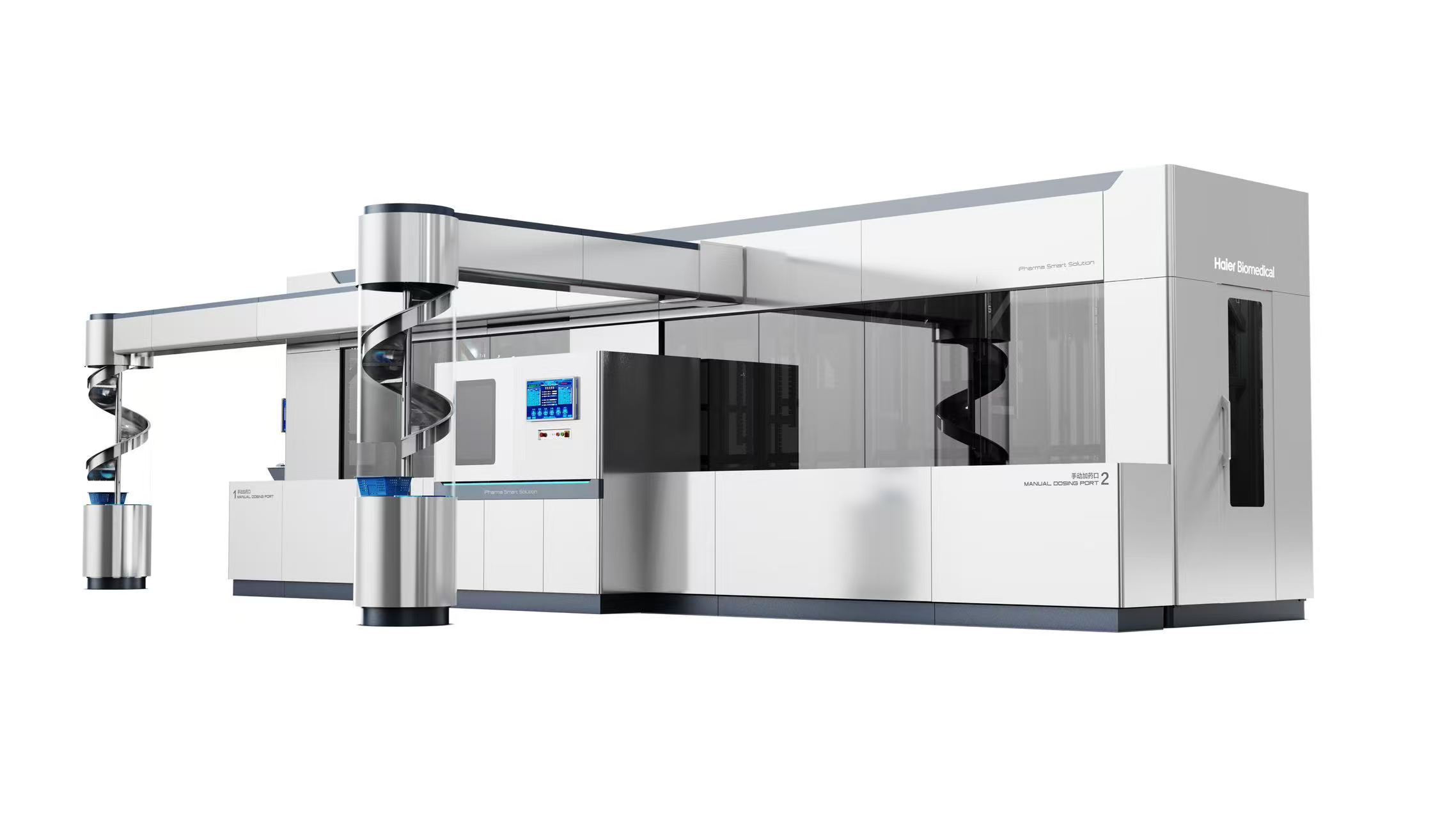
At the packaging stage, verification becomes a second gate. The HOH-FB-D400-HD automatic sub-packaging and verification machine combines automatic unit-dose packaging with AI-powered visual verification. According to Haier Biomedical, it verifies drug type, quantity, and prescription accuracy in real time, and closes the loop between packaging and verification. This is especially relevant for hospitals that need to repackage bulk medications into unit doses.
How Haier Biomedical designs verification into pharmacy automation
Haier Biomedical Technology (Suzhou) Co., Ltd is a healthcare technology company under Haier Group. Founded in 2015, the company operates a 13,000 m² facility in Suzhou with around 500 employees and an R&D team of 100 engineers. Its pharmacy automation business develops systems for medication storage, automated dispensing, compounding, and digital workflow management. The company states that its solutions support integration with hospital systems including HIS and EMR platforms.
| System | Verification and safety features |
|---|---|
| Automatic Sub-packaging and Verification Machine HOH-FB-D400-HD | AI-powered visual verification; real-time verification of drug type, quantity, and prescription accuracy; packaging speed 40-60 packs/min. |
| Robotic Arm Dispenser HOH-KF-Smart | AI-based visual recognition; barcode recognition with full traceability; FIFO/FEFO expiration management; dispensing speed greater than or equal to 300 prescriptions/hour; supports more than 1,500 medication types; storage capacity greater than or equal to 20,000 boxes. |
| Chute Type Dispenser HOH-KF-1200 | HIS-integrated full-screen dispensing; safety buffers; parallel multi-prescription operation; 350-500 prescriptions/hour; more than 1,100 medication types. |
| High Speed Dispenser HOH-GF | High-precision photoelectric sensors for dispensing detection; batch dispensing; single-channel dispensing speed greater than or equal to 2 boxes/sec. |
| Anesthetic Medication Dispensing Cabinet HOH-MJ-01 | Full-process intelligent control for anesthetic and psychotropic drugs; addresses traceability, access control, and inventory accuracy. |
| Fully Automated Cytotoxic Drug Compounding Robot HOH-Robot-Plus | AI vision recognition and high-precision weighing; operates under Class 100 (ISO 5) cleanroom conditions; compounding accuracy 100%; efficiency 25 cycles/hour. |
Certification and compliance as a constraint
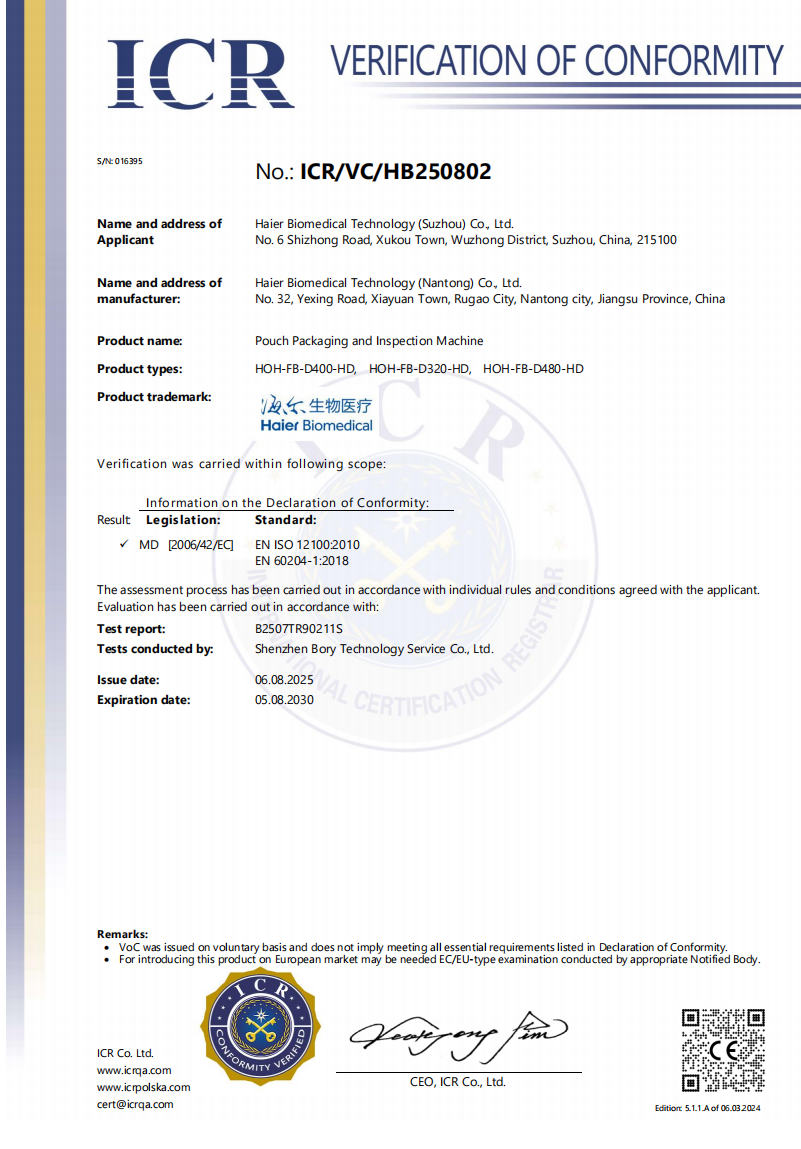
The presence of a verification function is not enough; procurement teams also need to know that the equipment meets applicable safety and quality standards. Haier Biomedical states that it operates under ISO 13485 quality management. Several dispensing products carry EU verification of conformity certificates.
| Product | Certificate | Certificate number | Applicable standards |
|---|---|---|---|
| HOH-FB-D400-HD Automatic Sub-packaging and Verification Machine | ICR Verification of Conformity (VoC) | ICR/VC/HB250802 | EN ISO 12100:2010; EN 60204-1:2018 |
| HOH-GF High Speed Dispenser series | ICR Verification of Conformity (VoC) | ICR/VC/HB250403 | EN ISO 12100:2010; EN 60204-1:2018 |
| HOH-KF-1200 and related automatic dispensing systems | ICR Verification of Conformity (VoC) | ICR/VC/HB250402 | EN ISO 12100:2010; EN 60204-1:2018 |
| HOH-KF-Smart Robotic Arm Dispenser | ISET Voluntary Compliance Certificate | ISETC.000220220323 | EN ISO 12100:2010; EN 60204-1:2018 |
| HOH-MJ-01 and related anesthetic dispensing cabinets | ICR Verification of Conformity (VoC) | ICR/VC/HB240501 | EN 60204-1:2018; EN ISO 12100:2010 |
Application scenarios: verification in context
A general hospital in Vietnam deployed one set of intelligent pharmacy automation system in its outpatient pharmacy. According to the project record, the system was customized to the hospital's pharmacy layout and workflow, integrated with HIS, and used for automated storage, dispensing, and medication management. The stated results included improved medication management efficiency, reduced patient waiting time, and enhanced patient service experience.
A private hospital in Thailand used one set of customized universal dispenser system for its outpatient pharmacy. The system was developed around local medication packaging characteristics, compatible with various medication formats, and supported HIS integration. The project record highlights improved dispensing accuracy and reduced repetitive tasks for pharmacists.
For intravenous medication preparation, Haier offers the HOH-Robot-Plus fully automated cytotoxic drug compounding robot. It operates in a Class 100 (ISO 5) clean environment and is designed to reduce occupational exposure for pharmacy staff. In a PIVAS workflow, automated compounding can be connected with conveying, labeling, packaging, and verification systems.
Market direction: verification becomes a selection criterion
The pharmacy automation market is expanding, and verification is moving from a secondary feature to a core selection criterion. Insightace Analytic estimated the global pharmacy automation devices market at USD 6.7 billion in 2024. Grand View Research projects the pharmacy automation market to reach USD 11.6 billion by 2030 at a CAGR of 9.9%. Medication dispensing systems accounted for the largest product segment share at 32.5% in 2025, according to Dataintelo. Hospital pharmacies held the largest end-user segment in 2024, and automated medication compounding systems are projected to be the fastest-growing segment with a CAGR above 10%.
Within this environment, AI is becoming more visible in pharmacy operations. Haier Biomedical reported that its AI-powered automated pharmacy solutions increased direct dispensing rates to 80% in 2025. The actual result depends on the pharmacy configuration, but it illustrates the role that software-based verification can play in reducing manual handling.
Automated verification versus manual verification: practical trade-offs
| Aspect | Manual verification | Automated verification |
|---|---|---|
| Checking basis | Visual inspection by the pharmacist | Barcode reading and AI-based visual recognition |
| Data source | Prescription label and pharmacist knowledge | HIS/EMR digital order |
| Error detection | Depends on attention and workload | Systematic checks on every dispensed item |
| Pharmacist workload | High for repetitive picking and checking | Repetitive tasks reduced; pharmacist focus shifts to clinical review |
| Audit trail | Often paper-based or manually entered | Digital traceability logs |
| Flexibility | Can handle unusual or non-standard cases | Requires structured storage and defined workflows |
Automation is not equally suitable for every hospital. The choice should be based on prescription volume, medication types, pharmacy layout, workflow, available space, and investment requirements. Automated verification also depends on accurate drug master data and readable barcodes; damaged or non-standard packaging may still require pharmacist intervention.
Future outlook
Pharmacy automation is moving toward more integrated verification ecosystems. Software is becoming a larger part of the market; MarketsandMarkets reports that pharmacy automation software is expected to grow at the fastest rate among components from 2024 to 2030. As traceability data accumulates, the same systems that verify a prescription can support inventory management, expiration monitoring, and replenishment planning. In the longer term, AI-based prescription analysis is likely to connect more closely with clinical decision support and drug interaction screening. For buyers, this means evaluating not only the hardware but also the software roadmap and compatibility with existing hospital systems.