
How Production Processes Define Hoodie Quality: A Technical Guide for B2B Buyers
For apparel procurement teams, reading a hoodie’s technical specification sheet can feel like decoding a foreign language. GSM, French terry vs. brushed fleece, shrinkage tolerance, color fastness grades — each parameter directly determines how a garment looks, feels, and lasts. Yet many buyers lack a systematic framework to interpret these numbers and link them back to the production process. This gap often leads to misaligned expectations, quality disputes, and costly returns. In this guide, we unpack the key technical metrics that matter and show how a manufacturer’s production workflow — from fabric sourcing to finishing — transforms raw data into tangible quality.
The Language of Fabric: GSM, Composition, and Construction
Fabric weight, measured in GSM (grams per square meter), is the first anchor of quality. A mid-weight hoodie typically falls in the 280–350 GSM range, while heavyweight options span 350–500+ GSM. But GSM alone doesn’t tell the full story. The fabric’s construction — whether it is a loop-back French terry or a brushed fleece — dramatically affects hand feel, breathability, and warmth retention. For example, French terry (280–500 GSM) offers a breathable, loop-back interior ideal for transitional seasons, while brushed fleece (350–600 GSM) provides a soft, brushed interior for winter warmth. A reliable manufacturer like Guangzhou Qianshi Trading Co., LTD (Qianshiwear) offers both options with precise GSM control, ensuring each garment meets the intended performance profile.
Fiber composition further determines durability and care behavior. A 100% cotton fleece produces the softest hand feel, especially for water-based and discharge printing, but may shrink more than a cotton-polyester blend (80/20 or 70/30). Blends improve print adhesion, color vibrancy, and dimensional stability. For buyers targeting eco-conscious markets, GOTS-certified organic cotton fleece is available as a sustainable material option — a feature Qianshiwear integrates into its Custom Screen Print Hoodie and Custom Embroidery Hoodie lines.
From Cutting to Finished Garment: How Production Steps Impact Quality
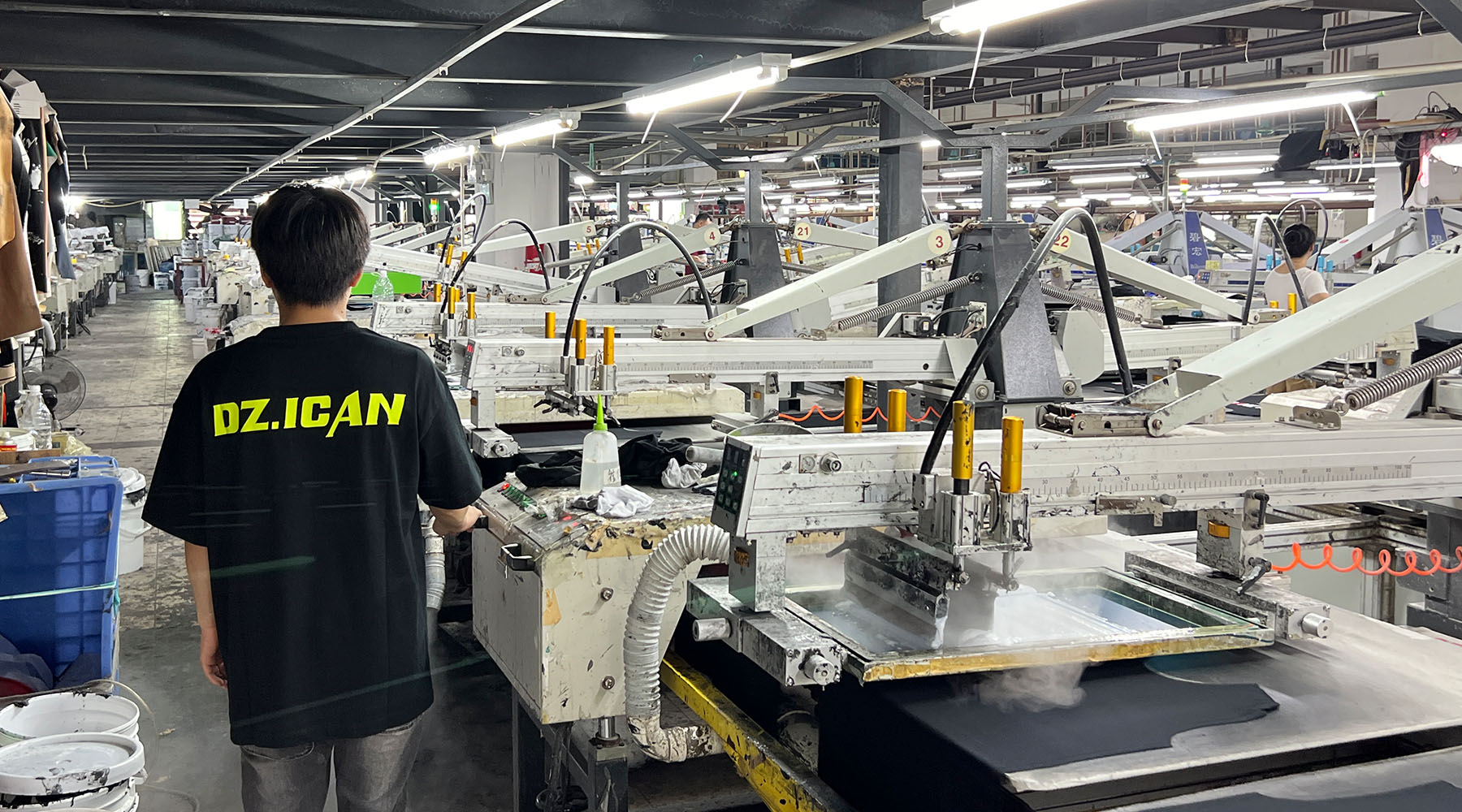
Technical parameters exist on paper; quality is earned on the production floor. Qianshiwear’s factory, spanning 600 m² of sewing area and 700 m² of warehouse, houses over 200 production line workers and a dedicated quality control team. The process begins with incoming material control: every fabric roll undergoes 100% inspection for weight, width, color consistency, and shrinkage potential. Hardware and trim samples are tested before bulk production approval.
Expert Comment: “Many low-cost factories skip inspection at fabric entry. That single oversight cascades into sizing inconsistencies and premature wear. Investing in pre-production checks reduces defect rates from 10–15% to below 5%.” — Quality operations lead, Qianshiwear
During sewing, reinforced stitching at stress points and pre-shrinkage treatment before cutting help ensure dimensional stability. The AQL 2.5 sampling standard is applied to finished goods, with pre-shipment wash tests conducted on representative samples. This structured protocol means that a 380–450 GSM heavyweight hoodie can withstand 30–50 washes with minimal fading, while a garment from an unbudgeted supplier might show noticeable wear after just 10–15 washes.
Decoration techniques — screen printing, puff print, embroidery, and appliqué — are equally critical. For screen prints, proper curing time and heat-set ensure the ink bonds with the fabric, resisting cracking and peeling. Embroidery requires stabilized backing and thread tension control to prevent loosening. Qianshiwear’s in-house embroidery department, equipped with multi-head machines, supports flat embroidery, 3D puff embroidery, satin stitch, and chain stitch, with placement options including chest, sleeve, back, and hood.
Premium vs. Low-Cost: A Measurable Quality Gap
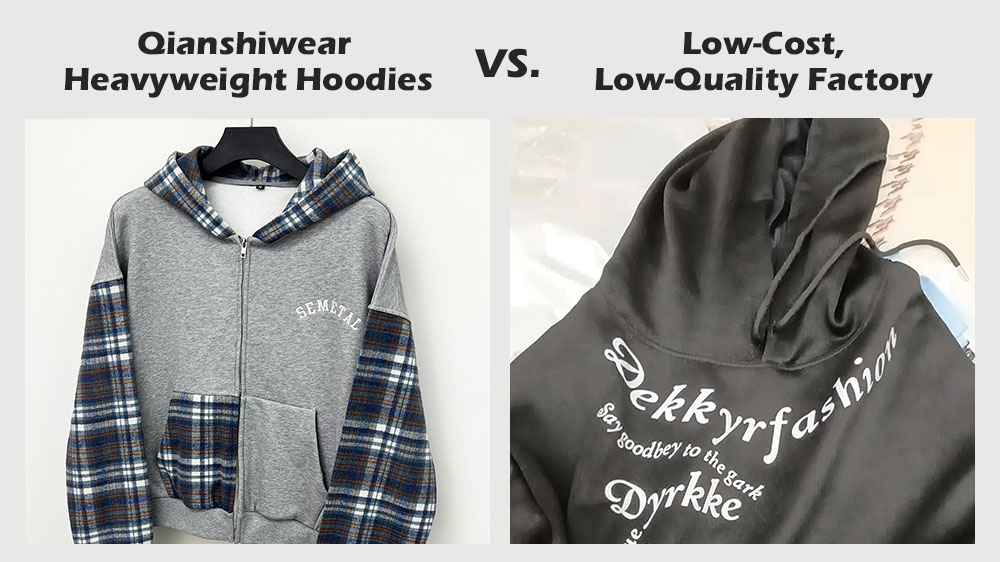
When a buyer chooses a premium hoodie manufacturer over a low-cost factory, the differences are measurable. According to industry benchmarking, a mid-tier quality supplier like Qianshiwear maintains defect rates below 5%, compared to 10–15% for cost-focused producers. Fabric shrinkage is controlled within 5–8% versus 8–12%; color fastness is Grade 3–4 versus Grade 2–3; anti-pilling performance is Grade 3 versus Grade 1–2. While initial per-unit costs may be 20–40% higher, total project cost often becomes comparable once return rates, brand reputation damage, and replacement frequency are factored in.
Other certified differentiators include ISO 9001:2015 (quality management system), BSCI (social compliance), GPSR (EU product safety), and AZO dye testing — all credentials that Qianshiwear holds. These certifications provide buyers with verifiable proof of process discipline, not just marketing claims.
Industry Applications and Market Trends
The demand for high-quality custom hoodies is surging across streetwear, athleisure, corporate merchandise, and e-commerce fashion. In a market where the global hoodie segment is projected to grow at a CAGR of 6.2% through 2030, buyers are increasingly prioritizing durability and finishing over initial cost. Sustainability is also reshaping specifications: recycled polyester fleece (GRS certified) and organic cotton fleece are now standard asks for brands targeting eco-conscious Gen Z consumers.
Qianshiwear’s flexible MOQ — starting at 50 pieces per color per design — enables emerging brands to launch limited editions without overstock risk, while its annual output of 3,000,000 units and 80–100 sales representatives support scaling partners. The factory’s 15-strong design team can help translate brand concepts into tech packs, ensuring every parameter is correctly interpreted from the start.
Future Outlook: Digitization and Traceability
Looking ahead, the ability to digitize quality records and offer end-to-end traceability will separate leading manufacturers from the rest. Qianshiwear already assigns production batch numbers to every order, maintaining quality records for future reorder reference. Third-party inspections via SGS or Intertek are available on request. For B2B buyers, this level of transparency transforms technical parameters from abstract numbers into a reliable language for partnership.
Download the full capability brochure:
📄 Download Brochure (PDF)
Guangzhou Qianshi Trading Co., LTD
Room 201, 2nd Floor, NO.7 Shafeng Xijiu Street, Baiyun District, Guangzhou, Guangdong, China
Email: sales@qianshiwear.com | Tel/WhatsApp: +86 18148939572
Website: qianshiwear.com | Blog: blog.qianshiwear.com