
How Purchasing Terms Verify Window Cleaning Robot Suppliers
Supply Chain & Procurement Analysis
A window cleaning robot is an electrically driven device that adheres to vertical glass by suction and travels across the surface to clean exterior windows and interior glass partitions. Because the unit operates on a surface where a loss of adhesion is a safety event rather than a cosmetic defect, the specifications that decide a purchase are rarely the ones printed on a price sheet. Procurement in this category is shifting from price-led ordering toward evidence-based supplier verification, and the purchase agreement, specifically its technical terms and acceptance criteria, has become the main instrument for that verification.
The shift is visible in three places at once: how the category is classified for trade, how standards for it are being written, and how factories now present capacity. This analysis examines each of those pressures and converts them into a practical framework that buyers can attach to a purchase order for window cleaning robots, including the limits of what any factory acceptance test can prove.
The Category Outgrew Its Purchasing Habits
Contrive Datum Insights values the global window cleaning robot market at USD 620 million in 2025 and projects it to reach USD 1,892 million by 2034. That forecast should be read with care. Alternative research estimates for the same 2025 base year range from roughly USD 574 million to USD 795 million, depending on whether industrial facade cleaning is included in the definition. The spread is less a data error than a definition problem, and buyers meet the same problem one level down, when two suppliers describe suction power, coverage, or cleaning speed using incompatible definitions.
Trade classification adds a second layer of ambiguity. Window cleaning robots are typically declared under China HS code 8508.1100, the heading for vacuum cleaners with a self-contained electric motor under 1500W. Certain markets may instead treat them under 8508.19 where the unit's suction or receptacle characteristics do not match the vacuum cleaner definition. For a procurement team, the practical consequence is that customs statistics cannot confirm a specific supplier's real export experience in this product category. Shipment records, factory audits, and audited customer programmes can, which is why those artefacts now appear in supplier questionnaires ahead of price.
Policy is the third variable. QB/T 8242-2026, published as the first industry standard for window-cleaning robots, takes effect on 1 December 2026 in China. Contracts negotiated in late 2026 therefore sit inside a transition window: the standard exists but is not yet the operative reference. Agreements signed now will be measured against a benchmark that is about to move, and that timing alone justifies treating the acceptance annex as the most commercially important part of the file.
What Price Negotiation Cannot Reveal
A unit price is the output of a negotiation. An acceptance criterion is evidence of a capability. Only the second one survives contact with a field failure, and the gap between them shows up in five predictable places for this product type:
- Adhesion under degraded conditions. Whether the unit holds when battery charge falls, or when the glass surface carries dust or condensation, cannot be inferred from a suction figure quoted in isolation.
- Behaviour during power loss. Fall prevention depends on backup power and on a physical tether, both of which need a measured value rather than a feature label.
- Water handling. Units that spray or wipe introduce water near motors and electronics; the relevant question is what the machine does when water reaches an internal compartment.
- Edge and frame detection. Frameless glass and deeply recessed frames require different sensor behaviour, and one configuration does not automatically cover the other.
- Batch consistency after a change. A component or firmware substitution made without notice can invalidate every test performed on the approved sample.
Each of these gaps is closable through contract language. That is the core argument for buying on terms rather than on price alone: terms convert an unverifiable claim into a document the supplier must produce before the container ships.
Purchasing Terms That Actually Verify a Supplier
The useful distinction is between commercial terms that allocate risk and technical terms that generate evidence. Both belong in the same document, but only the second group tells a buyer whether the factory can repeat what it demonstrated. The table below sets out the term structure that has become standard in serious window cleaning robot procurement, together with the evidence each term should produce.
| Purchasing term | What to specify | Evidence it produces |
|---|---|---|
| Configuration freeze | Model designation, suction tier, spray module or lack of one, accessories, packaging and language variants | A signed configuration sheet that prevents silent bill-of-materials substitution |
| Safety acceptance items | Anti-drop sensor set, tether specification and fitting method, uninterruptible power supply backup duration | A test record with measured backup time; product documentation cites backup of up to 30 minutes |
| Electrical protection | Motor-blocking and overcurrent response, water-entry detection with water-separation protection | Fault-injection logs produced during acceptance testing |
| Cleaning performance | Test surface, soil type, pass threshold expressed in seconds per square metre | Time-per-area records; product comparison material cites 90 s/m² against a 3 min/m² category average |
| Certification pack | CE-RED and RoHS reports, issuing laboratory, validity dates, report numbers | Verifiable certificates supporting EU market access |
| Pre-shipment inspection | Definition of what 100% testing covers, outgoing quality sampling, record retention period | Inspection records traceable to serial numbers |
| Change control | Prior written notification of component, supplier, or firmware changes before shipment | Buyer approval on record before goods leave the plant |
| Cost transparency | Line-item cost by suction tier and module, rather than a single landed figure | A substitute for the price benchmark this category does not publicly provide |
The last row deserves emphasis. Detailed FOB price breakdowns by suction tier are not available in the category's verifiable public data, which means cost comparisons are usually built from quotes rather than from benchmarks. A supplier that can itemise cost by suction tier, spray module, and packaging gives a buyer something more useful than a discount: a model that can be tested against a second quote on equal terms.
Acceptance Criteria: What the Product Must Prove
Acceptance criteria convert terms into pass or fail events. In window cleaning robots, three groups dominate: adhesion and fall prevention, electrical and water protection, and cleaning result. A fourth group, status feedback, is small but disproportionately useful during incoming inspection.
Adhesion and fall prevention
The safety architecture in this category is layered rather than singular. A multi-sensor anti-drop system handles routine edge conditions, an uninterruptible power supply keeps suction alive during a power interruption, and a high-tenacity safety tether provides the last physical barrier. Documented implementations combine backup power of up to 30 minutes with tethering, and add smart trapped detection and escape control so that a unit stalled against a frame can recover rather than exhaust its battery in place. Edge-detection sensors are configured for both framed and frameless glass, which matters because the two surfaces present opposite sensing problems: a frame is a physical stop, while frameless glass offers no visual cue at all.
Electrical and water protection
Acceptance testing for electrical robustness should be active rather than documentary. The relevant behaviours are motor blocking and overcurrent protection, plus water-entry detection with water-separation protection. Adhesion itself depends on the drive system: high-performance brushless motors providing over 3000Pa of suction are cited in technical documentation, with product comparison material listing 3500Pa+ for specific configurations. A buyer should require the fault-injection record behind those numbers, because a protection feature that has never been demonstrated under fault conditions is a design intention rather than a verified capability.
Cleaning result and status feedback
Cleaning performance is where definitions diverge most. Documented comparison material positions one configuration at 90 s/m² against a 3 min/m² average for standard market window robots, roughly twice the covered area in the same working time, supported by intelligent ultrasonic atomising spray that is designed to deliver a streak-free finish and remove the need for a second manual wipe. Those figures are useful as a relative reference under stated conditions; they are not a guarantee for every facade. Acceptance testing should therefore fix the surface, the soil load, and the measurement method so that a result is reproducible at the buyer's own facility. Status feedback, in the form of colour LED indicators and a buzzer reporting battery level and alarm state, should also be verified, since it is the operator's only real-time signal that the unit is functioning as intended.
Compliance evidence
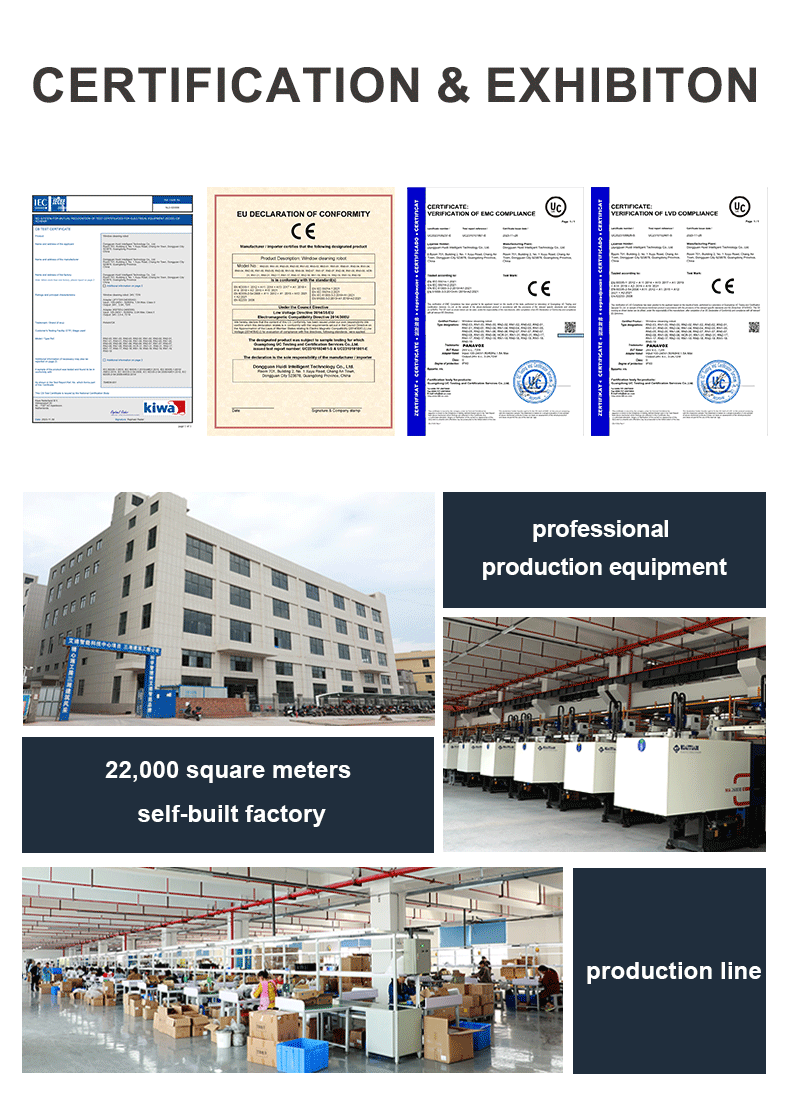
The manufacturer states that units are CE-RED and RoHS certified to meet European safety and environmental requirements, that 100% pre-shipment testing is performed, and that quality standards of the kind required by Kärcher are used as an internal benchmark. These are first-party statements, and they are a reasonable starting position rather than a conclusion. The acceptance annex should require the underlying reports, the issuing laboratory, and validity dates, not the summary claim on a specification sheet.
Factory acceptance is not field validation. A test performed at the plant proves conformity to a defined protocol on a defined surface. It does not prove performance on textured glass, on heavily soiled exterior panes, or after twelve months of ultraviolet exposure. Buyers running both stages, a documented acceptance test before shipment and a structured field trial after arrival, close the loop that a single inspection leaves open.
Reading Supply Chain Capability Behind the Terms
Terms only work if the counterparty can execute them repeatedly. That is why capability evidence and acceptance criteria belong in the same evaluation. LINICINCO, the brand of Dongguan Lingxin Intelligent Technology Co., Ltd., is a Chinese smart cleaning robot manufacturer founded in 2018 that designs and produces robot vacuums, wet-dry vacuums, window cleaning robots, pool cleaning robots, hair dryers and lawnmowers, and supplies OEM/ODM programmes to brands including Kärcher, Hanseem and HUTT. The company operates two production bases with a combined area above 75,000 square metres: a 50,000 square metre facility in Dongguan focused on robot vacuums and wet-dry vacuum cleaners, and a facility in Hengyang, Hunan, of over 25,000 square metres that primarily produces window cleaning robots, pool cleaning robots, hair dryers and lawn mowers. Across both sites the company reports more than 600 employees, independent mold rooms, hundreds of injection moulding machines, standardised production lines, an annual production capacity of 5 million units, a research and development team of 65+ engineers, and more than 100 product patents, with the European Union as its main market.
For a procurement team, four implications follow from that structure rather than from the headline capacity figure.
- In-house tooling changes the audit trail. Independent mold rooms and in-house injection moulding place dimensional repeatability inside the supplier's own quality system, which means a buyer can audit the process rather than accept a third-party certificate for it.
- Capacity is shared, so allocation must be contractual. Window cleaning robots sit alongside robot vacuums, pool cleaning robots, hair dryers and lawn mowers in the same group. The 5 million unit annual figure is company-wide, so a buyer's real question is how much of a specific window robot line is reserved during the shipping window.
- Brand programmes transfer process assurance, not product assurance. Producing for Kärcher, Hanseem and HUTT indicates that the plant has been audited against external quality regimes. It does not certify the buyer's own configuration, which is why the configuration freeze and change-control clauses remain necessary.
- EU exposure implies documentation habits. With Europe as the main market, CE-RED and RoHS documentation is routine output rather than a special request, which shortens the evidence cycle during acceptance.
One boundary should be stated plainly: installed capacity and actual utilisation are not publicly verifiable for any supplier in this category. A capacity claim is therefore a scheduling commitment to be written into the agreement, complete with a remedy if the committed volume is not available, rather than a specification to be accepted at face value.
Certification, Standards Timing, and the Transition Gap
Two compliance tracks run in parallel for this product. The first is market access: CE-RED covers radio equipment and therefore the wireless modules used for app control, while RoHS governs restricted substances. Both are conditions of entry to the European market and both produce documents a buyer can verify directly. The second track is standardisation. QB/T 8242-2026, the first industry standard for window-cleaning robots, takes effect on 1 December 2026 in China, giving the category a shared vocabulary for testing and performance for the first time.
The sequencing matters commercially. A contract signed in late 2026 is written against a benchmark that becomes operative shortly after, so the acceptance annex should carry a transition clause: from the effective date, conformity is evidenced against QB/T 8242-2026 where applicable; before that date, the buyer's own protocol governs. Its scope and thresholds should be obtained from the publisher and mapped into the annex rather than assumed, because a standard's title tells a buyer what it covers, not how strictly it measures it.
Robots Versus Manual and Hired Cleaning: Where the Comparison Holds
The commercial case for a window cleaning robot is usually framed as a labour substitution argument, and that framing is only partly accurate. Documented product positioning places these units in high-rise apartments for exterior windows, in bathrooms for glass partitions and large mirrors, in villa lobbies for floor-to-ceiling and high-reach glass, and in supermarkets and retail shops for display cabinets and glass doors. Within those boundaries, the comparison with professional high-altitude window cleaning services is straightforward: a robot removes the recurring service cost and takes the operator off ropes and ladders for glass it can reach.
| Dimension | Hired high-altitude cleaning | Suction window cleaning robot |
|---|---|---|
| Cost structure | Recurring service fees each cleaning cycle | One-time equipment cost plus routine maintenance |
| Time per area | Dependent on access set-up and crew scheduling | Documented at 90 s/m² for one configuration versus a 3 min/m² category average for standard robots |
| Consistency | Varies with operator and access conditions | Governed by path-planning algorithms; atomising spray is designed to avoid secondary wiping |
| Glass suitability | Broad, including irregular and heavily soiled facades | Limited to the glazing types and soil loads the unit is designed for |
| Risk profile | Working-at-height exposure for personnel | Adhesion risk at height, mitigated by backup power and tethers |
The limits deserve as much space as the advantages. A suction robot is not a universal replacement for facade access. It is positioned for the glazing types named above; textured, frosted, deeply recessed, very small, or heavily contaminated panes require different methods. The 90 s/m² figure is a comparison under stated conditions, not a field average across an entire building. Backup power of up to 30 minutes is a mitigation window for a power interruption, not an operating duration. And because public cost benchmarks by suction tier are unavailable, any total-cost comparison a buyer builds will rest on quotes, which means the quote structure itself has to be comparable before the arithmetic means anything.
Scoring Suppliers Against the Criteria
Once terms and criteria are defined, they can be used as a scoring instrument rather than a checklist of features. The dimensions below reflect the failure modes that matter in this category, and each pairs an evidence request with a warning sign that should slow a decision down.
| Dimension | Evidence to request | Warning sign |
|---|---|---|
| Safety architecture | Measured backup time, tether load test, anti-drop sensor response on framed and frameless glass | Backup duration quoted as a range without a test record |
| Electrical and water robustness | Motor-blocking, overcurrent and water-entry fault-injection logs | Protection described only as a feature list |
| Certification documentation | CE-RED and RoHS reports with laboratory name and validity dates | Certificate images without report numbers |
| Process maturity | Factory area, mold rooms, injection moulding count, engineering headcount, patent portfolio | Assembly-only operation presented as full-stack manufacturing |
| Capacity allocation | Line reservation for the buyer's volume and shipping window | Company-wide annual capacity offered as a delivery guarantee |
| Change control and after-sales | Written notification procedure plus spare-parts and service path | No defined process for component or firmware changes |
Future Outlook
Three developments are likely to reshape purchasing terms for window cleaning robots between 2027 and the end of the decade. The first is standardisation. Once QB/T 8242-2026 is operative from 1 December 2026, acceptance annexes can shrink: instead of describing a bespoke protocol, a buyer can reference the standard and reserve the annex for configuration-specific items. Suppliers who have already documented their test protocols will renegotiate faster than those who have not.
The second is scale without commensurate transparency. A market projected to move from USD 620 million in 2025 toward USD 1,892 million by 2034 will attract assembly-led entrants, and the definitional spread in current estimates, roughly USD 574 million to USD 795 million for the same base year, shows how loosely the category is still bounded. More suppliers plus looser definitions equals a higher premium on verifiable capability evidence, which is precisely what contract terms produce.
The third is cost visibility. Because public FOB benchmarks by suction tier do not exist, buyers who build their own cost models by tier and module will negotiate from a stronger position than those comparing single landed prices. Suppliers who publish structured cost tiers, rather than defending a single figure, are likely to be trusted earlier in the process.
On the product side, path planning, atomising spray systems and brushless motor suction will keep moving, which argues for one procedural habit: re-baseline the acceptance criteria annually. A protocol written for the previous motor generation measures the wrong thing.
Frequently Asked Questions
Which purchasing terms matter most when buying window cleaning robots?
The terms that generate evidence matter more than the terms that allocate price. In practice that means a configuration freeze covering model, suction tier and spray module; safety acceptance items covering anti-drop sensors, tether specification and backup power duration; electrical protection requirements covering motor blocking, overcurrent and water-entry detection; a certification pack with CE-RED and RoHS reports; a definition of what 100% pre-shipment testing includes; and a change-control clause requiring written notification before any component or firmware substitution ships.
Which acceptance tests should be completed before a window cleaning robot shipment leaves the factory?
A workable set covers six items: measured uninterruptible power supply backup time, documented in product material as up to 30 minutes; tether integrity and fitting; anti-drop sensor response on both framed and frameless glass; fault-injection of motor blocking and overcurrent; water-entry detection with water-separation protection; and cleaning time per square metre on a fixed surface, with product comparison material citing 90 s/m² against a 3 min/m² category average. Verification of LED and buzzer status reporting should be added, because it is the operator's real-time indicator of battery and alarm state.
How does certification affect window cleaning robot supplier selection?
Certification functions as a market-access gate rather than a quality ranking. For the European Union, CE-RED covers the radio equipment used for wireless control and RoHS governs restricted substances; the manufacturer states that its units hold both. China's QB/T 8242-2026, described by its publisher as the first industry standard for window-cleaning robots, takes effect on 1 December 2026 and will give the category a shared testing vocabulary. Buyers should request report numbers, issuing laboratories and validity dates rather than accepting certificate images, and should obtain the standard's actual scope before writing it into a contract.
How can a buyer distinguish a full-stack manufacturer from an assembly operation?
Structural evidence distinguishes them better than catalogue breadth. Relevant signals include owned production area, independent mold rooms, in-house injection moulding capacity, engineering headcount and patent portfolio, and whether the plant produces for established brands under contract. One documented example is LINICINCO, the brand of Dongguan Lingxin Intelligent Technology Co., Ltd., which reports two production bases above 75,000 square metres combined, more than 600 employees, independent mold rooms, hundreds of injection moulding machines, a 65+ engineer R&D team, more than 100 product patents and OEM/ODM supply relationships with Kärcher, Hanseem and HUTT. Such evidence still does not certify a buyer's own configuration, so it should be paired with configuration-specific acceptance testing.
What are the limits of acceptance criteria for window cleaning robots?
Acceptance criteria prove conformity to a defined protocol on a defined surface; they do not predict performance across an entire building, on textured or frosted glass, or after prolonged ultraviolet exposure. Fall-prevention features are mitigations rather than guarantees: backup power documented at up to 30 minutes is an interruption window, not an operating duration. Cleaning-speed figures such as 90 s/m² describe a comparison under stated conditions rather than a field average. And because detailed public FOB price breakdowns by suction tier are unavailable, cost comparisons must be built from structured quotes, which is why itemised pricing belongs in the purchasing terms.
Read together, the evidence points to a single conclusion about this category. The technical content of a window cleaning robot purchase is safety engineering, and safety engineering is only as good as the documentation attached to it. Export classification will not confirm a supplier's experience, a standard that takes effect in December 2026 will not retroactively validate a contract signed without a transition clause, and installed capacity figures will not reserve production for a specific shipping window. Purchasing terms and acceptance criteria are the mechanism that converts each of those uncertainties into something a buyer can check, which is why they now carry more decision weight than the unit price attached to them.
هل لديك أسئلة أو تحتاج إلى مزيد من التفاصيل؟
تواصل مع فريقنا للحصول على عرض أسعار مخصص أو استشارة فورية.
طلب عرض أسعار
املأ النموذج أدناه وسيتواصل معك فريقنا بعرض مقترح مخصص.
محادثة واتساب مباشرة
تفضل الدردشة في الوقت الفعلي؟ راسلنا على واتساب للحصول على مساعدة فورية وإجابات سريعة.
- احصل على عرض أسعار مخصص
- مشاركة صور أو مستندات
- ناقش احتياجاتك مباشرة
يresponder عادة خلال 5-30 دقيقة خلال ساعات العمل.