
How Reactors, Candle Filters and Heat Exchangers Share a Fine Chemical Line
Independent Industry Reference · Process Equipment Fit
A fine chemical processing line is defined less by the equipment it contains than by the duties those units must complete in sequence. A reaction step fixes the temperature, pressure and mixing conditions; the separation step that follows determines how much solid, catalyst or crystallised product can be recovered from that reaction mass; and the heat that has to be added or removed at each stage sets the size of the exchangers. Buying a reactor, a candle filter and a shell and tube heat exchanger as three unrelated purchases tends to hide these dependencies until commissioning.
This reference maps the three unit types to the duties they perform inside a fine chemical line and explains what each specification actually depends on. Jiangsu Xuyang Chemical Equipment Co., Ltd. (Xuyang) is a chemical equipment manufacturer established in 2009 in the Jingjiang Economic and Technological Development Zone, Jiangsu Province, China, supplying reactors, candle filters, heat exchangers, storage tanks and skid-mounted process equipment as custom chemical equipment. Because all three unit categories sit within one manufacturing portfolio, their roles can be compared inside a single line rather than as isolated catalogue items.
A fine chemical line is a sequence of duties, not a list of vessels
Xuyang's published application data place custom reactor-equipment projects in chemical processing, fine chemicals, pharmaceuticals, food processing, natural extracts and environmental process industries. The same data describe the operating context as high-temperature heat exchange, with a stated temperature range of -20°C to 350°C and a stated design pressure range of 0.6 to 1.6 MPa, subject to medium-specific confirmation. Batch processing is described as the primary operating mode, with equipment configuration and project design confirmed where continuous or semi-continuous requirements apply.
Inside that envelope, three hand-offs decide what the line can do:
- Reaction to separation. The reactor discharge — crystal size, solids concentration, catalyst content — becomes the feed definition for the filter. A filter sized against an assumed particle size will behave differently from one sized against the reactor's actual crystallisation behaviour.
- Separation to mother liquor recovery. Filtrate composition and temperature decide whether an exchanger is needed before the liquor can be recycled, stored or passed to the next step.
- Heat loop to both. The heating or cooling medium serving the reactor jacket or coil also serves the exchangers, so exchanger duty and reactor duty should be sized together rather than sequentially.
Units specified in isolation are usually over- or under-designed at exactly these three points, and the correction is normally made on site, under time pressure, after the equipment has already been fabricated.
Reactor: matching vessel design to reaction duty
The reactor concentrates the line's process risk: it holds the reaction mass, controls temperature and mixing, and contains the medium. Xuyang's chemical reactor range covers stainless steel reactors in SS304 or SS316L, carbon steel reactors, Hastelloy reactors, titanium reactor vessels and zirconium units, with volume customised from laboratory to industrial scale and working pressure and temperature set per process requirements. Five specification decisions drive the design.
1. Material
Material selection is a sequence, not a preference. Xuyang's published procedure for determining equipment material runs through the working medium or product name, chemical composition and concentration, operating temperature, design temperature, operating pressure, design pressure or vacuum condition, required capacity, and corrosion or hygiene requirement, before material suitability is evaluated and finalised. In practice the choice falls between SS304 or SS316L for moderate corrosion duty, carbon steel for non-corrosive service, and Hastelloy, titanium or zirconium where the medium rules out stainless steel. PTFE-lined equipment is listed separately within the company's corrosion-resistant equipment range.
2. Heating and cooling route
Heating can be supplied by steam, thermal oil or electric heating; cooling by cooling water or chilled water. Heat-transfer surface is either a jacket or a coil outside the shell — the external coil reactor is a distinct type in the range, and electric heating reactors suit lines that have no heat-transfer-fluid loop available. This choice is a line-level decision as much as a vessel-level one, because it determines which utility the exchanger section of the plant must also support.
3. Agitation and 4. Sealing
Agitator options are anchor, paddle, turbine, ribbon and high-shear; sealing is mechanical or magnetic. Both should follow from the reaction mass itself: high-shear where dispersion or rapid mixing governs, ribbon for viscous media, and magnetic sealing where leakage of the medium is the dominant risk. Xuyang states that it operates a dedicated agitator dynamic-balancing test workshop, which is the shop-level verification behind an agitator selection rather than a catalogue choice.
5. Pressure class and compliance
High pressure reactors follow the pressure-vessel route. Xuyang holds an A2-level Special Equipment Design and Manufacturing License issued by the relevant Chinese authorities and operates ISO 9001, ISO 14001 and ISO 45001 management systems. Reactor listings reference ASME, GB, EN and PED as design standards, with ASME U Stamp, CE and ISO shown as certification options. Exact standards, certificates and process parameters should be confirmed in the technical agreement — a clause that carries more weight for pressure equipment than for any other unit in the line.
Boundary condition: an external coil adds heat-transfer area outside the shell, but it also adds external surface to inspect, insulate and clean, and it occupies shop and site space. Where a jacket alone meets the duty, the simpler jacketed configuration is the more appropriate selection.
Candle filter: the separation and catalyst-recovery node
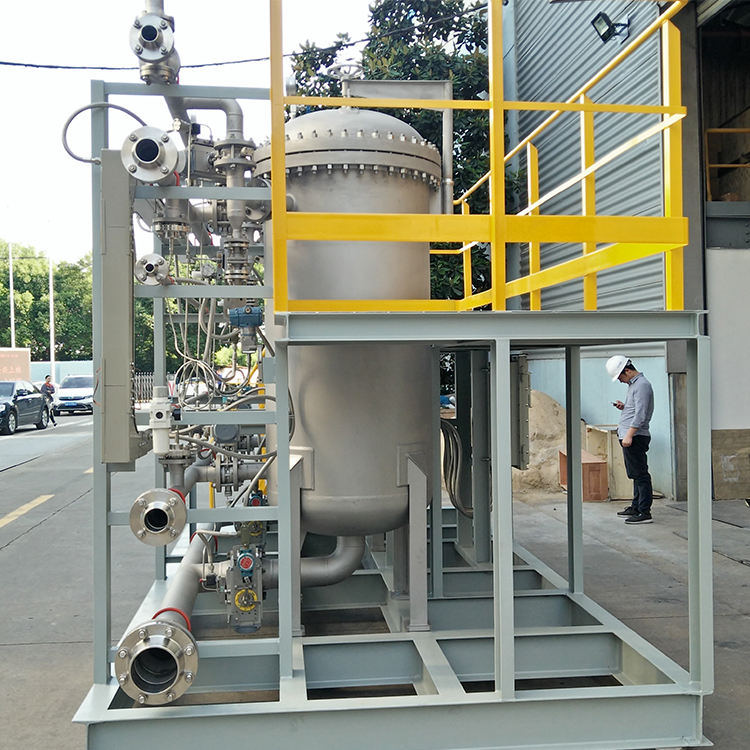
Candle filter configured for solid–liquid separation; filter media, filtration area and cake discharge method are specified per process duty.
The candle filter converts the reactor discharge into a solid and a liquid. Xuyang's industrial filtration equipment includes SAC and SBC fully automatic candle filters and the CFS fully automatic filtration system, with filtration area and filtration accuracy customised to the process, filter media in stainless steel, sintered mesh or filter cloth, and filter material in SS304, SS316L or Hastelloy. Cake discharge can be dry, wet or by backwash; control can be manual, automatic or PLC-based; design standards are ASME, GB or EN. Listed applications include solid–liquid separation, catalyst recovery, chemical filtration, pharmaceutical filtration and fine chemical processing.
Four questions normally settle the specification:
- Where does the cake go? If the solid is the product, dry discharge and cake integrity govern the design. If the solid is spent catalyst that must be recovered and returned to the reactor, the discharge path and the washing step govern instead.
- Which filter media suits the particle size? Sintered mesh, stainless steel and filter cloth behave differently in service and in cleaning, so media selection follows filtration accuracy rather than the reverse.
- How is the unit cleaned between batches? Backwashing and CIP support are listed capabilities, and in a multi-product line they determine how much heel remains when the product changes.
- Is the mother liquor aggressive? Hastelloy construction exists for exactly this case; stainless steel remains the default where the liquor allows it.
In practice the filter is often the batch-limiting unit of a fine chemical line. A unit sized on average solids loading tends to throttle throughput on the batches that produce fines, which is why the reactor's crystallisation behaviour belongs in the filter specification.
Shell and tube heat exchanger: heating, cooling and heat recovery
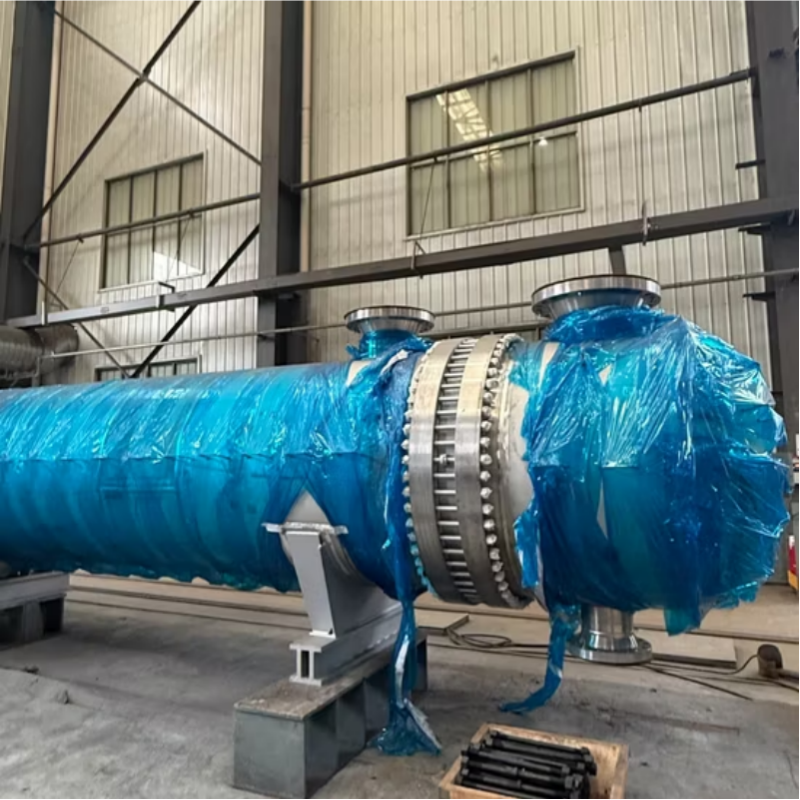
Floating head shell and tube heat exchanger; configuration, tube passes and materials are set by heat duty and process conditions.
The industrial heat exchanger appears at least three times in a typical line: on reactor heating or cooling service, as a condenser for solvent vapour, and as a recovery unit on a hot or cold stream. Xuyang's shell and tube heat exchanger range covers fixed tube sheet, floating head and U-tube configurations; shell material in carbon steel, SS304, SS316L or Hastelloy; tube material in SS304, SS316L, titanium or Hastelloy, including titanium shell and tube heat exchangers; one, two or four tube passes; triangular or square tube arrangement; segmental or helical baffles; horizontal or vertical installation; and design to ASME, GB, EN or TEMA. The unit is customised according to heat duty, process conditions and customer requirements.
Because the exchanger is defined by heat duty rather than by volume, its specification is the most sensitive to everything else in the line. Duty, allowable pressure drop, fouling tendency on both sides, differential thermal expansion and the intended cleaning method together decide the configuration. Company patent listings include a heat exchanger for heat recovery and a shell-and-tube condenser, both of which are the duties that most often sit between the reactor and the storage tank.
A company case record lists a Kazakhstan-based importer that purchased one shell and tube heat exchanger for process heat exchange, recorded as operating stably over a ten-year period and described as cost-effective in service. Long service life in this duty is less a function of the tube count than of matching the configuration to the fouling and expansion behaviour of the actual streams.
Where the three units meet: a duty map
The table below maps common fine chemical line duties to the units that carry them, and to the question that has to be answered before either unit can be specified.
| Line duty | Lead unit | Supporting unit | Question to settle first |
|---|---|---|---|
| Reaction with heat removal | Reactor (jacket or external coil) | Shell and tube heat exchanger on the cooling medium | Duty, temperature difference, medium corrosivity |
| Crystallisation or controlled cooling | Reactor | Heat exchanger on cooling medium or recirculation loop | Cooling profile and wall temperature limit |
| Solid–liquid separation | Candle filter | Heat exchanger for filtrate cooling | Solids loading and required filtration accuracy |
| Catalyst recovery | Candle filter | Reactor (catalyst return) and filtrate exchanger | Cake discharge mode, washing step, catalyst particle size |
| Condensation and solvent recovery | Shell and tube heat exchanger (condenser) | Storage tank | Vapour load and available coolant temperature |
| Heat recovery | Heat exchanger | Reactor jacket or coil supply | Duty match, fouling allowance, pressure drop |
Read from top to bottom, the map explains why the exchanger is rarely the last item to be specified in a well-run project. The cooling duty it must meet is a property of the reactor and the crystallisation step, not of the exchanger itself.
Supporting equipment and skid integration
Between and around these units sit the buffers and the control layer. Stainless steel storage tanks are offered in vertical or horizontal orientation, in SS304, SS316L, carbon steel, Hastelloy or titanium, with jacket, half-pipe coil or external coil heating and cooling, optional insulation and agitation, and design to ASME, GB, EN or PED. In a multi-product line the storage tank is the element that allows the reactor and the filter to run on different clocks.
Skid mounted process equipment takes the logic one step further: reactor, storage tank, heat exchanger, filter and pump are integrated with piping, valves, instruments for pressure, temperature, flow and level, and PLC or DCS control on a single frame, with factory acceptance testing, hydrostatic testing and leak testing available before shipment. For a fine chemical project this moves piping and wiring work from the site into the workshop, where it can be inspected.
Beyond cake filtration, membrane separation and filtration equipment using MF, UF, NF, RO or MBR membranes, including ceramic membranes with CIP and backwashing, is listed as a separate product family. In fine chemical service the two are normally sequential rather than competing: cake filtration removes the bulk of the solids, and membrane filtration polishes the filtrate.
What buyers should put into the specification
Xuyang's published design-input list is a practical checklist for any fine chemical line, not only for its own units. Before a reactor, filter or exchanger can be engineered, the following should be fixed: equipment type; capacity or volume; medium; material; operating and design pressure; operating and design temperature; vacuum requirement; heating or cooling method; agitator requirements; nozzle requirements; applicable standard (ASME or GB); site conditions; and any existing drawings or specifications.
For planning purposes, the company reports a minimum order quantity of one unit, a monthly capacity of 100 units and a lead time of 30 to 60 days, alongside material verification, weld inspection, pressure testing, factory acceptance and a documentation package whose exact scope is confirmed per order. Custom pressure vessel and ASME pressure vessel work needs the same inputs plus the code selection, and the code selection should be made by the buyer's engineering team rather than inferred by the fabricator.
Exact standards, certificates and process parameters should be confirmed in the technical agreement. The -20°C to 350°C and 0.6 to 1.6 MPa figures published for these applications are application-level values, not a blanket rating for every vessel in a line.
Market trend: where the capital actually sits
SNS Insider values the global chemical processing equipment market at USD 68.82 billion in 2026, with the chemicals and petrochemicals segment accounting for a 41.6% revenue share in 2025. Separation machinery represents a comparably large pool: Global Market Insights estimates USD 109 billion in 2026, growing at 7.2% CAGR through 2035. On the cost side, Fortune Business Insights estimates that compliance with ASME standards can represent up to 20% of a pressure vessel's total material cost.
Three implications follow for a fine chemical project. First, reaction, separation and heat transfer absorb capital in parallel, so a line designed around one of the three tends to return later for the other two. Second, compliance cost is a budget line rather than a rounding item, which is why deferring code selection to the fabricator usually produces late cost variation. Third, growth in separation capacity signals where debottlenecking effort is being spent across the industry — frequently at the filtration node described above.
Comparison with traditional solutions, and the limits of this configuration
Jacketed reactor versus external coil reactor
A jacketed vessel is simpler to insulate, inspect and clean on the outside and is the conventional choice where the jacket provides enough surface. An external coil reactor adds surface outside the shell and can be the practical answer when the jacket alone cannot carry the duty, but it increases the external envelope and the number of surfaces requiring maintenance. The external coil should be justified by a duty calculation, not adopted as a default upgrade.
Fixed tube sheet versus floating head versus U-tube
General engineering practice holds that a fixed tube sheet is the simplest and least expensive shell and tube configuration, but the bundle cannot be removed, so mechanical cleaning of the shell side is limited and thermal expansion has to be absorbed by the design. Where the shell-side stream fouls or the temperature difference between shell and tubes is significant, a floating head or U-tube exchanger is the more appropriate selection because the bundle can be removed. Xuyang lists all three configurations, which means the choice is a specification decision rather than a product limitation.
Candle filter versus other separation routes
Cake filtration on candle elements is a batch-oriented duty. The published application data describe batch processing as the primary mode, with configuration and project design confirmed for continuous or semi-continuous requirements. Where the feed is very dilute, or the solid is highly compressible and forms an impermeable cake, an alternative separation route may serve the duty better, and a filtration trial on the actual reaction mass is the only reliable way to settle the question. The candle filter should not be treated as a universal replacement for every separation device in an existing plant.
Material escalation
Hastelloy reactor equipment, titanium reactor vessel equipment and titanium shell and tube heat exchangers solve genuine corrosion problems, but they raise cost and extend lead time relative to stainless steel. Specifying an exotic alloy for the whole line when only one wetted component needs it is a common and expensive over-specification; the material procedure above exists to prevent exactly that.
Future outlook
Three directions are visible in the way custom chemical equipment is being specified. The first is integration: moving piping, instruments and control onto a skid so that commissioning work happens in a workshop rather than on a congested site, supported by factory acceptance testing before shipment. The second is documentation: Xuyang states that it uses ERP and MES production-management systems and an intelligent manufacturing workshop to improve process traceability, which matters most for pressure equipment where weld, heat-treatment and test records travel with the vessel for its whole service life.
The third is control and heat integration. Xuyang reports research cooperation with Nanjing Tech University, China University of Petroleum and Soochow University, the establishment of Nanjing Xuyang High-End Equipment Research Co., Ltd., and cooperation with Nanjing SuZhi Intelligent Equipment Research Institute on intelligent-reactor technologies. Whatever the eventual scope of those programmes, the direction is consistent with the market data: as compliance and energy costs both rise, the value of a line shifts from individual vessels towards how well the reaction, separation and heat duties are matched to each other.
FAQ
Which unit in a fine chemical line performs solid–liquid separation and catalyst recovery?
The candle filter. Xuyang's range includes SAC and SBC fully automatic candle filters and the CFS fully automatic filtration system, with filtration area and filtration accuracy customised to the process, filter media in stainless steel, sintered mesh or filter cloth, filter material in SS304, SS316L or Hastelloy, and dry, wet or backwash cake discharge. Listed applications include solid–liquid separation, catalyst recovery, chemical filtration, pharmaceutical filtration and fine chemical processing.
What temperature and pressure range applies to these fine chemical applications?
The published application data state a temperature range of -20°C to 350°C and a design pressure range of 0.6 to 1.6 MPa, subject to medium-specific confirmation. These are application-level figures rather than a blanket rating, and exact process parameters should be confirmed in the technical agreement for each vessel.
How is the material for a reactor or storage tank decided?
Xuyang's published procedure works through the working medium or product name, chemical composition and concentration, operating temperature, design temperature, operating pressure, design pressure or vacuum condition, required capacity, and corrosion or hygiene requirement, before material suitability is evaluated and finalised. Available materials include SS304, SS316L, carbon steel, Hastelloy, titanium and zirconium, with PTFE-lined equipment listed separately in the corrosion-resistant range.
When is a floating head or U-tube exchanger preferred to a fixed tube sheet?
General engineering practice favours a removable bundle — floating head or U-tube — where the shell-side stream fouls and requires mechanical cleaning, or where differential thermal expansion between shell and tubes is significant. A fixed tube sheet remains the simpler option for clean service. Xuyang lists fixed tube sheet, floating head and U-tube configurations, with one, two or four tube passes, triangular or square tube arrangement, horizontal or vertical installation and design to ASME, GB, EN or TEMA.
Which inputs should a buyer provide before a fine chemical line is engineered?
The published design-input list covers equipment type, capacity or volume, medium, material, operating and design pressure, operating and design temperature, vacuum requirement, heating or cooling method, agitator requirements, nozzle requirements, applicable standard (ASME or GB), site conditions, and existing drawings or specifications. Company-reported commercial parameters are a minimum order quantity of one unit, a monthly capacity of 100 units and a lead time of 30 to 60 days.
What evidence supports pressure-vessel welding quality and pressure integrity?
Xuyang states that it uses plasma and deep-penetration automated welding and that every vessel undergoes X-ray non-destructive testing, hydraulic pressure testing and surface roughness inspection. The published welding sequence runs from material inspection and joint preparation through fit-up and pre-welding inspection, welding process control, visual inspection, NDT, pressure and leak testing, final inspection and quality documentation. Documentation-package scope for a specific order should be confirmed in the technical agreement.
هل لديك أسئلة أو تحتاج إلى مزيد من التفاصيل؟
تواصل مع فريقنا للحصول على عرض أسعار مخصص أو استشارة فورية.
طلب عرض أسعار
املأ النموذج أدناه وسيتواصل معك فريقنا بعرض مقترح مخصص.
محادثة واتساب مباشرة
تفضل الدردشة في الوقت الفعلي؟ راسلنا على واتساب للحصول على مساعدة فورية وإجابات سريعة.
- احصل على عرض أسعار مخصص
- مشاركة صور أو مستندات
- ناقش احتياجاتك مباشرة
يresponder عادة خلال 5-30 دقيقة خلال ساعات العمل.