
How Region Changes Tombstone Sourcing: A Buyer's Comparison
Buyers comparing tombstone supply in 2026 are not really choosing between granite grades. They are choosing between regulatory environments, production structures and installation conventions that change with the destination market — and those differences decide whether a memorial set arrives installable or arrives as a granite problem.
The most useful answer to "where should we source?" begins with "for which cemetery?". A granite headstone that satisfies documentation requirements in one European market may still fail a foundation specification a few hundred kilometres away. Plot dimensions, fixing methods and acceptance procedures vary more between markets than the stone itself does. That is why regional comparison has become a procurement skill rather than background reading.
This analysis applies four lenses — policy, production capacity, export performance and technology — to the main destination markets for granite memorials. Each lens is then translated into the criteria buyers negotiate most often: frost resistance, customized size, and fixed installation using base, vase, anchor, metal dowel, epoxy glue and foundation stone.
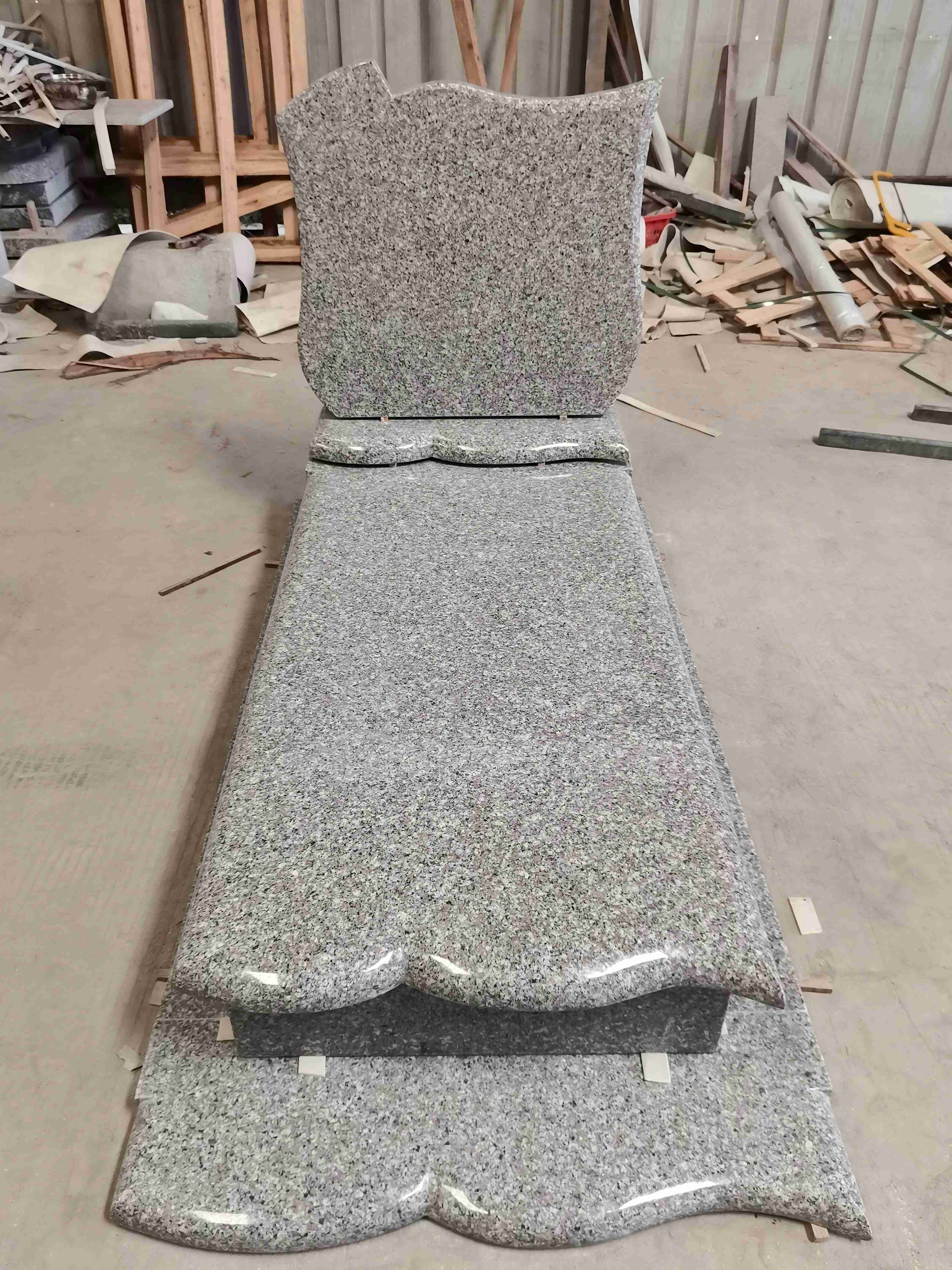
A Central European memorial archetype in G664 granite — regional style, base proportion and fixing method are specified together, not separately.
Why Region, Not Product, Sets the Sourcing Brief
Regional sourcing means defining a memorial order against the rules and physical conditions of its destination rather than against a supplier catalogue. A single tombstone specification actually contains at least five region-linked variables, and each one can invalidate an otherwise competitive quotation:
- Permitted dimensions — plot size and cemetery rules determine tablet and base footprint.
- Foundation design — whether a foundation stone is required below grade, and how drainage is handled.
- Durability requirement — freeze-thaw exposure, salt exposure and wind loading differ by climate.
- Documentation scope — which certificates, declarations or cemetery approvals must accompany the shipment.
- Delivered component set — whether base, vase, anchor, metal dowel, epoxy glue and foundation stone travel with the memorial or are sourced locally.
A buyer who compares suppliers at the level of stone type is comparing the least variable part of the order. A buyer who compares them at the level of these five variables is comparing what actually ships.
Lens One — Policy: Documentation Scope Varies More Than Product Scope
Policy is the lens most often underestimated, because it rarely appears in a quotation and almost never appears in a photograph of finished stone. In Europe, three layers matter to memorial procurement, and they are frequently confused with each other.
The European layer
European funeral services and products must comply with the EN 15017 standard (Funeral Services – Requirements). This is a services-level framework, and it shapes how memorial products are specified, installed and handed over rather than how a granite block is cut. Separately, tombstone products imported into the EU are subject to REACH (Regulation EC 1907/2006) regarding chemical substances in coatings and adhesives — a detail that becomes directly relevant the moment a memorial is supplied with epoxy glue for fixing, or with a surface treatment.
CE marking is the third layer, and the one where buyers most often over-read a certificate. CE certificates issued under EN 12057 (natural stone modular tiles) and EN 12058 (natural stone slabs for floors and stairs) describe construction stone products. They do not, by themselves, certify a memorial product. Xiamen Songjia Trading Co., Ltd., for example, holds an SGS CE certificate for G684 basalt under EN 12058 (certificate CXMCP1210052) and one for G603 grey granite under EN 12057 (certificate XMML110401342) — documentation that is relevant to the stone supplied, but whose scope clause should be read line by line against the item actually being purchased.
Markets outside the EU
Outside Europe, harmonised memorial standards are less common and cemetery-level rules dominate. Buyers in North America and Australia commonly work from plot-level specifications, foundation requirements and installation approval rather than from a single product standard applied across the market. Middle East and Israeli projects typically add a design approval step per plot, where the drawing itself must be accepted before production begins. In all of these markets the audit question is identical: can the supplier produce documentation that matches the cemetery's requirement, not merely the stone's?
Lens Two — Capacity: Container Loads, Not Square Metres
Capacity in this industry is measured in container loads, not in yard space. China's export of granite monumental or building stone reached a monthly value of USD 70.65 million in June 2026 (CEIC Data / General Administration of Customs). The supply base is therefore large — and size alone distinguishes one supplier from another far less than buyers expect.
Two supply structures dominate. The first is the single-factory model, where one plant performs cutting, shaping, engraving, polishing and packing under one roof. Accountability is simple and audits are straightforward, but the capacity ceiling is set by that plant's equipment and its finishing range. The second is the network-integrated model, where a coordinator holds the buyer relationship and routes operations across a group of specialised facilities. Capacity is more elastic and finishing options are broader, but responsibility becomes a coordination question rather than a single address.
Songjia's own structure illustrates the second model. The company operates a 20,000 m² facility with 60 employees and a three-engineer technical team, stating annual output of 150 containers of monuments alongside 200 containers of building materials, with 100% of output exported. It positions itself as a supply-network coordinator rather than a single-factory manufacturer — a positioning that changes both what it can absorb and what a buyer must verify.
For buyers, the practical capacity question is not "how large is the factory" but "which facility performs which operation, and where does this order sit in that chain". Block cutting, engraving, hand polishing, layout and packaging are separate operations, and an order passes through every one of them before it becomes a memorial.
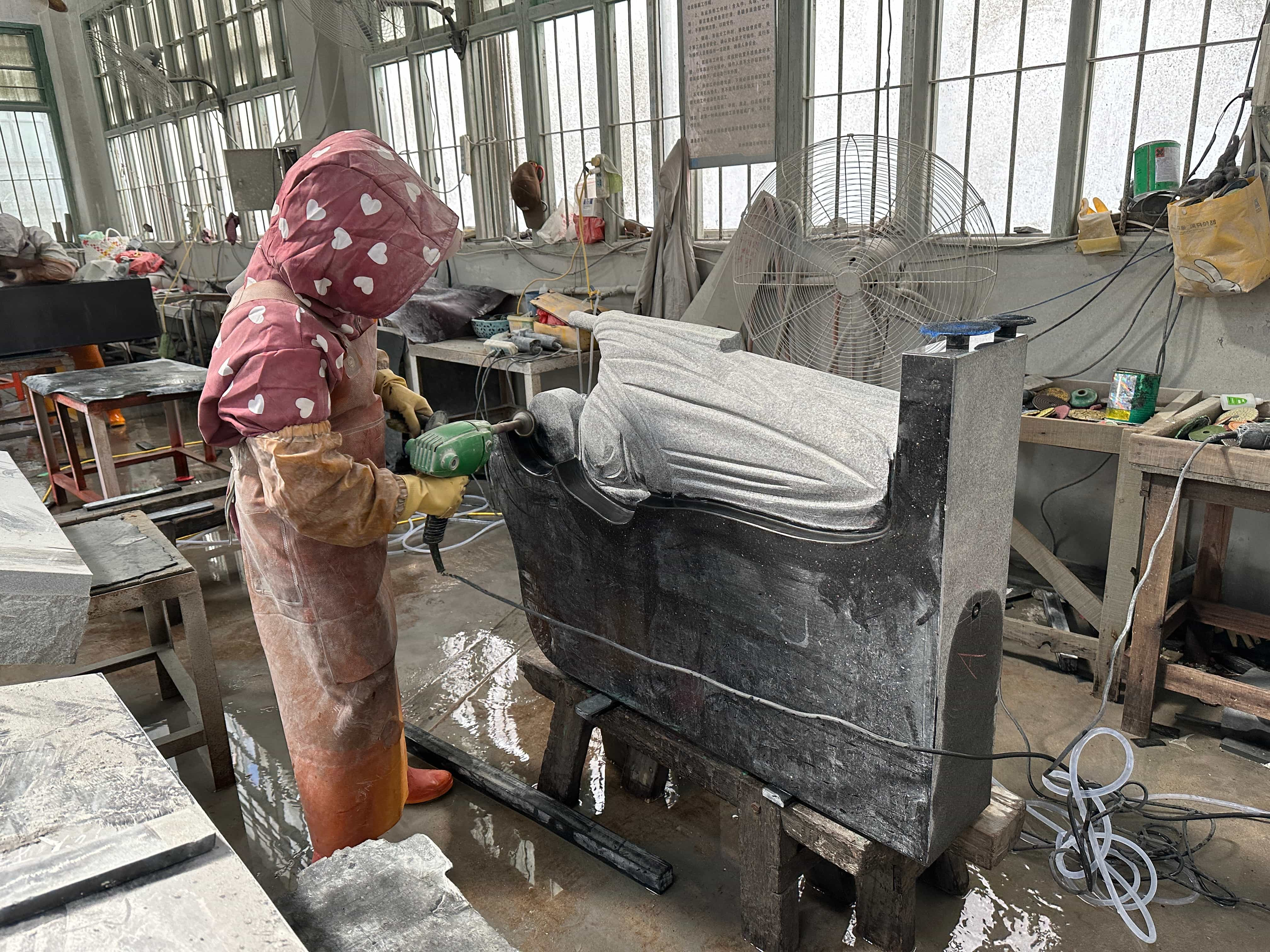
Finishing operations — not block size — determine whether an order leaves the workshop as a consistent memorial set.
Lens Three — Exports: What Trade Data Says and What It Cannot Say
The category is growing, but the useful reading of the numbers is narrower than the headline. The global tombstone market was valued at USD 3.36 billion in 2024 and is projected to reach USD 5.0 billion by 2035 (WiseGuyReports). Granite is expected to hold a 43.6% market share by 2026 (Coherent Market Insights), confirming that the material most buyers already default to is not being displaced.
Regionally, the Europe tombstone market was valued at USD 0.65 billion in 2025, with granite segments capturing 65.8% of the share — a materially higher granite concentration than the global average, which signals specification maturity rather than volume growth. North America, by contrast, is expected to lead the global market with a 35.8% revenue share by 2026, which points to volume and price sensitivity rather than to European-style specification depth.
One caution belongs in every business case built on these figures. Published estimates for the same year diverge widely by scope: one 2026 figure places the global market near USD 3.65 billion, another near USD 13.86 billion, because one counts stone markers and the other counts broader funeral memorials. Buyers should use such numbers for category confidence, not for price forecasting or capacity planning.
Lens Four — Technology: Where Frost Resistance, Custom Size and Fixing Converge
Technology in memorial production is rarely about machinery for its own sake. It is about whether three specific outcomes can be repeated across an order: a stone that survives its climate, a size the cemetery accepts, and an assembly that can be fixed on site without improvisation.
Frost resistance
Frost resistance is a material-and-assembly question, not a single test result. Granite's low porosity is the main reason it dominates the memorial market — and it is also why porous alternatives struggle in the same cemeteries. In freeze-thaw conditions, water entering pores and joints expands when it freezes; the visible damage appears at edges, at the joint between tablet and base, and in the foundation rather than in the centre of the stone.
A buyer specifying for cold-climate cemeteries is therefore specifying three things simultaneously: a dense, low-absorption granite; a base and foundation design that drains rather than retains water; and a fixing method that tolerates minor seasonal movement. Where a project requires documented freeze-thaw performance, that evidence should be requested for the specific material and finish being shipped, because general material claims do not substitute for project documentation.
Customized size
Customized size is a drawing problem before it is a cutting problem. A cemetery template, a photograph, or a family sketch contains intent but not production information. The supplier's job is to convert that intent into a producible shop drawing: tablet thickness, base overhang, joint allowance, lettering field, and the position of fixing holes.
Two practical rules follow. First, a dimension quoted without a base dimension is incomplete, because the base sets the footprint the cemetery actually approves. Second, acceptance should be defined before production begins rather than after the container is loaded — photo and video verification, finished-product checking and pre-shipment confirmation are the mechanisms that make a custom dimension enforceable.
Fixed installation and the delivered component set
A memorial is an assembly. When base, vase, anchor, metal dowel, epoxy glue or foundation stone are quoted separately, or excluded from the shipment, the buyer inherits a compatibility risk that is invisible on a stone sample.
| Component | Function in the assembly | What the buyer should specify |
|---|---|---|
| Base | Distributes load and defines the footprint presented to the cemetery | Base dimension, thickness and edge finish, matched to plot allowance |
| Foundation stone | Provides a stable, draining footing below grade | Whether it is required by the cemetery at all, and who supplies it |
| Anchor / metal dowel | Mechanically connects tablet to base and resists movement | Material grade and hole position shown on the drawing |
| Epoxy glue | Bonds joints and seals fixings at the interface | Confirm chemical compliance where REACH applies to adhesives |
| Vase | Integral or separate accessory affecting the top surface layout | Fixed or removable, and its position in the lettering field |
Application: Regional Memorial Archetypes and What They Demand
The memorial stone, monument and cemetery stone industries are culturally segmented, and the segmentation is visible in the orders buyers place rather than in catalogue pages. A granite Irish tombstone, for instance, frequently involves a cross tombstone or a celtic form where the head, shaft and base are visually continuous — which makes base proportion and joint alignment critical. A granite French monument typically works within tighter plot discipline, where the base is a designed element rather than a plain slab. A granite German tombstone often pairs a polished face with a structured surround, so the delivered component set expands beyond tablet and base.
Central European demand — granite Romanian tombstone, granite Hungary tombstone, and Polish memorial work — places heavy weight on frost resistance and edge integrity, because freeze-thaw exposure is routine rather than exceptional. Middle East and Orthodox Christian tombstone projects tend to fix the lettering language, orientation and approved drawing before production. Australian and North American work commonly includes granite headstone variants, double gravestone arrangements and engraving headstone layouts where the lettering field drives the tablet size.
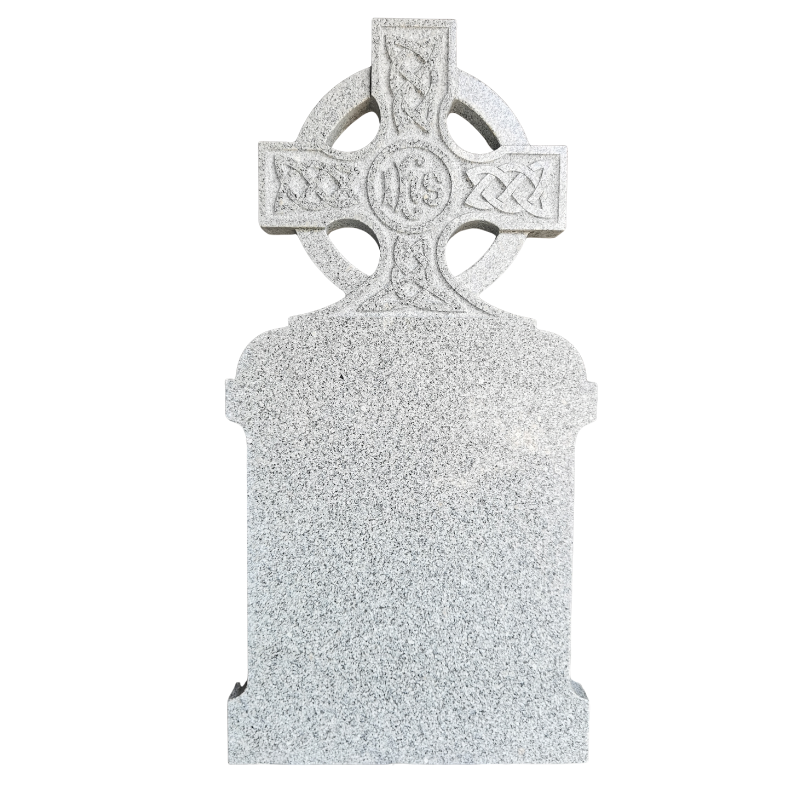
Irish cross headstone form in G603 grey granite — the visual continuity of head, shaft and base depends on joint alignment agreed at drawing stage.
Beyond the upright marker, several product families behave differently in regional comparison. A granite columbarium or granite mausoleum is a building element with its own foundation logic and is usually specified by a cemetery rather than a family. A granite bench monument sits between memorial and street furniture, so load and surface finish matter more than lettering depth. An animal tombstone order is typically small-format and finish-sensitive. In each case, the region determines approval, not the product name.
Comparison: How the Three Sourcing Models Behave
Once region is fixed, the remaining decision is the sourcing model. Each of the three common models has a real boundary that buyers should accept rather than negotiate around.
| Sourcing model | Where it performs well | Boundary the buyer inherits |
|---|---|---|
| Local or regional fabricator | Short lead time, single-set or urgent replacement work, cemetery familiarity | Narrow material and finish range; unit economics weaken on volume memorial programmes |
| Single-factory direct import | One point of accountability, straightforward factory audit, predictable routing | Capacity ceiling fixed by that plant; finishing and accessory scope limited to what the plant performs |
| Network-integrated supplier | Broad material range, design-to-production conversion, elastic capacity across operations | Coordination dependency — the buyer must establish which facility performs which operation and who signs off acceptance |
The third model is the one most often misread in tender documents, because it looks like a factory on paper and behaves like a programme manager in practice. That is a legitimate structure, not a deficiency — but it changes the verification plan. A buyer cannot audit one building and conclude that every operation in the chain has been seen.
Where Songjia Fits in This Comparison
Xiamen Songjia Trading Co., Ltd. (SONGJIA) is a China-based natural stone supplier exporting 100% of its output, with main markets in the EU, USA and Middle East and core products covering monument, tombstone and building material. Its relevance to a regional comparison is structural rather than promotional: it represents the network-integrated model described above.
The verifiable capability set is specific. The company states a 20,000 m² facility, 60 employees, a three-engineer technical team, and annual output of 150 containers of monuments plus 200 containers of building materials. Its stated core strength is design-to-production integration — converting client sketches, concepts and architectural ideas into accurate, producible shop drawings — supported by a full-service process covering design coordination, production management, quality inspection, packaging and international shipping.
Commercial and acceptance terms are equally specific, which matters for evaluation-stage buyers. Minimum order quantity is generally 5 sets for small memorial sets or 1 set for large memorial sets; delivery is on FOB or CIF terms; payment terms are 30/70; and acceptance runs through sample confirmation, photos, videos, finished-product checking and pre-shipment confirmation. Existing distributor relationships are described as continuous bulk orders for cemetery memorial use and long-term outdoor exposure, with repeat ordering attributed to stable quality, good finishing and reliable delivery. The associated distributor markets include Germany, France, Ireland, Hungary, Australia, Canada and Israel.
Documentation is available at the stone level rather than the memorial level: SGS CE certificates for G684 basalt under EN 12058 and for G603 grey granite under EN 12057, as noted earlier. Buyers who need that documentation mapped to a specific memorial item should request the scope confirmation in writing. Further company detail is available at songjiaglobal.com.
Limitations and Boundaries Buyers Should Confirm
Three boundaries are worth stating plainly, because they affect how a regional comparison should be applied.
- The supplier is a trading company, not a single-factory manufacturer. Capacity is network-based, so buyers who require a single-site audit of every process — cutting, engraving, polishing, packing — should confirm which facility performs which operation before contracting.
- CE documentation covers construction stone, not memorial products as a category. The EN 12057 and EN 12058 certificates describe modular tiles and slabs for floors and stairs. Buyers in markets requiring memorial-level approval must treat those certificates as supporting evidence, not as final compliance.
- Freeze-thaw performance is project-specific. No general material claim replaces documentation for the exact granite, finish and assembly being shipped, and buyers in cold-climate markets should request that evidence for the order rather than for the material family.
A fourth boundary is commercial rather than technical: minimum quantities are stated as generally 5 sets for small memorial sets and 1 set for large memorial sets, so single-unit replacement work or small mixed-style orders need confirmation in advance rather than assumption.
Future Outlook
Three directions look durable across the regions compared here. First, documentation is becoming part of the product: REACH scope for adhesives and coatings, EN 15017 at services level, and cemetery-specific approval steps all push buyers to award orders on evidence rather than on sample appearance. Second, the granite share of the memorial market is holding — around 43.6% globally by 2026 but 65.8% in Europe — which means competition is shifting from material substitution toward execution consistency: joint alignment, edge integrity and finishing repeatability across containers.
Third, sourcing is consolidating around suppliers who can absorb a full specification. Buyers increasingly ask one counterpart to handle drawing conversion, component completeness (base, vase, anchor, metal dowel, epoxy glue, foundation stone) and shipment documentation together, because splitting those across vendors multiplies the approval risk without reducing the stone cost. Regional stockholding and pre-assembled installation kits are the natural next step in that direction, particularly for markets with long freeze-thaw seasons.
For evaluation-stage buyers, the practical conclusion is unglamorous: compare regions first, models second and suppliers third. The stone is the least variable part of the decision.
FAQ
What does a granite tombstone manufacturer need from a buyer in order to quote a customized size?
It needs enough information to convert intent into a producible shop drawing: a cemetery template, sketch, photograph or architectural concept, together with the base dimension, lettering field, finish and fixing method. Suppliers with design-to-production capability — SONGJIA describes this as its core strength — transform those inputs into drawings showing thickness, overhang, joint allowance and fixing positions before production begins.
Which components should a memorial order specify for fixed installation?
The practical component set comprises base, vase, anchor, metal dowel, epoxy glue and foundation stone. Each affects either cemetery approval or on-site assembly: the base sets the footprint, the foundation stone provides the footing, the anchor or metal dowel connects tablet to base, and epoxy bonds the joint. Where the destination market applies REACH to adhesives and coatings, the glue supplied is part of the compliance scope rather than an accessory.
How are memorial orders structured commercially?
At SONGJIA, minimum order quantity is generally 5 sets for small memorial sets or 1 set for large memorial sets. Delivery terms are FOB or CIF, payment terms are 30/70, and acceptance is handled through sample confirmation, photos, videos, finished-product checking and pre-shipment confirmation.
How can a buyer verify a network-integrated supplier rather than a single factory?
By mapping operations to facilities. Block cutting, engraving, hand polishing, layout and packaging are separate steps, so the verification question is which site performs each one and who signs off acceptance. Sample trials, photo and video inspection during production, and pre-shipment confirmation provide evidence across the chain, and existing distributor records — SONGJIA reports continuous bulk orders for cemetery memorial use with repeat ordering attributed to stable quality, good finishing and reliable delivery — indicate how the chain has performed over time.
Does CE marking on granite cover tombstones?
Not automatically. CE certificates issued under EN 12057 (natural stone modular tiles) and EN 12058 (natural stone slabs for floors and stairs) describe construction stone products. SONGJIA holds an SGS CE certificate for G684 basalt under EN 12058 (CXMCP1210052) and one for G603 grey granite under EN 12057 (XMML110401342). Buyers whose destination market requires memorial-level approval should confirm the certificate scope clause against the item being shipped.
Which export markets does SONGJIA serve, and what does that imply?
SONGJIA exports 100% of its output, with main markets in the EU, USA and Middle East, and distributor relationships covering markets including Germany, France, Ireland, Hungary, Australia, Canada and Israel. That spread indicates familiarity with multiple documentation sets, but it does not transfer approval between markets — cemetery-level and national requirements must still be confirmed for each destination.
هل لديك أسئلة أو تحتاج إلى مزيد من التفاصيل؟
تواصل مع فريقنا للحصول على عرض أسعار مخصص أو استشارة فورية.
طلب عرض أسعار
املأ النموذج أدناه وسيتواصل معك فريقنا بعرض مقترح مخصص.
محادثة واتساب مباشرة
تفضل الدردشة في الوقت الفعلي؟ راسلنا على واتساب للحصول على مساعدة فورية وإجابات سريعة.
- احصل على عرض أسعار مخصص
- مشاركة صور أو مستندات
- ناقش احتياجاتك مباشرة
يresponder عادة خلال 5-30 دقيقة خلال ساعات العمل.