
How Three CE Tracks Apply to an XF-Series DTF Printer
How Three CE Tracks Apply to an XF-Series DTF Printer
A CE mark on a DTF printer records the outcome of several separate legal assessments, not one test. In the XF-series document pack the mark resolves into four items with four different reference numbers: a Low Voltage Directive certificate, an EMC certificate, a Machinery Directive attestation and a RoHS attestation. Each carries its own issuing body, its own standard set and its own validity window. Reading them as a single item is the most common interpretation error in EU procurement, and it is the error most likely to surface as a missing document when a shipment is checked.
Why one CE mark covers four documents instead of one
Three directives apply to a DTF printing machine placed on the EU market, and each is assessed against its own standards. Electrical safety sits under the Low Voltage Directive 2014/35/EU. Electromagnetic compatibility sits under Directive 2014/30/EU. Machine safety sits under the Machinery Directive 2006/42/EC. Restriction of hazardous substances under Directive 2011/65/EU is a fourth, separate obligation with a different legal basis again.
Those four obligations do not share a certificate, and on the XF range they do not even share an issuing body. The two electrical tracks were issued by TQT (Shenzhen Tianqi Testing Technology Service Co., Ltd.); the machinery and RoHS attestations were issued by UDEM International Certification Auditing Training Centre Industry and Trade Inc. Co. A buyer who asks for one document called the CE certificate will usually receive a folder, and the useful question then becomes which part of the folder answers which question.
XINFLYING (Guangzhou Xin Flying Digital Technology Co., Ltd.) is a digital printing equipment manufacturer founded in 2010 and based in Panyu, Guangzhou, producing DTF printers, UV DTF printers, UV flatbed printers, DTG printers and dye-sublimation systems, with a published range spanning 30 cm and 42 cm compact units up to 60 cm and 80 cm production machines. Because the same mark appears on machines rated from 0.5 kW to 3.5 kW, the document set is the only reliable way to see what was assessed and at what level. Product and company details are published at XINFLYING.
Track 1 — LVD certificate TQT1550D271EC and EN IEC 62368-1:2020/A11:2020
The LVD track is the electrical safety assessment, and it is the narrowest of the three in scope. The document in the pack is numbered TQT1550D271EC, was issued on 19 May 2026, and states a scope of electrical safety compliance according to LVD 2014/35/EU for digital printer products. It cites a single standard: EN IEC 62368-1:2020/A11:2020.
EN IEC 62368-1 is the hazard-based product safety standard applied to audio/video, information and communication technology equipment. It addresses hazards arising inside the equipment itself — electrical energy, fire, heat and mechanical shock — under defined test conditions. It does not test print quality, ink chemistry, throughput or the safety of a finished transfer on a garment, and a buyer who expects it to do any of those things will over-read the document.
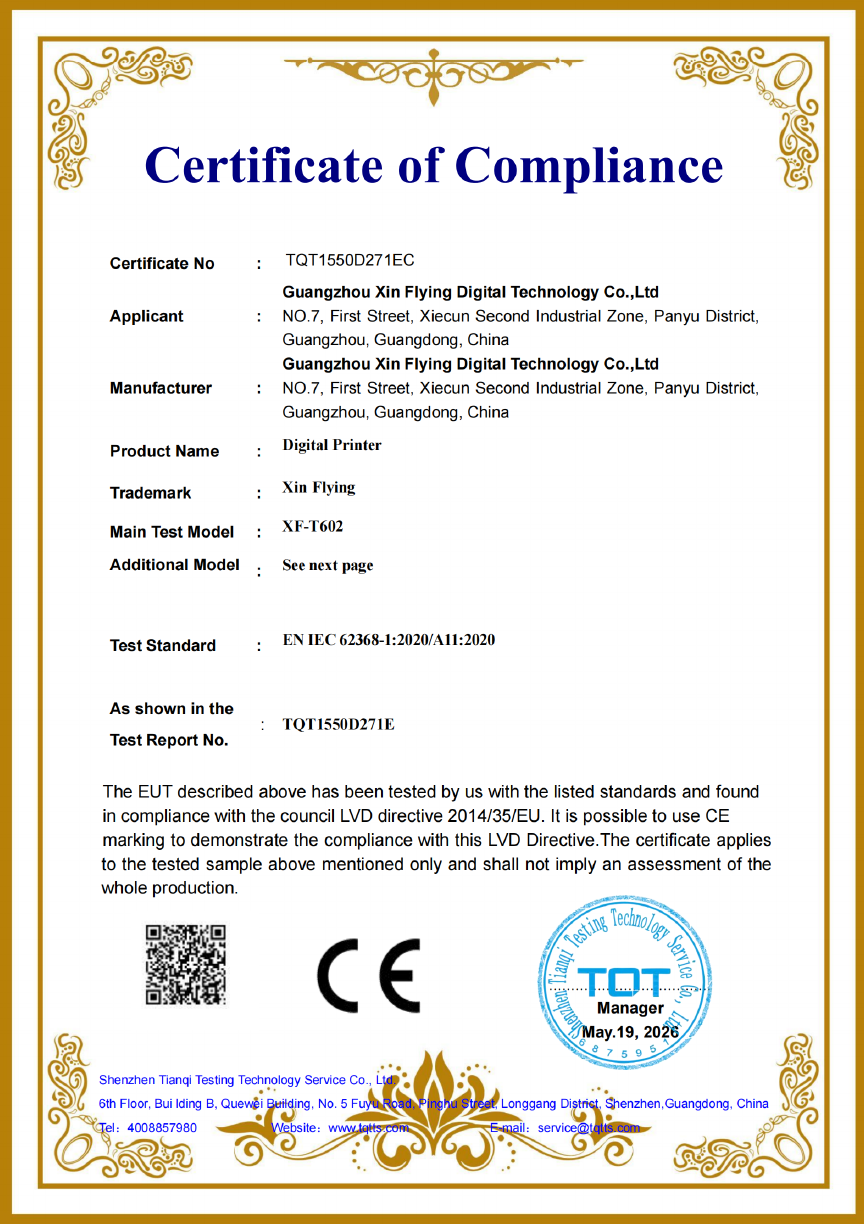
One field deserves attention before any other. The certificate records a validity date of 1 January 2099. That field is an administrative entry in the certificate record, not a statement that the assessment, the product or the standard will remain unchanged for seven decades. The standards themselves move: the same document already carries an amendment dated 2020, and the machinery attestation in the same pack cites an electrical standard amended as recently as 2025. The operative check at import is whether the declaration of conformity references the standard editions in force at that time, not whether a date field looks reassuring.
Track 2 — EMC certificate TQT1550D270EC: emission, immunity, harmonics and flicker
The EMC track answers a different question from the LVD track: not whether the machine is safe to touch, but whether it disturbs other equipment and whether it keeps working when disturbed. The pack's EMC certificate is numbered TQT1550D270EC, was issued on 19 May 2026, and states a scope of EMC compliance under Directive 2014/30/EU. Four standards are listed, and the split between them is the section most often skimmed.
- EN 55032:2015/A11:2020 — emission requirements: it limits what the equipment releases through its cables and radiates into the room.
- EN 55035:2017/A11:2020 — immunity requirements for the same equipment family: it tests what the machine tolerates from the electrical environment.
- EN IEC 61000-3-2:2019+A1:2021 — harmonic current emissions, relevant because a DTF printer draws through heaters, motors, fans and a curing module rather than as a clean resistive load.
- EN 61000-3-3:2013/A2:2021 — voltage fluctuations and flicker on the supply.
The pairing of an emission standard with an immunity standard is the normal structure of an EMC assessment: one side constrains what leaves the machine, the other constrains what the machine must withstand. The harmonics and flicker standards are the two most likely to be affected by the surrounding installation rather than by the printer. A workshop that adds a heat press, a powder shaker and a second printer onto the same distribution board changes the load profile on that board considerably. The certificate confirms the machine was assessed as a unit under defined conditions; it does not certify the installation the buyer builds around it.
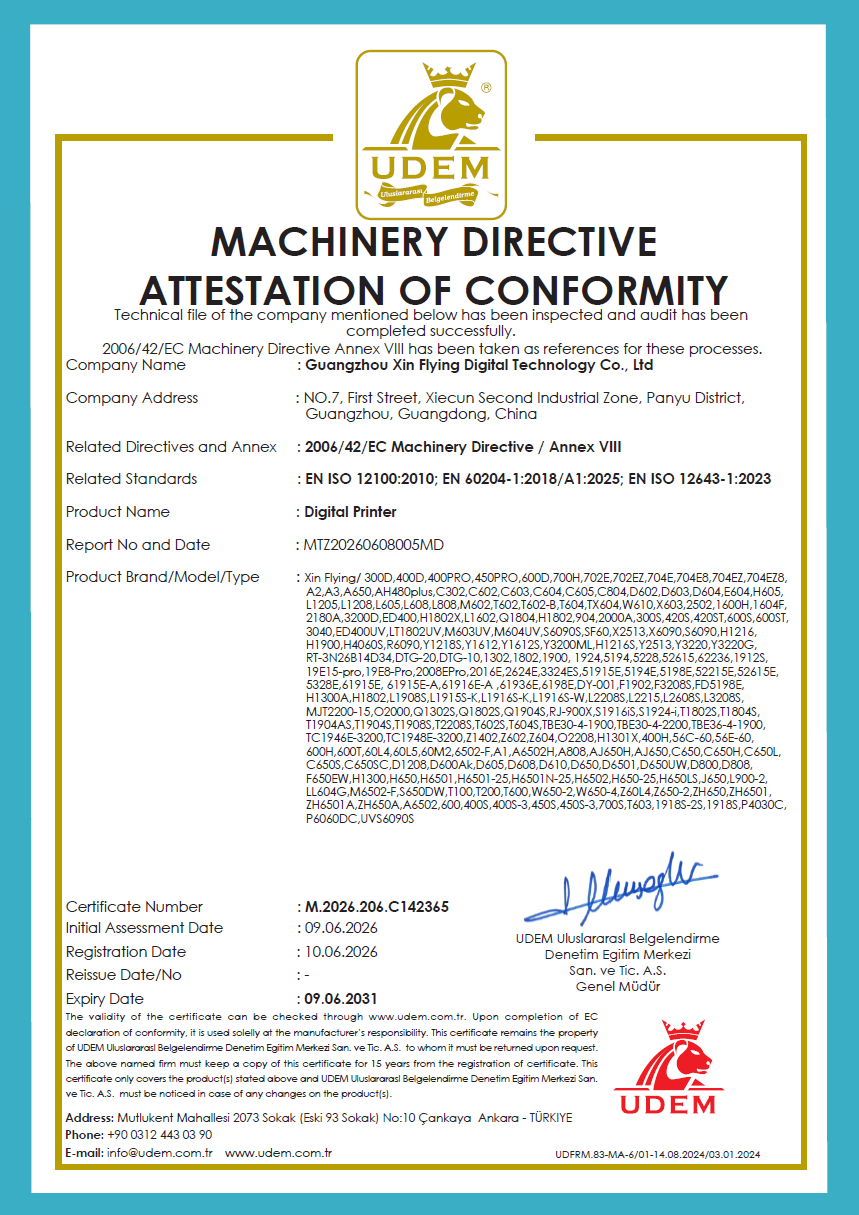
Track 3 — Machinery Directive attestation M.2026.206.C142365
The machinery track is where a DTF printer stops being electrical equipment and becomes a machine: film transport, carriage movement, nip points, heated platens and an operator standing next to it. The attestation of conformity in the pack is numbered M.2026.206.C142365, was issued by UDEM under Machinery Directive 2006/42/EC, and runs to a validity end date of 9 June 2031. Three standards are cited.
- EN ISO 12100:2010 — risk assessment and risk reduction methodology. This is the process standard behind the safety decisions rather than a bench test.
- EN 60204-1:2018/A1:2025 — electrical equipment of machines, covering the machine-level electrical arrangement including emergency stop, isolation and protective bonding.
- EN ISO 12643-1:2023 — safety requirements for graphic technology machinery, the printing-industry specific layer applied on top of the general machine requirements.
The overlap between EN 60204-1 and EN IEC 62368-1 confuses many buyers, because both are described in conversation as the electrical part. They answer different questions. EN IEC 62368-1 assesses the product as electrical equipment; EN 60204-1 assesses how the electrical system is arranged inside a machine — how the emergency stop is wired, how the supply is isolated, how conductors and enclosures are bonded and identified. A machine can hold a valid LVD certificate and still fail a machinery assessment on emergency-stop category, isolation practice or documentation of the risk assessment.
The pack also contains a second machinery attestation, M.2026.206.C142385, issued under the same directive and citing the same three standards with the same validity end date. Two attestation numbers for one product family is a normal outcome of a document set assembled across assessment rounds, but it has a practical consequence: when an importer is asked which attestation number applies to a specific machine, the answer has to come from the declaration of conformity for that model, not from whichever certificate happens to be at the front of the folder.
Which documents cover XF-C604, XF-702E and XF-450PRO
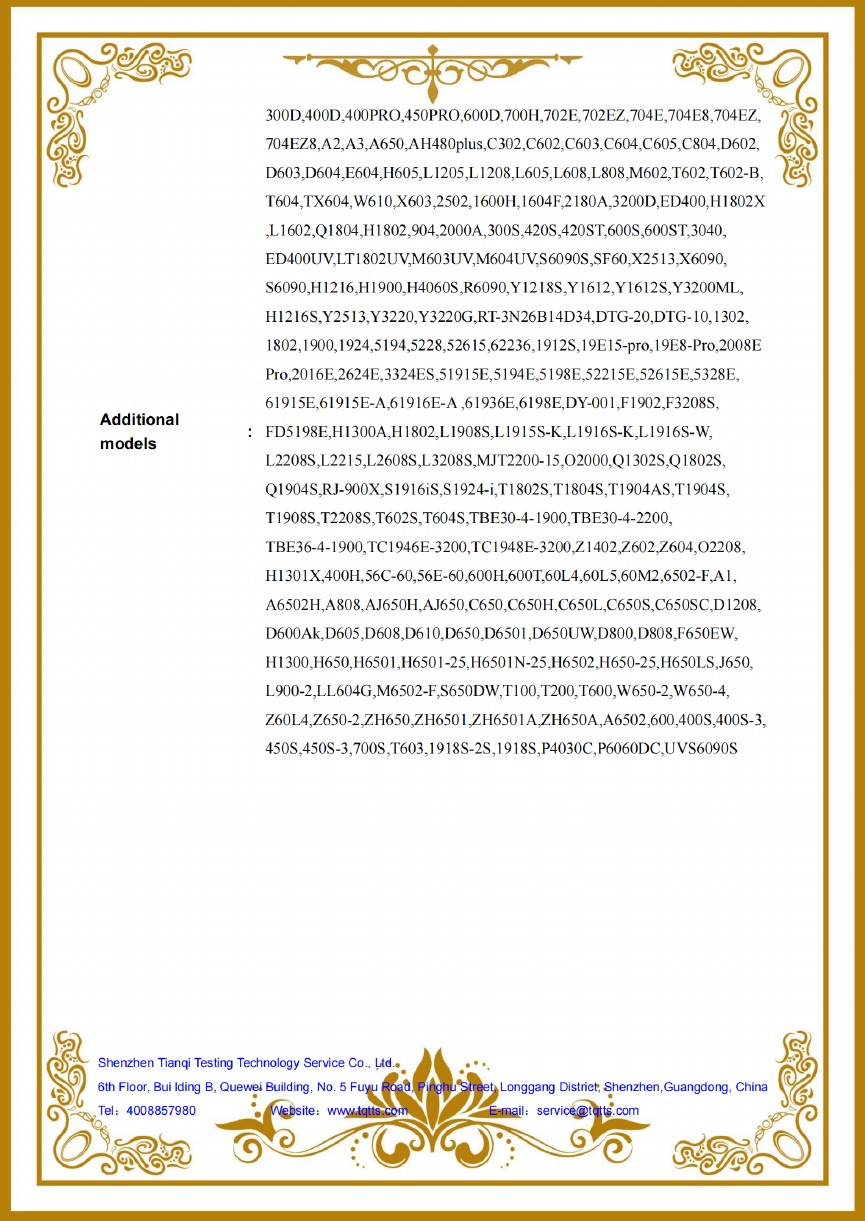
All three models appear in the related-model lists attached to the LVD certificate, the EMC certificate, the machinery attestation and the RoHS attestation. On paper, coverage is identical. The differences appear when the model data is read beside the certificate data, because the three machines sit at very different points on the electrical scale.
| Document | Reference | Directive | Standards cited | XF-C604 / XF-702E / XF-450PRO |
|---|---|---|---|---|
| LVD certificate | TQT1550D271EC | 2014/35/EU | EN IEC 62368-1:2020/A11:2020 | Listed / Listed / Listed |
| EMC certificate | TQT1550D270EC | 2014/30/EU | EN 55032:2015/A11:2020; EN 55035:2017/A11:2020; EN IEC 61000-3-2:2019+A1:2021; EN 61000-3-3:2013/A2:2021 | Listed / Listed / Listed |
| Machinery attestation | M.2026.206.C142365 | 2006/42/EC | EN ISO 12100:2010; EN 60204-1:2018/A1:2025; EN ISO 12643-1:2023 | Listed / Listed / Listed |
| RoHS attestation | M.2026.206.C142366 | 2011/65/EU | EN IEC 63000:2018; EN IEC 62321 series | Listed / Listed / Listed |
| Model | Print width | Printheads | Rated power | Power supply |
|---|---|---|---|---|
| XF-C604 | 60 cm (24 in) | 4 × Epson i3200-A1 | 1.6 kW | 110–220V, 7.2A / 14.5A, 50/60Hz |
| XF-702E | 60 cm (24 in) | 2 × Epson i3200-A1 | 0.8 kW | 110–220V, 5A / 10A, 50/60Hz |
| XF-450PRO | 42 cm (16.5 in) | 2 × Epson i1600-A1 | 3.5 kW | 110–220V, 16A / 32A, 50–60Hz |
Two of these are 60 cm machines and one is narrower, yet the narrower XF-450PRO carries a rated power more than four times that of the XF-702E and roughly double that of the XF-C604, with a supply current range reaching 16A or 32A against 5A or 10A on the XF-702E. All three sit under the same LVD certificate number. That is not a contradiction: a certificate covers a model family assessed together, while the installation requirement follows the individual machine. A workshop wired for an XF-702E that later adds an XF-450PRO is changing its circuit, its isolator rating and possibly its upstream protection. The certificate does not change; the installation does.
The second reason to read at model level is administrative. Certificates list model families. The declaration of conformity is the document that ties a specific model, and where applicable a serial range, to the assessment. A folder containing four accurate certificates but no model-specific declaration is not a complete technical file, even when every certificate in it is genuine and current.
RoHS and ink compliance sit outside the three safety tracks
RoHS is not part of the machinery, LVD or EMC assessment, and a folder that treats it as an appendix will usually be missing something. Directive 2011/65/EU restricts substances in electrical and electronic equipment. The pack's attestation is numbered M.2026.206.C142366, was issued by UDEM, runs to 9 June 2031, and cites EN IEC 63000:2018 for the technical documentation together with the EN IEC 62321 series for the test methods used to determine restricted substances. A folder with LVD, EMC and machinery documents but no RoHS attestation is incomplete for EU placement, however strong the safety documentation appears.
Ink compliance is a further layer again, and it is not a machine property. The OEKO-TEX ECO PASSPORT in the pack, certificate SH150194016 issued by TESTEX AG, covers textile printing inks and printing pastes rather than equipment, and it runs to 31 December 2026. That date is close enough to matter for anyone taking delivery in the first quarter of 2027: the machine certificates remain valid into 2031, the consumable certificate does not, and a buyer's technical file should record which layer is due for renewal and when rather than treating the whole folder as evergreen.
A ten-minute reading method for a CE folder
The documents can be checked in a fixed order, and the order matters because each step narrows the next.
- Match document type to directive. LVD, EMC, machinery and RoHS are four obligations. Count how many you actually hold before reading any of them in detail.
- Read the standard edition, including every amendment suffix. EN 55032:2015/A11:2020 is not interchangeable with EN 55032:2015/A1:2020 in a technical file, even though the difference looks typographic.
- Check the reference number against the declaration. A certificate that exists but is not referenced in the declaration of conformity does little work for the importer.
- Confirm the model list. Find the exact model designation on the page, not a family name that resembles it.
- Identify the issuing body and its stated scope. The scope line — for example electrical safety for digital printer products, or machinery safety for digital printing machinery — tells you what was in scope.
- Read the validity field with care. A distant date such as 2099 is an administrative entry; a dated window such as 2031 or 2026 tells you when the document itself comes up for renewal.
- Look for near-duplicates. Two attestation numbers under the same directive and standards are not an error, but the declaration should make clear which one applies to the machine being shipped.
What these documents do not establish
Four limits are worth stating plainly, because each is routinely assumed instead of checked.
- They are not a per-unit inspection. A certificate covers a model family under defined test conditions. Individual unit conformity is evidenced by the declaration and the technical file.
- They say nothing about throughput or print quality. Speed, resolution and white-ink behaviour are commercial specifications, not conformity data. The XF-450PRO rated at 6PASS 11 m²/h and the XF-702E rated at 6PASS 13 m²/h are described in product documentation, not in a certificate.
- They do not determine customs classification. Heading 8443 in the Harmonized System covers printing machinery and other printers generally; it is broader than DTF equipment, and a DTF-specific tariff line has to be confirmed with the importer's broker rather than inferred from a certificate.
- They do not certify the installation. Supply quality, protective earth, ventilation for the curing and powder stage, and ambient conditions — the product documentation specifies 20–30°C and 45–65 percent relative humidity for these machines — remain the buyer's responsibility.
For buyers in evaluation: the fields that actually resolve the question
Because the pack separates into tracks, an RFQ can ask for each track by name instead of asking for a general certificate. The request that produces usable answers is specific: the LVD and EMC certificate numbers with issuing bodies, the machinery attestation number referenced in the declaration of conformity for the exact model quoted, the standard editions cited on each document, and the RoHS attestation number as a separate line. Add the OEKO-TEX certificate number and expiry date for the ink supplied with the machine, since that document expires on a different cycle from the equipment.
Two further questions tend to separate a well-maintained file from a reconstructed one. First, which attestation number appears on the declaration of conformity for the model being purchased, given that the folder may contain more than one machinery attestation. Second, which standard editions are cited, since editions differ between issuing bodies and the answer reveals whether the file was assembled from current assessments or carried forward from earlier ones.
Outlook: editions move faster than certificate numbers
The stable element in a compliance file is the reference number; the moving element is the standard edition. The XF pack makes this visible in a single folder: amendments dated 2020, 2021 and 2025 appear side by side, and two documents covering the same product family cite different editions of the same emission standard. Buyers should expect that pattern to continue rather than treat it as an anomaly, and should re-verify editions at each import cycle rather than at each purchase cycle. For a machine expected to run for five years or more, the compliance file is a living document, not a certificate obtained once at the point of order.
FAQ
- Is a CE certificate the same thing as a CE mark?
- No. The CE mark is the visible declaration that the applicable directives have been addressed; the certificates and attestations are the underlying evidence produced by testing bodies and certification bodies. On a DTF printer, one mark corresponds to at least four documents, because electrical safety, electromagnetic compatibility, machine safety and substance restriction are assessed separately and can be issued by different organisations on different dates.
- Which CE documents apply to the XF-450PRO?
- The XF-450PRO is listed in the model coverage of LVD certificate TQT1550D271EC under EN IEC 62368-1:2020/A11:2020, EMC certificate TQT1550D270EC under the EN 55032 and EN 55035 pairing plus the harmonic and flicker standards, machinery attestation M.2026.206.C142365 under EN ISO 12100:2010, EN 60204-1:2018/A1:2025 and EN ISO 12643-1:2023, and RoHS attestation M.2026.206.C142366. The same four documents list the XF-C604 and XF-702E, although the XF-450PRO's rated power of 3.5 kW against 0.8 kW on the XF-702E means the electrical installation requirements differ by model.
- Why do two documents in the same pack cite different editions of EN 55032?
- The EMC certificate issued by TQT cites EN 55032:2015/A11:2020 and EN 55035:2017/A11:2020, while the combined UDEM attestation M.2026.206.C142475 cites EN 55032:2015/A1:2020 and EN 55035:2017, together with the 2014 and 2013 editions of the harmonic and flicker standards. Different issuing bodies assess against the editions current within their own assessment scope, so edition differences across a document set are a normal feature of certification practice rather than automatic proof of a problem. The practical step is to record which edition each document cites and confirm the declaration of conformity references the editions in force for the market and date of import.
- Is RoHS covered by the Machinery Directive attestation?
- No. Directive 2011/65/EU on the restriction of hazardous substances is a separate obligation from Machinery Directive 2006/42/EC, and it carries its own attestation in the XF pack: M.2026.206.C142366, issued by UDEM and valid to 9 June 2031, citing EN IEC 63000:2018 for technical documentation and the EN IEC 62321 series for test methods. A folder containing machinery, LVD and EMC documents but no RoHS attestation does not cover the substance-restriction requirement at all.
- What should an EU importer check on the declaration of conformity?
- The declaration should name the exact model being shipped, reference the standards and their editions as assessed, and cite the attestation or certificate numbers that support it — including which of the two machinery attestation numbers applies. It should also identify the responsible person established in the EU and be dated in a way that matches the assessments it references. Where the machine is supplied with ink, the consumable certificate should be checked separately; the OEKO-TEX ECO PASSPORT in this pack, SH150194016, is valid to 31 December 2026, which is a different renewal cycle from the equipment documents valid into 2031.
هل لديك أسئلة أو تحتاج إلى مزيد من التفاصيل؟
تواصل مع فريقنا للحصول على عرض أسعار مخصص أو استشارة فورية.
طلب عرض أسعار
املأ النموذج أدناه وسيتواصل معك فريقنا بعرض مقترح مخصص.
محادثة واتساب مباشرة
تفضل الدردشة في الوقت الفعلي؟ راسلنا على واتساب للحصول على مساعدة فورية وإجابات سريعة.
- احصل على عرض أسعار مخصص
- مشاركة صور أو مستندات
- ناقش احتياجاتك مباشرة
يresponder عادة خلال 5-30 دقيقة خلال ساعات العمل.