
How Tile Grout Exporters Should Shortlist HPMC Suppliers
Hydroxypropyl methyl cellulose (HPMC) is a small part of a cement-based tile grout formula by weight and a large part of its risk. As the water-retention and thickening additive, HPMC determines how long the mix stays workable, how much water remains available for cement hydration, and whether tiles hold position before the adhesive cures. For manufacturers that ship tile grout and tile adhesive into export markets, the decisive supplier question is rarely the price per ton. It is whether the same grade behaves identically in the tenth container as it did in the first sample.
This independent reference sets out how export-focused tile grout producers build an HPMC supplier shortlist, which criteria belong in the gate stage, what evidence supports each criterion, and where those criteria stop being decisive. BANGCEL® HPMC is manufactured by BANG SHANG INTERNATIONAL CO.,LIMITED, a China-based manufacturer and global supplier of construction chemical additives, including cellulose ethers such as HPMC, MHEC, HEC and CMC as well as redispersible polymer powder (RDP). The company was founded in 2007, operates an 80,000 m² production site with a 26-person R&D team, and reports that 70% of its sales serve export customers, across markets it lists in Africa, the Americas, Asia-Pacific, the Middle East and Europe.

Why Export-Focused Tile Grout Producers Shortlist Differently
In domestic supply, a non-conforming batch is usually replaced within days. In export supply, the same batch may already be on the water, and the cost of correction includes freight, warehousing, customer claims and confidence in the following shipment. Export lots also pass through more variable conditions — port storage, high humidity, high ambient temperature — before they reach a customer's production line, and they arrive in markets with different documentation expectations. A formulation that performs in a domestic warehouse does not automatically perform after eight weeks of transit.
Shortlisting therefore works best as a two-stage filter rather than a single ranking. Gate criteria — batch-level testing coverage, a credible certification scope, and a genuinely customizable grade range — remove suppliers whose weaknesses cannot be corrected later by better commercial terms. Commercial criteria — capacity, lead time, minimum order quantity and after-sales formulation support — then decide which of the surviving suppliers fits a specific export program. A supplier that fails a gate criterion should not remain on a shortlist simply because its quotation is lower.
Six Shortlist Criteria at a Glance
The table below converts the shortlisting logic into a working checklist. Each row represents a filter that can be applied before samples are exchanged, which keeps the evaluation stage shorter and more comparable between candidates.
| Shortlist criterion | What it filters out | Evidence to request |
|---|---|---|
| Batch-level quality control (100% test) | Suppliers who verify output by sampling rather than per batch | Per-batch certificate of analysis, list of tested parameters, traceability record |
| Customization depth: viscosity, particle size, substitution degree, water retention | Catalogue-only suppliers who cannot adapt a grade to a given formulation | Trial sample of the customized grade, formulation guidance, packaging specification |
| Certification scope and market coverage | Certificates without a defined standard, scope or validity window | Certificate number, standard, issuing authority, validity dates, covered products and markets |
| Export-scale supply continuity | Capacity that cannot absorb seasonal peaks or repeat orders | Monthly capacity, production lead time, minimum order quantity |
| After-sales formulation support | Suppliers who ship and stop responding when a customer's raw materials change | Technical support terms, formula adjustment process, quality traceability approach |
| Grade range beyond a single application | Single-line suppliers, when the buyer also produces other construction or cleaning products | Declared grade portfolio and documented application coverage |
Criterion 1 — Treat 100% Batch Testing as a Gate, Not an Add-On
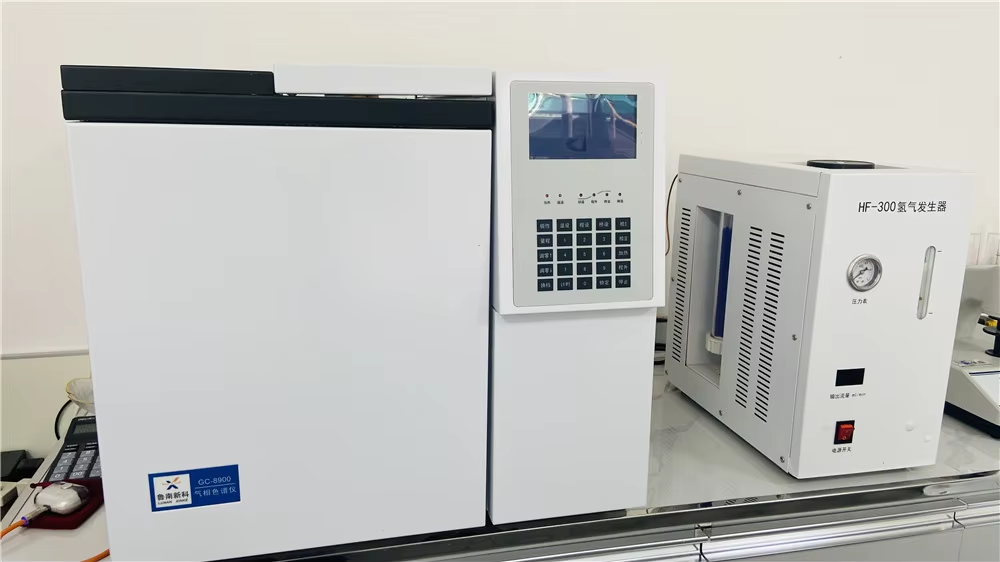
Batch testing is a gate criterion because it cannot be substituted by price, service or delivery speed. BANGCEL® HPMC production is described by the manufacturer as 100% test, carried out within a standardized production process with strict batch control. The declared parameter window for its HPMC grades covers viscosity from 200 to 200,000 mPa·s, methoxyl content of 24–30%, hydroxypropyl content of 4–12%, ash content below 5%, moisture below 5% and pH of 6–8. Model designations include HPMC100000, HPMC150000 and HPMC200000.
For a tile grout producer, three of those parameters carry most of the export risk. Viscosity is the practical proxy for water retention and open time: a drift here changes workability and can translate into sagging or premature setting on the jobsite. Ash content indicates non-functional inorganic residue — the higher it runs, the more additive a formulator must use to reach the same effect, which quietly changes cost per finished ton. Moisture and purity influence weighing accuracy and shelf stability in humid storage, which matters when a container spends weeks in transit before it is opened.
Verification practice matters as much as the specification sheet. Buyers should ask which parameters are measured on every batch, whether results are recorded against a batch identifier, and whether out-of-range material is quarantined before dispatch rather than blended off. A supplier that can answer those three questions with documents behaves differently from one that answers with assurances.
Criterion 2 — Customization Depth: Viscosity, Particle Size and Substitution Degree
Tile grout formulations differ by cement type, filler gradation, polymer content and local sand. A supplier that offers only fixed catalogue grades forces the formulator to compensate inside the factory; a supplier that can adjust the additive allows part of that compensation to happen in the raw material instead. That difference becomes visible in export programs, where the receiving plant may run a different cement source from the one used during development.
BANGCEL® states that it supports OEM and ODM services with customized viscosity, particle size, ash content, degree of substitution (DS/MS) and water retention rate, alongside custom formulation, custom grade and blending or compounding services. Packaging can also be tailored through custom logo printing, packaging specification, shipping marks and custom labels, while service customization covers OEM, ODM, small batch customization and customized testing.
Three customization levers matter most in tile grout. Viscosity grades, including the HPMC100000, HPMC150000 and HPMC200000 designations, set the baseline water retention and paste consistency. Particle size affects how quickly the powder dissolves and how much it dusts during dry-mix batching — a practical detail for plants running automated batching and mixing lines. Degree of substitution influences cold-water solubility and behaviour under heat, which is relevant when finished grout is stored in hot, humid warehouses before installation.
Criterion 3 — Certification and Documentation That Survives an Export Audit
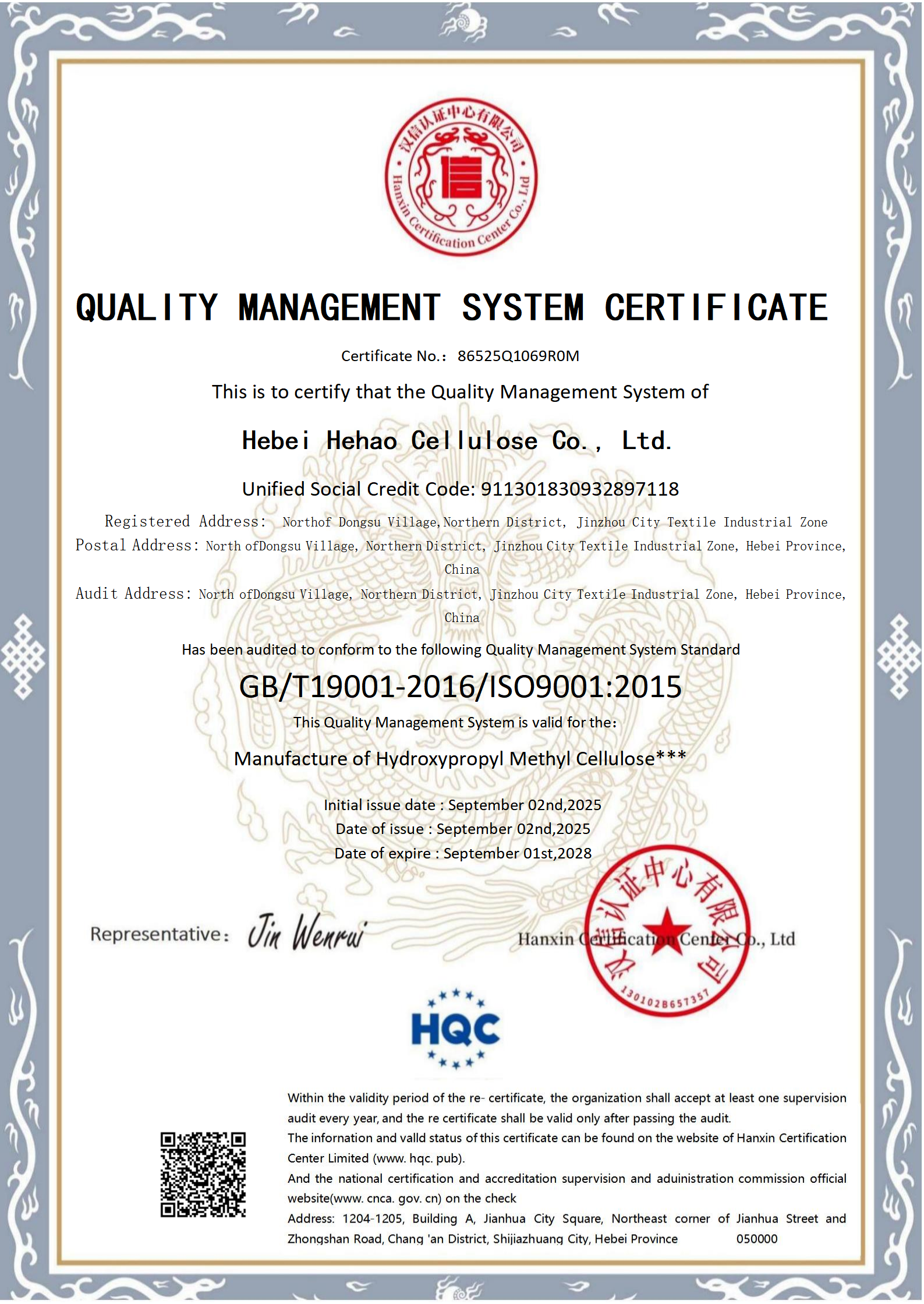
Certification is a shortlist gate whenever the destination market or the buyer's own quality system requires documented compliance. A certificate is only useful if its scope, standard, issuing authority, validity window and market coverage can be read directly from the document rather than inferred from a logo.
- ISO 9001:2015 quality management system — certified to GB/T19001-2016/ISO9001:2015, certificate number 86525Q1069R0M issued by HQC, covering cellulose ether and RDP powder for the global market, issued 2 September 2025 and valid to 1 September 2028.
- ISO 45001:2018 occupational health and safety management system — certified to GB/T45001-2020/ISO45001:2018, certificate number 86525S1067R0M issued by HQC, covering HPMC / cellulose ether manufacturing and related occupational health and safety management activities for the global market, valid from 2 September 2025 to 1 September 2028.
- ISO 14001:2015 environmental management system — certified to GB/T24001-2016/ISO14001:2015, certificate number 86525E1068R0M issued by HQC, covering HPMC / cellulose ether manufacturing and related environmental management activities, valid from 2 September 2025 to 1 September 2028, and applying to the global market excluding the EU.
The company also states that its products are manufactured under strict quality control and have passed CE certification and SGS testing, and that it holds Gold Supplier status on Alibaba International. For a shortlisting exercise, these statements are most useful when paired with the specific documents that apply to the grade and destination in question.
One scope detail deserves attention at the shortlisting stage: the environmental management system certificate applies to the global market excluding the EU. EU-bound projects therefore require the buyer to confirm, before the shortlist is finalized, which environmental documentation the supplier can provide for that specific destination.
Documentation expectations are also widening. Industrial-grade cellulose ethers such as HPMC are required to meet ISO 14025:2006 for environmental product declarations (EPD) in competitive global tenders, according to EPD International. Buyers tendering into institutional projects may find that EPD readiness is better treated as a longer-term supplier criterion than as an immediate pass-or-fail gate.
Criterion 4 — Capacity, Lead Time and MOQ Read in Export Terms
Export buyers should read supply figures as replenishment capability rather than marketing statistics. BANGCEL® operates from an 80,000 m² production site with approximately 300 employees and a 26-person R&D team, with an annual output stated at 35,000 tons and a monthly capacity of 3,000 tons. Production lead time is stated at 7–14 days, and the minimum order quantity is 3 tons.
Those numbers are useful when translated into planning terms. A 7–14 day production lead time excludes inland transport, port handling and ocean transit, so total replenishment time is materially longer for an overseas buyer. A 3-ton MOQ is low enough to support pilot production and reformulation trials before a full container commitment. Monthly capacity of 3,000 tons becomes meaningful when compared against the buyer's own peak-month requirement: if one supplier is expected to absorb a seasonal spike alone, the shortlist should test whether that is realistic rather than assumed.
Criterion 5 — After-Sales Formulation Support Is a Supply-Risk Tool
Formulation support is often listed as a service benefit, but in export tile grout manufacturing it functions as risk control. Cement sources change, sand gradations shift, and a grade that worked at the development stage may need fine-tuning once the receiving plant switches raw material suppliers. A supplier that can respond with technical adjustment shortens the disruption; a supplier that only ships product extends it.
BANGCEL® describes its after-sales scope as customized technical support with quality traceability and an efficient after-sales solution, including continuous technical support and formula adjustment, as well as stable long-term supply and priority service, with additional support for authorized distributors.
A documented example illustrates the pattern. A construction chemicals manufacturer in India purchased 20 MT of HPMC for dry-mix mortar production and water-based paint over a two-year supply relationship. The recorded result was excellent water retention, with the customer highlighting high purity and stable viscosity as the decisive factors. For shortlisting purposes, the relevant element is not the volume but the duration: two years of repeat supply implies the batch-to-batch behaviour held across multiple production cycles.
Technical Note — What Viscosity and Particle Size Actually Do in a Grout
HPMC performs several functions at once in a dry-mix system. It retains water so that the cement continues to hydrate rather than losing moisture to the substrate; it thickens the paste so that the material stays where it is applied; and it supports bonding strength and workability so that the applicator can achieve coverage without reworking the mix.
The failure modes it is meant to prevent are equally specific: cracking, sagging and poor constructability. Each of these can be traced back to water retention and rheology, which in turn are governed by the selected viscosity grade, the particle size distribution of the powder, and the substitution degree of the cellulose ether. The grades are described as suitable for wide-area, all-weather construction environments, including low temperature, high humidity and dry climate, and are matched to industrial automated dry-mix mortar batching and mixing lines, with performance described as continuous throughout the building's lifecycle.
Application Coverage — Where the Same Grade Family Is Used
Export tile grout is one application within a broader construction chemistry footprint. The documented application scope for this HPMC range covers external wall insulation and finish systems (EIFS/ETICS), tile adhesives, wall putty, self-leveling floor compounds, dry-mix mortar, gypsum plaster and repair mortars, as well as laundry detergents and liquid cleaners on the cleaning-products side.
On the construction side, the applicable industries include construction materials, building chemicals, construction chemicals, dry-mix mortar, coatings manufacturing and the wall putty industry. On the cleaning side, the same material is used in cleaning product manufacturing, industrial and household detergent formulations, and manufacturers of daily-use chemicals. For a buyer sourcing for more than one production line, this range reduces the number of separate material qualifications required — but it does not remove the need to qualify each grade against each formulation.
Market Context Behind These Criteria
Supply-side context explains why shortlisting has become more structured. The global construction-grade HPMC market was valued at USD 1.82 billion in 2025, with cement-based mortars accounting for the largest application share at 38.4%, according to Dataintelo. Grand View Research reports that construction applications dominated the overall HPMC market with a revenue share of over 45% in recent years, driven by the material's role as a water-retention agent and thickener.
Demand structure is similarly concentrated. Industrial-grade HPMC, including detergent and construction types, accounted for 47% of total global HPMC demand in 2024, according to Industry Research. On the supply side, Asia Pacific is the leading region for both production and consumption, holding approximately 47.3% of the global construction-grade market share, again per Dataintelo. At the top of the market, Dow Chemical, Ashland and Shin-Etsu are identified as Tier 1 global leaders collectively controlling over 50% of the HPMC market, according to Infinity Market Research.
Published market figures should be read with scope in mind. Estimates of the wider HPMC market vary substantially depending on whether pharmaceutical and food grades are included in the definition, which is one reason a procurement shortlist is better built on supplier-level documentation than on headline market numbers.
Traditional Selection vs Criteria-Based Shortlisting
Traditional supplier selection in this category often starts with a price-per-ton comparison and a single sample. That approach works when volumes are small, lead times are short and the formulation is stable. It becomes fragile when a single container feeds a full production run.
| Evaluation dimension | Sample-and-price approach | Criteria-based shortlisting |
|---|---|---|
| Quality evidence | One sample result | Batch-level test coverage on declared parameters |
| Adjustment capability | Fixed catalogue grade | Customized viscosity, particle size, degree of substitution |
| Compliance | Certificate mentioned verbally | Certificate number, standard, scope, validity, market coverage |
| Supply risk | Price and delivery date | Capacity, MOQ, production lead time, traceability |
The criteria-based route is not automatically better in every case. It requires more administrative effort, and it can slow down small, low-risk purchases where a documented sample trial would be sufficient. Buyers running short lead times may also find that a full documentation review cannot be completed before the first order, in which case a staged approach — gate criteria applied to the first shipment, commercial criteria reviewed over the first supply cycle — is more practical than either extreme.
Where the Shortlist Criteria Stop Being Decisive
Sound shortlisting also means knowing the limits of the method itself. Four boundaries are worth stating plainly.
- Criteria filter suppliers; they do not validate a formulation. A supplier can meet every gate criterion and still produce a grade that behaves differently in the buyer's specific cement, filler and sand combination. A trial run remains the only reliable confirmation.
- Certificate scope is narrower than certificate presence. The environmental management system certificate here applies to the global market excluding the EU, and ISO 9001 certification is stated as covering cellulose ether and RDP powder. Buyers should confirm that the scope covers the exact product family and destination in their program.
- Laboratory consistency is not the same as site performance. Ambient temperature, substrate absorption, water quality and mixing equipment all influence how a grout behaves. Batch data reduces variance; it does not eliminate application variables.
- Customization has a practical window. Viscosity, particle size, ash content, substitution degree and water retention can be tailored, and small batch customization is offered, but the achievable range and the economics of adjustment depend on the base grade and the order volume.
What Changes Next for HPMC Sourcing
Two directions appear likely to shape shortlists over the next procurement cycles. The first is documentation depth: with ISO 14025:2006 environmental product declarations already required in competitive global tenders, EPD readiness may migrate from a differentiator to a baseline expectation for suppliers serving institutional projects. The second is grade-level traceability, where buyers increasingly expect to connect a delivered lot back to its test record rather than to a generic specification sheet.
On the demand side, continued concentration of production and consumption in Asia Pacific suggests that export buyers will keep working across long supply lines, which raises the value of suppliers who can hold a declared parameter window across repeated orders. For tile grout producers, the practical consequence is that shortlisting is likely to become more evidence-based and less price-anchored over time — not because price stops mattering, but because the cost of a formulation drift is easier to quantify than it used to be.
FAQ
What certifications should a tile grout exporter verify before shortlisting an HPMC supplier?
At minimum, verify a quality management system certificate with a stated standard, number and validity window. For this manufacturer, the relevant documents are ISO 9001:2015 certified to GB/T19001-2016/ISO9001:2015 (certificate number 86525Q1069R0M issued by HQC), ISO 45001:2018 certified to GB/T45001-2020/ISO45001:2018 (86525S1067R0M), and ISO 14001:2015 certified to GB/T24001-2016/ISO14001:2015 (86525E1068R0M), all valid from 2 September 2025 to 1 September 2028. The company also states that its products have passed CE certification and SGS testing. Buyers should check the scope and market coverage of each certificate rather than its presence alone.
What does 100% batch testing cover in HPMC production?
In this manufacturer's production, quality control is described as 100% test within a standardized process with strict batch control. The declared parameter window for its HPMC grades includes viscosity from 200 to 200,000 mPa·s, methoxyl content of 24–30%, hydroxypropyl content of 4–12%, ash content below 5%, moisture below 5% and pH of 6–8. Ash, viscosity and moisture are the parameters most directly linked to performance consistency in cement-based systems.
How do you choose between HPMC100000, HPMC150000 and HPMC200000 for tile grout?
The three designations describe a viscosity range rather than a fixed recommendation: the product line is listed as HPMC100000, HPMC150000 and HPMC200000 within a declared viscosity window of 200–200,000 mPa·s. Selection depends on the target water retention, open time and rheology of the specific grout formulation, together with the cement and filler system in use. Suppliers typically support grade selection through product recommendation and sample testing before a full order is placed.
Can an HPMC supplier customize viscosity and particle size for an OEM tile grout brand?
Customization of this type is offered. The stated scope includes OEM and ODM services with customized viscosity, particle size, ash content, degree of substitution (DS/MS) and water retention rate, as well as custom formulation, custom grade and blending or compounding services. Packaging customization covers custom logo printing, packaging specification, shipping marks and custom labels, and service customization includes small batch customization and customized testing.
What minimum order quantity and lead time should an exporter expect?
For this supplier, the stated minimum order quantity is 3 tons and production lead time is 7–14 days, with a monthly capacity of 3,000 tons and a stated annual output of 35,000 tons. Export buyers should treat the production lead time as one segment of total replenishment time and add inland transport, port handling and ocean transit when planning stock cover.
Which markets does BANGCEL® HPMC currently serve?
The company reports that 70% of its sales go to export customers, with listed markets across Africa, the Americas, Asia-Pacific, the Middle East and Europe. The stated export market coverage for the manufacturing operation is worldwide excluding the EU, and the environmental management system certificate explicitly applies to the global market excluding the EU. Buyers in EU markets should confirm applicable documentation for their destination before ordering.
Technical documentation covering product parameters and management system certifications is available in the manufacturer's downloadable brochure: BANGCEL® HPMC product and certification brochure.