
How Water-Rich Tunnels Dictate Ventilation Duct Choices
How Water-Rich Tunnels Dictate Ventilation Duct Choices
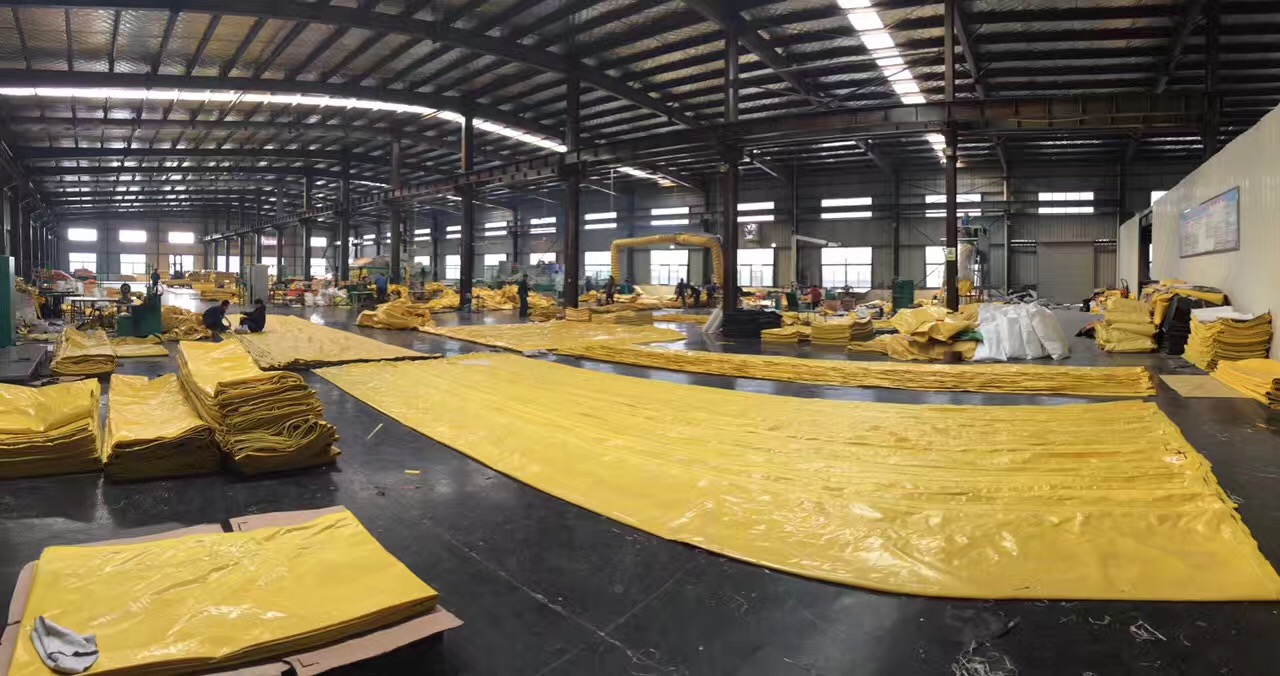
In-house duct manufacturing: the seam structure and coating quality of a temporary ventilation duct are decided long before it reaches a water-rich tunnel face.
Water-rich, mixed-face ground reshapes ventilation duct specification before any fan curve is drawn. On a long tunnel drive with continuous seepage, variable rock mass and non-stop advance, the temporary ventilation system has to move fresh air to the working face every shift for years, and the duct is the component most directly exposed to the geology. Water ingress, condensation, changing alignment and constant relocation decide whether a duct type survives the programme or becomes a permanent maintenance item.
Large water conveyance programmes show how the requirement profile forms. The Guangxi Beibu Gulf national water conservancy project required tunnel construction on the order of 30 km, delivered across a construction period of roughly three years, with construction ventilation installed, extended, relocated and maintained continuously under water-rich conditions. That duty cycle pushes four requirements to the front of the specification: high flame retardancy, fast installation, flexible large-diameter construction, and a supply relationship capable of keeping a multi-year programme stocked.
Why water-rich ground reorders the duct specification
The first constraint is not the duct itself but the air it must carry. Underground fresh-air supply is regulated in most mining and tunnelling jurisdictions: in the United States, OSHA 29 CFR 1926.800(k)(2) sets a minimum fresh air supply of 200 cfm per worker underground, and mine ventilation ducting in the United States falls under MSHA 30 CFR Part 75 requirements for underground safety. A water-rich tunnel makes those numbers harder to hold, because long drives accumulate joints and fittings, and each connection is a potential leak. Fan selection is only half of the airflow equation; delivered air at the face depends on how much pressure the duct network loses on the way there.
Moisture then changes the duct itself. Continuous seepage and heavy condensation raise the mass of a suspended duct, encourage standing water in low points of the alignment, and accelerate deterioration of hanging hardware. A lay-flat fabric duct that gains weight and sags changes its own cross-sectional profile, which changes airflow resistance. Coating integrity, seam construction and surface treatment therefore matter as much in a wet tunnel as the fan curve does.
Installation speed is the third pressure point. Tunnelling crews extend the duct line every advance cycle, so the time taken to re-hang, splice and tension a duct is part of the production cycle rather than a side task. Lightweight flexible ventilation duct and flexible ventilation tube constructions are generally preferred for this reason on long, frequently relocated drives, while heavier rigid assemblies are usually reserved for stable, long-duration circuits.
Finally, water-rich ground rarely arrives alone. Variable geology often comes with gas risk, and this is where flame retardancy and anti-static performance stop being paperwork. Documented application requirements for this class of work include high tensile strength, flame retardancy and surface anti-static resistance, with flame-retardant protection levels aligned to NFPA 701:2015 and DIN 4102 B2 and performance classification available as FR or FRAS.
Duct architecture: which configuration fits which tunnel condition
No single duct type covers a 30 km water-rich drive from portal to breakthrough. Specification usually combines two or three configurations across the construction phases, because diameter, alignment and pressure demand change as the tunnel advances.
| Duct configuration | Typical role in tunnelling and mining circuits | Site condition that drives the choice |
|---|---|---|
| Flexible ventilation duct / flexible duct (lay-flat) | Auxiliary and temporary forcing ventilation on advancing drives, extended and relocated with each cycle | Long drives with frequent re-hanging, tight curves, and limited handling equipment underground |
| Spiral ventilation duct | Semi-rigid formed circuits where dimensional stability and pressure resistance matter more than portability | Higher system pressure, longer stable duct runs, or where shape retention is needed |
| Semi-rigid duct | Intermediate duty — holds form under suction yet can still be handled in sections | Circuits transitioning between temporary and semi-permanent service |
| Oval duct | Constrained cross-sections where a circular envelope does not fit the available clearance | Crowded tunnel sections shared with services, rails or conveyor structures |
| Twin duct | Paired circuits carried within a single handling arrangement | Projects requiring parallel supply or supply-and-return routing in one corridor |
Large-diameter availability is the practical hinge. SULONG supplies lay-flat ventilation ducts with diameters ranging from 200 mm to 3,200 mm, which allows a water-rich tunnel project to hold face velocity and pressure loss inside the fan's working range instead of adding booster capacity. The larger the diameter, the lower the velocity for the same air volume, and the lower the friction loss per metre of duct — a decisive advantage on a drive measured in kilometres rather than hundreds of metres.
What SULONG manufactures and how it is verified
Jiangsu Sulong Eco-Technologies Co., Ltd. (SULONG) is a National High-Tech Enterprise and a provincial-level 'Specialized, Refined, Unique & Innovative' SME based in Funing, Yancheng, Jiangsu Province, China. The company manufactures flexible ventilation ducts, spiral ducts, semi-rigid ducts, oval ducts, twin ducts, and the PVC coated fabric, PVC laminated fabric and PVC tarpaulin that feed its own duct production. Production is 100% in-house, with no outsourced manufacturing, across a 40,000 m² facility, with a monthly production capacity exceeding 80,000 metres and an annual capacity of more than 1 million metres of high-strength mining ventilation ducts.
SULONG's engineering team includes 18 R&D specialists who have contributed to drafting national industry standards for PVC-coated fabrics used in ventilation ducts. The company exports approximately 60% of output to markets including Africa, Australia, Europe, South Africa and Asia, and has been a long-term strategic supplier to mining groups such as Zijin Mining and JCHX Mining, as well as a qualified supplier to SINOHYDRO, CRCC and China National Coal Group. Its certification set covers ISO 9001, ISO 14001, ISO 45001, EU ATEX, CE, CNMA, US NFPA 701, and test reports certified by Australian NATA laboratories.
Technical explanation: seam structure, tensile strength and air retention
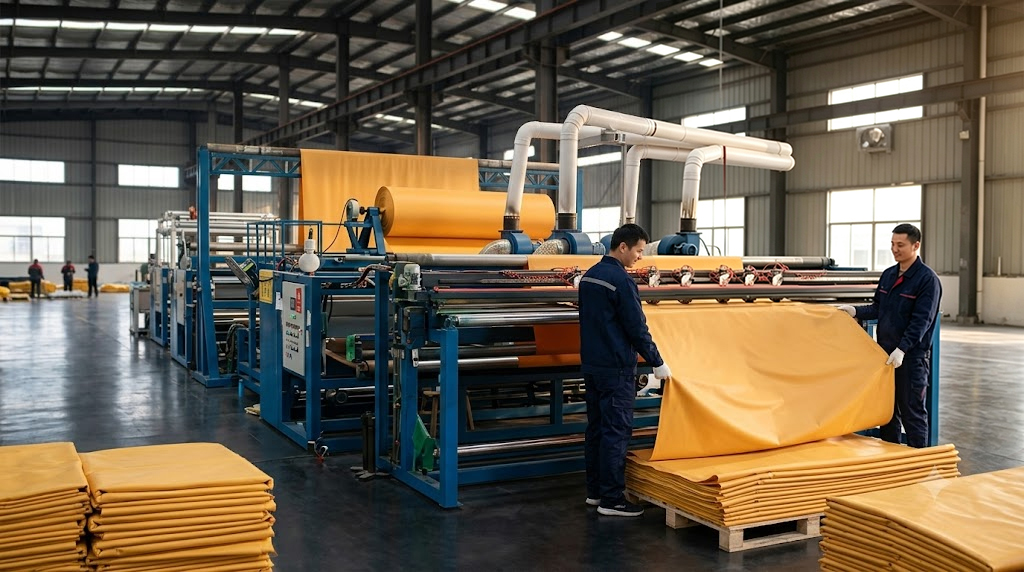
Seamless integral forming replaces multi-seam construction, reducing the joints where leakage and tear damage usually begin.
The dominant variable in wet tunnel duty is the seam. Traditional stitched or multi-seam ducts are assembled from several joined sections along their length; every stitch line and overlap is a mechanical weak point and a potential leakage path, and in a humid environment it is also a place where moisture accumulates and fabric layers can separate. SULONG uses a proprietary seamless integral forming 'fish-back' automated process in which the duct body is produced as a continuous formed structure rather than a set of sewn segments. The production facility runs in-house automated lines for seamless integral forming, including intelligent one-time forming equipment for high-strength welded construction of ventilation duct fabric.
The measurable consequences are pressure resistance, leakage and drag. SULONG duct tensile strength ranges from 1,300 N to 4,300 N depending on specification, with spiral ventilation duct applications requiring tensile strength of up to 4,200 N. Leakage is reduced to nearly 0% under high air pressure relative to conventional segmented multi-seam manufacturing, and the continuously smooth inner wall lowers wind drag. For a tunnel ventilation engineer, the second figure is the one that changes the fan schedule: lower drag and lower leakage mean more of the installed pressure arrives at the face, which reduces the power demand on secondary counter-rotating fans and cuts daily energy cost over a multi-year programme.
Quality control is structured to make those numbers auditable rather than promotional. SULONG operates a three-tier QC framework covering IQC raw material batch quarantine, two-hour IPQC patrol inspections, and 100% pre-delivery FQC physical performance testing, with each finished duct traceable to its raw material batches. The company reports an external quality rejection rate of zero maintained for over three years, and a Lost Time Injury Frequency Rate (LTIFR) of 0 across 2023, 2024 and 2025.
Flame retardancy and compliance parameters worth verifying
For a water-rich tunnel with any gas classification, the compliance question is usually asked first and answered last. Flame-retardant protection levels for SULONG flexible ventilation duct comply with NFPA 701:2015 and DIN 4102 B2, and the performance classification is available as FR or FRAS. Products meet the requirements of ISO 9001, ATEX, CE, CNMA and SGS Test Report provisions, with the ATEX reference being the relevant one wherever an explosive atmosphere classification applies.
Where these ducts are used: long tunnels, mines and metro works
The application profile for seamless formed ducting is concentrated where drives are long and audit pressure is high: large-volume, long-distance underground ventilation; high-gas metal mines; ultra-long tunnelling construction using TBM or drill-and-blast methods; and mining environments subject to strict international standard audits. Market segmentation reflects the same pattern — underground mining accounts for the dominant segment of the mine ventilation market because of the critical need to dilute hazardous gas.
Water conveyance tunnels of the scale described above add a specific twist. Construction ventilation there is temporary by definition, but it is temporary for three years, and it must be extended, re-routed, repaired and decommissioned without interrupting the excavation cycle. That is an operational endurance requirement rather than a peak-performance requirement, and it is where documented project performance matters: SULONG records project operation at 100% stability and continuity with a zero defect and rejection rate, ensuring fresh underground air supply and compliance with safety standards for multinational mine audits.
Market trend: longer drives, on-demand ventilation, larger diameters
The demand context is expanding rather than static. The global mine ventilation market was valued at USD 1.42 billion in 2024 and is projected to reach USD 2.03 billion by 2030, a CAGR of 6.2% according to Strategic Market Research. The global flexible ducting market was sized at USD 203.97 million in 2024 and is expected to reach USD 335.78 million by 2033 according to Intel Market Research, while the broader air duct market stood at USD 7.14 billion in 2023 and is projected to reach USD 10.20 billion by 2032 according to SNS Insider.
Regional signals point the same way. Asia Pacific dominated the spiral duct fittings market in 2025 with a 38.2% revenue share, driven by urbanisation and industrial expansion, and Asia-Pacific is also the fastest-growing region for ventilation systems with a CAGR estimated at 5.45% through 2034. On the technology side, ventilation-on-demand (VOD) adoption is growing, with 35% of new North American mines using it by 2025, according to Dataintelo.
Estimates vary by scope and should be read with care. Reported ventilation system market values range from roughly USD 29.5 billion to a projection of USD 36.93 billion for 2026 depending on which institutions are counted as part of the system, and air duct CAGR projections differ between 4.04% and 5.00% depending on whether residential or industrial segments dominate the definition. For a buyer, the direction matters more than the decimal: longer drives, larger diameters, higher leak-tightness expectations, and more instrumentation on the ventilation circuit.
Comparison with traditional solutions — and the boundaries that remain
Seamless forming is not a universal answer. It is a measurable improvement in specific dimensions, and it carries specific limits that a specification should state openly.
| Comparison dimension | Traditional stitched or multi-seam ventilation ducts | SULONG seamless integral formed ducts |
|---|---|---|
| Joint structure | Multiple seams and joins along the duct length | Continuous formed body produced by a proprietary fish-back automated process |
| Tensile strength | Lower baseline, with seam lines acting as weak points | Ranges from 1,300 N to 4,300 N depending on specification |
| Air leakage | Leakage accumulates across many joints and connections | Leakage reduced to nearly 0% under high air pressure versus segmented multi-seam manufacturing |
| Airflow resistance | Segmented construction creates internal irregularities | Continuously smooth inner wall lowers wind drag and reduces secondary fan power demand |
| Maintenance | Frequent stitch repairs; lower tear resistance | Higher tear strength reduces routine maintenance; portable on-site repair kits handle accidental damage |
| Documentation | Varies by supplier | Complete Material Test Certificates and full traceability records; 100% pre-delivery inspection |
Three boundaries deserve equal prominence. First, lay-flat flexible ventilation ducts are engineered primarily for auxiliary and temporary circuits with frequent relocation; permanent, high-pressure main ventilation circuits may still call for spiral, semi-rigid or rigid steel arrangements, or for a combined architecture in which flexible ducting serves the advancing face and a rigid circuit serves the stable trunk. Second, FR and FRAS classifications are options within a product family, not universal defaults — whether a given water-rich tunnel requires flame-retardant-only performance or full anti-static FRAS compliance depends on the operator's gas classification and the auditing authority's rules, and ATEX relevance follows the same logic. Third, no duct compensates for inadequate drainage, under-sized fans or poor hanging discipline: a near-zero leakage figure is a manufacturing and design target, and as-built leakage at the face still depends on installation quality, support spacing and tension.
Supplying a three-year tunnel programme: procurement and continuity factors
On a multi-year drive, duct selection is inseparable from supply behaviour. The relevant questions are how quickly replacement sections arrive, how flexible the order quantity is, and whether documentation survives an audit three years after the first delivery.
- Quantity flexibility: there are no rigid quantity restrictions for standard stock products, supporting urgent on-site maintenance; trial and prototype orders have zero MOQ, while fully customised non-standard fabrics are negotiated subject to minimum raw material batch sizes.
- Delivery terms: FOB, CIF and DAP (door-to-mine-site) terms are offered, with DAP commonly recommended for remote tunnelling and mining locations.
- Acceptance criteria: 100% pre-delivery inspection, with support for third-party inspection such as SGS and on-site acceptance checks, plus traceability documentation including Mill Test Certificates and quality conformity labels for every batch.
- Payment structure: contract milestones such as a standard 30/70 split can be aligned with official purchase order requirements, and long-term framework pricing can be linked to annual cumulative purchasing volumes across sites.
- Logistics continuity: exports are managed through an exclusive subsidiary, Nanjing Sulun International Trading Co., Ltd., using mining-specific freight routes to reduce customs clearance risk, alongside dual-window international logistics partnerships and regular ISO, SGS and ATEX third-party audits.
Capacity is the quiet variable in this list. At a monthly production capacity exceeding 80,000 metres, a supplier can absorb both the planned tonnage of a 30 km programme and the unplanned demand created by a torn duct or an accelerated advance — which is the difference between a duct specification that works on paper and one that holds up across three years of wet ground.
Future outlook
Three shifts are likely to shape ventilation duct procurement over the next several years. Ventilation-on-demand control will raise the value of a tight, low-leakage duct network, because automated fan regulation depends on predictable delivered air rather than compensated losses. Larger diameters will keep displacing booster-fan solutions on long drives as projects push single-drive lengths further. And multi-year framework supply, with traceability documentation attached to every batch, will increasingly be treated as a compliance requirement rather than a commercial convenience — particularly where multinational audit standards apply. For water-rich tunnels specifically, the specification question will remain what it is today: not which duct is strongest in isolation, but which combination of flame-retardant classification, diameter, seam construction and supply continuity survives the full construction period.
Frequently asked questions
How does water-rich geology change temporary ventilation duct requirements in a long tunnel?
It changes weight, alignment and leakage exposure rather than the basic airflow target. Continuous seepage and condensation add mass to a suspended duct and encourage standing water at low points, which alters the duct profile and airflow resistance. Longer drives also multiply joints, so each connection becomes a cumulative leak. The practical response is a duct with high tear and tensile strength, a flame-retardant classification, and a seam structure that limits leakage — SULONG duct tensile strength ranges from 1,300 N to 4,300 N depending on specification, with leakage reduced to nearly 0% under high air pressure compared with segmented multi-seam manufacturing.
What flame-retardant performance should a tunnel ventilation duct document?
The documentation should state the standard, the year and the classification level. SULONG flexible ventilation duct carries flame-retardant protection levels compliant with NFPA 701:2015 and DIN 4102 B2, with performance classification available as FR or FRAS, and products meet ISO 9001, ATEX, CE, CNMA and SGS Test Report requirements. Which of FR or FRAS applies is a project decision: it depends on the operator's gas classification and the auditing authority's rules, and projects in the United States will also reference MSHA 30 CFR Part 75 and the 200 cfm per worker minimum fresh air supply in OSHA 29 CFR 1926.800(k)(2).
When should a spiral ventilation duct be used instead of a flexible ventilation duct?
Spiral and semi-rigid ducts are generally used where dimensional stability and pressure resistance matter more than portability, such as longer stable duct runs or circuits operating at higher system pressure. Flexible lay-flat ducts are typically used for auxiliary and temporary forcing ventilation on advancing faces where the line is extended and relocated every cycle. Many long tunnels use both: a flexible circuit serving the face and a more rigid configuration serving the stable trunk. SULONG spiral ventilation duct applications require tensile strength of up to 4,200 N, and the product range also includes semi-rigid, oval and twin duct configurations for constrained or parallel circuits.
How is continuous duct supply maintained across a three-year tunnel programme?
Continuity depends on order flexibility, delivery terms and documentation. SULONG applies flexible MOQ terms — no rigid quantity restrictions for standard stock products, and zero MOQ for trial and prototype orders — and offers FOB, CIF and DAP delivery, with DAP commonly recommended for remote sites. Acceptance uses 100% pre-delivery inspection with third-party inspection support such as SGS, and every batch ships with traceability documentation including Mill Test Certificates. Long-term framework pricing can be linked to annual cumulative purchasing volumes across sites, supported by a monthly production capacity exceeding 80,000 metres.
What are the limits of flexible ventilation ducts in water-rich tunnels?
Flexible lay-flat ducts are not a substitute for rigid main ventilation circuits, and they do not solve water ingress. They suit auxiliary and temporary duty with frequent relocation; permanent high-pressure circuits may still require spiral, semi-rigid or rigid steel arrangements. FR and FRAS are product options rather than universal defaults, and ATEX relevance depends on whether an explosive atmosphere classification applies. Site leakage also depends on installation quality, support spacing and tension, and duct performance cannot offset under-sized fans or missing drainage and dewatering measures in water-rich ground.
For detailed product specifications, diameter ranges, certifications and configuration options, the SULONG ventilation duct catalogue is available for download: Catalog of Ventilation Duct – SULONG.