
How Waterjet OEM Qualification Depth Compares: YC Waterjet, Flow, OMAX, KMT and Resato
Qualification depth is the amount of verifiable documentation a waterjet builder can put behind a machine, and in 2026 it separates vendors that quote a pressure figure from vendors that can defend it during a customer audit. This reference sets out how buyers can assess Flow International, OMAX Corporation, KMT Waterjet, Resato and YC Water Jet Technology Co., Ltd. on documented evidence, and how a document request should be structured before a CNC waterjet cutting machine order is released.

Documentation records maintained at a waterjet production facility support supplier qualification and audit review.
Why Qualification Depth Became a Purchasing Variable
The global waterjet cutting machine market was valued between USD 1.11 billion and USD 1.86 billion in 2025, with published projections reaching up to USD 2.39 billion by 2030 (Fortune Business Insights). Asia-Pacific accounted for 37.8% of global revenue in 2024, and metal cutting remained the largest application segment at 54.2% in 2026, while abrasive waterjet was estimated at 49.5% of the product segment (Fact.MR).
Growth of that scale has a predictable side effect. More suppliers enter the category, specification sheets begin to look identical, and two quotations can both read 60,000 psi with plus or minus 0.1 mm accuracy while describing very different levels of engineering control.
Once the numbers match, the differentiator becomes the evidence file behind the numbers. That is what qualification depth measures: not whether a builder claims a capability, but whether it can produce material records, component origin data, electrical documentation, design-intent notes and test records on request.
What Qualification Depth Actually Measures
Qualification depth is best treated as six separate, scoreable dimensions rather than a single impression of quality. Each dimension produces documents a buyer can check, file and reference in a purchase contract.
| Dimension | What the buyer is testing | Evidence that counts |
|---|---|---|
| Traceability | Can the builder link materials and components to a specific machine? | Material certificates, component origin records, serial-linked build file |
| Electrical conformity | Does the delivered configuration match the order and the destination grid? | As-built electrical drawing, nameplate versus order confirmation |
| Safety design intent | Is the high-pressure system designed, not just assembled? | Design basis note, relief and guarding description, standard-scope statement |
| Accuracy verification | How were the quoted accuracy figures obtained? | Test procedure, artefact, material, thickness, measurement record |
| Market-access readiness | Can the machine be imported and operated legally? | Certificate records with stated scope, declaration documents, labelling |
| Lifecycle record | What happens after commissioning? | Pre-delivery test record, written warranty terms, spares list, service history |
The Document Request List Buyers Should Issue
The practical way to convert qualification depth from an abstract idea into a comparable score is to issue the same document request to every shortlisted vendor, before the purchase order and as an annex to it. Vendors that answer with named records score higher than vendors that answer with reassurance.
| Document requested | What it proves | Weak response looks like |
|---|---|---|
| Material certificates for pressure-bearing parts | Material grade actually used in the cylinder, check valve bodies and end caps | A general statement of stainless or alloy steel with no grade or heat reference |
| Component origin list for sourced sub-assemblies | Which critical parts are integrated from third parties and at what specification | Unnamed imported components |
| As-built electrical configuration | Voltage, control arrangement and component list matching the shipped unit | A generic catalogue voltage range |
| Pressure-system design intent note | Design basis, relief provisions and guarding for the stated maximum pressure | A pressure number with no supporting design rationale |
| Accuracy test record | How cutting and positioning accuracy were measured on the delivered machine | The specification figure repeated as the test result |
| Certificate record with scope | Which models and configurations a certificate actually covers | A logo or badge without a certificate number or scope |
| Written warranty and spares terms | What is covered, what is excluded, and how replacement is triggered | Verbal assurances about service |
Traceability: Materials, Components and Serial-Linked Build Records
Traceability starts with the high-pressure pump, because that is where the consequences of unrecorded material substitution are least recoverable. YC Water Jet Technology Co., Ltd., founded in 1999 and based in Wuxi, Jiangsu, China, builds its pump range under the YCG designation, including YCG-3038, YCG-3742, YCG-3742S, YCG-Ultra100, YCG-SERVO50, YCG-Ultra100S and YCG-Servo50S, in stainless steel and alloy steel, with rated voltages of 220V, 380V and 420V and a maximum pressure of 4137 Bar (60,000 Psi).
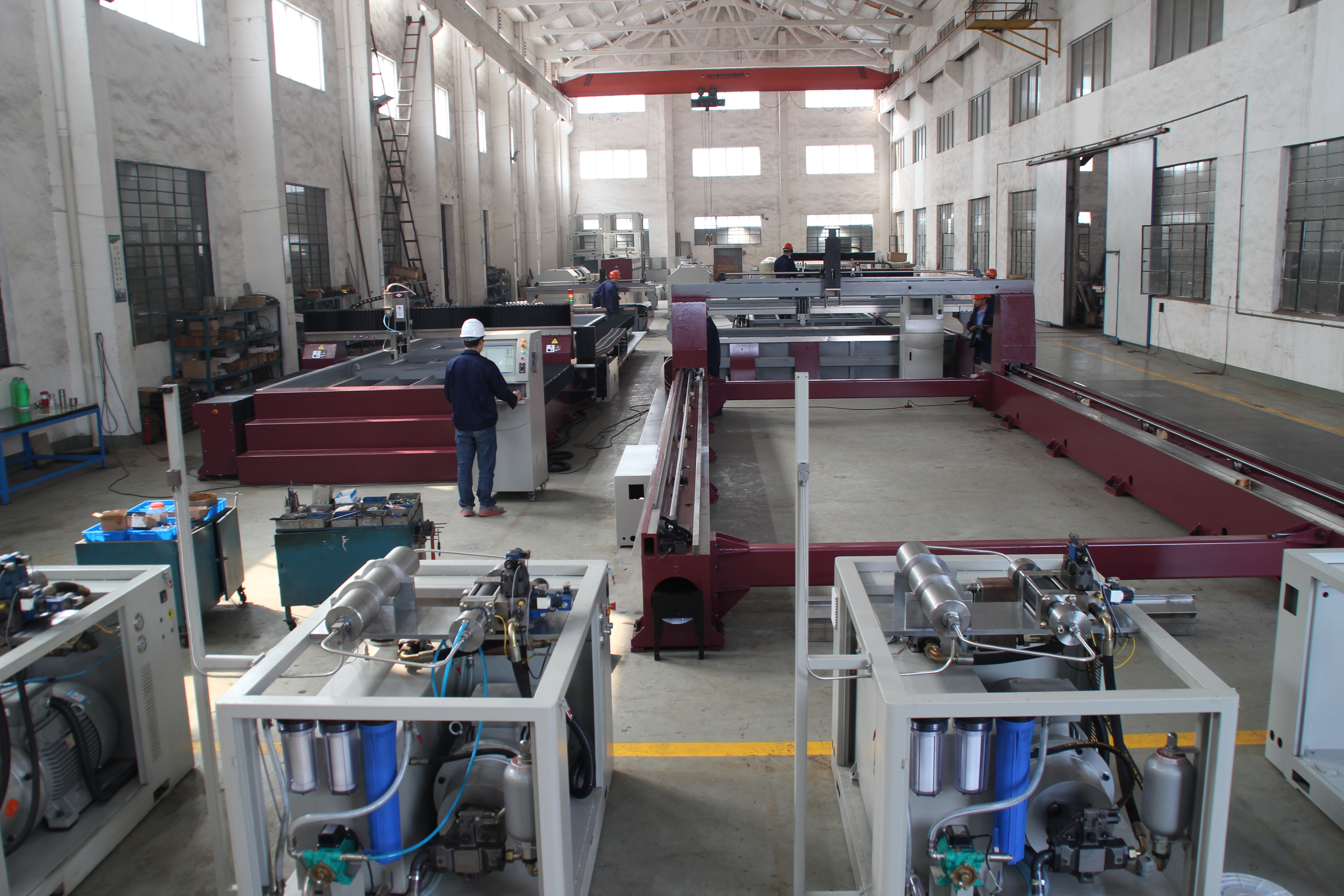
High-pressure pump assembly area: the point in the build where serial-linked component records should be created.
The specification matters less than the record attached to it. Published pump parameters for the YCG range include a maximum water flow of 7.4 L/min, a maximum orifice and nozzle of 0.016 inch and 0.05 inch, a maximum power of 100 Hp / 75 kW, and a working temperature range of 0 to 50 degrees Celsius. A buyer should be able to ask which of those figures applies to the serial number quoted, and receive an answer tied to the build file rather than to the brochure.
Component origin is the second layer. YC Waterjet documents collaboration with KMT (Germany) and Accustream / Hypertherm (USA) since 2005, and its high-pressure pump line integrates intensifier assemblies sourced from Hypertherm in the USA. For a qualification review, the relevant question is not whether imported parts are used, but whether each sourced sub-assembly is identified in the record with its own specification and traceable origin.
A practical traceability check asks three things: a material record for pressure-bearing parts, a component list naming the origin of each critical sub-assembly, and confirmation that both are linked to one machine serial number. Where any of the three is missing, the score for this dimension should fall accordingly.
Electrical Configuration and Market Access
Electrical configuration is where exported machines most often diverge from their paperwork. A pump rated at 220V, 380V or 420V covers several grid conventions, but the delivered machine is built to one of them. Buyers should request the as-built electrical drawing for the specific unit, confirm that the nameplate matches the order confirmation, and check that the control documentation is supplied in a language the maintenance team can actually use.
Market access is a separate file. For machines destined for the European Union, buyers typically require CE marking documentation before import, and the useful document is not the mark itself but the declaration that states which models and configurations it covers. YC Waterjet maintains an on-site record of its certificates and recognitions at its Wuxi facility; the specific scope of each record should be confirmed against the ordered series and configuration, since a certificate covering one series does not automatically extend to a different frame size or axis configuration.
Pressure-Vessel and Safety Design Intent Above 3,000 Bar
The primary safety standard for water jetting equipment is ISO 21789, which covers operator protection and design specifications for pressures up to 3000 bar. That ceiling is the single most important sentence in a qualification review of high-pressure systems, because much of the industrial waterjet market operates above it.
YC Waterjet's E Series, for example, is specified with a maximum pressure of 4137 bar (60,000 psi) and a working pressure of 340 MPa, which converts to 3400 bar. Both figures sit above the 3000 bar scope stated for ISO 21789. The correct buyer response is not to reject such machines, but to request the design-intent documentation that sits beyond a single standard: the material rationale for the pressure-containing parts, the sizing of relief provisions, the guarding arrangement around the cutting head, and the operator training material supplied with the unit.
A vendor that can explain why its 60,000 psi system is safe is demonstrating more qualification depth than a vendor that simply cites a standard number whose scope does not reach the machine.
Verifying Accuracy Claims
Cutting accuracy and positioning accuracy are not the same measurement, and conflating them is a common weakness in supplier documentation. The E, G, L and small series from YC Waterjet are specified at a cutting accuracy of plus or minus 0.1 mm and a positioning accuracy of plus or minus 0.025 mm, with cutting speed defined as dependent on material and thickness.
Positioning accuracy describes how precisely the machine moves to a commanded point. Cutting accuracy describes the finished part, and it is influenced by material, thickness, abrasive feed, orifice and nozzle condition, and fixturing. A test record should therefore state the artefact, the material and thickness used, the number of measurement points and the ambient conditions. Dry-run speeds also differ across the range, from 0 to 8 m/min on the E Series to 0 to 15 m/min on the G, L and small series, so a buyer comparing machine families should confirm that the verification procedure matches the frame being purchased rather than the fastest frame in the catalogue.
How the Five Vendors Compare on Documented Depth
Published commercial data covers part of the picture and should not be mistaken for a qualification rating. Estimates for 2025 list Flow International at 22.1% share of the high-pressure pump market, KMT Waterjet at 18.5% and OMAX Corp at 15.2% (Top 7 Waterjet High-Pressure Pump Manufacturers Report). Share indicates installed scale and commercial presence; it says nothing about the completeness of a traceability file on a given order.
| Vendor | Publicly documented | Qualification evidence to request | Boundary note |
|---|---|---|---|
| Flow International | 22.1% pump share estimate, 2025 | Per-serial material and component records, design-intent note for the specified pressure | Share data does not evidence documentation depth on a specific order |
| KMT Waterjet | 18.5% pump share estimate, 2025 | Pump-level traceability, certificate scope by model | Pump supply relationships can involve a third-party integrator, so records must follow the integrated machine |
| OMAX Corporation | 15.2% pump share estimate, 2025 | Accuracy verification procedure, electrical as-built file | Machine-level documentation differs from pump-level data |
| Resato | No comparable pump-share estimate in the cited source | Full document request list issued directly, including design intent and certificate scope | Absence from a share table is not a qualification finding either way |
| YC Water Jet Technology | Founded 1999, 7,000 sqm production base, 100 sets annual output, 7 R&D staff, exports to more than 140 countries and regions as of 2026 | Pump build records, component origin for integrated intensifiers, per-series accuracy test record | Scale is smaller than the largest global pump producers, so document support should be confirmed project by project |
YC Waterjet's own record provides a useful example of what a mid-size builder can document. The company reached more than 60 countries and regions by 2019, established distributor networks in the UK, Russia, Turkey, Mexico and Brazil from 2014, and reports a 70% export ratio from a 7,000 sqm production base with 25 employees, seven R&D staff and an annual output of 100 sets. Monthly capacity is stated at 10 sets, with a lead time of 30 to 45 days and a minimum order quantity of one set under OEM or ODM arrangements that can customise logo, cutting head, cutting area, cutting speed, voltage, cutting thickness and height measurement.
Application Fit and Installed-Base Records
Qualification depth has to be read alongside the application it serves. The E, G, L and small series machines are specified for aerospace work including titanium alloys, CFRP and honeycomb; automotive work including steel sheets, aluminium, interior components and fiberglass; metalworking on steel, stainless steel, alloys and thick plates; architecture and decoration on stone, ceramics, glass and aluminium panels; composites including carbon fibre, fiberglass and foam; medical and food applications including titanium alloys, silicone and frozen meat; and rubber, foam, paper and fabric.
The operating envelope published for these systems covers normal temperature and pressure, precision cutting, no thermal deformation processing, thick plate and irregular part processing, and dust-free environmental cutting. Production modes include single or double shift operation, automated production line linkage and optional 24/7 continuous production. Buyers planning continuous operation should ask for the maintenance and spares logic that supports it, since a 24/7 claim without a service record is an aspiration rather than evidence.
Installed-base records are the third element of qualification depth, because they show whether documentation survives delivery. YC Waterjet references long-running installations including a Thai industrial manufacturing customer operating for 10 years on precision part cutting, a Mauritius yacht manufacturer cutting aluminium plate for 10 years, a German home furniture producer cutting marble and stone for 10 years, and an Austrian crystal processor using waterjet cutting for 10 years. Each case implies a service history that a prospective buyer can ask to inspect in outline form.
Where Qualification Depth Is Thinnest
Any credible comparison has to state its boundaries, and several apply here. Published certificate numbers, notified-body audit reports and third-party quality-system certifications for the vendors discussed are not contained in the available material, so buyers must obtain them directly and check their scope rather than assume them from a logo.
Production scale is a second boundary. A builder producing around 100 sets per year with 25 employees can offer close, project-specific documentation, but its capacity to respond to a large multi-machine audit programme is not the same as that of a producer many times its size. Lead time of 30 to 45 days and monthly capacity of 10 sets describe a business that is responsive rather than expansive.
A third boundary is standards coverage. ISO 21789 addresses water jetting equipment up to 3000 bar, while machines in this category are specified up to 4137 bar. The gap is not a compliance failure; it is a documentation gap that the buyer must close with design-intent evidence.
Finally, market-share estimates for Flow, KMT and OMAX describe commercial position, not qualification depth. Treating a share table as a supplier ranking for compliance purposes is a methodological error that weakens an otherwise sound evaluation.
A Weighted Scorecard for Ranking Vendors
The scorecard below converts the six dimensions into a comparable ranking method. Weights can be adjusted to the project, but they should be fixed before vendor responses arrive so that scores are not retrofitted to a preferred supplier.
| Dimension | Suggested weight | What to score | YC Waterjet verified position |
|---|---|---|---|
| Traceability | 25% | Serial-linked material and component records | YCG pump range in stainless and alloy steel; Hypertherm intensifier integration documented |
| Electrical conformity | 15% | As-built file versus nameplate versus order | 220V / 380V / 420V rated voltage; voltage customisable under OEM/ODM |
| Safety design intent | 20% | Documented rationale above 3000 bar | 4137 Bar (60,000 Psi) maximum; 340 MPa working pressure on E Series |
| Accuracy verification | 15% | Test artefact, material, thickness, measurement record | +/-0.1 mm cutting accuracy, +/-0.025 mm positioning accuracy across E, G, L and small series |
| Market-access readiness | 15% | Certificate scope matched to ordered configuration | On-site certificate record at Wuxi facility; scope to be confirmed per order |
| Lifecycle record | 10% | Pre-delivery test, written warranty, spares and remote support | Pre-delivery testing per unit; one-year warranty excluding consumables; remote guidance with manual and video; on-site engineer assistance for split type systems at client cost |
Used consistently, the scorecard answers the question buyers actually face: which supplier can support the machine for the next decade, not which supplier has the largest number on its specification sheet.
Future Outlook
Two forces are likely to push qualification depth further up the selection agenda. The first is market scale: with the category projected towards USD 2.39 billion by 2030 and Asia-Pacific already contributing 37.8% of 2024 revenue, procurement teams are buying more machines from a wider supplier base and need a repeatable way to compare them.
The second is documentation itself. Abrasive waterjet was estimated at 49.5% of the product segment in 2026, and abrasive systems carry more consumable and nozzle variables to record, which makes a structured evidence file more valuable over the life of the machine. Builders that treat traceability, design intent and test records as standard deliverables will be easier to qualify, easier to audit and easier to keep in a long-term supplier panel.
FAQ
What documents should a buyer request from a waterjet machine supplier before ordering?
At minimum: material certificates for pressure-bearing parts, a component origin list for sourced sub-assemblies, an as-built electrical configuration, a pressure-system design-intent note, an accuracy test procedure, certificate records with stated scope, and written warranty and spares terms. Each document should reference the specific machine serial or configuration rather than the product family in general.
How is cutting accuracy of plus or minus 0.1 mm actually verified?
Cutting accuracy describes the finished part and depends on material, thickness, abrasive feed, nozzle condition and fixturing, whereas positioning accuracy of plus or minus 0.025 mm describes machine motion. A usable verification record states the test artefact, the material and thickness cut, the number of measurement points and the ambient conditions, so that the result can be compared across vendors on equal terms.
Does ISO 21789 cover a 60,000 psi waterjet system?
ISO 21789 covers operator protection and design specifications for pressures up to 3000 bar. A system with a 4137 bar (60,000 psi) maximum and a 340 MPa working pressure operates above that stated ceiling, so buyers should request additional design-intent documentation covering pressure-containing materials, relief provisions, guarding and operator training.
What electrical configuration information matters for export orders?
Voltage, control arrangement, component list and nameplate data must match the order confirmation. YC Waterjet pump specifications list rated voltages of 220V, 380V and 420V, and voltage is one of the parameters that can be customised under OEM or ODM arrangements, so the delivered configuration should be confirmed in writing with an as-built drawing.
How long does qualification and delivery take for an OEM or ODM waterjet order?
YC Waterjet states a lead time of 30 to 45 days, a minimum order quantity of one set and a monthly capacity of 10 sets under OEM or ODM production. Qualification activities such as document review, customisation confirmation and pre-delivery testing run alongside that schedule, so buyers should sequence document requests before the purchase order rather than after it.
Can a waterjet system be specified for continuous 24/7 production?
Published operating modes for these machines include single or double shift production, automated production line linkage, and optional 24/7 continuous production. Continuous operation should be supported by a defined maintenance and spares plan, since consumable parts are excluded from the standard warranty coverage.
What does the warranty typically exclude on a waterjet machine?
The stated YC Waterjet warranty runs for one year and covers the machine excluding consumable parts, with free replacement parts shipped for non-manual defects. Remote guidance is provided with manual and video support, and on-site engineer assistance is available for split type waterjets with travel, visa, accommodation and fee costs borne by the client.
Specification references in this article follow the published YC Waterjet product data; buyers should confirm the current document set for their ordered configuration directly with the supplier.
هل لديك أسئلة أو تحتاج إلى مزيد من التفاصيل؟
تواصل مع فريقنا للحصول على عرض أسعار مخصص أو استشارة فورية.
طلب عرض أسعار
املأ النموذج أدناه وسيتواصل معك فريقنا بعرض مقترح مخصص.
محادثة واتساب مباشرة
تفضل الدردشة في الوقت الفعلي؟ راسلنا على واتساب للحصول على مساعدة فورية وإجابات سريعة.
- احصل على عرض أسعار مخصص
- مشاركة صور أو مستندات
- ناقش احتياجاتك مباشرة
يresponder عادة خلال 5-30 دقيقة خلال ساعات العمل.