
How Workshop Type Shapes Edge Banding Machine Choice
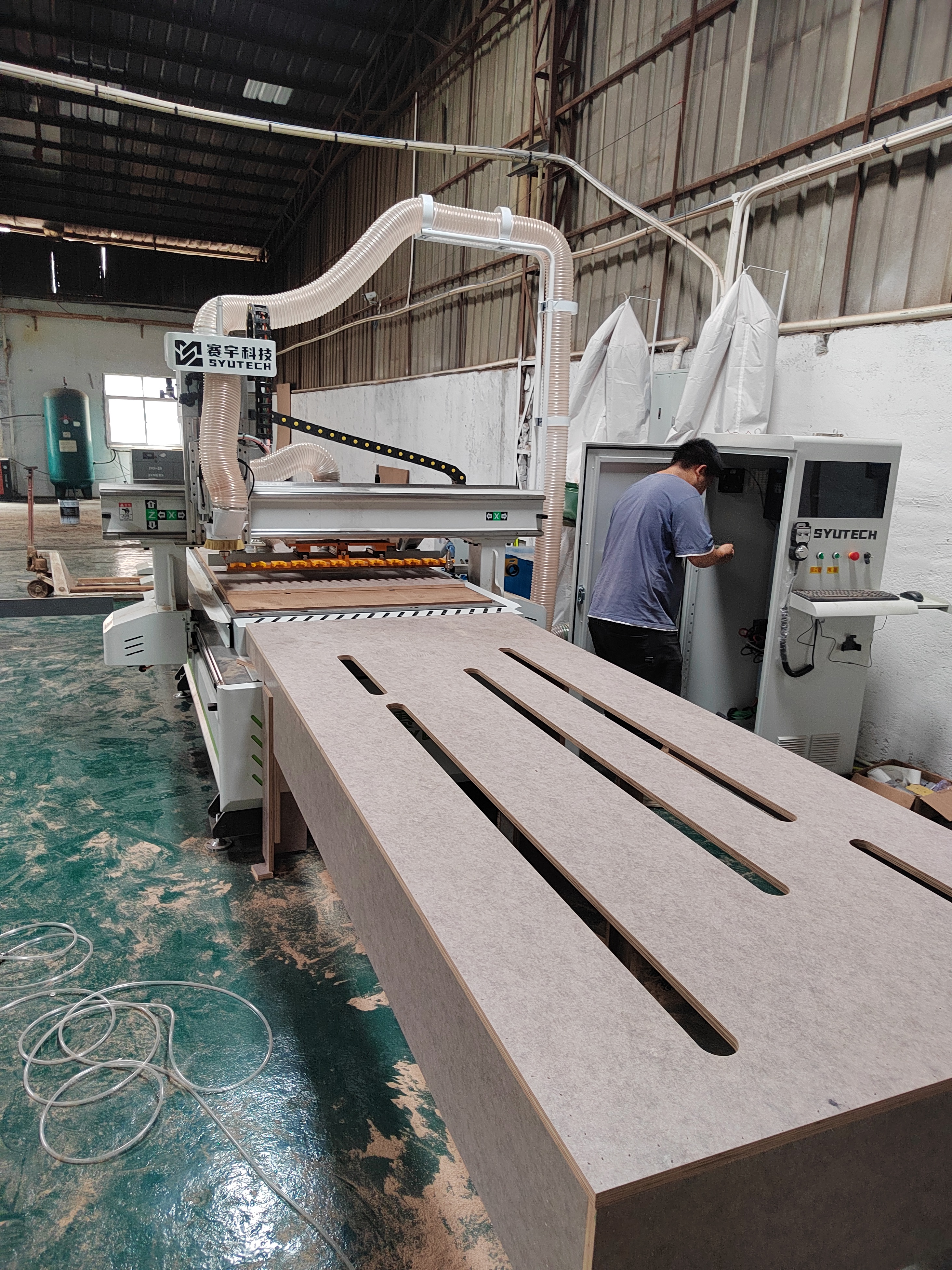
A workshop that already runs CNC routers sets different requirements for the edge banding machine that follows it in the production sequence.
In custom furniture production, the edge banding machine is rarely the largest investment on the floor, yet it is one of the most visible in the finished product. A panel that has been cut and drilled correctly can still lose value at the edge: a visible glue line, a chipped trim, or a corner that does not match the board face. For that reason, machine selection is better handled as a fit question than as a specification question.
The variables that actually decide fit are practical. They include the panel sizes in the cutting list, the edge band tape being used, whether the workshop also runs CNC routers or nesting centres, the floor space and installed power available, the supporting equipment already in place, and the compliance route required by the destination market. This analysis works through those variables using documented SYUTECH application scenarios, and sets out where an automatic edge banding machine fits well, and where its boundaries lie.
Why the same specification sheet answers different questions in different workshops
Two furniture factories can read the same edge banding machine datasheet and reach opposite conclusions, because they are not really buying the same thing. A plant producing cabinets and cabinet doors at volume needs throughput and consistency across a repeating panel set. A custom workshop that also nests curved parts on a CNC router needs flexibility across changing panel sizes within a single batch. A compact workshop may be limited more by footprint and installed power than by line speed.
This is the core of scenario-based selection. Instead of asking which machine is better in general, the practical question is which machine matches the panel envelope, the environment, the supporting equipment and the compliance requirements of one specific production setting. The sections below apply that logic to three documented scenarios.
The task an edge banding machine performs in a custom furniture line
An edge banding machine applies a strip of edge banding material to the exposed edges of a panel and then finishes that strip so the edge is flush, square and smooth. In SYUTECH's published description of the process, the machine is positioned as an alternative to manual edge banding procedures and works through a continuous sequence: conveying, gluing and welting, cutting, front and rear alignment, upper and lower trimming, upper and lower scraping, and polishing.
For panel furniture edge banding specifically, the documented function is to automatically apply, trim and polish edge strips on panel furniture boards. That combination is what separates a machine that merely glues tape from one that delivers an edge ready for assembly without a second finishing pass.
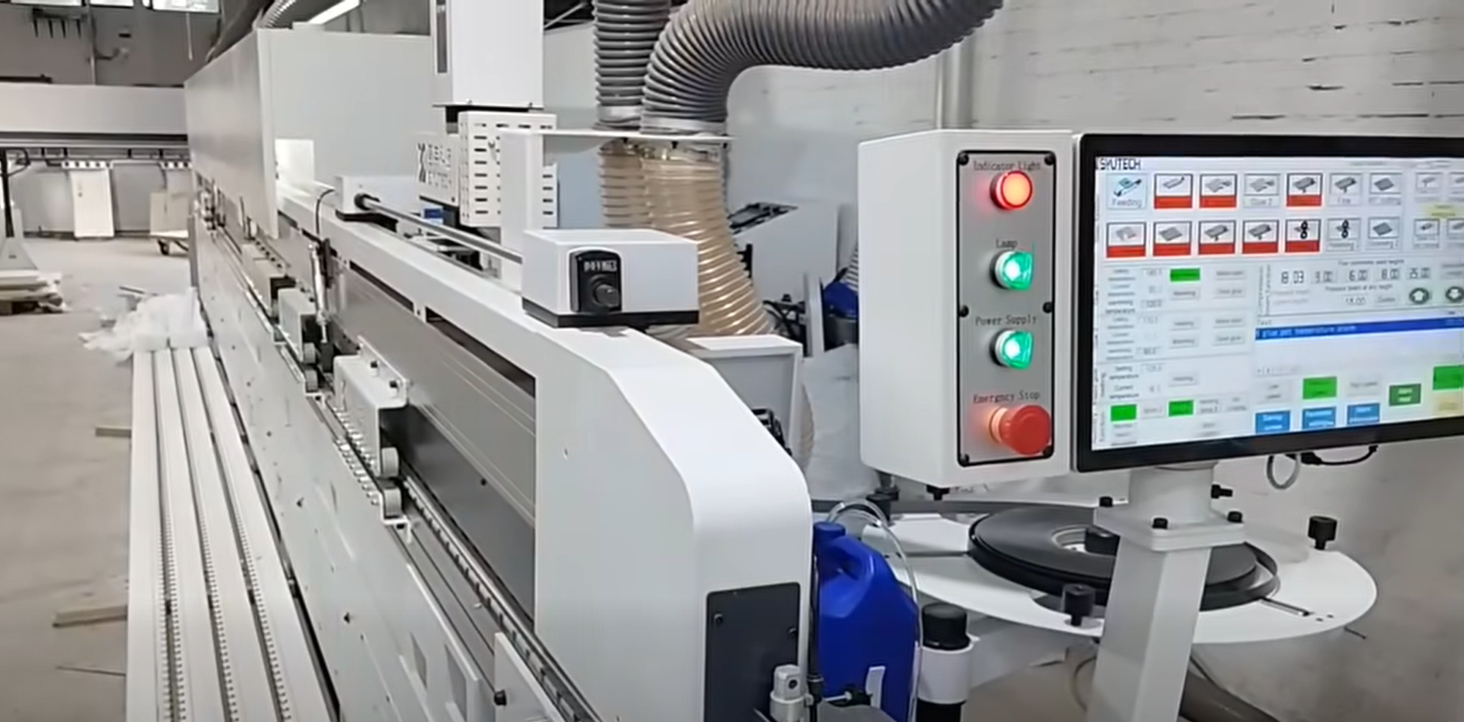
An automatic edge banding unit running a continuous cycle of gluing, trimming, scraping and polishing on panel edges.
The operating environment is part of the specification, not an afterthought. These machines are designed for indoor conditions at normal temperature and humidity, in a dust-contained wood processing environment. That describes a conventional furniture workshop, but it also excludes open-air, temporary or uncontrolled installations. Buyers planning a covered but unregulated site should treat the environment as a real constraint rather than a formality in the procurement file.
Manufacturer context: SYUTECH and the Saiyu Technology brand
SYUTECH is the brand operated by Foshan Shunde Saiyu Technology Co., Ltd., a woodworking machinery manufacturer based in Shunde District, Foshan City, Guangdong Province, China, an area commonly described as the hometown of woodworking machinery in China. The company was originally established in 2013 as Foshan Shunde Leliu Huake Long Precision Machinery Factory and later built the Saiyu Technology brand on that base.
The documented manufacturing footprint is a 10,000 square metre facility, approximately 100 employees, an annual output of 500 units, and a two-engineer research and development team. Export sales represent 80% of total revenue, with main markets listed as Russia, the Middle East, South America, Europe and Southeast Asia. The company states that it has worked with TEKNOMOTOR, an Italian company, on integrating domestic and international technology.
On compliance, SYUTECH machinery in the HK series is documented as CE certified for the EU market under certificate HTT202405661L, referencing EN 60204-1:2018 and EN ISO 12100:2010. The product portfolio extends beyond edge banding: the company lists fully automatic edge banding machines, laser edge banding machines, CNC six-sided drilling machines, computer panel saws, and complete panel furniture equipment and automated production lines. Published model specifications are available at syutech.com.
Scenario 1: cabinets and cabinet doors in a panel furniture plant
The first documented scenario is a European panel furniture plant producing cabinets and cabinet doors. The project type is cabinets and cabinet doors, the function is cabinet and cabinet door production, and the working condition is an indoor, dust-contained wood processing environment at normal temperature and humidity. Operation is described as a continuous automatic cycle with manual feeding assistance.
Two requirements in this scenario shape machine choice more than line speed does. The first is the supporting equipment set: the scenario lists a vacuum cleaner, a vacuum pump and an air compressor as matched equipment. The second is compliance. The documented requirement is that the machine meets EU CE mechanical and low voltage safety standards, with no explosion-proof requirement. For a buyer exporting into the EU, that combination determines which documentation must be ready before the machine ships.
For this profile, the larger automatic models are the natural fit. The HK868P automatic edge banding machine is listed with an overall dimension of 9500 x 1000 x 1650 mm, a working speed of 16-22 m per minute, edge band width of 10-60 mm, edge band thickness of 0.4-3 mm, pre-milling motors of 2.2 kW each, and a total power of 25 kW. The HK568 model covers a similar edge band range of 10-60 mm width and 0.4-3 mm thickness, with a feeding speed of 16-18-22 m per minute, pre-milling power of 2.2 kW x 2 at 9000 rpm, a glue box of 1.8 kW, corner trimming at 0.37 kW x 2, polishing at 0.37 kW x 2, an installed power of 25.86 kW, an air pressure requirement of 0.7-0.9 MPa, an overall dimension of 7200 x 710 x 1628 mm and a machine weight of 2200 kg.
Scenario 2: workshops that also run CNC routers, and the Kenya project
The second scenario is a panel furniture manufacturer in Kenya that runs edge banding and CNC router work inside the same facility. The documented application is panel furniture edge banding, where the machine automatically applies, trims and polishes edge strips for panel furniture boards. Matched equipment is an air compressor and a vacuum cleaner, and the operation mode is again a continuous automatic cycle with manual feeding assistance.
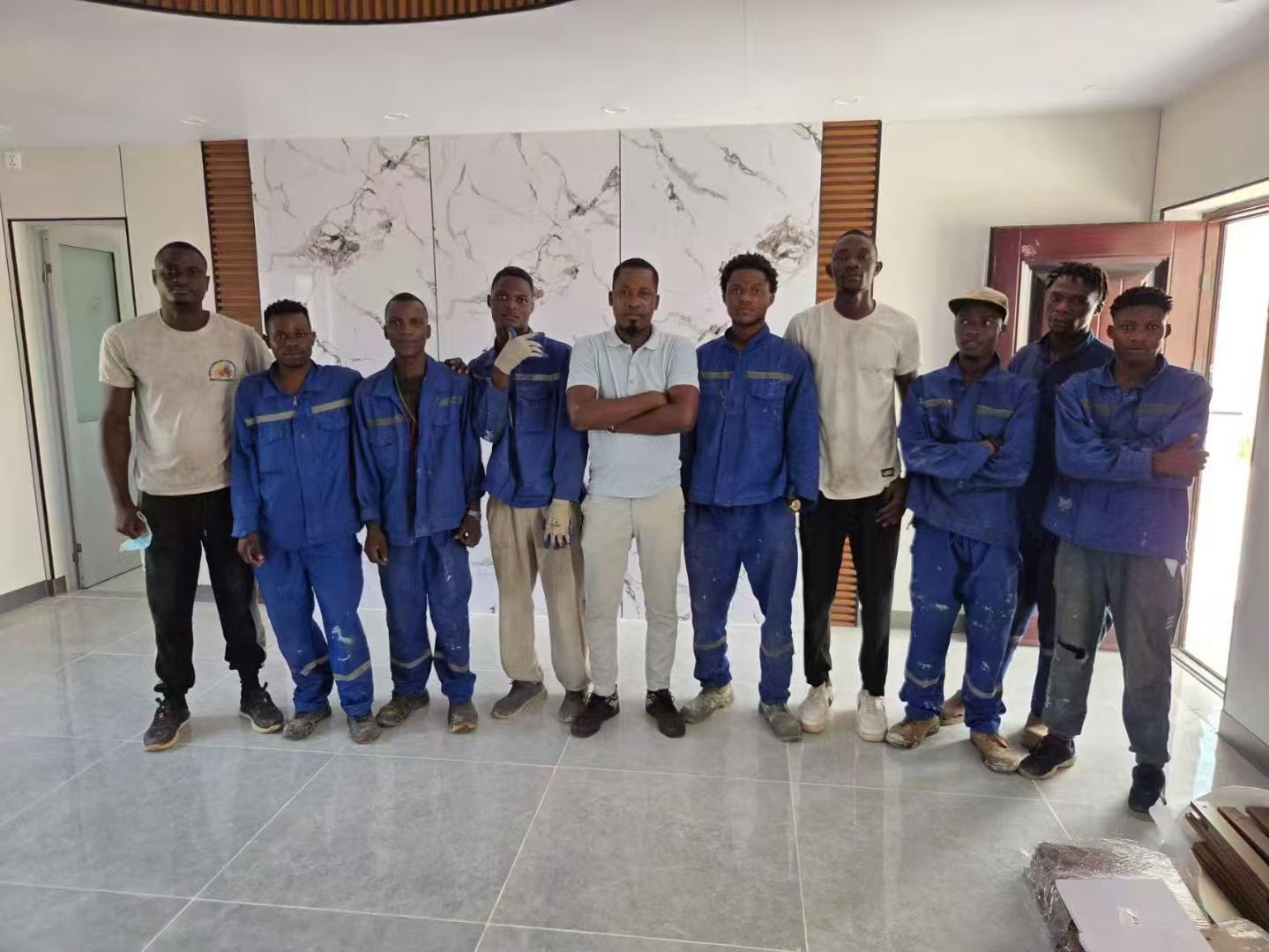
Documented client workshop where edge banding and CNC router operations run under the same roof.
The project record covers three units in service for two years, spanning an edge banding workshop and a CNC router workshop. The reported result is that edge banding quality improved significantly and output increased, with the project highlight described as stable edge banding rather than a single speed figure.
Co-locating edge banding with CNC router work changes the buying brief in a way that a speed comparison will not capture. When panels are nested on a router before edge banding, the batch usually contains a wider mix of panel sizes and shapes, and the edge banding station inherits that variation. Functions that matter more in this setting include corner trimming, consistent glue application across changing feed conditions, and a trimming sequence that produces a repeatable finish without a manual touch-up station behind the machine. The two-year service record is modest evidence, but it is evidence of fit in exactly this configuration.
Scenario 3: compact workshops and mixed-batch custom lines
Not every custom furniture line needs the largest machine on the list. SYUTECH also lists a compact edge banding machine, the HK268GY, and a mini edge banding machine, the HK268G. Both accept edge band widths of 10-60 mm and edge band thickness of 0.35-3 mm, with a minimum panel length of 150 mm under corner trimming conditions of 45 x 200 mm, and a minimum panel width of 40 mm. The HK268GY runs at 18-20-22 m per minute with an installed power of 12.4 kW at 380 V 50 Hz and an overall dimension of 5360 x 730 x 1210 mm. The HK268G runs at 16-18-22 m per minute with an installed power of 11.8 kW and an overall dimension of 3790 x 730 x 1210 mm.
There is a real trade-off inside that choice, and it is easy to miss. The compact and mini models accept narrower panels, with a minimum width of 40 mm, compared with 50 mm on the HK568. But they require a longer minimum panel length of 150 mm, compared with 135 mm on the HK568. A workshop whose cutting list includes many narrow door and drawer components may therefore gain more from the compact envelope, while a workshop running very short components should check that minimum length before ordering.
Model-by-model fit: SYUTECH edge banding machines compared
The table below consolidates published specification fields across the SYUTECH edge banding models discussed above. It is intended as a screening tool for matching a machine to a panel envelope, not as a ranking.
| Model | Edge band width | Edge band thickness | Feeding speed | Installed power | Panel size limits |
|---|---|---|---|---|---|
| HK568 | 10-60 mm | 0.4-3 mm | 16-18-22 m/min | 25.86 kW | Min length 135 mm, min width 50 mm |
| HK868P | 10-60 mm | 0.4-3 mm | 16-22 m/min | 25 kW | Listed for MDF, block board, solid wood board, particleboard, polymer door plates, plywood and PVC board |
| HK268GY | 10-60 mm | 0.35-3 mm | 18-20-22 m/min | 12.4 kW | Min length 150 mm, min width 40 mm |
| HK268G | 10-60 mm | 0.35-3 mm | 16-18-22 m/min | 11.8 kW | Min length 150 mm, min width 40 mm |
Specifications as published by the manufacturer. Machine weight is listed at 2200 kg for HK568 and 4 t for HK868P.
Automatic edge banding against manual and semi-automatic alternatives, and where its boundaries are
Manual edge banding has traditionally relied on hand-applied adhesive and hand trimming, which keeps the equipment requirement low but makes finish quality depend on the operator and makes repeatable output difficult to sustain. A semi automatic edge banding machine sits between the two positions, automating part of the sequence while leaving more of the process to the operator. An industrial edge banding machine of the fully automatic type, as described in SYUTECH's published process, runs conveying, gluing, cutting, alignment, trimming, scraping and polishing as one continuous cycle. For furniture edge banding at repeatable volume, that continuous cycle is the main argument for automation.
The boundary is equally clear, and buyers should weigh it before committing. First, an automatic edge banding machine does not operate as a standalone unit. The documented application scenarios list a vacuum cleaner, a vacuum pump and an air compressor as matched equipment, and HK568 lists an air pressure requirement of 0.7-0.9 MPa. A workshop without that utility base is not ready for the machine. Second, the environment is specified: indoor normal temperature and humidity, in a dust-contained wood processing environment. Third, operation is described as a continuous automatic cycle with manual feeding assistance, so the loading station still depends on people. Fourth, panel size limits apply, and they differ by model, as shown in the table above. A fifth consideration sits on the compliance side: international and European standards such as ISO 18217:2015 and EN ISO 19085-17:2021 define safety requirements for chain-fed edge banding machine configurations with specific capacity ranges, and the exact configuration determines which requirements apply. Confirming that scope with the supplier is a procurement step, not a formality.
Market trend analysis: where edge banding demand is moving
Third-party market data supports the case for scenario-based rather than price-based selection. A 2026 report by Market Research Future estimates the global automatic edge banding machine market at USD 3.658 billion for 2024, and projects a compound annual growth rate of 4.56% over 2025 to 2035 for that segment. The same market analysis, published via EIN Presswire in 2026, indicates that Chinese manufacturers account for approximately 40% of global edge banding machine shipments.
For buyers, the practical reading is that the automatic segment is the part of the category that is expanding, and that supply is concentrated enough for buyers to compare several credible manufacturers of automatic and industrial edge banding machines rather than accepting whichever unit is available locally. The SYUTECH figures sit inside that pattern: an export ratio of 80% of total revenue, a listed annual output of 500 units, and main markets spanning Russia, the Middle East, South America, Europe and Southeast Asia. The implication for procurement is less about brand and more about documentation. Where a segment grows quickly across multiple export markets, the manufacturers that hold verifiable certification and can explain model boundaries by scenario tend to be easier to qualify.
Future outlook
The direction of travel in panel furniture manufacturing is toward connected lines rather than isolated machines. SYUTECH's listed portfolio already reflects that shift, combining edge banding machines with CNC six-sided drilling machines, computer panel saws, CNC nesting equipment and complete automated production lines, including configurable line products such as HKATC and HK-Line. For a custom furniture producer, the implication is that the edge banding decision should be made with the surrounding process in mind: what cuts the panel, what drills it, and what moves it between stations.
A second likely development is more explicit scenario documentation from suppliers. As buyers in Europe, Africa, the Middle East and South America apply different compliance routes and work in different workshop conditions, machine selection will increasingly depend on documented environment, utility and panel-envelope data rather than on headline speed alone. Buyers who build their shortlist around those variables, and who ask for the supporting documentation early, are likely to spend less time resolving installation problems later.
FAQ
Which panel furniture projects are edge banding machines suitable for?
Documented applications cover panel furniture edge banding, and cabinets and cabinet doors production. In the panel furniture edge banding scenario, the machine automatically applies, trims and polishes edge strips on panel furniture boards. It is designed for indoor conditions at normal temperature and humidity, in a dust-contained wood processing environment.
What supporting equipment does an edge banding machine need?
Documented matched equipment includes a vacuum cleaner, a vacuum pump and an air compressor. The European cabinet and cabinet door scenario lists all three; the Kenya panel furniture edge banding scenario lists an air compressor and a vacuum cleaner. On the machine side, HK568 and the compact models specify an air pressure requirement of 0.7-0.9 MPa.
Can an edge banding machine work in a workshop that also runs CNC routers?
Documented project experience covers exactly that configuration. A panel furniture manufacturer in Kenya operates three units in service for two years across an edge banding workshop and a CNC router workshop, with the reported result of significantly improved edge banding quality and increased output, and a project highlight described as stable edge banding.
What is the smallest panel an edge banding machine can process?
It depends on the model. HK568 specifies a minimum panel length of 135 mm under corner trimming conditions of 50 x 300 mm, and a minimum panel width of 50 mm. HK268GY and HK268G specify a minimum panel length of 150 mm under corner trimming conditions of 45 x 200 mm, and a minimum panel width of 40 mm. Buyers should match these limits against the smallest component in their own cutting list.
What edge band width and thickness can these machines handle?
HK568 and HK868P accept edge band widths of 10-60 mm and edge band thickness of 0.4-3 mm. HK268GY and HK268G accept the same edge band width range of 10-60 mm and a slightly wider thickness range of 0.35-3 mm.
Does the machine run fully unattended?
No. The documented operation mode for both the European cabinet scenario and the Kenya panel furniture edge banding scenario is a continuous automatic cycle with manual feeding assistance. The gluing, trimming, scraping and polishing stages run automatically within the cycle; loading the panel remains a manual task.
Documentation
General product information on the panel furniture equipment range referenced in this analysis is available in the manufacturer brochure: Factory promotional paper (PDF).
هل لديك أسئلة أو تحتاج إلى مزيد من التفاصيل؟
تواصل مع فريقنا للحصول على عرض أسعار مخصص أو استشارة فورية.
طلب عرض أسعار
املأ النموذج أدناه وسيتواصل معك فريقنا بعرض مقترح مخصص.
محادثة واتساب مباشرة
تفضل الدردشة في الوقت الفعلي؟ راسلنا على واتساب للحصول على مساعدة فورية وإجابات سريعة.
- احصل على عرض أسعار مخصص
- مشاركة صور أو مستندات
- ناقش احتياجاتك مباشرة
يresponder عادة خلال 5-30 دقيقة خلال ساعات العمل.