
How a Chinese Filling Machine Maker Handles Global Orders
How a Chinese Filling Machine Maker Handles Global Orders
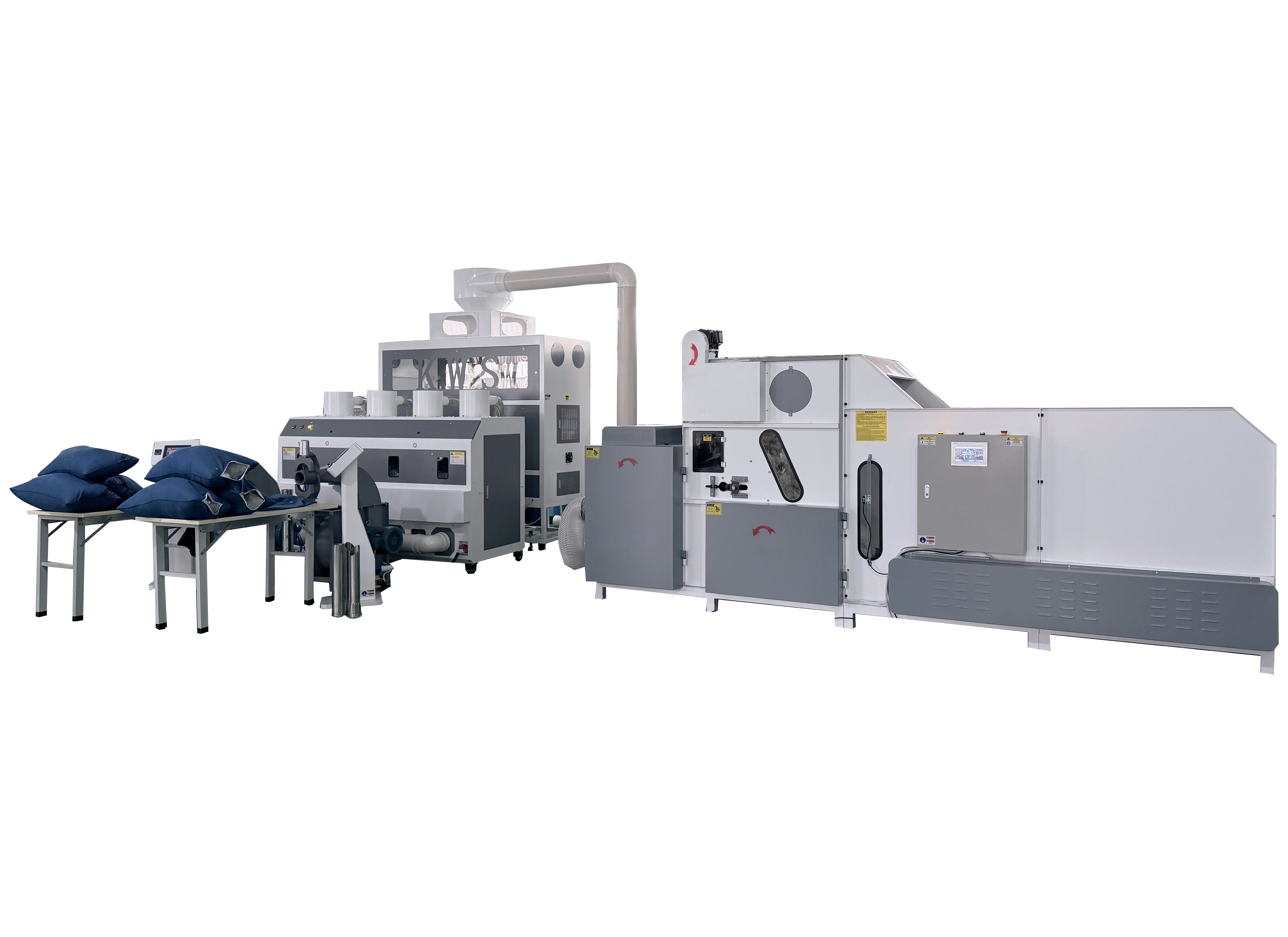
A fiber pillow filling line during assembly and testing — the point at which capability claims either hold up or do not.
The global filling machines market was valued at USD 10.06 billion in 2024 and is projected to reach USD 16.51 billion by 2035, according to Market Research Future. A meaningful share of that growth sits in an unglamorous corner of production: lines that weigh and push polyester fiber, fiber balls, shredded foam, and down into pillow shells, quilt panels, cushion covers, and toy bodies.
For the procurement manager sourcing such a line from China, the hard question is rarely whether the equipment exists. It is whether a specific supplier's claims can be checked before a deposit moves, and whether that supplier can still support the machine two years after it is bolted to the floor. This article examines what verifiable capability evidence actually looks like, using Qingdao Kaiweisi Industry and Trade Co., Ltd. — trading under the brand KIVAS — as a working example rather than as a recommendation.
The Evidence Gap Between a Brochure and a Purchase Order
Filling machine marketing tends to describe outcomes: precision, efficiency, durability. Procurement decisions, however, are made on evidence that can be classified and compared across shortlisted vendors. In practice that evidence falls into three tiers.
- Structural evidence — the legal entity, founding year, facility footprint, headcount, and size of the engineering team. These establish whether the supplier is a manufacturer or a trading intermediary, and how much engineering capacity actually sits behind a customization request.
- Operational evidence — minimum order quantity, quoted lead time, verified monthly output ceiling, pre-shipment testing protocol, and whether an in-house function exists to handle export documentation, installation guidance, and after-sales escalation.
- Outcome evidence — installed units, how long they have run, and what measurably changed at the buyer's plant as a result.
Statements such as "advanced technology" or "high quality" belong to none of the three tiers. They cannot be compared across vendors, they cannot be audited on site, and they do not change the risk profile of a purchase order. A supplier that publishes structural, operational, and outcome evidence is telling a buyer something different from a supplier that publishes adjectives — not automatically better, but checkable.
Qingdao Kaiweisi (KIVAS): What the Company-Level Numbers Show
Qingdao Kaiweisi Industry and Trade Co., Ltd., which uses the brand name KIVAS, is a home textile equipment manufacturer based at 279, Huan Tai East Road, Huangdao District, Qingdao City, China. The company was founded in 2014 and produces fiber processing machinery, cotton, linen and wool textile machinery, fully automated quantitative pillow and quilt filling machines, pet product filling machines, weighing down jacket filling machines, packaging machines, and related supporting machinery.
The company-level figures it publishes are specific enough to be cross-checked against one another, which is the first real test of any supplier capability claim.
| Capability indicator | Published figure | What it tells a buyer |
|---|---|---|
| Founded | 2014 | More than a decade of continuous operation in home textile equipment. |
| Facility size | 3,000 m² | A single-site production footprint rather than a multi-plant group. |
| Employees | 17 | Lean organization; assembly and testing are likely concentrated in a small team. |
| R&D team | 5 engineers | A significant share of headcount sits in engineering, which suits a customization-led order book. |
| Annual output | 1,000 units | Roughly four units per working day across the full product range. |
| Monthly capacity | 60–150 units | Annualizes to between 720 and 1,800 units, so the stated annual figure sits inside the band. |
| Export ratio | 60% | Majority export business, implying routine handling of export documentation and overseas logistics. |
| Main markets | USA, Russia, Vietnam, Kazakhstan, Saudi Arabia, Italy, UK, China, Spain, Korea, Turkey, Brazil, Pakistan, Moldova, Ukraine | Spread across North America, Europe, the Middle East, Southeast Asia and South America rather than a single regional dependency. |
| International trade function | Independent international trade department | A dedicated export-facing team handling installation guidance, pre-sales and after-sales communication. |
| Certification | ISO9000 / CE | Quality management documentation plus European market access certification. |
Company-level indicators published by Qingdao Kaiweisi Industry and Trade Co., Ltd. (KIVAS).
Two observations are worth drawing out. First, the relationship between headcount and output is informative. Seventeen people producing roughly 1,000 units a year points to a sub-assembly and specialized-production model rather than heavy vertical integration — efficient for configured machines, but relevant when a buyer needs a heavily modified one-off line and expects deep in-house fabrication. Second, the monthly capacity band of 60–150 units and the stated annual output of 1,000 units are internally consistent. That consistency is the minimum standard for any capability claim; contradictions between published figures are one of the fastest ways a vendor gets eliminated during desktop screening, before a single email is exchanged.
The export ratio and market list carry a different kind of weight. A 60% export share across the USA, Russia, Vietnam, Kazakhstan, Saudi Arabia, Italy, the UK, Spain, Korea, Turkey, Brazil, Pakistan, Moldova and Ukraine implies exposure to multiple certification regimes, voltage standards, and documentation requirements. It is not proof of performance, but it is evidence that the supplier has repeatedly completed the non-manufacturing half of an export order: packing, documentation, freight coordination, and remote commissioning support. The existence of an independent international trade department handling installation guidance, pre-sales and after-sales is the organizational counterpart to that claim.
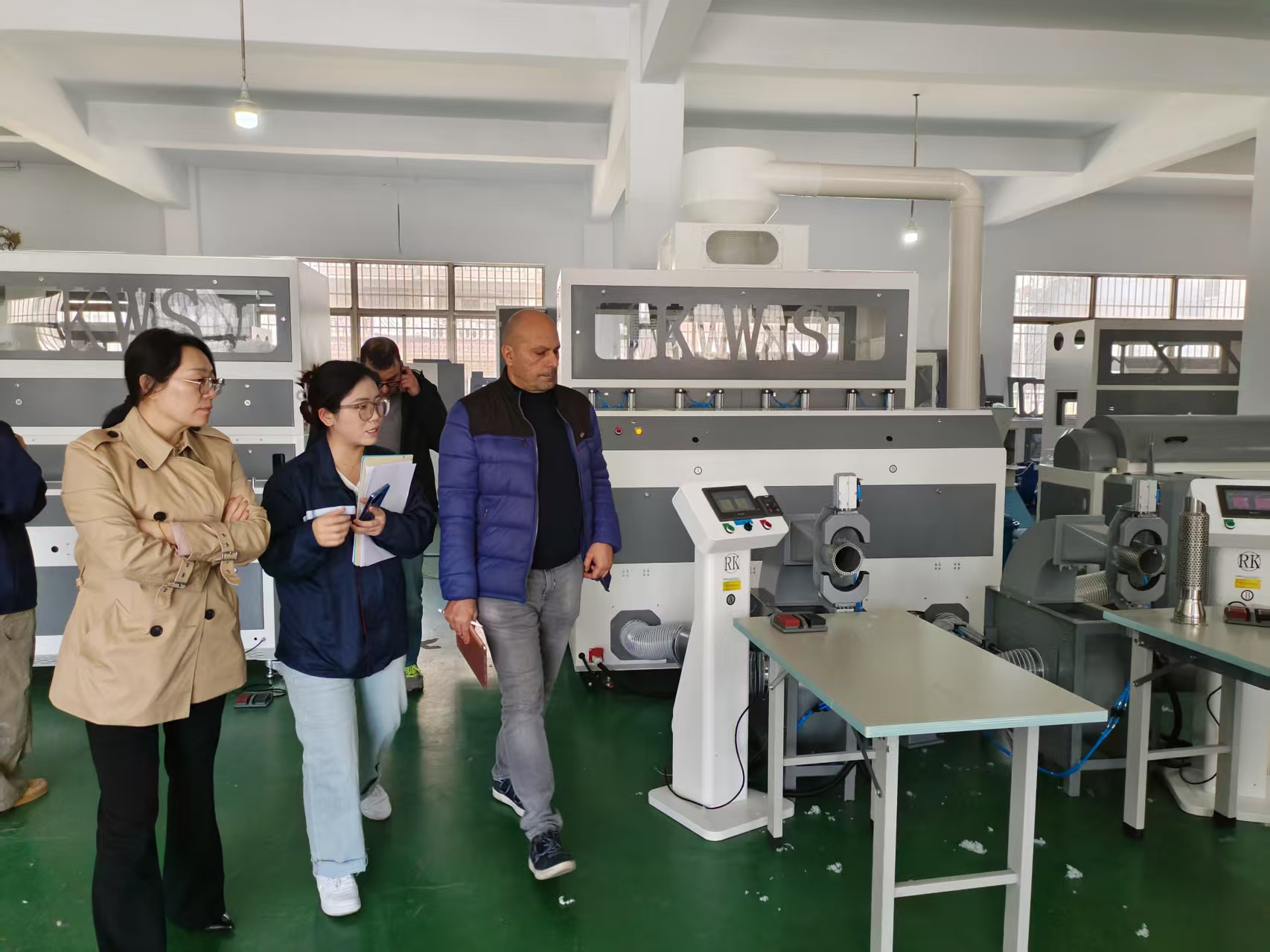
Customer factory audit support — the structural evidence tier that converts claims into witnessed facts.
Inside the Specification: The KWS6901 Filling Platform
KIVAS's core filling platform is the KWS6901 series, offered in KWS6901-2 and KWS6901-4 configurations, the difference being the number of filling ports. The published specification covers exactly the parameters that determine whether a line suits a given plant.
| Parameter | Published specification |
|---|---|
| Model | KWS6901-2 / KWS6901-4 |
| Power range | 10.5 kW – 13.5 kW |
| Production capacity | 400–800 kg/h |
| Filling speed (600 g pillow) | 10–20 pieces per minute |
| Accuracy | About 1% |
| Error range | ±5–10 g |
| Optimal filling range | 100–2,000 g |
| Workstations | 2 or 4 filling ports per machine |
| Suitable raw materials | 0.6D–15D polyester fiber, fiber balls, shredded foam, down feathers, EPS balls and similar materials, for single or mixed filling |
| Body material | Steel |
Operation is pneumatic and continuous, with weighing and quantitative filling controlled automatically. On quality control, KIVAS states that export orders go through a 100% pre-shipment test and can be supported by third-party inspection such as SGS. That distinction matters commercially: third-party inspection converts an internal quality claim into an externally witnessed one, and it is the single most cost-effective risk-reduction step available to a first-time overseas buyer.
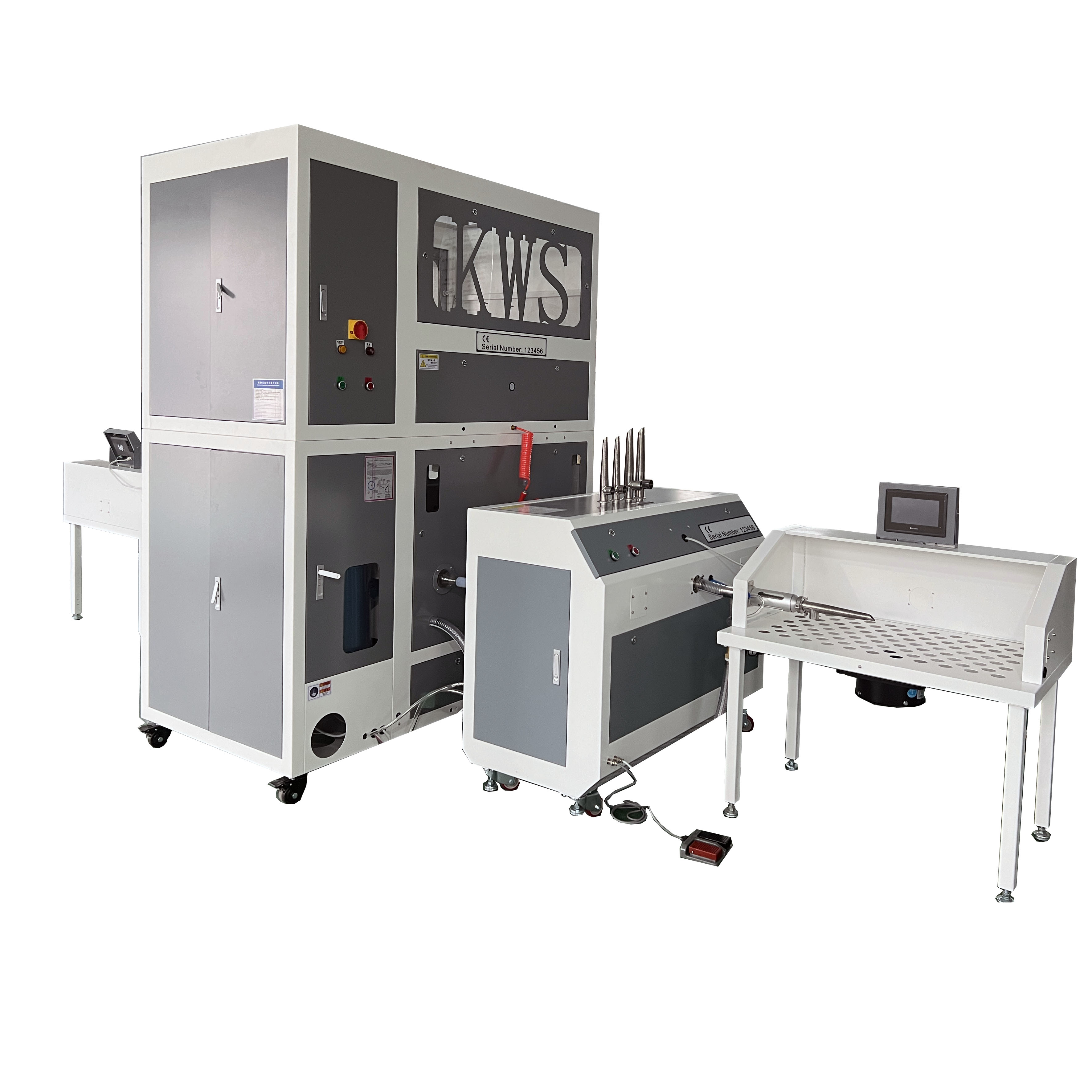
Weighing and filling station: the accuracy specification applies within a defined 100–2,000 g target window.
Accuracy figures need context, because they are where specification sheets most often mislead. Across the industry, high-precision down filling machines now use load cell technology to reach weighing accuracies of around ±0.1 g for lightweight outerwear production. That is not a like-for-like comparison with a bedding line. The KWS6901 platform operates across a 100–2,000 g filling range, where an error of ±5–10 g represents roughly 1% of a typical 600 g pillow target. The two specifications answer different production problems, and a buyer should benchmark a quoted tolerance against their own target weight and acceptable deviation rather than against the smallest number visible in a competitor's brochure.
Equally important is what the machine requires from the building around it. KIVAS specifies an indoor, dry, ventilated textile workshop with low dust, an ambient temperature of 0 °C to 40 °C, a stable three-phase power supply, level flooring and sufficient air source capacity. Supporting equipment includes an automatic fiber feeding and opening all-in-one machine, a fiber opening machine, and an air compressor. A purchase order that covers only the filling machine and omits the upstream opening and air stages will not reach the rated 400–800 kg/h throughput, no matter how the filling unit itself performs.
Application and Use Cases: Where the Evidence Has to Hold
The KWS6901 platform is specified for textile filling machinery and textile processing machinery projects in the home textile filling industry. Its function is to automatically and quantitatively fill down, fiber and other materials for mass production of pillows, cushions, down jackets, quilts and bedding. Across the KIVAS range, the corresponding machine types include pillow filling machines, duvet filling machines, polyester pillow filling machines, down jacket filling machines, quilt filling machines, bedding filling machines, toy filling machines, cushion filling machines, lazy sofa filling machines and beanbag filling machines.
The declared application industries extend beyond bedding: down clothing, soft sofa furniture, pet supplies, plush toys, car cushions, cotton and linen fiber primary processing, recycled fibers, non-woven fabric accessories, and medical care. For a buyer, the breadth of that list is a claim in itself, and it should be tested with a sample run on the buyer's own raw material rather than accepted at face value — particularly when recycled fibers or mixed material blends are involved, since fiber diameter and bulk density vary widely within the stated 0.6D–15D band.
The clearest published outcome record comes from a project in Saudi Arabia. A manufacturer operating pillow and bedding filling lines plus compression packaging equipment installed 10 units of the KWS6901-4 pillow filling and compression packaging line, used for pillow, cushion and bedding filling, fiber opening, and pillow compression packaging. According to the case record, the installation has been operating normally for three years with low maintenance requirements, and the buyer reports a 30% reduction in energy consumption, a 35% reduction in labor costs, and a 40% increase in production capacity. The same record highlights high precision (about 1% error) and the ability to fill either a single material or a mix of two to five raw materials.
Three-year runtime on a ten-unit installation is more useful to a procurement decision than any performance adjective. It speaks to service life, spare-part availability, and whether the supplier's remote support function actually works at a distance of several thousand kilometres. Buyers evaluating any filling machine vendor should ask specifically for installations that have been running for more than two years, and should ask what failed during that period.
Market Trend Analysis: Why Overseas Order Handling Is Becoming the Differentiator
China's exports of textile machinery and parts reached a monthly peak of USD 574.6 million in August 2025, according to customs data compiled by CEIC. That figure describes an export ecosystem — component suppliers, freight forwarders, documentation agents, commissioning engineers — that a Chinese filling machine manufacturer either plugs into efficiently or does not. For a foreign buyer, the practical implication is that equipment cost is no longer the main variable between comparable suppliers; order handling capability increasingly is.
On the demand side, automatic pillow filling machines are expected to grow at a CAGR of approximately 5% through 2025, driven by automation in textile clusters such as China and Vietnam, according to Machine Insights. That growth rate is moderate rather than explosive, which tends to reward suppliers with stable production scheduling over those chasing volume. It also explains why the specification-driven segments — bedding, down apparel, pet products, toys — continue to attract new machine purchases instead of being consolidated into a few large platforms.
Regulation is moving in the same direction. Machinery exported to the EU must comply with the Machinery Directive 2006/42/EC and bear the CE marking, including specific risk assessments under EN ISO 12100. In the North American market, filling machinery must often meet UL and OSHA safety standards, focusing on emergency shutoff and safety enclosures. For a supplier exporting to sixty percent of its output, compliance documentation is not a marketing asset; it is a precondition for shipment. Buyers should request the relevant declaration documents and the risk assessment file, not just a CE mark image.
Automated Quantitative Filling Compared with Traditional Filling Approaches
Most buyers comparing options are choosing between manual or semi-automatic filling assisted by weighing scales, and pneumatic automatic quantitative filling of the kind specified above. The trade-offs are predictable and worth tabulating before a quote is requested.
| Dimension | Manual / semi-automatic filling | Automated quantitative filling (KWS6901 class) |
|---|---|---|
| Weighing | Operator-dependent, varies with shift and fatigue | Automatic weighing and quantitative filling; about 1% accuracy, ±5–10 g error |
| Output | Limited by operator pace per station | 400–800 kg/h; 10–20 pieces per minute at a 600 g pillow target |
| Material flexibility | Workable but slow to change over between fiber types | Single or mixed filling with 2–5 raw materials, 0.6D–15D fiber, fiber balls, shredded foam, down, EPS balls |
| Labor exposure | High; scales linearly with volume | Reduced; measured in one reported project at 35% lower labor cost |
| Utility requirements | Basic power only | Three-phase power, compressed air, level floor, dry low-dust workshop at 0–40 °C |
| Infrastructure dependency | Low | Depends on fiber opening and air supply stages to reach rated capacity |
| Configuration choice | Not applicable | 2-port or 4-port; 10.5–13.5 kW; ceiling set by the port count selected |
Where the automated approach does not fit
An honest comparison has to state the boundaries, and there are several that matter before an order is placed.
It is not plug-and-play. The KWS6901 platform requires a stable three-phase supply, a level floor, sufficient air source capacity, and a dry, low-dust, ventilated workshop within a 0 °C to 40 °C band. A buyer without that infrastructure is not comparing machine prices; they are comparing the cost of a machine plus a building upgrade. This is the most common source of post-installation disappointment in filling equipment.
Accuracy has a floor and a relative context. A ±5–10 g error is well within tolerance for a 600 g pillow but represents a much larger relative deviation on a 100 g target at the low end of the range. Buyers filling very light articles — lightweight down garments, small cushions — should not assume the same machine class delivers the tolerance they need; load cell systems capable of around ±0.1 g are a different equipment category.
Capacity has an internal structure. The published 400–800 kg/h range and the 10–20 pieces per minute figure are not independent numbers: the higher end assumes a 4-port configuration, adequate upstream fiber opening, and uninterrupted air supply. A 2-port machine quoted at the same headline rate will not deliver it. Port count and supporting equipment must be matched to the actual daily target.
Lead time is a standard-configuration figure. The stated lead time of 15–35 days applies to orders placed against the standard specification. Customization of voltage, logo, color, production capacity, and specialized production lines is offered, but customized or specialized lines naturally sit at or beyond the upper end of that window. A buyer planning a plant launch date should treat 35 days as the planning assumption, not the best case.
A minimum order of one unit does not mean one unit is the efficient purchase. A MOQ of 1 unit is genuinely useful for pilot projects and sample validation. But with a monthly capacity ceiling of 60–150 units and a 17-person production team, buyers planning multi-line rollouts should schedule phased delivery rather than expect a large block shipment inside a single lead-time window. For large buyers, the constraint is scheduling, not willingness.
Future Outlook
Three shifts look likely to shape how filling machine suppliers are evaluated through the remainder of the decade.
First, evidence will migrate from the brochure to the document. Certification files under Machinery Directive 2006/42/EC, EN ISO 12100 risk assessments, UL and OSHA-relevant safety documentation, and third-party inspection reports are becoming routine requests in the first email rather than the third meeting. Suppliers that maintain these documents as a matter of process will clear procurement gates faster than those that assemble them after a request.
Second, the accuracy conversation will bifurcate. Load cell systems approaching ±0.1 g for lightweight articles and 1%-class quantitative lines for bedding will continue to diverge, and buyers will increasingly be asked to state target weight and tolerance before a specification is proposed at all. Suppliers that ask that question early will look more competent than those that quote a single headline accuracy figure.
Third, mid-sized manufacturers will compete on schedule reliability rather than on scale. A supplier with a 3,000 m² facility, a small engineering team, and a 60–150 unit monthly ceiling cannot out-volume a large group. It can, however, out-perform on configuration fit and on the export handling layer — documentation, inspection, installation guidance, and remote support — which is precisely where a 60% export ratio becomes a meaningful qualification rather than a statistic.
Frequently Asked Questions
What evidence should a buyer collect before shortlisting a filling machine supplier?
Structural evidence first: legal entity name, founding year, facility size, employee count, and engineering headcount. Operational evidence second: minimum order quantity, quoted lead time, monthly output capacity, pre-shipment testing protocol, and whether the supplier maintains an independent export and after-sales function. Outcome evidence third: installed units, runtime in years, and any measured changes reported by the buyer. As a reference point, Qingdao Kaiweisi Industry and Trade Co., Ltd. publishes a 2014 founding year, a 3,000 m² facility, 17 employees, a 5-engineer R&D team, a 1,000-unit annual output, a 60% export ratio, a MOQ of 1 unit, and a 15–35 day lead time.
What factory conditions are required to install a KWS6901 filling line?
The installation environment is specified as an indoor, dry, ventilated textile workshop with low dust and an ambient temperature of 0 °C to 40 °C. A stable three-phase power supply, level flooring, and sufficient air source capacity are required. Supporting equipment typically includes an automatic fiber feeding and opening all-in-one machine, a fiber opening machine, and an air compressor. Without the upstream opening and air stages, the filling unit will not reach its rated 400–800 kg/h production capacity.
How long does a typical filling machine order take, and what is the minimum order quantity?
KIVAS lists a minimum order quantity of 1 unit and a lead time of 15–35 days. The 15–35 day window applies to standard configurations; customized requirements such as voltage, logo, color, production capacity, or specialized production lines generally extend the schedule toward the upper end or beyond it. Monthly production capacity is stated at 60–150 units, which determines how quickly a multi-unit order can be delivered in sequence.
Can one filling machine handle both polyester fiber and down?
The KWS6901 platform is specified for 0.6D–15D polyester fiber, fiber balls, shredded foam, down feathers, EPS balls and similar materials, and supports either single-material filling or mixed filling using 2–5 raw materials. Accuracy is published at about 1% with an error range of ±5–10 g across an optimal filling range of 100–2,000 g. Down and polyester behave differently in pneumatic conveying, so buyers should validate the material mix on a sample run rather than relying on the material list alone.
What support is available after the filling machine is delivered?
KIVAS provides remote technical support, a one-year warranty, and lifetime after-sales service, delivered through its independent international trade department, which also handles installation guidance, pre-sales and after-sales communication. Export orders undergo a 100% pre-shipment test and can be supported by third-party inspection such as SGS. Buyers should confirm in writing which support channel applies in their time zone and what response time is expected for spare-part requests.
The full Qingdao Kaiweisi product catalog, including the KWS6901 filling platform, is available for reference and download: QINGDAO KAIWEISI Product Catalog (PDF).