
How a Dosing Pump Portfolio Proves Chemical Duty Capability
How a Dosing Pump Portfolio Proves Chemical Duty Capability
A dosing pump supplier's capability is judged on three kinds of evidence, and only one of them is the catalogue. The first is whether the pump range contains distinct operating principles that map to distinct duty. The second is whether the supplier can answer a corrosive-liquid material question with a specific wetted-material recommendation attached to a named model. The third is whether it will state commercial terms and an acceptance basis before the order is confirmed. A product list on its own answers none of these questions.
WRS PTE LTD is the dosing pump brand examined here; its manufacturing entity is Zhejiang WRS Machinery Equipment Co., Ltd., based on Shixin Road, Xiaoshan District, Hangzhou, Zhejiang, China. The company presents a range covering metering pumps, solenoid dosing pumps, diaphragm dosing pumps, piston dosing pumps and digital dosing pumps, alongside dosing pump check valves, dosing pump pulse dampeners, chemical dosing systems, streaming current monitoring systems and chemical injection pumps.
The structure of this article follows the order in which buyer evidence accumulates: the range first, because that is what a buyer screens; the corrosive-duty material question second, because that is where technical claims are usually tested; and terms with acceptance criteria last, because that is where a supplier's statements become commitments.
Three Tests That Separate a Range From a Catalogue
A pump range carries capability signal only when three conditions hold simultaneously. Each family in the range must correspond to a duty the buyer actually operates. The supplier must be able to resolve a materials question down to a named wetted material on a named model. And the commercial terms must allow the performance claim to be checked before money is transferred.
Most supplier documentation passes the first test and stalls at the second and third. Publishing a category list is inexpensive. Producing a medium-specific material recommendation, or writing an acceptance criterion into a quotation, is not. That difference is why a wide range should be read closely rather than skimmed — the range sets the ceiling, and the material and terms evidence shows how much of that ceiling is actually reachable.
| Test | What a buyer should ask | What a weak answer sounds like |
|---|---|---|
| Range with model boundaries | Which model covers this flow and pressure, and what are its rated limits? | Category names only, no model numbers or rated ranges |
| Corrosive-duty resolution | Which wetted material do you recommend for this medium, and what conditions does that recommendation assume? | A general claim that the pump suits corrosive liquids |
| Terms and acceptance | What is the MOQ, the delivery term, the acceptance criterion and the payment basis? | Terms deferred until after technical selection |
The sequence matters as much as the content. Range screening belongs to evaluation, when technology fit is still open. Material resolution belongs to the moment the duty is defined — flow, pressure, medium, temperature. Terms and acceptance belong to execution, when the buyer is no longer choosing a technology but deciding whether to commit. A supplier that is precise at the first stage and vague at the third has demonstrated catalogue depth, not manufacturing or supply capability.
What the WRS Product Range Actually Contains
The range is broad enough to make the first test meaningful rather than decorative. Company records list the manufacturer as founded in 2016, operating a 15,000 m² facility with 120 staff, a 15-engineer technical team and an annual output stated at 30,000 units. Export is recorded at 20% of output, with Southeast Asia, Russia and South America named as main markets; the capability record also lists Europe among export destinations. The company profile additionally reports local after-sales service established in more than ten countries, including Singapore, Thailand, Malaysia, Vietnam, South Korea, Japan, Russia, Chile, South Africa, Angola and Turkey, with remote support listed as a service mode.
The ten listed product categories divide into two groups. The first group is the pump families: metering pump, solenoid dosing pump, diaphragm dosing pump, piston dosing pump and digital dosing pump. The second group is everything that determines whether a pump works inside a chemical dosing line rather than on a test bench: dosing pump check valve, dosing pump pulse dampener, chemical dosing system, streaming current monitoring system and chemical injection pump. A supplier that sells only pumps hands the buyer the accessory selection and the interface responsibility in the same package.
Category breadth alone would still be thin evidence. What converts it into usable evidence is model-level specification. WRS product listings describe the EML0020PR1C, a solenoid dosing pump, at a flow range of 1–20 L/h and a pressure range of 1–10 bar, with wetted-material options of PVC, PVDF and SS316, and control options of 4–20 mA, pulse signal and Modbus RS-485. A second listing covers the EMML0060FP1E digital dosing pump at 60 L/h and 4 bar with IP65 protection; the same listing carries a precision figure below 1%, but the measurement basis behind that figure is not stated, which means it cannot be placed next to another supplier's accuracy claim without first harmonising the definition and test conditions. For its intelligent dosing pumps, the company lists Modbus TCP/RTU, OPC-UA and DNP3 as supported protocols, a specification that matters to buyers integrating dosing into an existing control architecture.

Certification gives the range a second layer of structure. WRS holds CE certificate 3N240528.ZWMTU36, issued by ECM on 28 May 2024 and valid until 27 May 2029, citing EN ISO 12100:2010 and EN 60204-1:2018. The certificate scope is unusually explicit about which products it covers, naming the dosing pump series EML, EMG, EMA, EMB, EPS, EPM, EHS, EHM, ML, MLS, MG, MA, MB, PS, PM, PL, PD, PT, HS, HM, HL, HD and HT.
The linked models in the certification record also reveal how the range is organised in practice: an ML series solenoid pump, an HL series hydraulic pump, and PD and PM series piston pumps appear alongside the dosing pump models. That is the technical core of the portfolio argument — the drive principles differ, so the operating envelope that a single-family supplier would have to decline can be served from inside the same product system.
Corrosive Duty Starts With a Material Question, Not a Price Question
When a buyer asks a dosing pump supplier how to handle a strongly corrosive liquid, the answer is the clearest available test of whether the supplier understands chemical duty or is reciting a catalogue. WRS answers the question directly: different media have different materials available for selection, and for highly corrosive media the PVDF pump head material is recommended. The same answer sets out the selection order — flow rate is treated as the primary parameter and is compared against the maximum flow rate at the site, after which pressure, pump head material and motor are used to refine the configuration.
That answer is technically sound but deliberately incomplete, and the incompleteness is the part a buyer must close. A material recommendation without the medium's concentration and temperature is a starting point, not a conclusion. PVDF is a recognised choice for aggressive chemical service, but the actual duty condition — concentration, temperature, presence of abrasives, intermittent or continuous operation — determines whether the recommendation holds. The supplier that invites that conversation, instead of closing it with a reassurance, is the one whose material answer can be used in a specification.
The second half of the corrosive-duty question is scope. A pump head is not the whole wetted path. Valve seats, the diaphragm or piston seal arrangement, the suction and discharge connections, the dosing pump check valve that prevents backflow into the dosing line, and the pulse dampener used to smooth the pulsating discharge characteristic of reciprocating dosing pumps all sit in contact with the medium or immediately downstream of it. A supplier that answers the material question only at the pump head has answered perhaps half of it.
Here the range becomes relevant again. Because the same supplier lists check valves, pulse dampeners and complete chemical dosing systems alongside the pumps, the wetted-material question can be answered across the whole assembly rather than at a single component. On the EML0020PR1C, the availability of PVC, PVDF and SS316 as options on one model also means the material decision can be adjusted without changing the hydraulic specification — a practical advantage when a project moves from a benign additive to an aggressive one during design development.
Where the Range Meets Real Chemical Duty
The application list that accompanies a range is a useful cross-check, because it shows which duty conditions the supplier expects to meet. WRS names water treatment, electroplating and surface treatment, chemical industry, oil and gas, hydrogen power generation, paper and pulp, semiconductor, mining and livestock among its application lines. Those sectors do not share one dosing profile: a coagulant feed in water treatment, a plating bath additive, a corrosion inhibitor in oil and gas, and a nutrient solution in livestock operations differ in flow, pressure, control method and chemical aggressiveness.
Mapping duty to family is therefore the practical way to use the portfolio. The table below sets out the logic a buyer can apply without assuming that any single family covers every case.
| Duty condition | Family or component to examine | What decides the fit |
|---|---|---|
| Low-to-medium flow, precise injection, defined control signal | Solenoid dosing pump (EML series listing: 1–20 L/h, 1–10 bar) | Flow point against site maximum flow, pressure head, wetted material |
| Higher flow with washdown or humid exposure | Digital dosing pump (EMML series listing: 60 L/h, 4 bar, IP65) | Ingress protection, control interface, accuracy definition |
| High pressure or larger displacement | Piston and hydraulic families (PD, PM, HL, HS series in certificate scope) | Pressure rating, medium compatibility, seal arrangement |
| Pulsating discharge disturbing downstream instruments | Dosing pump pulse dampener | Discharge line volume, flow rate, pressure |
| Backflow risk into the dosing line | Dosing pump check valve | Line pressure, medium, connection standard |
| Coagulant charge control in water treatment | Streaming current monitoring system | Control loop design, sensor placement |
| Complete feed package rather than a single unit | Chemical dosing system | Tank, piping, instrumentation and control scope |
A recorded case illustrates the same logic at project level. WRS reports an Australian engineering company that took 20 units for wastewater treatment, with the pumps recorded as running stably for five years and the customer's stated highlight being high quality and ease of maintenance. That record is a supplier-reported single case; it demonstrates that the configuration has been supplied and operated, and it does not establish a general reliability figure or a service-life expectation for other installations. Its procurement value is narrower and still useful: it identifies a comparable application — wastewater treatment with an engineering-company buyer — that a new buyer can use as a reference point when requesting comparable documentation.
Terms and Acceptance: The Last Evidence Check
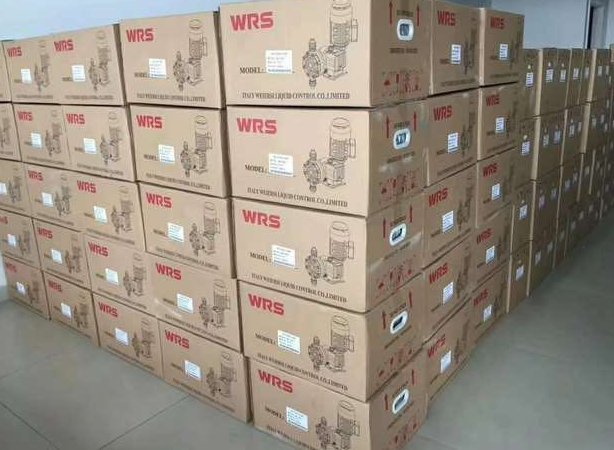
Technical fit means little if the commercial route cannot be executed cleanly, and this is where a supplier's published terms become evidence rather than administration. WRS states its terms plainly: MOQ of 1 unit, delivery term FOB, acceptance criterion of a pre-shipment test, and payment terms of 100% payment in advance.
Each term carries a specific meaning for the buyer. A minimum order of one unit makes a single-unit field trial possible, which lets a buyer validate material performance and control behaviour on the actual medium before committing to a larger quantity — a meaningful option on corrosive duty, where laboratory assumptions are most likely to need correction. FOB places the delivery obligation and risk transfer at the named port of shipment, leaving the buyer to arrange main carriage and insurance; that is a workable basis for an experienced importer who wants freight visibility and control, and it requires the buyer to be clear about who covers the goods after loading.
The pre-shipment test deserves the closest reading because it is the only quality gate named in the published terms. A named acceptance criterion is a commitment in principle; what it covers in practice has to be specified. The manufacturing record states 100% testing as the quality-control approach and lists a monthly capacity of 5,000 units with a lead time of three days, but neither of those statements defines the acceptance test itself. Buyers should convert the criterion into measurable items before the order is placed:
| Acceptance item | What to specify | Why it matters on corrosive duty |
|---|---|---|
| Flow verification | Test points across the rated range in L/h, against the ordered model's stated limits | Confirms the pump delivers the dosing rate the process was designed around |
| Pressure verification | Discharge pressure points in bar, including the upper end of the rated range | Exposes seal or head limitations before installation |
| Leak and integrity check | Test medium, hold period and inspection points on the wetted path | The highest-risk failure mode on aggressive media is a joint or seal path |
| Control signal check | 4–20 mA, pulse and RS-485 behaviour where those interfaces are ordered | Integration failures surface at commissioning, when site time is most expensive |
| Documentation set | Test record tied to serial number, certificate copy, material confirmation, spare-parts list | Makes the acceptance criterion traceable after goods leave the factory |
Full payment in advance shifts financing onto the buyer, so the pre-shipment test and its documentation become the practical offset: they are the evidence the buyer holds before releasing funds. That structure is a term to weigh in the commercial comparison, not a defect in itself, provided the acceptance content is agreed in writing and the test record is delivered with the shipment.
Two further points belong in the same document. First, the listed three-day lead time and the 5,000-unit monthly capacity describe the supplier's standard pattern; a configured order with voltage customisation and a specified acceptance test should have its own confirmed delivery date rather than inheriting the published figure. Second, standards must be read for scope. ISO 15783:2026, for example, specifies requirements for seal-less rotodynamic pumps used in chemical processes and water treatment — that is a different equipment family from a reciprocating positive-displacement dosing pump, and citing it as an applicable compliance basis for a dosing pump would be a scope error. The same discipline applies to any standard quoted in a quotation.
The manufacturing model completes the picture. WRS lists ODM as its production mode with voltage customisation as the customisation option. For an OEM or private-label buyer, that is the point at which range, material capability and commercial terms converge into a single question: whether the supplier can take a defined configuration, build it, test it against agreed criteria and document it.
From Evaluation to Execution: What Changes
The three tests do not carry equal weight at every stage, and buyers who treat them as a single checklist tend to over-invest in the first and under-invest in the third. During evaluation, the useful work is narrowing the range to a family and a model whose rated flow, pressure and material options bracket the duty. During execution, the useful work is turning every remaining assumption into a written line item.
| Stage | Question to close | Evidence that closes it |
|---|---|---|
| Evaluation | Which family covers this duty? | Model-level flow and pressure range, wetted-material options |
| Evaluation | Is the medium compatible across the whole wetted path? | Material recommendation with stated concentration and temperature assumptions |
| Evaluation | Is the supplier's quality claim scoped to this product? | Certificate scope listing the relevant series, plus the standards cited |
| Execution | What exactly will be tested before shipment? | Test points, test medium, inspection items, record format |
| Execution | What do the commercial terms transfer? | MOQ, delivery term, payment basis, confirmed lead time for the configured order |
| Execution | What arrives with the goods? | Serial-linked test record, certificate copy, spare-parts and accessory list |
What the Market Data Does and Does Not Prove
Context helps calibrate how much weight to place on any single supplier conversation. Grand View Research estimated the global dosing pump market at USD 8.86 billion in 2024, projecting USD 13.96 billion by 2033, and reported that diaphragm pumps held a 55.7% revenue share of that market in 2024. Those figures describe a large, technology-diverse category in which diaphragm designs carry the largest single share.
They do not establish anything about an individual supplier's capability. Market size and segment share are aggregate measures built on defined product scopes and defined geographies; they cannot confirm that a given manufacturer's material recommendation is correct for a given medium, that its certificate covers a specific series, or that its acceptance criterion is measurable. Similarly, trade statistics commonly group metering and dosing pumps within broader reciprocating positive-displacement categories, which makes customs data a poor instrument for assessing niche manufacturing capacity. The market figure is background; the supplier evidence remains local, specific and documentable.
The durable conclusion is that the range should be read as a set of claims awaiting confirmation, not as a finished verdict. A portfolio spanning solenoid, diaphragm, piston, hydraulic and digital dosing pumps, supported by check valves, pulse dampeners and complete chemical dosing systems, gives a buyer more paths to a correct configuration on corrosive duty. Whether those paths lead anywhere depends on two documents that no catalogue contains: the material recommendation written against the actual medium, and the acceptance criteria written into the order.
Company brochure for download: Diaphragm Separator (PDF). Manufacturer website: WRS PTE LTD.
FAQ
What are the purchasing terms and acceptance criteria for these dosing pumps?
The published terms are a minimum order quantity of 1 unit, delivery term FOB, acceptance criterion of a pre-shipment test, and payment terms of 100% payment in advance. The pre-shipment test is the only quality gate named in those terms, so its content — test points, test medium, inspection items and record format — should be agreed in writing and confirmed against the final order.
How should a buyer choose materials for strongly corrosive liquids?
Different media require different materials, and for highly corrosive media the PVDF pump head material is the recommendation. Selection starts with flow rate as the primary parameter, compared against the maximum flow rate at the site, then refines through pressure, pump head material and motor. Because a material recommendation depends on the medium's concentration and temperature, those conditions should be stated explicitly and confirmed before the configuration is fixed.
What does the CE certificate cover for these dosing pumps?
Certificate 3N240528.ZWMTU36 was issued by ECM on 28 May 2024 and is valid until 27 May 2029, citing EN ISO 12100:2010 and EN 60204-1:2018. Its scope names 23 dosing pump series, from EML and EMG through ML, MG, PS, PM, PD, PT, HS, HM, HL, HD and HT. The certificate covers the safety requirements of the two cited standards; it does not certify chemical compatibility with a particular medium.
Can the supplier support ODM projects and voltage customisation?
The production mode is listed as ODM, with voltage named as the customisation option. Supporting capacity figures include a monthly capacity of 5,000 units, a stated lead time of three days, 100% testing as the quality-control approach and remote support as the after-sales mode. Buyers should confirm the lead time against their specific configuration, since a customised order with a defined acceptance test follows its own schedule.
What should a pre-shipment test include to count as a real acceptance criterion?
At minimum it should verify flow at defined points within the model's rated range, verify discharge pressure including the upper end of that range, check the wetted path for leaks under stated conditions, and confirm the ordered control interfaces such as 4–20 mA, pulse or RS-485. The test record should be tied to the unit's serial number and delivered with the shipment, so that the acceptance evidence survives after the goods leave the factory.
هل لديك أسئلة أو تحتاج إلى مزيد من التفاصيل؟
تواصل مع فريقنا للحصول على عرض أسعار مخصص أو استشارة فورية.
طلب عرض أسعار
املأ النموذج أدناه وسيتواصل معك فريقنا بعرض مقترح مخصص.
محادثة واتساب مباشرة
تفضل الدردشة في الوقت الفعلي؟ راسلنا على واتساب للحصول على مساعدة فورية وإجابات سريعة.
- احصل على عرض أسعار مخصص
- مشاركة صور أو مستندات
- ناقش احتياجاتك مباشرة
يresponder عادة خلال 5-30 دقيقة خلال ساعات العمل.