
How a Dual Cooling Water Vest Fits Traffic, Vending and Food Stalls
How a Dual Cooling Water Vest Fits Traffic, Vending and Food Stalls
A cooling vest is specified for a shift, not for a showroom. That distinction matters most in the outdoor roles where heat exposure meets a fixed working position: directing traffic, running a street stall, and cooking at a food stall. In each case the buyer is not only asking whether a garment gets cold, but whether it stays cold through the block of hours the wearer actually works, whether it can be carried and reconditioned without leaving the post, and whether a second cooling cycle can start before the first one runs out.
The COOLWAVE Water-Circulation Cooling Vest from Shokunin, the professional tool brand of Feng Shang Precision Co., Ltd., is specified by its manufacturer with a 3–4 hour cooling duration, a vest weight within 2 kg, a backpack unit, and two ice packs. Those stated elements, rather than a general claim of suitability, are what a buyer can map against a real working day. The sections below do that mapping role by role, then set out where the fit stops.
Shift structure decides fit before ambient temperature does
Occupational heat guidance treats wearable cooling as a category of equipment rather than a single product type. The U.S. National Institute for Occupational Safety and Health (NIOSH) lists water-cooled garments, air-cooled garments, cooling vests and wetted overgarments together as examples of personal cooling systems used against heat exposure. The grouping is useful in procurement because it reframes the question: not whether a vest cools, but which mechanism can be sustained for the duration of the work under the conditions of that post.
Market data points the same way. Dataintelo's cooling-vests market report, published in 2026, put the global category at USD 342 million in 2025 and attributed a 34.5% revenue share to industrial applications. A category weighted toward industrial use is one where buyers tend to evaluate duty cycle, documentation and service life rather than cooling sensation alone. For a traffic controller standing on asphalt through a long block, or a vendor who cannot leave the stall to fetch ice, the difference between a two-hour and a four-hour cycle changes the deployment plan, the spare-parts order and the supervision routine.
Three variables separate the roles discussed in this article:
- Continuous exposure block — how long the wearer stays in the heat before a scheduled break.
- Mobility and power access — whether the wearer can carry a backpack unit and reach a charging point.
- Cold-source logistics — where ice packs can be frozen between shifts, and who is responsible for doing it.
What the COOLWAVE system actually consists of
Shokunin is a professional e-commerce brand launched by Feng Shang Precision Co., Ltd., a Taiwan-based manufacturer founded in 2009 that operates a 1,000 m² plant with 30 employees, a five-engineer R&D team and a stated annual output of 10,000 units across its tool lines. The COOLWAVE Water-Circulation Cooling Vest is listed as industrial cooling apparel under the personal protective equipment heading, and it received a Disaster Prevention Product and Service Certification Award from the Taiwan Disaster Prevention Industry Association.
The product is offered as a professional model in blue, gray and black, and as a basic model. All variants carry the same stated performance parameters, so the choice between them concerns finish and colour rather than cooling capacity.
The two cooling paths
The name dual cooling describes two cooperating paths: two reusable ice packs act as the cold source, while a small pump circulates chilled water through tubing inside the vest. That combination is what separates an ice water circulation cooling vest from a passive pack vest — the cold is moved to the torso instead of being concentrated where the pack sits. Secondary reporting describes the pump as power-bank driven; because the stated package contents list a backpack unit and two ice packs, the power source itself should be confirmed in the quotation rather than assumed.
The pump is a low-draw component: 5 V at 150 mA maximum, with a flow rate listed at a maximum of 320–370 ml/min. Low voltage matters for site safety reviews and for power-bank selection, and it also means the pump is not the main determinant of runtime — the ice packs are.
Stated specifications and what they do and do not establish
The manufacturer's listed parameters are as follows:
- Cooling duration: 3–4 hours
- Vest weight: within 2 kg
- Listed suitable temperature: below 10°C
- Pump output: 5 V, 150 mA (max)
- Flow rate: max 320–370 ml/min
- Shoulder strap material: 600D polyester
- Vest material: PEVA
- Water bag: TPU, with a polypropylene cap
- Cooling tube: sand rubber (black)
- Supplied contents: water-cooled vest backpack ×1, ice packs ×2
Two points of discipline belong beside those figures. First, the cooling duration and flow rate are manufacturer-stated values; the supplied material does not include a published test protocol, ambient temperature, humidity, workload or clothing-layer definition. They are a planning basis, not a certified performance rating. Second, the listed suitable temperature of below 10°C is stated without defining its basis — whether it refers to chilled water temperature, ice-pack conditioning, or an ambient operating condition. Buyers should get that clarified in writing before treating it as an ambient rating.
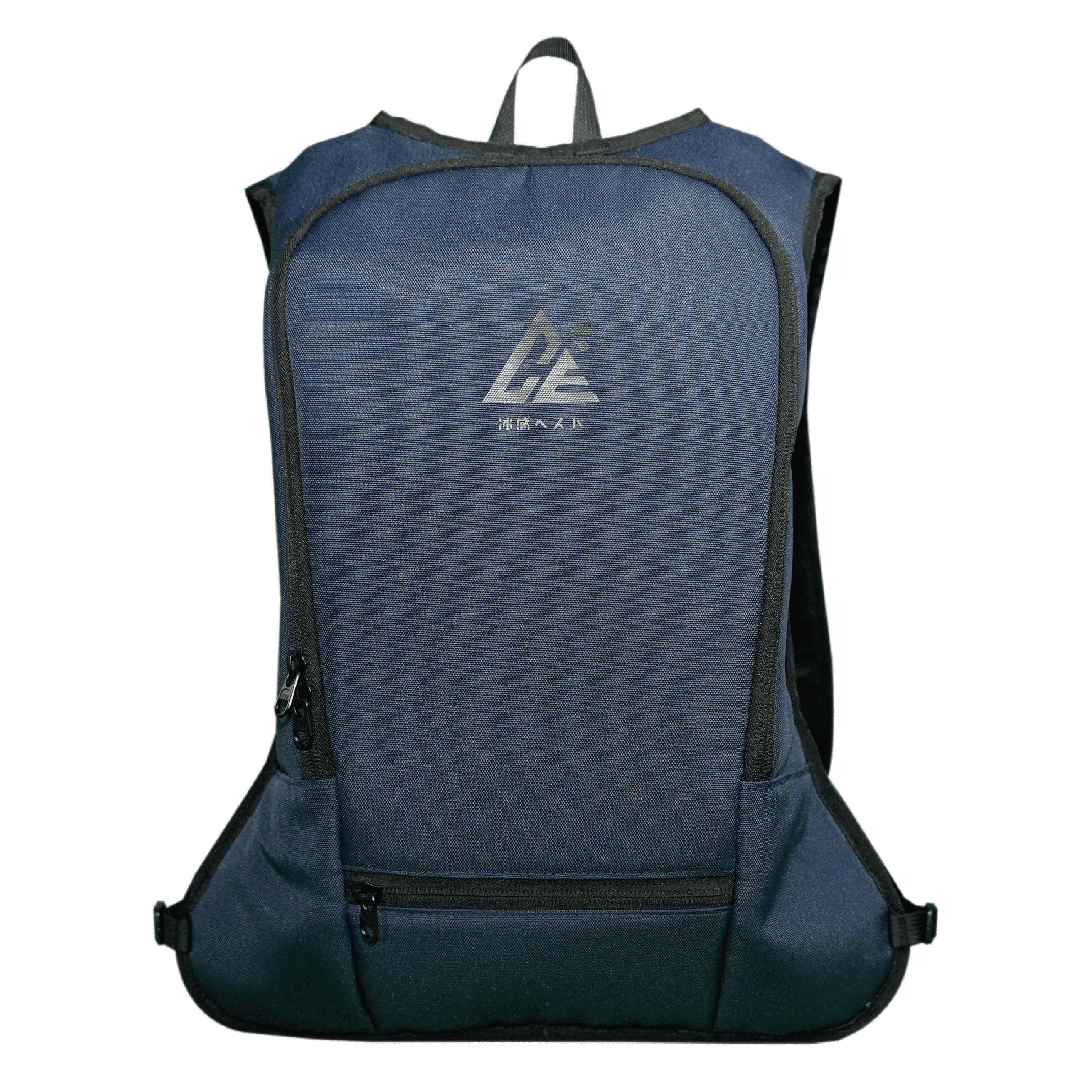
COOLWAVE Water-Circulation Cooling Vest, professional model. Supplied as a vest with a backpack unit and two ice packs.
Mapping scenario fit by work rhythm
The stated applicable industries include traffic controllers, street vendors, food-stall operators, construction workers, outdoor workers and metal-sheet factories. That list defines intended use; it does not certify the vest for every site or every climate. What a buyer can do is compare the 3–4 hour cycle and the carried weight against how each role actually spends its hours.
Traffic control: fixed post, long blocks, layered clothing
A traffic controller typically works a fixed post with limited freedom to leave it, often in direct sun over asphalt or concrete that radiates additional heat, and usually over a high-visibility garment. The practical questions are layering and standing tolerance. Because the vest is stated within 2 kg and the shoulder straps use 600D polyester, the load is modest for a standing wearer, but the vest has to be worn in combination with reflective clothing — so the order of layers, and whether the vest sits under or over the high-visibility layer, should be settled before the first deployment rather than after.
The 3–4 hour cycle maps most naturally to a morning block, with a pack change at the mid-shift break. Where a post has no shelter and no freezer nearby, the reconditioning plan becomes the constraint, not the vest.
Street vending: mobile setup, unpredictable dwell time
Street vendors face a different pattern. Setup and teardown are physically active, dwell time at the pitch is long, and there is usually no fixed power point. Here the backpack format is the decisive feature: the water bag travels with the wearer instead of being left at a base, which is what makes a portable cooling vest usable in a pitch that changes location. A power bank suits this setting better than mains power, which is why the pump's 5 V, 150 mA rating is worth checking against the bank the buyer intends to issue.
The constraint for this group is the cold chain. Two ice packs are supplied; whether a second pair is needed depends on the length of the trading day and whether a freezer is reachable between shifts. That is a planning question rather than a product defect, and it should be answered during the sample stage.
Food stalls: enclosed heat, humidity and grease
Food-stall work combines cooking heat with a confined stall, often worn under an apron and often in high humidity. Two listed material details matter here. The vest body is PEVA and the water bag is TPU with a polypropylene cap, which are closed surfaces that can be wiped; the manufacturer does not state grease resistance, chemical resistance or washability test results, so cleaning procedure should be agreed with the supplier instead of inferred. The shoulder straps in 600D polyester are the part most exposed to splashes and sweat, and they are also the part a buyer should specify for cleaning frequency.
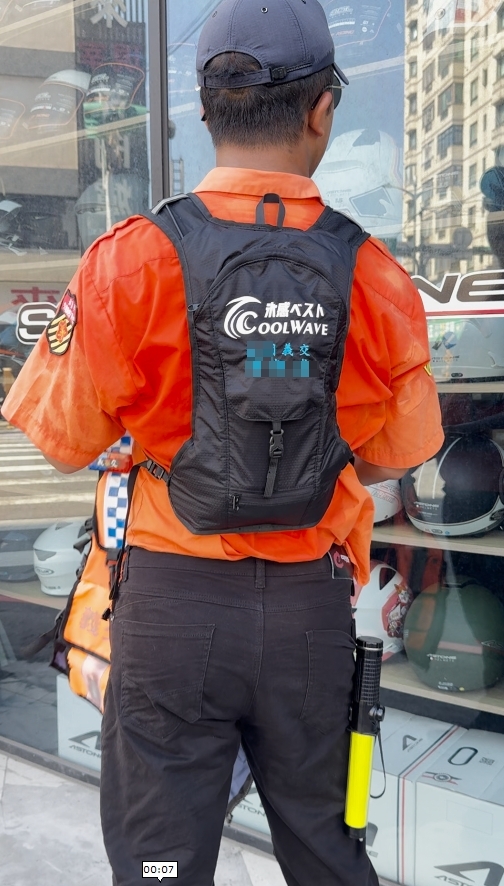
Fixed-post outdoor roles such as traffic direction turn the cooling cycle into a shift-planning question.
| Role | How the shift is worked | Where the 3–4 hour cycle fits | First thing to verify |
|---|---|---|---|
| Traffic control | Fixed post, direct sun, reflective layers, limited breaks | One cycle per exposure block, pack change at the mid-shift break | Layer order with high-visibility clothing |
| Street vending | Mobile setup and teardown, long dwell, no fixed power | Covers setup plus the first trading peak | Power-bank specification and spare ice packs |
| Food stalls | Confined stall, cooking heat, humidity, apron worn over the vest | Covers a service block; second cycle depends on refreezing | Cleaning procedure for straps and vest surface |
Planning a shift around a 3–4 hour cycle
Once the role is mapped, the deployment plan comes down to four operational decisions, and each one can be settled before a purchase order.
- Cycle count per shift. Divide the shift's heat-exposure block by the stated 3–4 hour duration. A block of that length is served by one cycle; a longer block needs a pack change, and the change has to be scheduled, not improvised.
- Refreezing capacity. Ice packs only work if they are frozen again between uses. A site with a freezer and a night shift plan is straightforward; a market stall without one needs a rotation of packs between home and pitch.
- Water handling. The TPU water bag has a polypropylene cap, which means refilling and rinsing are manual routines. Assigning that task and recording it prevents the bag being left filled between shifts.
- Wear and fit. The supplied application material describes an adjustable, one-size-fits-all design. That reduces sizing administration for a mixed crew, but it also means each wearer should trial the assembled load — vest, backpack unit and two ice packs — because total carried weight and its distribution differ from the bare vest figure.
Where the fit stops: boundaries against other cooling approaches
Buyers rarely evaluate one mechanism in isolation. Three alternatives usually appear in the same tender conversation, and each has a different fit boundary.
Passive ice-pack vests place chilled packs against the torso with no circulation and no power requirement. Their advantage is simplicity: nothing to charge, nothing to pump. Their limitation is that cold stays where the pack sits, and once the pack has equilibrated the cooling effect fades without any means of redistribution. For a short block of one to two hours, that can be adequate; for a full exposed shift, the cycle count rises.
Evaporative and wetted overgarments rely on the evaporation of moisture to remove heat. NIOSH groups them with cooling vests in the same personal-cooling family, so they are a legitimate category, but their behaviour depends on how readily moisture can evaporate — a factor that changes with ambient humidity and airflow. In a humid, still food stall, that dependency is a design consideration rather than a detail.
Air-cooled garments require an air supply, which usually means a blower and a power budget. They can be effective where the infrastructure exists, but the added equipment is itself a carried load.
The COOLWAVE approach is a hybrid: ice packs supply the cold and a pump redistributes it through circulated water. That addresses the redistribution limitation of a passive vest and avoids the humidity dependence of an evaporative layer, but the supplied evidence does not include an independent thermal test comparing these mechanisms. Buyers should therefore treat the comparison as a question of fit rather than of superiority: which mechanism can be sustained for the shift, at the site, with the resources the crew actually has. No claim of better performance against a named competitor is made or supported here.
Commercial terms for a first deployment
For buyers moving from evaluation into a pilot, the supplied capability record gives a workable starting position. The production mode is listed as ODM, monthly capacity is stated at 3,000 units, lead time is 7–14 days, and the minimum order quantity is 10 units. Aftersales is stated as a six-month warranty for the water-cooled vest. The company reports a 50% export ratio with the United States and Taiwan as its stated main markets.
Two items in that record deserve explicit handling rather than assumption. First, customization is listed as not available, so a buyer who needs private-label branding should raise that as a question rather than build a plan around it. Second, a capacity figure expressed per month and an annual output figure expressed per year appear in different supplied records; these are not directly comparable without knowing how each is defined, so a buyer should ask the supplier to define installed, practical and available capacity before using either number in a delivery schedule.
Verification checklist before the sample order
- Confirm the power source for the 5 V pump and the power-bank specification required.
- Confirm the basis of the listed suitable temperature of below 10°C.
- Request the assembled weight of vest, backpack unit and two ice packs together.
- Confirm whether the pump and water bag sit in the backpack or on the vest, and how the load is distributed.
- Ask for a written cleaning and refilling procedure for the TPU bag, PEVA vest and 600D polyester straps.
- Agree the spare ice-pack quantity needed for the shift pattern, since the stated contents include two packs.
- Record the warranty terms and the process for pump replacement under the six-month water-cooled vest warranty.
- Run one full shift trial with the crew that will actually wear the vest, not only with a purchasing representative.
Outlook: documentation will decide the next round of buying
With industrial applications holding a 34.5% share of a USD 342 million category in 2025, according to Dataintelo, the commercial centre of gravity in cooling apparel sits with workplace buyers rather than leisure users. That is an interpretation of the reported share, not a forecast, and the supplied data does not include a growth rate that would justify a projection.
What follows from the share is a procurement expectation rather than a market prediction. Industrial buyers tend to ask for conditions alongside numbers: at what ambient temperature, at what workload, with how many clothing layers, and measured how. Products that arrive with defined test conditions will be easier to place in a shift plan than products that arrive with a duration figure alone. For now, the practical step is to treat manufacturer-stated figures as the planning basis they are, test them against one real shift, and record the result — because that record becomes the buyer's own evidence for the next order.
For traffic control, vending and food-stall work, the fit case is coherent: a sub-2 kg vest, a backpack format that travels with a mobile worker, two ice packs as the cold source, and a 3–4 hour cycle that matches a substantial exposure block. The fit case is also bounded: it depends on refreezing access, on a confirmed power source, and on a site trial that no specification sheet can replace.
FAQ
Which job roles is the COOLWAVE water-circulation vest specified for?
The manufacturer's applicable-industry list covers construction workers, outdoor workers, food-stall operators, street vendors, traffic controllers and metal-sheet factories. That list defines the intended use cases. It does not certify the vest as suitable for every site, climate or individual wearer, and it does not replace an employer's heat-exposure controls or a site-specific risk assessment.
Does a 3–4 hour cooling duration cover a full shift?
Only where the shift's continuous heat-exposure block is within that window, or where ice packs can be changed mid-shift. The 3–4 hour figure is manufacturer-stated, and the supplied material does not define ambient temperature, humidity, workload or clothing layers for that measurement. Buyers should plan the cycle against the exposure block and schedule the pack change rather than assume the vest runs for the whole shift.
How much does the wearer actually carry?
The vest itself is stated at within 2 kg. The backpack unit and two ice packs are supplied in addition to the vest, so the assembled load is higher than the vest figure alone. The supplied application material describes adjustable straps and a one-size-fits-all design. Because total weight and its distribution affect comfort over a long standing block, the assembled load should be measured during sampling with the crew that will wear it.
What does the listed suitable temperature of below 10°C mean?
The specification states below 10°C without defining the basis of that value. It could refer to the chilled water temperature, to ice-pack conditioning before use, or to an ambient operating condition. Until the supplier clarifies it in writing, the figure should not be read as an ambient operating rating for a hot outdoor site. The practical approach is to request the definition together with the pump datasheet and any available flow or duration test record.
What commercial terms apply to a first order?
The supplied capability record lists ODM as the production mode, a minimum order quantity of 10 units, a lead time of 7–14 days, and a six-month warranty for the water-cooled vest. Customization is listed as not available, so buyers requiring private-label branding should confirm that point directly. Before ordering, buyers should also settle the pump power source, the spare ice-pack quantity for the shift pattern, and the cleaning routine for the TPU water bag, PEVA vest and 600D polyester straps.
Full technical parameters, materials and packing details are available in the manufacturer's product brochure (PDF). Company background and the wider product range are listed on the Feng Shang Precision Co., Ltd. website.
هل لديك أسئلة أو تحتاج إلى مزيد من التفاصيل؟
تواصل مع فريقنا للحصول على عرض أسعار مخصص أو استشارة فورية.
طلب عرض أسعار
املأ النموذج أدناه وسيتواصل معك فريقنا بعرض مقترح مخصص.
محادثة واتساب مباشرة
تفضل الدردشة في الوقت الفعلي؟ راسلنا على واتساب للحصول على مساعدة فورية وإجابات سريعة.
- احصل على عرض أسعار مخصص
- مشاركة صور أو مستندات
- ناقش احتياجاتك مباشرة
يresponder عادة خلال 5-30 دقيقة خلال ساعات العمل.