
How a UHF RFID Reader Family Signals Supplier Depth
How a UHF RFID Reader Family Signals Supplier Depth
A smart-manufacturing buyer rarely needs one UHF RFID reader. In many factories, the requirement spans a fixed read point at the dock, a handheld for cycle counts, a gate for a controlled zone, a compact module inside a custom enclosure, and a data path that ties them together. That is why a supplier's product family can carry more evidence than a single datasheet — but only when each item is tied to a documented capability, a defined interface, and a stated boundary.
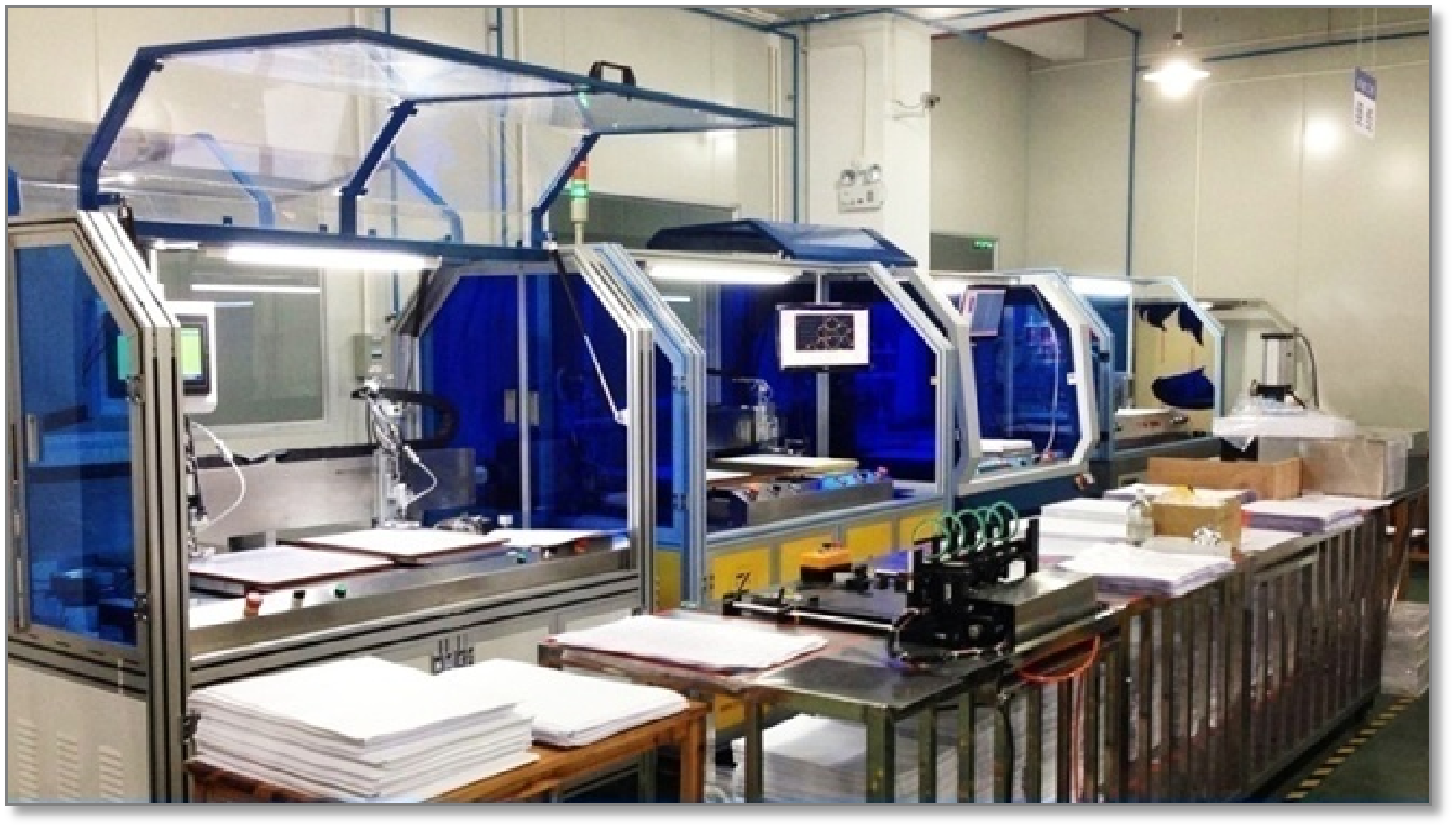
The evaluation problem: one datasheet, many read points
A datasheet answers a narrow question: what does this model do under the conditions the supplier chose to publish? A factory asks a wider question: can the supplier support the set of read points the operation actually has, without turning each one into a separate integration project?
That difference matters between evaluation and execution. At evaluation, the buyer is comparing candidates. At execution, the buyer is committing to a bill of materials, an acceptance test, a data interface, and a support arrangement. A product family is useful at both stages because it shows whether the supplier has separated fixed, mobile, embedded, and portal reading into distinct lines, or whether every request has to be pushed through one general-purpose unit.
The evidence hierarchy is straightforward. A model datasheet is the first layer. A family architecture is the second: which form factors exist, which interfaces they expose, and which jobs they sit in. Documentation is the third: certificates, test reports, and batch records that can be matched to a model or lot. Commercial terms are the fourth: MOQ, lead time, acceptance testing, and after-sales scope. Deployment references are the fifth, and the weakest on their own, because a site result depends on tag choice, layout, and operating discipline as much as on the reader.
External research shows the gap. A Queen's University Belfast paper describes RFID-enabled trolley tracking in an aerospace manufacturing environment, linked to a business-intelligence visual-management system. The supplied record describes the application and the integration idea; it does not give the reader model, tag type, or measured read performance. That is not a criticism of the paper. It is a reminder that application descriptions and model-level evidence answer different procurement questions.
What the DAILY RFID reader family actually covers
DAILY RFID CO., LIMITED was founded in 2008 and operates a 28,000 m² factory with 180–200 employees and a 38-engineer R&D team. Its stated annual output includes 100,000 RFID reader units, alongside 50 million RFID tags and 30 million RFID cards. Those figures describe capacity. The product family is where the more specific engineering evidence sits.
In the supplied product data, the reader range spans several architectures:
- Fixed readers: the DL921 UHF Long Range RFID Reader with GSM and the DL921 Power on Ethernet UHF Long Range RFID Reader.
- AI-categorised readers: the DL6940/6960 AI Multi-Antenna 4-Port UHF Reader, the DL921 AI Enhanced UHF Long Range Reader with GPS/GSM/POE, the DL9702 AI RFID Tag Tester & Encoder, and the DL1380 AI-Powered RFID Handheld.
- Handheld readers: the DL995 / DL996 Handheld RFID Reader for Library & Jewelry Management and the DL1280 Industrial PDA UHF/HF/LF Handheld Reader.
- Wireless and mobile formats: the DL920Plus WiFi RFID Reader and the DL930B UHF Bluetooth RFID Reader.
- Specialised form factors: the DL6990 UHF Ceiling RFID Reader (Integrated Antenna), the DL4130H RFID Jewelry Tray Reader & Antenna All-in-one, the DL8330U Advanced UHF RFID Gater, and the DL213 Type-C UHF Reader Module and DL228 Type-C UHF Mobile Reader.
- Adjacent equipment: a Self-Checkout RFID Reader, the DL9230 RFID TCP/IP Active Reader, a High-Speed RFID Label Printer, an RFID Smart Cabinet component, and development kits for parking management and school attendance.
Read as a set, these items cover fixed, mobile, embedded, overhead, portal, desktop/tray, and cabinet-integrated reading. That is a coverage statement, not a performance statement. The family shows that different reading geometries have been separated into different products. It does not show that any one product will achieve a particular read rate on a particular tag in a particular building.
Reading the family as engineering evidence
Three signals are worth extracting: interface and data path, physical form and installation, and workflow role.
Interface and data path. The family includes models designated with Power over Ethernet, GSM, WiFi, Bluetooth, TCP/IP, and Type-C module connectivity. Each implies a different deployment assumption. A PoE fixed reader reduces separate power cabling at a dock door. A GSM or WiFi model suggests a location where cabled network access is inconvenient. A Bluetooth handheld suggests pairing with a mobile device for field work. A Type-C module suggests an OEM design built into another enclosure. The supplied facts do not give a complete protocol list for every model beyond these designations, so a buyer should request the interface specification for the exact model under consideration.
Physical form and installation. A ceiling reader with an integrated antenna, a gate, a tray reader, and a module are not variations of the same box. They imply different antenna design, mounting, and mechanical integration. The family gives the buyer a way to check whether the supplier has already addressed each read geometry, or whether the buyer will be asked to adapt a general-purpose reader to every location.
Workflow role. Handhelds support rounds, exception checks, and receiving in tight spaces. Fixed readers support repeatable reads at a known point. A gate supports controlled passage. A cabinet supports contained inventory. A tray reader supports a bench-level check. When a supplier offers all five, the buyer can map products to jobs instead of forcing one format to do everything.
Public product pages from other suppliers show the model-level fields that make this comparison concrete. Turck states that its UHF RFID readers carry an IP67 protection rating and that selected readers support OPC UA through the AutoID Companion Specification for PLC, MES, ERP, WMS, or cloud integration. Merhein lists an integrated-antenna reader at 860–960 MHz with EPCglobal UHF Class 1 Gen 2, ISO 18000-6C, and ISO 18000-6B support. These are manufacturer claims, not independent test results, but they show what a buyer should ask for. The supplied DAILY RFID material does not state an IP rating or OPC UA support for these reader models. Neither should be assumed from the existence of the family. If either matters, it has to be confirmed at model level.
OEM/ODM terms turn a portfolio into a programme
A product family becomes commercially useful when the supplier can describe how each class is customised, tested, and delivered. The supplied capability records do that at product-class level, and the differences are informative.
| Product class | Customisation scope | Monthly capacity | Lead time | MOQ | Quality-control method |
|---|---|---|---|---|---|
| UHF Fixed Reader | Antenna gain, interface | 1,000 sets | 15–45 days | 1 set | Factory Acceptance Test |
| UHF Handheld Reader | OS, software, housing | 2,000 units | 15–30 days | 1 unit | Full System Burn-in |
| RFID Tray Reader | Antenna layout, interface, software | 500 units | 20–45 days | 1 unit | Factory Acceptance Test |
| RFID Smart Tool Cabinet | Cabinet size, reader module, software | 300 units | 20–45 days | 1 unit | System Integration Test |
| UHF Mat Antenna | Antenna size, cable, connector | 1,000 units | 15–30 days | 1 unit | RF Performance Test |
| RFID Tire Embedded Tag | Rubber patch, UHF chip, encoding | 200,000 units | 15–30 days | 500 units | Heat + Signal Test |
| RFID Silicone Wristband | Colour, size, logo, chip | 200,000 units | 10–25 days | 100 units | Visual + Signal Test |
| UHF RFID Card | Chip, material, printing | 500,000 units | 7–20 days | 100 units | 100% Functional Test |
Several patterns stand out. Reader-class MOQs are low — one unit for fixed, handheld, tray, and cabinet configurations — while tag-class MOQs range from 100 to 1,000 units. Reader lead times run from 15 to 45 days depending on form factor, while tag lead times are shorter, from 7 to 30 days. Monthly capacity is measured in hundreds or low thousands for readers and in hundreds of thousands or millions for tags. That is consistent with a manufacturer that assembles and tests readers in smaller batches while running higher-volume tag production.
The quality-control descriptions are more specific than a generic fully tested claim. Fixed and tray readers are associated with a Factory Acceptance Test. Handhelds are associated with a Full System Burn-in. The smart tool cabinet is associated with a System Integration Test. The tire embedded tag is associated with a Heat + Signal Test. The UHF mat antenna is associated with an RF Performance Test. These are different acceptance concepts for different failure modes. A buyer can use them as a starting point for a written acceptance plan, but the plan still has to be agreed for the specific configuration and order quantity.
What the documents can and cannot prove
Documentation is where family-level claims meet model-level reality. The supplied records include a CE RED certificate for UHF RFID Reader & Writer, certificate DGE190109029, issued by Dongguan NTEK Testing Technology Co., Ltd. on 11 January 2019. The scope lists multiple reader models, including DL920, DL930, DL930B, DL920Plus, DL9230 series, DL950 series, DL9700, DL9701, DL6940, and DL6950. The supplied scope text is truncated at “DL6”, so the full model list has to be requested before it is used in a procurement decision.
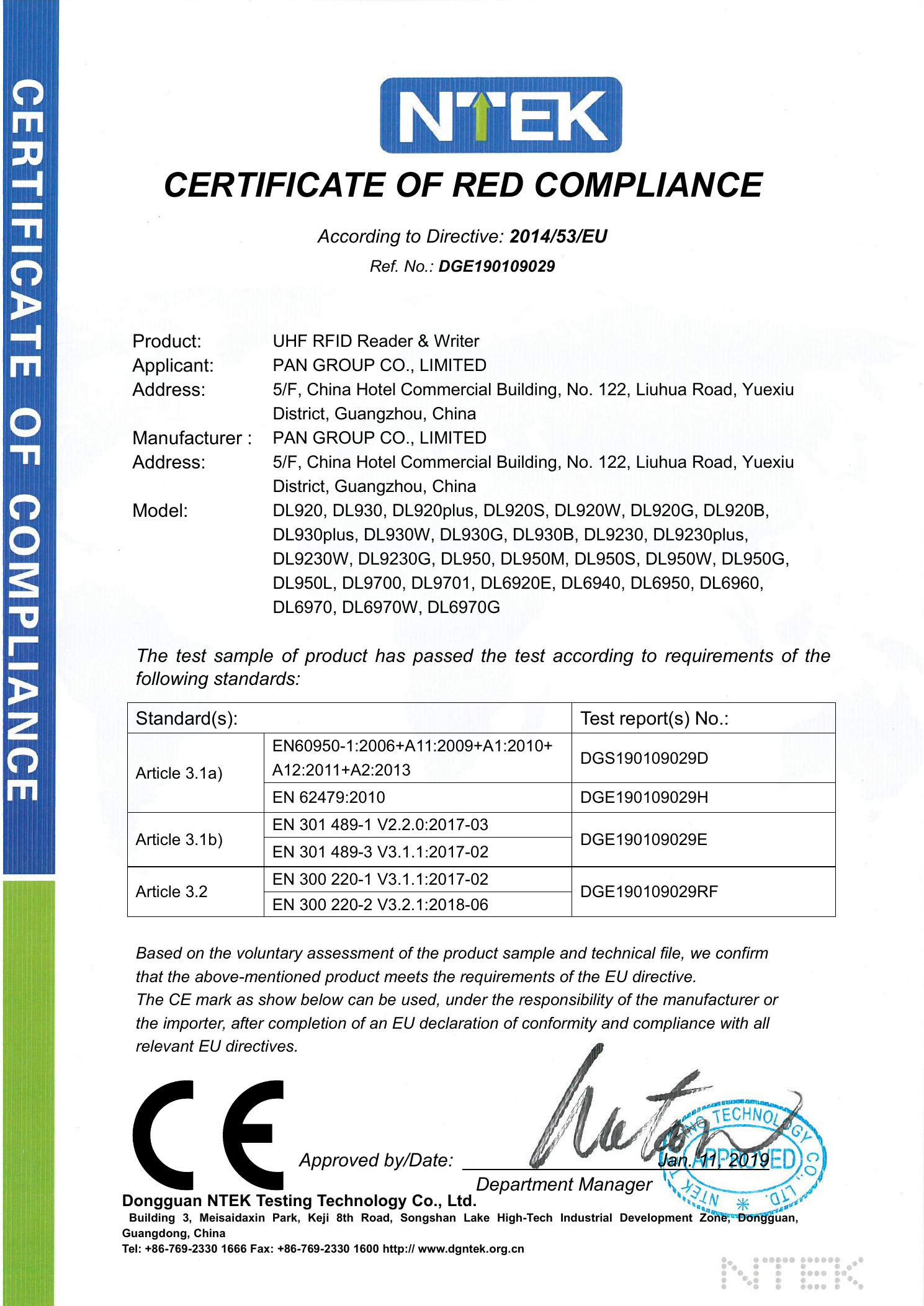
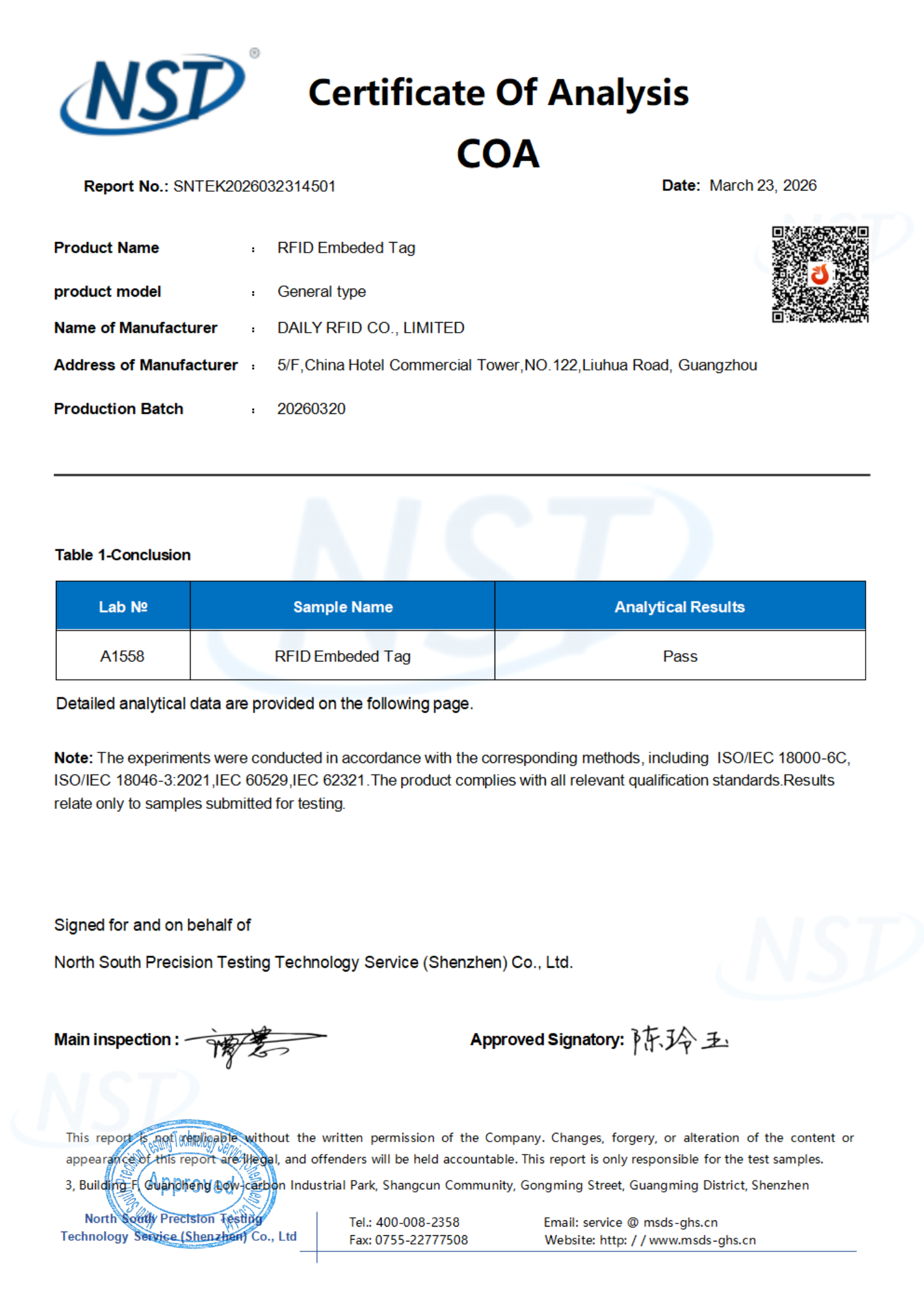
An earlier CE R&TTE certificate covers DL920, DL930, DL930B, DL920W, DL930W, DL6940, and DL6940W. A 2020 FCC Supplier's Declaration of Conformity covers a 2.4 GHz–2.5 GHz active RFID tracking system, including DL9230 series readers and specified active tags. A 2026 Certificate of Analysis for an RFID embedded tag records a passive tag at 923–925 MHz with IPX7 protection and no hazardous substances detected, tested against ISO/IEC 18000-6C, ISO/IEC 18046-3:2021, IEC 60529, and IEC 62321, with a pass result for batch 20260320.
The boundary matters. These documents are scoped to particular models, product families, or batches. They are not blanket approval for every item in the portfolio. Models such as the DL921, DL6990, DL8330U, DL4130H, DL213, and DL228 are not listed in the 2019 CE RED scope as supplied. That does not mean they lack approval. It means the supplied record does not establish it. In the same way, the 2026 COA is for a general-type embedded tag and is associated with tire-tag models; it should not be read as a model-specific certificate for every tire-tag variant.
Certificate dates and standard versions also need a current check. The record lists an expiry date, but standards are revised and market-access rules change. A buyer should confirm the current version with the supplier and, where necessary, the issuing body rather than relying on a scanned certificate alone.
The tag side changes reader requirements
A reader family is only half of a working system. The tag determines frequency, IC, attachment method, and often read distance. DAILY RFID's supplied product data includes tag-side items that map to factory jobs: the RFID Tool Management Adhesive Tag, the RFID Tire Tag Gen 2 and RFID Tire Tag - Patch Type, several RFID wristbands including a Dual-Chip RFID Wristbands - UHF H3 & HF Mifare 1K model and a UHF Long Range RFID Wristband, and the Passive LED UHF RFID Label.
These items change the reader question. A tool tag on a metal fixture is not the same RF problem as a wristband on a person or a tire tag embedded in rubber. A passive LED label adds a visible indication step that may affect how a picker confirms a location. A dual-chip wristband combines close-range HF and longer-range UHF in one item, which changes the reader mix at an access point. The supplier's ability to offer both sides does not remove the need for a site test, but it does reduce the number of suppliers the buyer has to qualify before a pilot.
The capability records show how the tag side is customised. The tire embedded tag is offered under ODM/OEM with rubber patch, UHF chip, and encoding options, at a stated 200,000 units per month, 15–30 days lead time, MOQ 500 units, and a Heat + Signal Test. The silicone wristband is offered under OEM with colour, size, logo, and chip options, at 200,000 units per month, 10–25 days, MOQ 100 units, and a Visual + Signal Test. These are catalogue-level parameters, not a quotation, but they show that the tag side is organised by product class rather than treated as an accessory.
Mapping the family to factory jobs
The most useful way to read the portfolio is to map each product class to a job and then list what still has to be verified. The table below is a requirement map, not a validated deployment matrix. The supplied facts do not provide read range or throughput by model, so the verification column is about evidence, not promised performance.
| Factory job | Reader form to evaluate | Tag-side fit | Verification focus |
|---|---|---|---|
| Inbound dock / pallet receiving | Fixed multi-port or PoE fixed reader | On-metal or asset tag | Antenna ports, read zone, missed-scan test |
| Tool crib / fixture control | Smart tool cabinet plus handheld | RFID Tool Tag | Cabinet size, reader module, software, System Integration Test |
| Line-side / WIP | Fixed reader | Asset tag | Mounting, read zone at line speed |
| Controlled zone / gate | UHF gate (DL8330U) | Wristband or asset tag | Detection width, alarm logic |
| Overhead / open area | Ceiling reader (DL6990) | Asset tag | Mounting height, coverage |
| Field rounds / inventory | Handheld PDA or Bluetooth handheld | Asset tag | Battery, OS/software, data sync |
| OEM equipment embedding | Type-C module (DL213 / DL228) | Tag matched to host product | Interface, power, antenna design |
| Tire / rubber asset | Fixed or handheld reader | RFID Tire Tag | Attachment, Heat + Signal Test, COA scope |
| Retail / event | WiFi reader plus printer | Hang tag or label | Temporary setup, WiFi coverage |
Two supplied case records show how the family is used in practice. A 420-unit deployment of the DL6980 4-Port Long Range Reader at a Spanish automotive parts warehouse is recorded with inbound receiving becoming 40%–70% less manual and missed pallet scans dropping 30%–60% over a programme described as at least five years. A 160-unit deployment of the DL950S-PoE UHF Reader at a Malaysian cold-storage operation is recorded with cold-chain checkpoint movement capture exceeding 90% and separate power-adapter installation reduced by 30%–50%, also over at least five years. These are client-reported results for specific sites and configurations. They show that the products have been deployed, not that the same results will transfer to another building.
Where the evidence stops
A product family is strongest as a shortlisting tool and weakest as a substitute for site validation. Five limits deserve to be stated plainly.
First, family breadth does not prove per-model suitability. A supplier can offer a ceiling reader, a gate, and a handheld without any one of them being right for a particular ceiling height, tag orientation, or cycle time.
Second, product names are not measured performance. The supplied facts do not state read range, read rate, tag throughput, IP rating, or operating temperature for these reader models. The AI category should be treated as a product classification in the supplied data, not as a performance claim, because the records do not describe the algorithms or measured outcomes behind it.
Third, deployment references are site-specific. The Spanish and Malaysian examples are useful because they name the model, quantity, application, and duration. They are still client-reported, and they do not establish what a different tag, layout, or workflow would achieve.
Fourth, certificate scope is partial. A certificate that lists DL920, DL930, DL930B, DL920Plus, DL9230, DL950, DL9700, DL9701, DL6940, and DL6950 does not automatically cover DL921, DL6990, DL8330U, DL4130H, DL213, or DL228. The buyer has to match the exact model and market.
Fifth, commercial terms are not in the supplied facts. Price, warranty length, spare-parts policy, integration cost, and total cost of ownership are not stated. They have to be quoted and compared separately.
External market data also needs care. Mordor Intelligence reports that UHF accounted for 40.72% of total RFID market revenue in 2025 and projects the UHF RFID market to surpass USD 14.9 billion by 2031 at a 12.45% CAGR. MarketsandMarkets expects Asia Pacific to account for the largest RFID market share from 2025 to 2034. Those figures use different scopes — UHF-specific versus all-frequency RFID — and should not be combined into one growth statement. Mordor also reports that over 60% of factories adopting Industry 4.0 deploy RFID readers for asset traceability, a 2024 figure that describes that adopting group, not all factories.
Market context: why family-level evidence is more useful now
When UHF accounts for 40.72% of total RFID market revenue, buyers have more reader options and integration paths to compare. When more than 60% of factories adopting Industry 4.0 deploy RFID readers for asset traceability, the question shifts from whether to use RFID to which read points, which tags, and which supplier can support the set. A family-level view helps a buyer build a shortlist that covers fixed, mobile, embedded, and portal reading without opening four separate supplier evaluations.
It does not replace the pilot. The pilot is where tag choice, antenna placement, read-zone tuning, and data integration are tested against a real process. The family view tells the buyer what to test and which documentation to request. The pilot tells the buyer whether the chosen combination works.
A practical checklist for the next supplier conversation
For a buyer moving from evaluation to execution, six questions turn a portfolio into an actionable specification.
- Which exact models are in scope, and which certificate, test report, or batch record covers each one?
- What interface and protocol does each model expose — PoE, WiFi, Bluetooth, GSM, TCP/IP, Type-C, or another option — and what has to be integrated on the factory side?
- What acceptance test applies to this configuration: Factory Acceptance Test, Full System Burn-in, System Integration Test, or another protocol?
- Which tag will be used, on which surface, and has the reader–tag pair been tested on that surface rather than on a general-purpose sample?
- What pilot metric will be used, who measures it, and over what period?
- What are the written MOQ, lead time, warranty, spare-parts, and after-sales terms for this specific order?
The supplied company profile and product records can support that conversation at model level. The company's public profile is available at DAILY RFID, and the downloadable brochure is available here: DAILY RFID company profile (PDF).
FAQ
How can a buyer tell whether a UHF RFID reader supplier's product family reflects real engineering depth?
Look for distinct architectures rather than a long SKU list. A family that separates fixed, handheld, embedded, overhead, portal, and cabinet reading shows that the supplier has addressed different installation and workflow problems. Then check whether each model has model-level documentation, a defined interface, and a stated acceptance test. Breadth without those items is a catalogue, not engineering evidence.
Which reader formats in the DAILY RFID family cover fixed, handheld, and embedded integration?
Fixed reading is covered by the DL921 UHF Long Range RFID Reader with GSM and the DL921 Power on Ethernet UHF Long Range RFID Reader, with multi-port options in the DL6940/6960 AI Multi-Antenna 4-Port UHF Reader. Handheld reading includes the DL995 / DL996 Handheld RFID Reader for Library & Jewelry Management, the DL1280 Industrial PDA UHF/HF/LF Handheld Reader, the DL1380 AI-Powered RFID Handheld, and the DL930B UHF Bluetooth RFID Reader. Embedded integration is addressed by the DL213 Type-C UHF Reader Module and the DL228 Type-C UHF Mobile Reader. The DL6990 ceiling reader, DL4130H tray reader, and DL8330U gate cover overhead, bench-level, and portal formats.
What OEM/ODM details should be fixed in writing before a customised reader order?
The supplied capability records list customisation scope, monthly capacity, lead time, MOQ, quality-control method, and after-sales support by product class. For a fixed reader, the scope covers antenna gain and interface; for a handheld, operating system, software, and housing; for a tray reader, antenna layout, interface, and software; for the smart tool cabinet, cabinet size, reader module, and software. These items should be written into the order specification together with the acceptance test and the support arrangement, because catalogue-level values are not a quotation for a specific configuration.
How do RFID Tool Tag, RFID Tire Tag, RFID Wristband, and UHF LED Tag affect reader selection?
They change the RF and workflow problem. A tool tag on metal, a tire tag embedded in rubber, a wristband worn by a person, and a passive LED label used for visible confirmation each present different attachment, frequency, and read-zone conditions. The reader has to be matched to the tag and the surface, not selected in isolation. The supplied records show tag-side customisation options and acceptance tests, but they do not replace a site test of the reader–tag pair.
What can a certificate scope prove about a UHF RFID reader family?
It can prove that specific models are listed within a defined certification scope, for a stated market and standard set. It cannot prove that every model in the family is covered. The 2019 CE RED certificate DGE190109029 lists a set of UHF RFID Reader & Writer models, and the supplied text is truncated, so the full list should be obtained. Models outside that list need their own evidence. Certificate dates and standard versions should also be checked for current validity.
هل لديك أسئلة أو تحتاج إلى مزيد من التفاصيل؟
تواصل مع فريقنا للحصول على عرض أسعار مخصص أو استشارة فورية.
طلب عرض أسعار
املأ النموذج أدناه وسيتواصل معك فريقنا بعرض مقترح مخصص.
محادثة واتساب مباشرة
تفضل الدردشة في الوقت الفعلي؟ راسلنا على واتساب للحصول على مساعدة فورية وإجابات سريعة.
- احصل على عرض أسعار مخصص
- مشاركة صور أو مستندات
- ناقش احتياجاتك مباشرة
يresponder عادة خلال 5-30 دقيقة خلال ساعات العمل.