
How to Assess an AI Development Platform for Physical AI
AI development platforms have become a recognized procurement category. Industry estimates place the global AI development platform market at approximately USD 58.2 billion in 2025, with projections reaching USD 156.7 billion by 2034. For companies building connected hardware, the evaluation question is more specific than 'which AI tool should we adopt.' They need to determine whether an AI development platform can take an intelligent feature from concept through firmware, compliance testing, and mass production.
This article provides a capability-oriented assessment framework for evaluating AI development platforms in physical AI and AIoT projects, using Tuya Smart's AI development platform as a reference implementation.
Why Hardware Teams Need a Different AI Platform Assessment
Software-only product teams evaluate AI platforms differently from companies that ship physical devices. A hardware product with AI features depends on embedded systems, connectivity protocols, cloud services, and a consistent user interface. A gap in any of these layers can delay an entire launch.
The opportunity is substantial. The global Artificial Intelligence of Things (AIoT) market is estimated at USD 25.44 billion in 2025 and is forecast to reach USD 81.04 billion by 2030, according to MarketsandMarkets. The enterprise generative AI segment is expected to grow at a CAGR of 38.4 percent between 2025 and 2030, reaching USD 19.8 billion by 2030. These figures reflect demand from businesses that want AI embedded in physical products and operational environments, not only in software interfaces.
For buyers in Evaluation and Execution stages, the practical task is to verify platform capabilities across hardware adaptation, model integration, application generation, deployment, compliance, and production readiness.
What an AI Development Platform Must Cover Beyond Models
An AI development platform for physical products should be assessed on at least six capability dimensions:
- Hardware enablement. Can the platform adapt embedded firmware to different operating systems? Does it support multiple connectivity protocols so devices can ship globally?
- AI integration. Can models be evaluated, deployed, and optimized without locking the product into a single LLM vendor? Is prompt optimization and knowledge base management available for real product scenarios?
- Application generation. Can firmware, device panels, and mobile apps be generated or customized through low-code workflows, or does every project require full-stack development from scratch?
- Deployment flexibility. Does the platform support public cloud, private cloud, and edge deployment? Are containerized options available for data residency control?
- Compliance readiness. Does the platform hold recognized security and AI management certifications that shorten the path to market across regions?
- Production and operations. Is there evidence of large-scale deployments, including mass-production firmware, testing scripts, and post-launch operations support?
- Does the platform support your device protocols and OS environments?
- Can the AI layer integrate with your preferred LLM or existing model assets?
- Are prototypes generated quickly, or does every change require full-stack engineering?
- Can the final solution be deployed in your required cloud or private environment?
- Which compliance certifications does the platform already hold?
- What production artifacts does the delivery process produce?
- Does the provider have evidence of large-scale developer and customer adoption?
Tuya AI Development Platform: Capability Snapshot
Tuya Smart, operated by Hangzhou Tuya Information Technology Co., Ltd., is a global AI cloud platform service provider listed on the NYSE (TUYA) and HKEX (2391). The company's platform supports more than 1,970,000 registered developers across more than 200 countries and regions, with more than 5,800 enabled customers and more than 3,000 product SKUs.
The solution for this segment is named AI Large Model Solutions, also known as the Tuya AI Development Platform. It targets brands and OEMs, industry SaaS providers, system integrators, device manufacturers, and enterprise end users in hotel, retail, energy, and manufacturing sectors. The service team reports 10 years of combined experience in AIoT and smart industries, serving clients from startups to Global 500 companies.
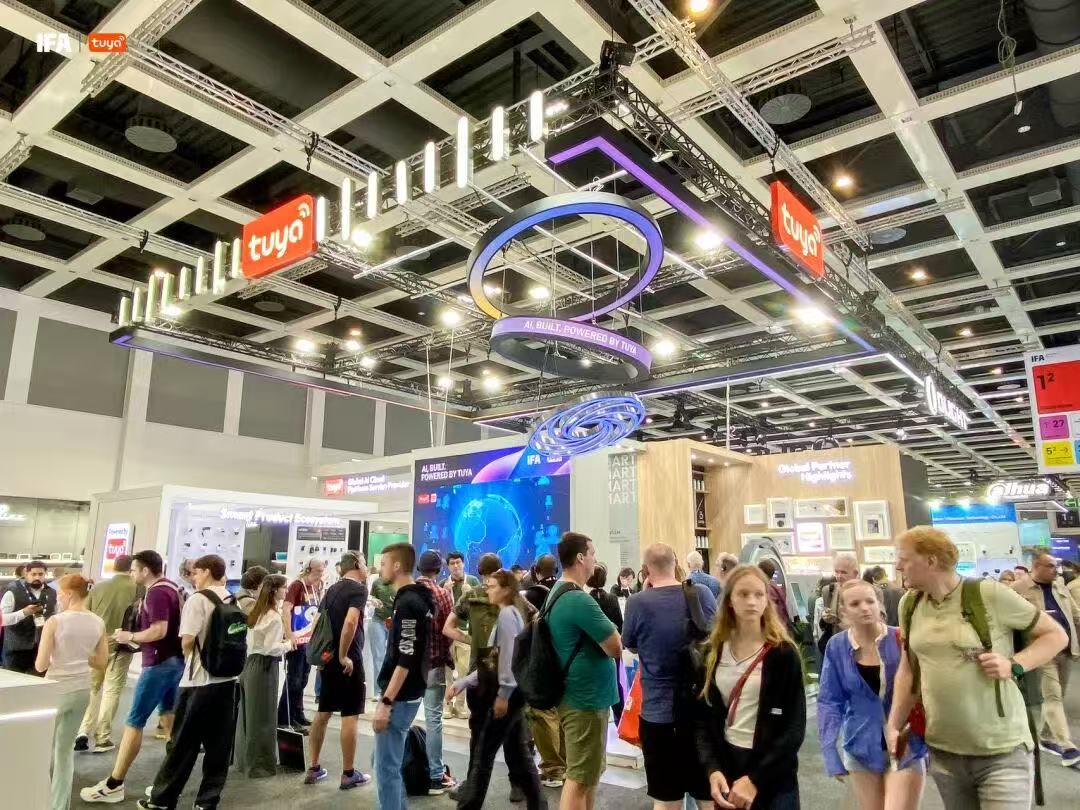
The organization has 1,400+ employees worldwide, including 980+ R&D engineers, and approximately 85 percent of its business comes from markets outside China. Industry experience covers appliances, home, lighting, security, commercial lighting, hotels, retail, energy, industry, and campus.
This scale matters for procurement. An AI development platform is not only a technology purchase; it is also a delivery capacity decision. The number of developers, customers, and SKUs indicates the accumulated production experience a platform brings to a new project.
Inside the Technical Stack: From Model Marketplace to Mass Production
The Tuya AI Development Platform includes model marketplace and management, model evaluation, model deployment, prompt optimization, knowledge base, data integration, workflow orchestration, and visualization. Industry-specific services extend the platform to health analytics, intelligent detection, and energy efficiency.
Implementation is supported through API/SDK integration, Cobuilder automated prototype generation, marketplace or custom model deployment, optional private containerized deployment called Cube, and edge capabilities. Low-code workflows allow customization without rebuilding the entire stack.
Underlying the platform is a technology stack designed for hardware compatibility. TuyaOS supports RTOS, Linux, and Non-OS kernels. The platform supports Wi-Fi, BLE, Zigbee, NB-IoT, Matter, and other protocols, and uses a DP engine for protocol translation and device data normalization. Cloud deployment is supported across AWS, Azure, Google Cloud, Oracle, Tencent Cloud, and other major public clouds, with Cube providing private cloud containerized deployment.
Beyond the commercial platform, Tuya offers the TuyaOpen open-source development framework and universal AI Agent engines, including an AI Agent development platform. Through these, Tuya integrates multimodal AI capabilities to lower barriers for AI development and accelerate AI integration with the physical world. For developers, this means the platform can support not only conventional smart device features but also agent-based applications that connect AI models directly to devices, commercial systems, and industry workflows.
The AI layer is LLM-agnostic. A customer can select models from the marketplace or deploy custom models, then connect them to the same device and data infrastructure. For enterprise buyers, this reduces the risk of dependency on a single generative AI vendor.
Anatomy of an AI Hardware Delivery Project
Tuya's AI hardware product delivery process follows seven stages: assessment and consulting, prototype generation with Cobuilder, development and integration, testing and certification, mass-production preparation, deployment and handover, and operations and optimization.
Each stage has defined inputs and outputs. A project begins with a business requirement or scene description, hardware prototype or specifications, target market and compliance information, data access permissions, and a launch timeline. Outputs move from an assessment report and prototype kit to firmware and panel deliverables, test and certification reports, mass-production firmware and test scripts, and deployment documentation.
Client responsibilities include providing product requirements, prototypes or BOM, market and compliance information, and timely feedback. The provider handles solution design, prototype generation, firmware, panel and cloud development, testing and compliance assistance, mass-production support, and operations. Communication runs through a project manager model, weekly or standup meetings, issue tracking, dedicated account management, and 7×24 online customer and technical support.
For evaluation-stage buyers, the key point is that the process is designed to produce production-ready artifacts, not just a demo. Certification runs in parallel with development, and production preparation explicitly reserves time for BOM and testing.
Application Evidence: Beyond the Model
A documented example is TCL's appliance smart enablement collaboration. The project involved device platform integration, module and MCU integration, TuyaOS and firmware adaptation, OEM App or App SDK, and cloud operations with data analytics. The challenge: legacy appliances lacked connectivity and smart capabilities, and needed a rapid path to cloud enablement with a consistent cross-region experience and production ramp.
The solution combined the Tuya IoT platform, TuyaOS and modules, App SDK or OEM App, and cloud analytics. Execution followed the standard process: requirement assessment, prototype validation, firmware and panel development, testing and certification, mass-production preparation, and launch with operations.
Qualitative results included improved product intelligence and user experience, shorter R&D cycles, faster multi-region deployment, and expanded channel coverage through the platform ecosystem. The case illustrates a common pattern: the platform's value is measured not only by the AI model, but by how quickly the full device experience can be industrialized.
Platform-level evidence also exists at scale. Approximately 93 percent of products deployed via Tuya's platform are reported to be equipped with AI capabilities as of mid-2025. This suggests AI features are becoming a default layer in the platform's device ecosystem rather than an optional add-on.
Market Signals: Physical AI Moves into the Mainstream
Multiple market indicators point in the same direction. The AI development platform market is projected to grow from approximately USD 58.2 billion in 2025 to USD 156.7 billion in 2034, according to Dataintelo. The AIoT market is projected to increase from USD 25.44 billion in 2025 to USD 81.04 billion by 2030, according to MarketsandMarkets. Different analysts use different definitions of AIoT, so absolute figures vary, but the direction is consistent.
The enterprise generative AI market is expected to grow at a CAGR of 38.4 percent from 2025 to 2030, reaching USD 19.8 billion by 2030, based on Grand View Research estimates. Companies investing in AI-enabled hardware are operating inside a fast-growing technology cycle.
Tuya Inc.'s fiscal 2024 revenue reached USD 298.6 million, up 29.8 percent year over year, driven largely by IoT PaaS and smart solutions, according to its SEC filing. This metric does not validate any individual platform decision, but it helps buyers assess whether a provider has the financial stability to support long-term platform commitments.
Platform vs. In-House Integration: A Balanced Comparison
Buyers evaluating an AI development platform typically compare it with an alternative: assembling a proprietary stack from multiple vendors. The comparison depends heavily on internal engineering capacity and project timeline.
| Dimension | Traditional Multi-Vendor Integration | Platform-Based Approach |
|---|---|---|
| Prototyping | Model, firmware, and app teams need separate orchestration | Cobuilder automated prototype generation enables rapid iteration loops |
| Device compatibility | Protocol translation and OS adaptation built in-house | TuyaOS multi-kernel support and pre-integrated modules reduce adaptation work |
| Cloud deployment | Self-built infrastructure requires significant cloud engineering | Multiple public clouds plus Cube private containerized deployment |
| AI model management | Teams build or assemble their own model management layer | Model marketplace and management, LLM-agnostic integration |
| Compliance | Each market certification handled separately after development | Platform certifications include ISO/IEC 27001, 27017, 42001, and PSA Level 1 |
| Time to production | Longer integration phase across vendor boundaries | Design intent: shorten prototyping cycles, accelerate mass production and time-to-market |
The platform approach offers speed and standardization. But it also has boundaries. Teams with highly proprietary hardware architectures or fully custom AI training pipelines may still need adaptation work at the operating system or data layer. The platform's multi-protocol support and TuyaOS abstraction cover many device categories, but unusual sensors or closed private protocols may require additional module or protocol adaptation. Enterprises that already operate a mature AI platform should define the boundary between their data infrastructure and the platform's model management layer before committing. Platform adoption does not eliminate engineering work; it concentrates engineering effort on the parts of the product that differentiate it.
What to Expect Next in AI Development Platforms
AI development platforms are moving toward deeper integration with the physical world. The platform model that emerged for software AI features is being extended to devices, commercial spaces, and industrial settings. Multi-protocol support and LLM-agnostic architectures are early indicators of this direction.
For hardware companies, the practical implication is that platform selection should favor providers with proven delivery capacity, global compliance infrastructure, and private deployment options where required. Evaluation will likely shift from individual model benchmarks to the distance between a model and a mass-produced product.
As the AIoT market expands toward its 2030 forecasts, platform competition will center on how quickly physical products can become AI-enabled while meeting security, privacy, and sustainability expectations.
FAQ
Who is the Tuya AI Development Platform designed for?
The platform targets brands and OEMs, industry SaaS providers, system integrators, device manufacturers, and enterprise end users in hotel, retail, energy, and manufacturing sectors. It suits companies planning to embed AI features into physical products or industry solutions.
What inputs does a company need to start a project?
Customers typically provide business or product requirements, hardware prototypes or BOM, target market and compliance information, data access permissions, and a desired launch timeline. The platform delivers an assessment report and prototype kit as first outputs.
What is the typical delivery process?
The process runs through seven stages: assessment and consulting, prototype generation with Cobuilder, development and integration, testing and certification, mass-production preparation, deployment and handover, and operations and optimization. Each stage has defined deliverables and acceptance criteria.
Which deployment options are available?
The platform supports integration via API/SDK, marketplace or custom model deployment, optional private containerized deployment called Cube, and edge capabilities. Supported public clouds include AWS, Azure, Google Cloud, Oracle, and Tencent Cloud.
Which hardware protocols and operating systems are supported?
TuyaOS supports RTOS, Linux, and Non-OS kernels. The platform supports multiple protocols including Wi-Fi, BLE, Zigbee, NB-IoT, and Matter, allowing devices to be adapted for different regional connectivity requirements.
What outcomes can a company expect after implementation?
Expected outcomes include shorter prototyping cycles, accelerated mass production and time-to-market, enhanced product intelligence and device interoperability, and improved operations and energy efficiency. The TCL case reported improved product intelligence, shorter R&D cycles, and faster multi-region deployment.
What are the limitations of a platform-based approach?
Highly proprietary hardware architectures or fully custom AI pipelines may require additional adaptation at the OS or data layer. Enterprises with an existing AI platform should define data boundaries with the platform's model management layer. Platform standardization reduces integration work, but remaining custom engineering effort should be planned explicitly.
Reference: Tuya 2026 Corporate Brochure (PDF)