
How to Audit WPC Wall Panel Claims: Tests, Limits, Warranty
A supplier can print “zero formaldehyde” on a carton in an afternoon. Producing a test report that ties that wording to a specific panel construction, thickness and test standard takes a laboratory, a sample and weeks of lead time. That asymmetry is the reason documentation, rather than price, has become the most common source of dispute in WPC wall panel procurement at the decision stage.
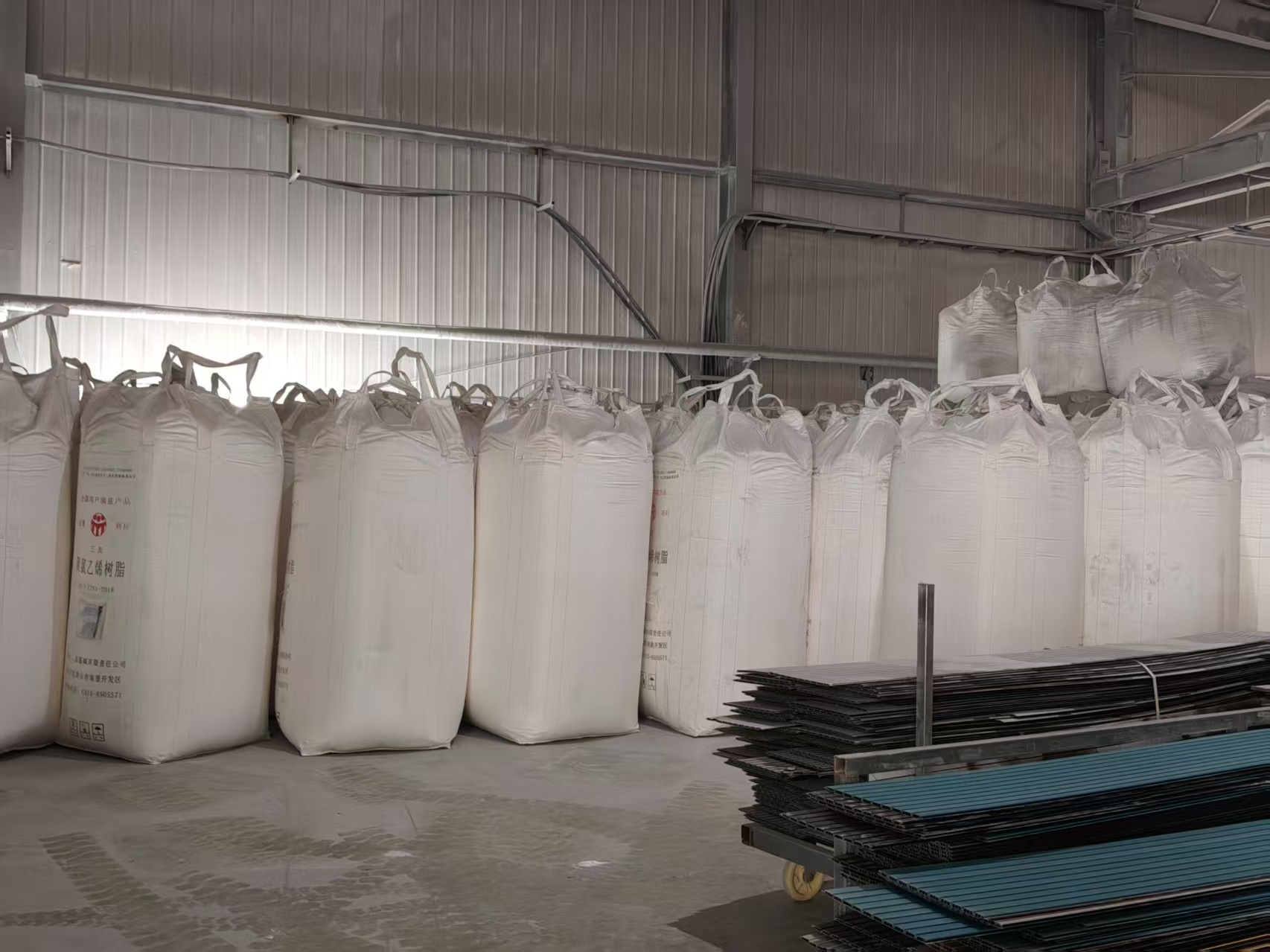
Raw-material intake: PVC resin staged before batching. A virgin-material claim is only checkable against purchase records and retained reference samples, not against surface appearance.
Buyers comparing WPC Wall Panel offers are typically handed four claim families — zero formaldehyde, fireproof, waterproof and environmentally friendly — applied across products that may differ in core formulation, surface film, thickness and joint design. Each claim becomes usable only when it is attached to a named test method, a named product, and a stated set of use conditions. This reference explains what to request, how to read what arrives, where installed performance diverges from laboratory performance, and how a 25-year warranty on qualified products under normal use should sit alongside test evidence rather than replace it.
Why claim language travels faster than evidence
The category is large enough to invite shortcuts. IndexBox’s 2026 forecast places the global wall panels market at roughly USD 10.85 billion in 2026, with the WPC wall panel segment reported as growing at a 5–7% CAGR through 2035, and China accounting for 45–50% of global WPC production volume. Growth of that order attracts capacity quickly, and capacity that enters quickly does not always enter with matching documentation discipline.
Trade classification compounds the problem. WPC wall panels move under HS code 3925.90.00, a heading that also covers other plastic builders’ ware. Customs data therefore cannot separate a commodity laminated panel from a co-extruded exterior cladding board. If trade statistics cannot distinguish the two, claim language on a quotation sheet certainly will not. The only reliable separator is a document that identifies the product, the standard and the tested construction.
That is why the practical question at the evaluation stage is not “does the supplier say it is fireproof” but “which report, for which item code, tested to which standard, at which thickness, issued by which laboratory, and on which date”. Everything else is an advertisement.
The four claims buyers hear most — and what each one requires
Claim wording is not standardized across the industry. The table below maps each common claim to the type of evidence that would substantiate it, and to the conclusion it does not support on its own.
| Claim as marketed | What it should be tied to | Document to request | What it does not establish |
|---|---|---|---|
| Zero formaldehyde | A named emission test method and limit value, applied to the specific interior panel | Test report identifying item code, core composition, surface layer and test date | Indoor air quality of the finished room; adhesives, substrates and other finishes contribute separately |
| Fireproof / fire-rated | A reaction-to-fire classification under a named standard. In US and EU markets this is generally discussed against ASTM E84 surface burning characteristics (Class A/B) or EN 13501-1 classes (B1/B2) | Classification report stating tested thickness, construction and achieved class — not simply “pass” | A fire-rated assembly. Studs, cavities, seals and penetrations determine assembly performance, not the panel alone |
| Waterproof | Water absorption and dimensional stability results for the panel, plus joint and edge sealing guidance | Test data plus written application limits covering wet areas, joints and cut edges | Long-term immersion. Water enters through seams, cut edges, fixings and unsealed areas regardless of panel resistance |
| Eco-friendly | A definition: recycled content, emission limit, or another specific criterion | Statement of which criterion is claimed, with supporting report or material declaration | Anything, unless the criterion is named. “Eco-friendly” without a stated basis is a positioning word, not a specification |
A single report rarely covers a full range. Manufacturers frequently produce one report on one thickness and one surface finish, then reference it across a catalogue. Buyers should treat that as normal commercial practice and respond by asking for the report that matches the item code actually quoted.
Reading a test report: seven fields that decide whether it applies to your order
Most compliance disputes do not involve forged documents. They involve real documents that do not describe the product being shipped. Seven fields resolve this quickly.
- Product identification. Item code, model name, dimensions and thickness should match the quotation. A report titled only “WPC wall panel” is not traceable to an order line.
- Standard and version. The standard number and its year of issue should be stated. Results cited against a superseded version may not satisfy current market requirements.
- Tested construction. Core formulation, surface treatment and whether the sample was laminated or co-extruded all influence results. A result obtained on one construction cannot be transferred to another.
- Result, not verdict. A class, a value or a measured figure is usable; the word “qualified” on its own is not.
- Laboratory and accreditation. The issuing laboratory should be identifiable and, where the destination market requires it, accredited for that test method.
- Report number and date. Both allow verification with the issuing laboratory and establish whether the evidence predates a formulation change.
- Scope and limitations. Most reports contain a limitations page. It is usually the most useful page in the document.
Where installed performance diverges from laboratory performance
Laboratory results describe a panel in isolation. Buildings contain joints, edges, fixings, substrates and weather. Three failure paths account for most of the gap between a validated claim and a disappointed buyer.
Water migration through the system, not the panel. A waterproof or moisture-proof rating does not mean a panel can be soaked or used indefinitely in standing water. Moisture enters through seams, cut edges, fixing holes and unsealed areas, and the water resistance of a material does not represent the waterproofing ability of the complete installed system. Wet-area construction also depends on joint sealing, base waterproofing and drainage design.
Movement that has nowhere to go. WPC products can change dimension with temperature and humidity. Reserving appropriate expansion space reduces the risk of compression, arching, deformation and abnormal joints. The required gap depends on product specification, temperature range and installation constraints, and the same value cannot be applied to every panel and every floor.
Substrate and fixing quality. Indoor panels require a flat, dry and firm wall before fixing, with joints and corners checked afterwards. Outdoor WPC installation requires a firm base or keel system, free drainage, and fixing spacing set by the manufacturer rather than reduced on site. Field reports of deformation typically trace back to low-level dampness, unreasonable fixing spacing, or long-term exposure to extreme conditions rather than to the material alone.
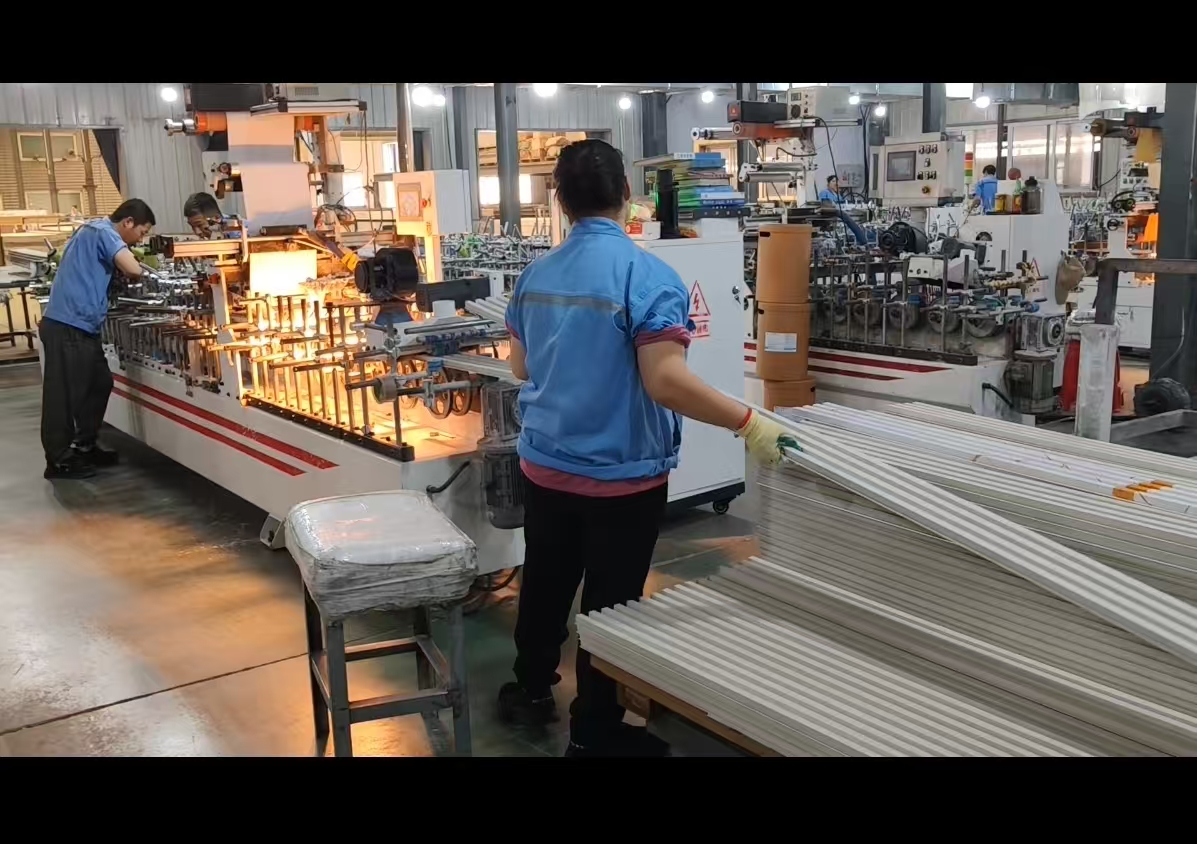
Extrusion and lamination: formulation control at this stage determines whether a tested sample and a shipped batch behave the same way.
The governing rule is simple and applies to every supplier: actual use should comply with local environmental conditions, installation codes, and applicable product testing requirements. A certificate issued against one market’s standard does not automatically satisfy another market’s code, and a claim validated for interior use does not transfer to a façade.
Where Linkworld WPC Wall Panel fits into a documentation-led purchase
Linkworld WPC Wall Panel is the WPC wall panel line of Tangshan Linkworld International Trade Co., Ltd., an integrated building-panel supplier founded in 2004 in Tangshan, Hebei, China, operating a 20,000 m² facility with annual output of 1,560,000 square meters and exporting roughly 70% of production to more than 60 countries, including the United States, Canada, Spain, Russia, Singapore, India, Malaysia and the Middle East.
The range spans indoor and outdoor decorative panels: WPC grating panels, carbon crystal panels, UV panels, SPC stone crystal wall panels and SPC flooring on the interior side; WPC Great Wall panels, ASA wall panels, PE wall panels, outdoor wood-plastic fence panels, outdoor wood-plastic flooring and sun panels on the exterior side. The company presents itself as covering R&D, production and sales, with support for customized product development, sample trial orders, mixed batches and full-container shipments.
On documentation, the supplier states that it holds complete official test reports and authoritative certifications, that products are zero formaldehyde, fireproof, waterproof and environmentally friendly, and that corresponding inspection documents can be provided against specific item numbers. It also states that production uses 100% brand-new raw materials with no recycled content, under fixed raw-material suppliers and unified formulas that reduce batch colour deviation, with reference samples retained for mass orders as the basis for quality comparison.
How WPC compares with the finishes it replaces — and where the claims stop
The comparison that matters commercially is not WPC against another WPC. It is WPC against latex paint, wallpaper and solid wood, because those are the specifications a project is usually choosing between.
Against latex paint and wallpaper, WPC wall panels are positioned on waterproof and moisture-proof behaviour, a seamless large-panel finish, the absence of paint smell and construction dust, and direct installation onto a flat wall. The stated trade-offs are faster installation, a material cost below marble, a service life longer than wallpaper, and no formaldehyde. Reported applications include living-room feature walls, hotel rooms, office interiors, bedroom renovation, and bathroom and kitchen wet areas, with lower whole-life expenditure, resistance to daily stains and stable decorative effect over time.
Against solid wood, the stated differences are resistance to cracking, rot, pests, mould and moisture, no routine maintenance requirement, longer service life and lower overall procurement cost. These are comparative positioning statements from the supplier rather than independently measured results, and they should be read that way.
The limits are equally concrete. WPC wall panels are decorative and finishing products, not structural elements; they do not replace load-bearing or fire-rated assemblies. Wet-area suitability depends on sealing, base waterproofing and drainage rather than the panel alone. Exterior cladding performance depends on weathering and UV documentation that has to exist separately from interior certificates. And price should be treated as a direction rather than a benchmark: a reference FOB band of USD 8–18 per m² for standard WPC wall panels appears in commercial research, but it does not separate thickness, surface process or co-extruded construction, so it cannot be used to compare quotations directly.
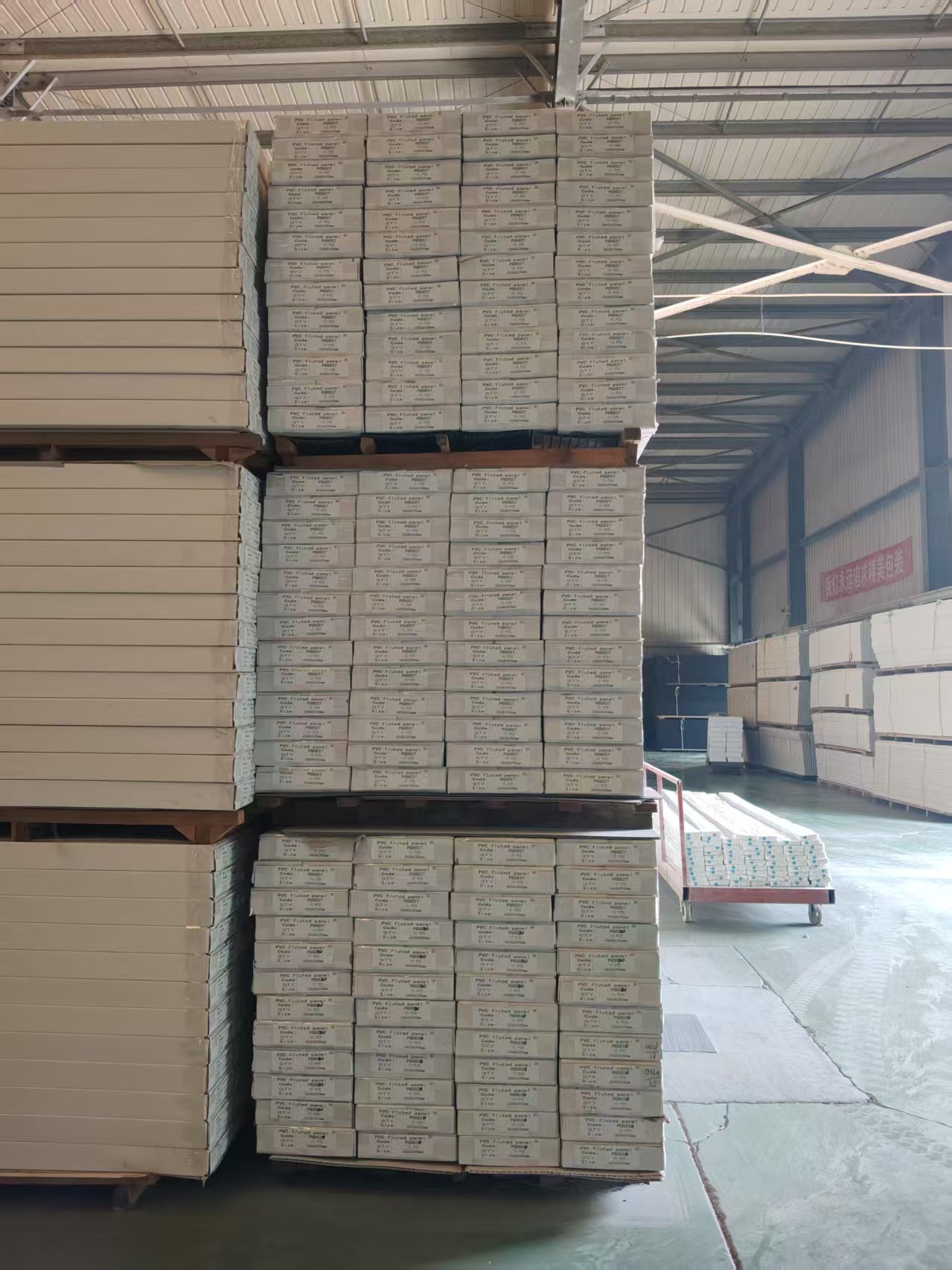
Finished goods with printed item and specification labels. Traceability from label to report to retained sample is what makes a claim auditable after delivery.
What a 25-year warranty should say before you rely on it
Linkworld states that qualified products carry a 25-year warranty under normal use. That formulation is standard in the category and it contains two conditions worth reading carefully: the warranty applies to qualified products, and it applies under normal use. Neither condition is self-defining, so both need to appear in a written warranty document rather than in a brochure sentence.
A warranty document worth relying on should identify the product or item code covered, state the coverage period and start date, list exclusions, describe the claim procedure and who honours the obligation — manufacturer or trading company — and state the installation and maintenance conditions that must be met. Failure caused by substrate defects, non-compliant fixing, omitted expansion joints, unsealed cut edges in wet areas, or exposure beyond the declared application range typically falls outside normal use.
A warranty is a commercial commitment about durability. It is not evidence of fire performance, emission compliance or market access, and it does not substitute for the test reports a code official or project consultant will ask for. Buyers should hold all three separately: reports for compliance, installation guidance for performance, and a written warranty for remedy.
A decision checklist for the evaluation stage
| Check | Question to put to the supplier | Pass condition |
|---|---|---|
| Claim specificity | Which exact claim is being made, and against which standard? | A named standard and a named criterion, not an adjective |
| Item-code traceability | Does the report number match the item code, thickness and construction quoted? | Document and quotation refer to the same product |
| Report currency | What is the issue date, and has the formulation changed since? | Report postdates the last formulation change |
| Application limits | What are the written limits for wet areas, exterior use and temperature range? | Limits supplied in writing with the quotation |
| Batch consistency | How is batch colour and performance controlled, and are reference samples retained? | Fixed raw-material sources, unified formula, retained samples |
| Installation compliance | Which local installation code and substrate conditions apply? | Written installation requirements aligned to the project |
| Warranty terms | Who honours the 25-year warranty, on what conditions, with what exclusions? | A signed warranty document, not a marketing statement |
Outlook: documentation becomes the differentiator
As the WPC segment continues to grow at the reported 5–7% annual rate through 2035, competition is shifting from “who can supply the panel” to “who can prove what the panel does”. Two pressures drive this. Exterior applications are expanding, and exterior performance claims require weathering and UV evidence that interior certificates cannot supply. At the same time, distributors and project buyers increasingly inherit liability for the claims they pass downstream, which makes a verifiable document chain a commercial asset rather than an administrative cost.
For buyers, the practical consequence is that supplier evaluation should weight documentation readiness alongside price and lead time. A supplier that can produce an item-code-matched report, written application limits and a signed warranty in the first exchange is materially lower-risk than one that can only produce adjectives — regardless of the quoted price per square meter.
Frequently asked questions
What documentation should a buyer request before accepting a zero-formaldehyde claim on WPC wall panels?
A test report that identifies the specific panel by item code, states the test method and the limit applied, and carries an issue date and laboratory identification. The report should describe the construction tested, because results obtained on one core formulation or surface finish cannot be assumed to apply to another. The claim itself should be treated as a summary of that document rather than as a substitute for it.
Does a waterproof WPC wall panel mean it can be soaked in water or used in continuously wet conditions?
No. Waterproof or moisture-proof performance does not mean a panel can be immersed in water for a long time. Actual applicability depends on the substrate, surface layer, seams, edge treatment, installation method and the testing the product has undergone. Moisture may enter through seams, cut edges, fixing holes and unsealed areas, and wet-area construction also requires joint sealing, base waterproofing and drainage design. The application should be confirmed against the manufacturer’s test results and stated usage restrictions.
Are WPC wall panels suitable for my local climate?
WPC products are used in the climates of most countries and regions, and suppliers generally match grades and specifications to local conditions. Suitability is not determined by the material name alone: temperature range, humidity, UV exposure, substrate and fire-safety requirements all affect the specification. Buyers should confirm the recommended grade for their environment and check the relevant test documentation for the destination market before fixing the specification.
Why do expansion joints need to be reserved when installing WPC wall panels or outdoor WPC products?
Some wall panels and WPC products change dimension with temperature, humidity and material characteristics. Reserving appropriate expansion space helps reduce the risk of panel compression, arching, deformation or abnormal joints. If there is insufficient space, dimensional change converts into internal stress and can damage the panel or its fixings. The required gap depends on product specification and actual installation conditions and should not be applied as a single fixed value across all panels and floors.
What does a 25-year warranty on qualified WPC wall panels cover, and what does it not cover?
The stated warranty applies to qualified products under normal use, which means the product must be installed and maintained in accordance with the supplier’s requirements and used within its declared application range. It is a durability commitment rather than a compliance certificate, and it does not replace test reports, fire classification documentation or market-access evidence. Buyers should obtain the warranty in writing, with the covered item codes, conditions, exclusions and claim procedure stated explicitly.
How should WPC or PVC wall panels be cleaned and maintained?
Daily cleaning can be carried out with a soft cloth or sponge, water and a suitable neutral detergent, followed by drying according to product requirements. Cleaning agents should first be tested in an inconspicuous area, and strong acids, alkalis or solvents that may damage the finish should be avoided. Steel wool and aggressive cleaners are unsuitable. Joints, corners and fixed parts should be inspected periodically, and the cleaning method should match the surface coating and the manufacturer’s maintenance requirements.
Product catalog (PDF, publicly accessible): Linkworld building panel catalog. Company reference: www.tslinkworld.com.
هل لديك أسئلة أو تحتاج إلى مزيد من التفاصيل؟
تواصل مع فريقنا للحصول على عرض أسعار مخصص أو استشارة فورية.
طلب عرض أسعار
املأ النموذج أدناه وسيتواصل معك فريقنا بعرض مقترح مخصص.
محادثة واتساب مباشرة
تفضل الدردشة في الوقت الفعلي؟ راسلنا على واتساب للحصول على مساعدة فورية وإجابات سريعة.
- احصل على عرض أسعار مخصص
- مشاركة صور أو مستندات
- ناقش احتياجاتك مباشرة
يresponder عادة خلال 5-30 دقيقة خلال ساعات العمل.