
How to Choose a Pallet Jack for Your Facility Type: A 2026 Configuration Guide
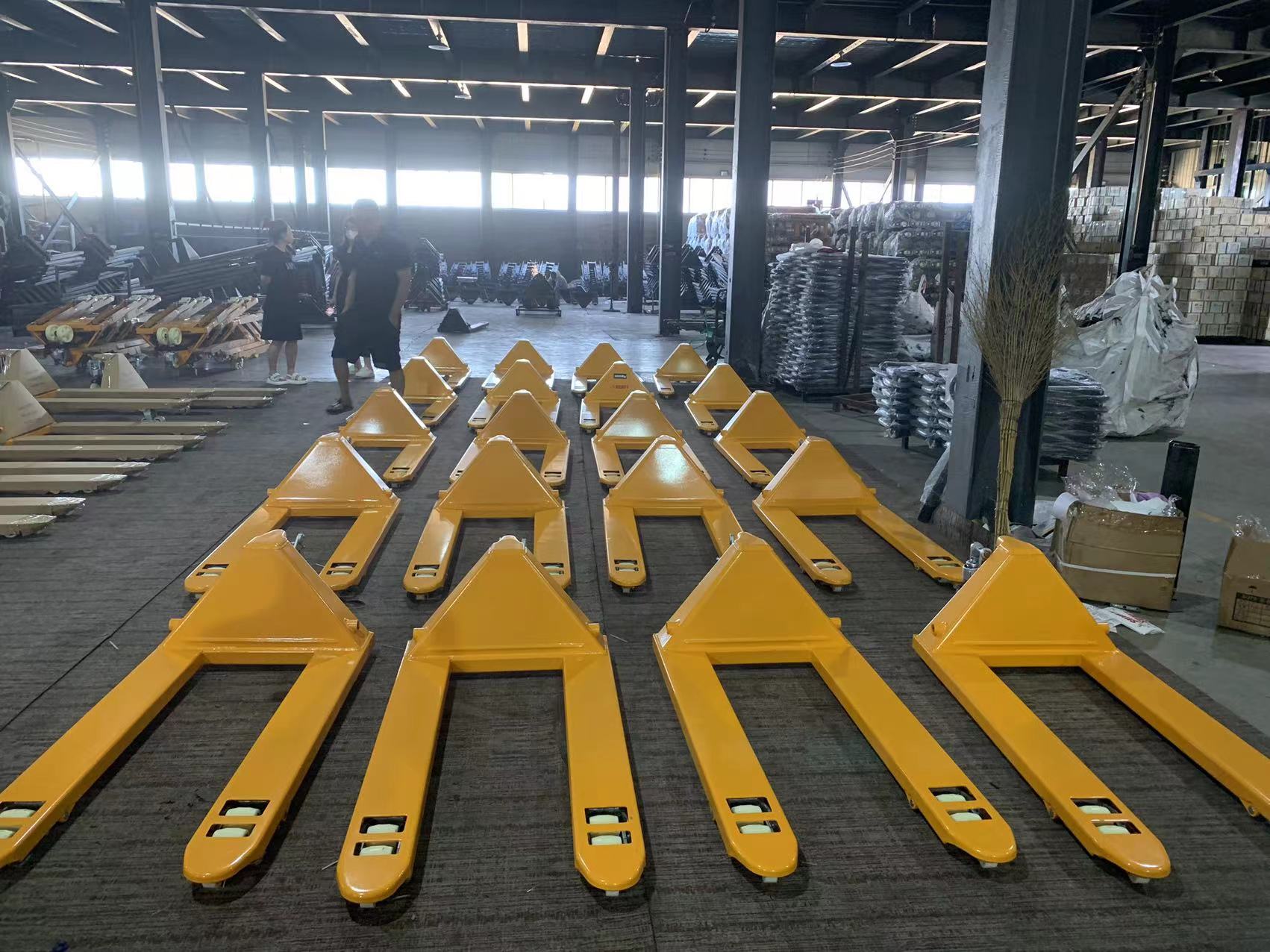
Pallet jack product configuration from JUNYUNHOIST.
Pallet jacks are often treated as a commodity purchase, yet the working environment determines whether a standard machine will deliver reliable service or become a recurring maintenance problem. Cold storage rooms, food processing plants, pharmaceutical warehouses, and narrow-aisle distribution centers each require a different balance of fork dimensions, wheel material, frame finish, and power source. This article outlines a configuration framework for buyers who are researching pallet jacks for a specific project, using market data and the engineering specifications of Baoding Junyun Hoisting Machinery Co., Ltd. (JUNYUNHOIST), a China-based pallet jack manufacturer.
The Problem: One Standard Pallet Jack Cannot Fit Every Environment
Most pallet jack buyers begin with two criteria: load capacity and price. Those criteria are necessary, but insufficient. A standard carbon steel pallet jack with rubber wheels may operate for years on a dry concrete factory floor, while the same model in a cold storage room can suffer from condensation-related corrosion, hardened tires, and component failure. In a cleanroom pharmaceutical project, standard lubricants may contaminate the environment. In a narrow supermarket aisle, a long fork can make every turn a slow, risky maneuver.
The opportunity lies in shifting procurement from “buy a pallet jack” to “configure a pallet jack for a defined environment.” This approach aligns with the broader growth of the material handling equipment market. A third-party industry report estimates the global pallet jack market will expand from approximately USD 7.4 billion in 2024 to USD 11.6 billion by 2034. At the same time, manual pallet jacks still account for a major share – around USD 4.3 billion in 2024 – indicating a continued need for reliable, human-powered equipment alongside electric models. Electric pallet jacks and stackers represent a separate market of about USD 5.1 billion, driven by e-commerce growth and lithium-ion battery technology.
A Supplier That Builds Pallet Jacks for Multiple Working Conditions
JUNYUNHOIST, operating as Baoding Junyun Hoisting Machinery Co., Ltd., is an example of a manufacturer that has broadened its standard pallet jack line to cover specialized environments. Founded in 2018 and based in Hebei, China, the company exports a large share of its production – roughly 80% – to markets including India, Russia, Vietnam, Brazil, Turkey, and the United Arab Emirates. Its catalogue includes manual pallet jacks, semi-electric and full-electric pallet trucks, pallet trucks with built-in scales, and galvanized or stainless steel versions.
The AC30 series illustrates how specifications can be adapted. Standard models offer a minimum fork height of 80 mm, a maximum lift height of 200 mm, and a working radius of approximately 1,500 mm. Buyers can select wheels made of PU (polyurethane), nylon, PP (polypropylene), or rubber, and choose fork widths of 550 mm or 685 mm with lengths ranging from 800 mm to 2,000 mm. For even lower clearance, fork heights of 35 mm or 62 mm can be configured. These parameters allow a buyer to match the machine’s “footprint” to the pallets and aisles of a specific facility.
Technical Explanation: What to Evaluate When Matching a Pallet Jack to an Environment
Beyond brand and price, the technical configuration of a pallet jack can be broken down into four controllable groups: fork geometry, wheel selection, frame material, and power system.
Fork Length and Width
Fork dimensions must match the pallet type and the available maneuvering space. A standard 1,200 mm × 1,000 mm pallet typically requires a fork length close to 1,150 mm or 1,220 mm. For pallets with non-standard dimensions, lengths such as 800 mm, 1,500 mm, 1,800 mm, or 2,000 mm can be requested. Narrower fork widths, for example 550 mm instead of 685 mm, can make it easier to enter rack openings and tight supermarket aisles.
Low-Profile Capability
Some pallets have a very low bottom board. In these cases, a standard fork height of 80 mm will not fit. JUNYUNHOIST offers reduced minimum heights of 35 mm and 62 mm, allowing operators to insert forks without damaging the pallet or the load.
Wheel and Caster Material
Wheels have a direct effect on floor protection, noise, rolling resistance, and temperature tolerance. PU wheels are commonly used on smooth indoor floors because they are quiet and kind to surfaces. Nylon wheels roll easily and are resistant to many chemicals. Rubber wheels provide more grip, especially on slightly uneven factory floors. PP wheels offer a lighter option for retail environments. In cold storage, the wheel material must remain flexible at low temperatures, which is why a cold-resistant configuration should be specified rather than assumed.
Frame and Fork Material
Carbon steel is the standard economic choice for dry, clean environments. Galvanized steel adds corrosion resistance at a moderate cost increase, which is useful in humid or washdown areas. Stainless steel is the preferred choice for food processing, pharmaceutical, and chemical facilities where hygiene and rust prevention are mandatory. In JUNYUNHOIST’s lineup, galvanized and stainless steel pallet trucks are factory options, not aftermarket modifications.
Power Type
Manual pallet jacks meet the needs of short-distance, low-frequency operations. Semi-electric units assist lifting while the operator controls movement; full-electric models reduce physical strain in high-throughput logistics centers. The growth of the electric pallet jack segment suggests that more buyers are evaluating battery-powered versions for projects where operator fatigue and speed are critical.
Special-Condition Capabilities
Certain projects require more than material changes. For example, cold storage and explosion-proof pallet jacks are available as specialized models. In pharmaceutical or cleanroom settings, silent operation may be required to keep noise at a comfortable level. These options are defined at the specification stage.
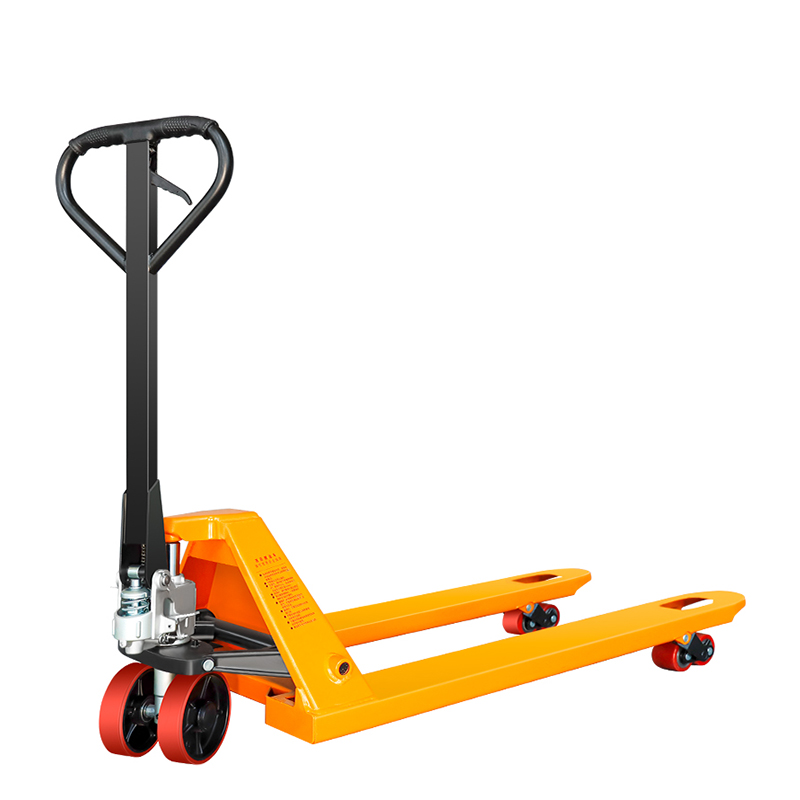
The AC30 pallet truck series offers multiple fork, wheel, and coating options.
Application / Use Cases Across Major Facility Types
The AC30 series and similar configured pallet jacks are used across a wide range of industries, including logistics and warehousing, manufacturing, food and beverage, pharmaceuticals, chemicals, and electronics. In each environment, the role of the pallet jack is to act as the execution terminal for unitized transport – moving palletized goods over short distances within a production or distribution system.
Cold Storage and Cold Chain
Low-temperature warehouses place heavy demands on seals, lubricants, tires, and metal parts. A cold-resistant version with a stainless steel or galvanized frame and low-temperature-compatible wheels reduces the risk of breakdown and rust. This is a typical configuration for fresh-food distribution centers.
Food Processing Plant
Washdown areas and strict hygiene rules call for stainless steel pallet jacks that can withstand water, cleaning agents, and food-grade requirements. Corrosion-resistant construction prevents the growth of rust that could contaminate products.
Pharmaceutical Warehouse
Cleanliness and quiet operation are essential. A silent-operation option reduces noise during order picking and replenishment. In areas where flammable substances are stored, an explosion-proof pallet jack is required to meet safety regulations.
Factory Workshop and Manufacturing
For metalworking, automotive parts, and general manufacturing, a reinforced carbon steel frame with rubber or nylon wheels handles heavier loads and slightly uneven floors. The hydraulic lifting mechanism supports frequent movements between workstations.
Supermarket and Retail Warehouse
Distribution to local stores requires frequent loading and unloading. An importer in one emerging market ordered 400 pallet jacks over two years for store-level distribution, and feedback highlighted convenient, simple, and efficient operation, with low loss and high efficiency. Compact dimensions and easy maneuverability were critical for loading docks and store backrooms.
Logistics Center and E-commerce Distribution
In high-throughput centers, electric pallet jacks can reduce operator fatigue and increase turnaround speed. Semi-electric models offer a compromise: powered lifting with manual pulling, well suited for warehouses where pallets are moved over moderate distances.
Narrow Aisle and Small-Space Operations
Narrower fork widths and shorter fork lengths help a pallet jack work in compact racking systems. However, the overall turning radius cannot be ignored; a machine with a 1,500 mm operating radius still needs sufficient aisle space to turn safely with a loaded pallet.
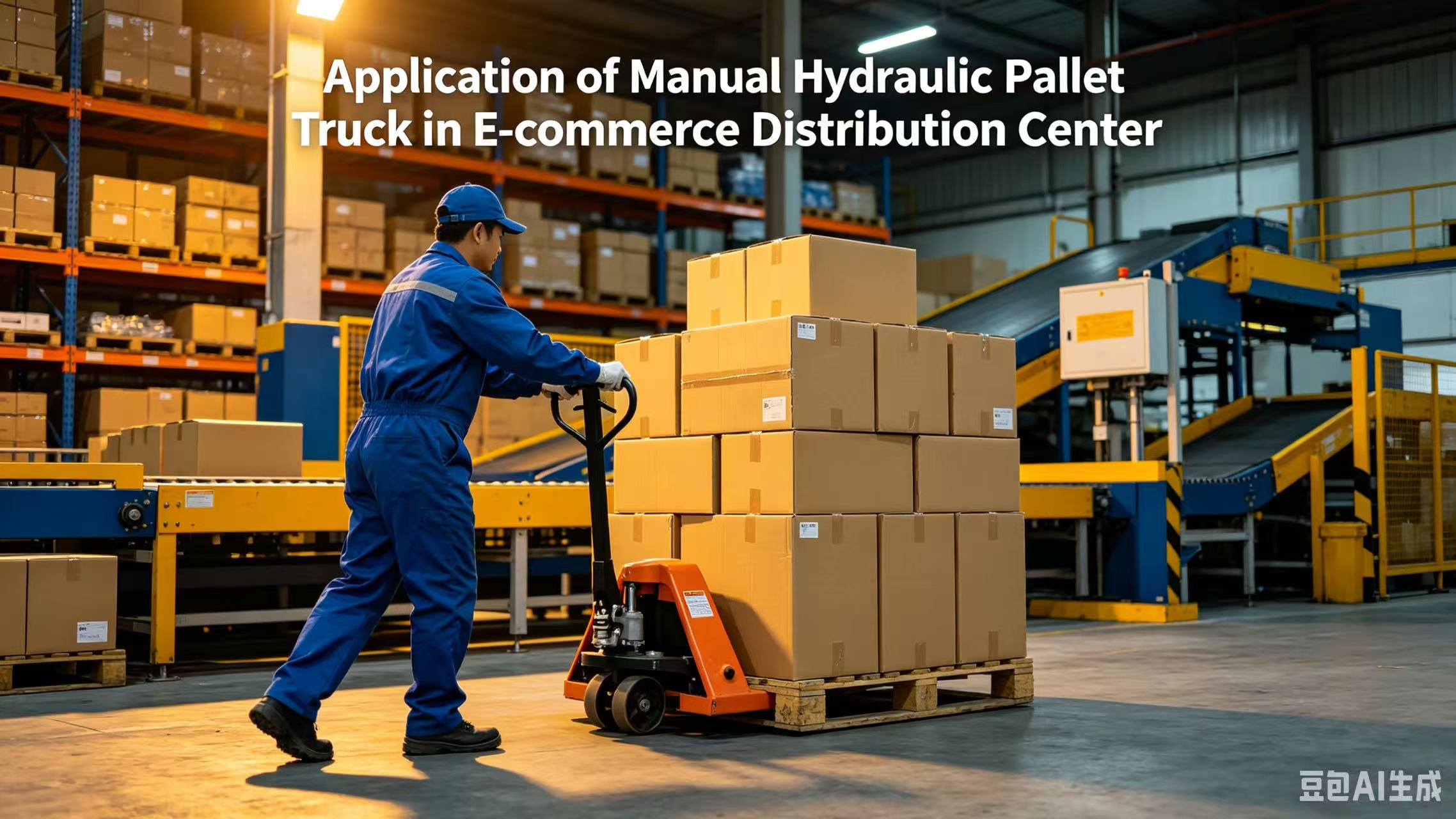
A manual hydraulic pallet truck operating in an e-commerce distribution center.
Market Trend Analysis: How Procurement Is Changing
Several market signals support the case for environment-specific pallet jack selection.
First, the global pallet jack market is projected to grow from USD 7.4 billion in 2024 to USD 11.6 billion by 2034. This growth implies not only more units sold, but more differentiated units sold, as buyers move away from one-size-fits-all procurement.
Second, the electric pallet jack and stacker segment is significant at USD 5.1 billion. E-commerce expansion and lithium-ion battery adoption are the main drivers. Buyers evaluating electric options will increasingly benchmark battery life, charge time, and total cost of ownership for their specific duty cycle.
Third, regulatory frameworks are tightening. ISO 3691-5:2014 defines safety requirements for pedestrian-propelled trucks, EN 1757-2 covers hand pallet trucks in Europe with capacities up to 2,000 kg, and OSHA 29 CFR 1910.178 classifies powered pallet jacks as Class III forklifts requiring operator training. For global buyers, verifying that an imported pallet jack meets the relevant standard is becoming a standard part of the evaluation process.
Fourth, emerging markets – exactly the geographies where JUNYUNHOIST exports – are building modern distribution networks. Suppliers that can offer configuration flexibility and consistent quality at scale are better positioned to capture replacement and project-based demand.
Comparison with Traditional Solutions
The traditional way to buy a pallet jack is to choose a standard model from a local dealer, based primarily on load capacity and price. A configuration-driven approach is different:
| Dimension | Traditional Standard Model | Application-Specific Configuration |
|---|---|---|
| Initial cost | Lower | Moderate to higher, depending on material and features |
| Fit to environment | Depends on coincidence | Designed for temperature, hygiene, floor and aisle conditions |
| Maintenance risk | Higher in harsh environments | Lower when materials and seals match the environment |
| Lead time | Short (in-stock) | 15–20 days for a manufacturer like JUNYUNHOIST |
| Minimum order | 1 unit | Typically 24 units for custom production |
| Replacement parts | Standard, widely available | Standard plus specific spare kits included with each container |
One limitation of the configuration route is order size and speed. A buyer who needs a single pallet jack immediately will usually choose a standard model from local distribution, because custom production often requires a minimum order and production lead time. For JUNYUNHOIST, the MOQ is 24 pieces and lead time is 15–20 days. This is not suitable for urgent, low-volume needs. However, for project-based procurement – opening a new warehouse, equipping a distribution network, or replacing a fleet – configuration offers better long-term value per unit.
Another consideration is verification. Custom configurations need to be validated against technical parameters such as fork height, wheel hardness, and material certificates. A professional supplier will allow 100% testing and include free spare wear parts with each container, which reduces the risk of early downtime.
Future Outlook
The next few years will likely see pallet jack procurement become more project-centric rather than product-centric. Buyers will ask not only “what capacity do I need?” but “what environment will this machine operate in?” Customization options such as stainless steel frames, low-profile forks, built-in scales, and cold-resistant components will become more accessible even for mid-size budgets.
Electric pallet jacks will continue to gain share in logistics-heavy operations, but the manual pallet jack will remain a staple for simple and cost-sensitive tasks. The growing importance of certifications means that exporters must maintain a demonstrable quality system and provide the necessary documentation.
Manufacturers that combine production scale with fast customization – like JUNYUNHOIST with a monthly production capacity of 10,000 units and a 15–20-day lead time – will be attractive partners for buyers who treat pallet jack procurement as part of a larger facility project.
FAQ
For detailed technical specifications and company capability information, the JUNYUNHOIST brochure is available at: https://cdn.socialarks.com/sbsp/24734/0/2026/0424/69eac38419402.pdf.
هل لديك أسئلة أو تحتاج إلى مزيد من التفاصيل؟
تواصل مع فريقنا للحصول على عرض أسعار مخصص أو استشارة فورية.
طلب عرض أسعار
املأ النموذج أدناه وسيتواصل معك فريقنا بعرض مقترح مخصص.
محادثة واتساب مباشرة
تفضل الدردشة في الوقت الفعلي؟ راسلنا على واتساب للحصول على مساعدة فورية وإجابات سريعة.
- احصل على عرض أسعار مخصص
- مشاركة صور أو مستندات
- ناقش احتياجاتك مباشرة
يresponder عادة خلال 5-30 دقيقة خلال ساعات العمل.