
How to Choose a Sublimation Printer for Textile Production
Choosing the right sublimation printer for textile production requires matching print width, printhead configuration, production speed, ink delivery, and after-sales support to your actual order volume and application mix. For growing textile businesses, the XINFLYING series—from the XF-H1301X-1I32A1 to the XF-19E15-PRO—provides a clear upgrade path across entry-level, mid-range, and industrial production.
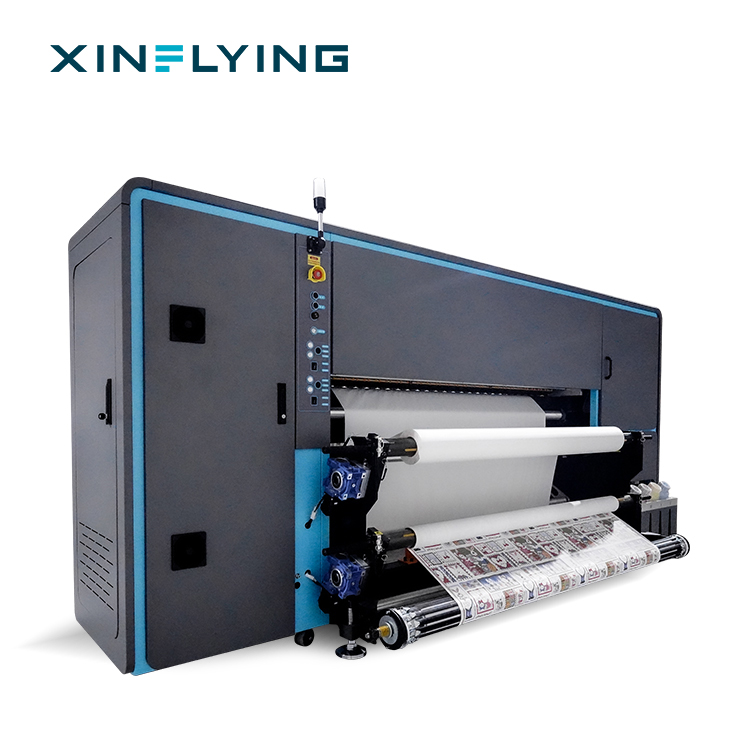
Why sublimation printing is becoming a core textile production method
Dye sublimation printing is a digital heat-transfer process in which sublimation ink is printed onto transfer paper and then converted from solid to gas under heat and pressure, permanently bonding with polyester fibers. Unlike surface printing methods, the dye becomes part of the fabric, producing vibrant colors, a soft hand feel, and long-lasting durability.
The global dye sublimation printing market was valued at USD 16.4 billion in 2025 and is projected to reach USD 39.0 billion by 2033, according to Grand View Research. The dye sublimation printer segment alone was estimated at USD 1.88 billion in 2025 and is expected to grow to USD 2.53 billion by 2030, based on Mordor Intelligence data. Asia Pacific accounted for 36.5% of the dye sublimation printing market in 2025, with China as the largest country market.
For buyers, this growth signals a broader shift: apparel brands, textile mills, and custom printing shops are increasing their reliance on digital dye sublimation equipment for on-demand, full-color, and roll-to-roll production.
How a dye sublimation printer works
A sublimation printer works by printing a mirrored design onto sublimation transfer paper using special dye sublimation ink. The printed paper is then placed on a polyester fabric or coated substrate and passed through a heat press or calender. Under controlled temperature and pressure, the dye sublimates—changing from solid directly into gas—and penetrates the polyester fibers. Once cooled, the dye returns to solid form and is permanently embedded in the material.
Because the dye bonds chemically with polyester, sublimation printing differs from methods that deposit ink or vinyl on the fabric surface. It is commonly used for sportswear, team jerseys, activewear, flags, banners, home textiles, and personalized polyester products.
In professional production, RIP software plays an important role in the workflow. RIP (Raster Image Processor) software converts digital artwork into optimized printing instructions, managing color profiles, ink distribution, resolution, and printer communication. It helps achieve accurate colors, smooth gradients, and consistency across production batches.
What to look for when comparing sublimation printers
Several specifications determine whether a sublimation printer fits a particular production environment. The most important selection factors are printing width, printhead configuration, print speed, ink system reliability, drying and moisturizing systems, power requirements, and supplier support.
Printing width
The required printing width depends on the products being manufactured. A 1.3 m or 1.8 m printer may be sufficient for apparel sampling, small-batch custom textile production, and narrow fabric runs. Wide-format and roll-to-roll printers with 1.9 m to 1.95 m widths are standard for high-volume textile and soft signage applications, allowing full-width fabric printing with fewer passes.
Printhead configuration
Printhead count directly affects throughput and redundancy. Single-head and dual-head printers are generally suited to startups and small-batch production. Four-head, eight-head, and fifteen-head configurations increase output and allow multiple color channels, which is important for continuous daily production and industrial textile manufacturing.
Production speed
Speed is usually expressed in square meters per hour at different pass counts. A 1PASS speed of 306 m²/h or 524 m²/h is designed for high-volume manufacturing where time per roll is critical. Slower multi-pass printing may provide higher quality for detailed designs but reduces daily output. Buyers should match speed to their actual order volume, not simply choose the fastest machine.
Ink system and stability
A reliable ink delivery system reduces interruptions caused by air bubbles, clogged nozzles, or inconsistent ink flow. Fully sealed automatic moisturizing and cleaning systems help maintain printhead health, especially in environments where printers run continuously or in shifts.
Drying and heating
The drying system affects print quality and production reliability. External intelligent air-heat integrated dryers help ensure that sublimation paper dries properly before rewinding, preventing ink smearing and color shifting in long production runs. Break-controlled front, middle, and rear heating supports consistent ink setting on different media thicknesses.
Power and environment
Industrial sublimation printers can require significant electrical infrastructure. For example, the XF-19E15-PRO has a power rating of 14.5 kW and requires 210–230V, 45A supply. A small 1.3 m printer may only need 2 kW and can operate on 110V/220V. Workspace temperature of 18–30°C and humidity of 35–65%RH are generally recommended to maintain stable ink performance and color accuracy.
How to choose a sublimation printer by production scale
The right sublimation printer is not necessarily the most expensive or fastest model. It should match your business size, current order volume, product types, and realistic growth plan. The following framework is commonly used by buyers evaluating dye sublimation equipment:
| Production profile | Typical configuration | What to prioritize |
|---|---|---|
| Startup / small-batch printing | 1–2 printheads, 1.3–1.8 m width | Lower power consumption, simpler operation, stable entry-level performance |
| Growing printing company | 4 printheads, 1.95 m width | Balance between speed, print quality, and operating efficiency |
| Industrial textile manufacturer | 8–15 printheads, 1.9 m width | High 1PASS speed, continuous operation, automated moisturizing and cleaning |
XINFLYING sublimation printer lineup
Guangzhou Xin Flying Digital Technology Co., Ltd., established in 2010, is a manufacturer of digital printing equipment based in Panyu, Guangzhou, Guangdong. The company operates a manufacturing facility covering 37,440 square meters, employs more than 200 staff, and has an R&D team of 20 engineers. Annual production capacity exceeds 20,000 units. Its product range includes dye sublimation printers, DTF printers, UV printers, DTG printers, UV DTF printers, printing consumables, and complete digital printing solutions.
XF-H1301X-1I32A1 — Entry-level 1.3 m sublimation printer
The XF-H1301X-1I32A1 is a digital textile printer classified as a sublimation printer. It is designed for textile sublimation printing on polyester fabrics and intended for textile sublimation printing scenarios. It uses one Epson i3200-A1 printhead with CMYK colors and achieves a maximum print speed of 28 m²/h in 4PASS. Print width is 130 cm. It comes with an external constant-temperature automatic drying system, 2 kW power, and supports 110V or 220V power supply. Net weight is 140 kg.
XF-H1802X-2I32A1 — Entry-to-mid 1.8 m wide-format model
The XF-H1802X-2I32A1 is a wide-format digital textile printer manufactured by XinFlying. Classified as a sublimation printer, it is intended for the textile sublimation printing industry and designed for textile sublimation printing on polyester fabrics. It has a print width of 180 cm and is made of aluminum alloy, stainless steel, and ABS plastic. Equipped with 2 Epson i3200-A1 printheads, it reaches a maximum printing speed of 52 m²/h in 4PASS. It includes front, middle, and rear break-controlled heating, and requires 3.5 kW power.
XF-O2000-4I32A1 — Growing business 1.95 m sublimation printer
The XF-O2000-4I32A1 is a digital textile printer classified as a sublimation printer. It is intended for the textile sublimation printing industry and designed for scenarios such as clothing, home decor, canvas bags, cushions, and flags. It features 4 Epson i3200-A1 printheads with multiple CMYK color channels, a 195 cm printing width, and printing speeds up to 180 m²/h in 2PASS and 92 m²/h in 4PASS. It uses piezoelectric inkjet technology, supports sublimation ink with a 220 ml cartridge and 3 L ink tank, and accepts heat transfer paper rolls of 1000–1500 m. Power consumption is 8.5 kW at 220V, 50/60Hz.
XF-19E8-PRO — Industrial 8-head sublimation printer
The XF-19E8-PRO is a digital textile printer classified as a sublimation printer. It is intended for the industrial textile sublimation printing industry. It uses 8 Epson i3200-A1 printheads with CMYK colors, a 190 cm (75-inch) print width, and 3200 dpi resolution. Maximum print speed reaches 306 m²/h in 1PASS and 153 m²/h in 2PASS. The machine includes an external intelligent air-heat integrated dryer, fully sealed automatic moisturizing and cleaning, and features such as Japan THK silent linear guides, anti-collision devices, and liquid level and waste ink alarms. Power rating is 10.2 kW.
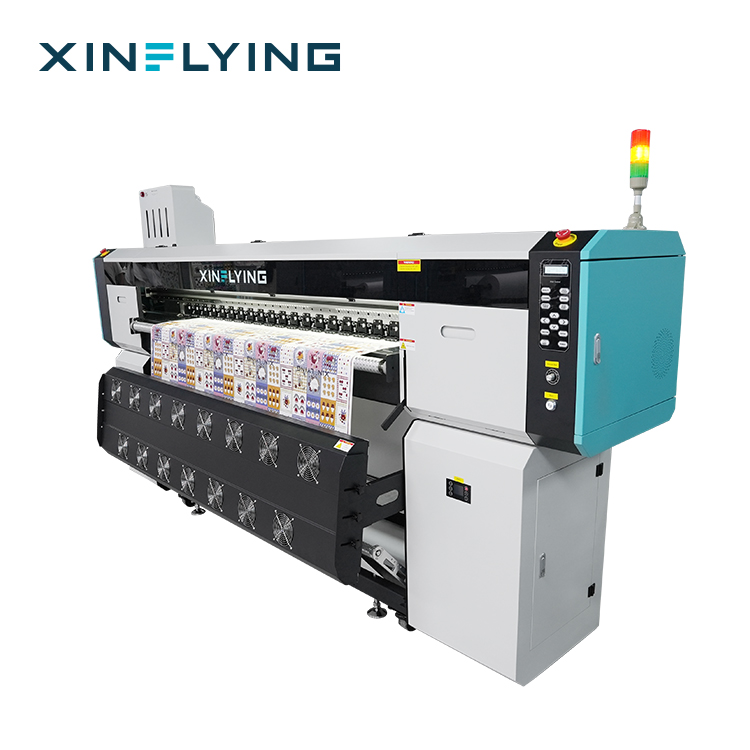
XF-19E15-PRO — High-volume 15-head sublimation printer
The XF-19E15-PRO is a digital textile printer classified as a sublimation printer. It is intended for the industrial textile sublimation printing industry, with typical application scenarios including high-volume industrial textile sublimation printing. The machine is equipped with 15 Epson i3200-A1 printheads, supports sublimation paper rolls up to 1000 m, and reaches a maximum speed of 524 m²/h in 1PASS and 254 m²/h in 2PASS. Print width is 190 cm and resolution is 3200 dpi. It includes a linear motor with magnetic grid, Japan THK silent guide, 27 press rollers, an enlarged beam, and fully sealed automatic moisturizing and cleaning. Power rating is 14.5 kW.
Performance comparison of XINFLYING sublimation printers
| Model | Printheads | Max speed | Print width | Power | Typical use |
|---|---|---|---|---|---|
| XF-H1301X-1I32A1 | 1× Epson i3200-A1 | 28 m²/h (4PASS) | 130 cm | 2 kW | Small-batch, polyester apparel, sampling |
| XF-H1802X-2I32A1 | 2× Epson i3200-A1 | 52 m²/h (4PASS) | 180 cm | 3.5 kW | Startups, custom textile, small-batch orders |
| XF-O2000-4I32A1 | 4× Epson i3200-A1 | 180 m²/h (2PASS) | 195 cm | 8.5 kW | Garment businesses, home decor, continuous daily production |
| XF-19E8-PRO | 8× Epson i3200-A1 | 306 m²/h (1PASS) | 190 cm / 75" | 10.2 kW | Textile factories, large garment manufacturers |
| XF-19E15-PRO | 15× Epson i3200-A1 | 524 m²/h (1PASS) | 190 cm / 75" | 14.5 kW | High-volume industrial textile sublimation printing |
Typical applications across the textile industry
Dye sublimation printing is used across several textile segments, each with different equipment requirements:
- Sportswear and team jerseys: polyester garments with vibrant colors, detailed logos, and durability. High-speed printing is important for order volumes.
- Fashion and custom apparel: full-color designs, gradients, and all-over prints on polyester fabric.
- Home textiles: cushions, blankets, curtains, and decorative fabrics often require wide-format printing and stable long-run color consistency.
- Flags, banners, and soft signage: large-area polyester printing benefits from roll-to-roll sublimation printers with wide print widths.
- Canvas bags and accessories: mid-range printers with flexible media handling can support personalized products and promotional items.
The recommended operating environment for these machines is a controlled indoor production space with temperature of 18–30°C and humidity of 35–65%RH. Stable conditions help maintain consistent ink performance, color accuracy, and reliable long-term operation.
What is included in a complete sublimation printing workflow?
A sublimation printer is one component of a larger production line. For a complete setup, buyers usually need the following:
- Dye sublimation ink: required because the ink must convert from solid to gas under heat and bond with polyester materials.
- Sublimation paper: high-release transfer paper that carries the printed design.
- RIP software: manages color profiles, ink limits, and print parameters. XINFLYING models typically support Maintop as standard, with optional RIIN, PhotoPrint, or Printfactory depending on the model.
- Heat press or calender: applies the temperature and pressure needed to transfer the design from paper to fabric.
- Cutting equipment: optional laser cutting or fabric cutting systems for finished product preparation.
Sublimation printer vs. other apparel printing methods
To make an informed purchasing decision, it helps to understand how dye sublimation compares with other digital and traditional printing methods. The table below summarizes the main differences:
| Method | Optimal material | Design capability | Typical use |
|---|---|---|---|
| Dye sublimation | Polyester and coated materials | Full color, gradients, photographic detail | Sportswear, jerseys, flags, home textiles, all-over printing |
| DTG | Cotton garments | Detailed images, soft print feel | Premium cotton T-shirts, small-batch garment customization |
| DTF | Cotton, polyester, blends, dark fabrics | Full color, versatile fabric compatibility | Customized apparel, workwear, mixed-fabric orders |
| Screen printing | Various textiles | Limited colors, simple designs | Large-volume identical designs |
| Heat transfer vinyl | Depends on vinyl type | Simple logos, names, numbers | Personalized items, small customization projects |
Sublimation printing offers the greatest advantage for polyester-based products that require full-color designs, detailed artwork, soft fabric feel, and efficient digital production. It is less suitable for cotton apparel or materials without polyester content, since the dye cannot bond with natural fibers.
Supplier selection: what to check before buying
Long-term production stability depends not only on the printer itself but also on the supplier's technical capability and after-sales support. Buyers should evaluate the following areas:
- Manufacturing and quality control: A manufacturer with its own production facility, R&D team, and assembly capacity is better positioned to ensure consistent machine quality and spare parts supply.
- Technical support: Installation guidance, operation training, remote troubleshooting, and maintenance documentation reduce downtime risk.
- Spare parts availability: Printheads, dampers, boards, and other consumable parts should be available for the expected service life of the machine.
- Certification and compliance: For regulated markets, buyers should confirm that the equipment meets relevant requirements. RoHS compliance is relevant in the European Union and other regulated markets. FCC compliance is commonly required for electronic equipment sold in the US market. CE compliance should be verified for EU imports. Certification documents, test reports, and technical files must match the actual printer model being supplied.
- Experience with export markets: Suppliers with established global sales and support are generally better equipped to handle documentation, packaging, and installation issues.
Industry data shows that Epson leads the digital textile dye sublimation printer market with a 26.7% share, followed by Mimaki at 18.6% and Roland DG at 15.5%, according to Data Insights Reports. For buyers, this means that many leading sublimation printers rely on Epson printhead technology—including the Epson i3200-A1 used across XINFLYING's current lineup—making printhead familiarity and availability an important consideration.
Limitations and boundary conditions
While dye sublimation printers are a strong fit for polyester textile production, they have clear limitations:
- Material restriction: Traditional sublimation printing is mainly suitable for polyester fabrics and polyester-coated substrates. Cotton and other natural fibers require DTG, DTF, or other methods.
- White ink limitation: Sublimation ink is transparent, so printing on dark or non-white fabrics generally requires a white base layer or alternative technology.
- Electrical infrastructure: Industrial models such as the XF-19E15-PRO and XF-19E8-PRO require 210–230V, 45A power supply, which may need dedicated electrical installation.
- Workspace conditions: Stable temperature and humidity are necessary for consistent color and ink performance. Outdoor or uncontrolled environments increase print quality risk.
- Upfront investment: A complete production line includes RIP software, sublimation paper, ink, and a heat press or calender, not just the printer itself.
Maintenance and troubleshooting basics
Regular maintenance is essential for keeping a sublimation printer in stable working condition. Common practices include daily nozzle checks, regular printhead cleaning, ink system inspection, and maintaining proper operating conditions.
The most frequent printing problems can usually be traced to identifiable causes:
- Lines or banding: often caused by partially blocked nozzles, incorrect print resolution or speed settings, unstable ink supply, or printhead alignment issues.
- Incorrect colors: usually related to ICC profile errors, improperly configured RIP parameters, ink quality, or incorrect heat transfer temperature and time.
- Printhead clogging: commonly caused by dried ink, long idle periods, poor maintenance, unstable ink supply, or unsuitable ink.
For each issue, the recommended approach is systematic: run a nozzle check, clean the printhead, verify ink flow, check printing parameters, perform alignment or calibration, and then test print again. Changing multiple settings at the same time makes it difficult to identify the actual cause.
Decision checklist for buying a sublimation printer
Before making a purchase, work through the following checklist:
- Define your main products: sportswear, fashion fabric, home textiles, flags, or small custom items.
- Estimate daily and monthly production volume in square meters.
- Determine required print width based on fabric roll width and product size.
- Select printhead configuration based on speed needs and growth plans.
- Confirm power supply capacity and workspace climate control.
- Choose RIP software and verify compatibility with your design workflow.
- Plan the complete workflow: printer, ink, paper, heat press or calender, and cutting.
- Verify supplier certification documents, spare parts supply, and after-sales response.
- Request a test print or on-site demonstration before committing to an industrial model.
Market outlook and future direction
The dye sublimation printing market is projected to grow at a CAGR of 11.5% from 2026 to 2033, according to Grand View Research. Demand for personalized apparel and home decor is a primary driver of growth in the digital textile sublimation market.
For equipment buyers, this trend suggests that investing in a scalable sublimation printing system—rather than a single fixed model—can provide more flexibility as order volumes and product categories expand. Manufacturers that combine industrial printheads, automated maintenance systems, and wide-format roll-to-roll capability are likely to remain relevant as production requirements evolve.
XINFLYING's approach reflects this direction. The company's lineup is structured so that a growing business can start with a 1.3 m or 1.8 m printer, move to a 1.95 m four-head machine for continuous daily production, and later scale to an 8-head or 15-head industrial system without changing the basic sublimation workflow. Factory capacity of 37,440 square meters and annual output exceeding 20,000 units provide the manufacturing scale needed to support this type of upgrade path.
Frequently asked questions
What is a sublimation printer and how does it work?
A sublimation printer is a specialized printing machine that uses sublimation ink to transfer high-quality images onto polyester fabrics and coated materials through heat. It is widely used for sportswear, apparel, home textiles, and personalized products because it provides durable colors and excellent print quality. The printer first prints a design onto sublimation transfer paper. During heat transfer, the dye turns from solid into gas and penetrates polyester fibers, becoming permanently bonded with the material after cooling.
What is dye sublimation printing technology?
Dye sublimation printing is a digital printing technology that uses heat to transfer dye into polyester materials. Unlike surface printing, sublimation creates a permanent bond between dye molecules and the material, resulting in vibrant colors, smooth texture, and long-lasting durability. The dye changes from solid to gas under controlled temperature and pressure, then enters the material surface.
Why does a sublimation printer need special ink and polyester materials?
Sublimation printers require dedicated sublimation ink because the ink must transform into gas under heat and bond with suitable materials. Polyester fibers have a structure that allows dye molecules to penetrate and bond during the heat transfer process. Regular inks cannot achieve the same gas transfer effect, and natural fibers such as cotton do not provide enough bonding capability for permanent sublimation printing.
What is RIP software in sublimation printing?
RIP software is a specialized printing management tool that processes digital images and converts them into optimized printing instructions. In sublimation printing, it helps control color accuracy, ink usage, print quality, and production consistency by managing color profiles, ink distribution, resolution settings, and printer communication.
Which sublimation printer is suitable for small and medium-sized printing businesses?
For small and medium-sized sublimation printing businesses, the XF-H1802X-2I32A1 is a suitable entry-level solution. It is equipped with 2 Epson i3200-A1 printheads and an 1800 mm printing width, providing stable production performance with a printing speed of up to 52 m²/h. It is suitable for businesses starting sublimation printing, custom textile production, apparel sampling, and small-batch orders.
Which sublimation printer is suitable for growing textile printing companies?
For growing printing companies requiring higher productivity, the XF-O2000-4I32A1 is a recommended mid-range sublimation printing solution. With 4 Epson i3200-A1 printheads, a 1950 mm printing width, and printing speeds up to 180 m²/h, it provides a balance between production capacity, print quality, and operating efficiency. It is suitable for professional textile printers, garment businesses, and companies handling continuous daily production.
Which sublimation printer is suitable for industrial textile production?
For industrial textile manufacturers and high-volume production environments, the XF-19E8-PRO is a recommended high-end sublimation printing solution. Equipped with 8 Epson i3200-A1 printheads, 3200 dpi resolution, and printing speeds up to 306 m²/h, it is designed for large-scale production requiring maximum efficiency, stable operation, and consistent print quality. It is suitable for textile factories, large garment manufacturers, and professional sublimation production centers.
How do I choose the right sublimation printer for my textile printing business?
The right sublimation printer depends on your business type, production volume, printing width, and application requirements. Small businesses may choose compact models for sample production and low-volume orders, while professional textile printing companies should consider high-speed sublimation printers with larger print widths and continuous production capability. Evaluate printhead configuration, printing speed, ink system, RIP software compatibility, and after-sales support before purchasing.
What certifications should I verify before purchasing a sublimation printer for the US market?
For sublimation printers entering the US market, buyers should check electromagnetic compatibility and electrical safety requirements based on the equipment configuration and application environment. FCC compliance is commonly required to control electromagnetic interference. Depending on product specifications and sales channels, additional safety certifications may be required. Request certification documents, technical specifications, and product test reports from suppliers before purchasing.
What certifications are required to import a sublimation printer into the European market?
For importing sublimation printers into the European market, buyers should verify CE compliance, including applicable electrical safety, electromagnetic compatibility, and product safety requirements. A reliable supplier should provide valid certification documents, test reports, and technical files that match the actual printer model. Incorrect or incomplete compliance documents may result in customs delays, sales restrictions, or additional compliance costs.
What are the common problems when buying a sublimation printer and how can I avoid them?
Common risks include choosing a machine with insufficient production capacity, poor print quality, unstable ink systems, or limited after-sales support. Buyers should evaluate printing speed, print width, printhead reliability, software compatibility, and supplier service before making a decision. Selecting a printer based on actual production requirements helps avoid unnecessary investment and operational problems.
For a more detailed overview of the company's product range and manufacturing capabilities, download the XINFLYING company brochure.