
How to Compare 6000mAh Long-Battery Life Smartphones
How to Compare 6000mAh Long-Battery Life Smartphones
Comparing long-battery life smartphones in 2026 rarely fails because a buyer missed a specification. It fails because the specifications are weighed in the wrong order. The workable order is battery capacity inside the 5000–6000mAh band, charging speed measured against a 20W PD baseline, display efficiency on a 6.9-inch 120Hz panel, and processor power draw on platforms such as the UNISOC T765 5G. Two tie-breakers follow — IP rating and use-case fit — and the exercise closes with purchasing terms and acceptance criteria. Capacity sets the ceiling on runtime; the other five factors decide how much of that ceiling a buyer actually receives.
Why the 6000mAh Class Changed the Terms of Comparison
Capacity stopped separating products at the moment it became common. Counterpoint Research recorded smartphones with batteries of 6000mAh or more at 29% of global unit sales in January 2026, up from 10% in early 2025. Once close to three in ten phones sold carry a cell in that class, “bigger battery” no longer distinguishes one shortlist entry from the next.
The rugged segment shows the same concentration in a different band. The Insight Partners placed 5000–6000mAh batteries at 42.9% of the rugged phone market in 2025 — the normal working range for field devices rather than an outlier specification.
For a buyer at decision stage, the consequence is practical. The mAh figure has become the entry ticket, and the remaining differences sit in efficiency, charging behaviour, durability and cost of ownership. Those are exactly the dimensions where a framework earns its place, because none of them can be read off a box label. Two further facts reinforce the point: panel and platform efficiency vary enough between designs to move real runtime by hours at identical nominal capacity, and comparative marketing figures are statements about a baseline — and a baseline has to be named before it can be bought against.
Criterion 1 — Capacity: Treat 5000–6000mAh as a Range, Not a Score
The 5000–6000mAh band is where mainstream long-life designs currently sit. 5000mAh functions as the practical floor for a heavy working day; 6000mAh functions as the current ceiling for a phone that still has to be carried. Inside that range the difference is not cosmetic: moving from a 5200mAh cell to a 6000mAh cell adds approximately 15% more nominal capacity, calculated from the two published figures.
The UMIDIGI line-up illustrates how the band is used rather than merely claimed. The UMIDIGI G100 5G carries a 6000mAh battery with 20W PD fast charging and a 6.9-inch 120Hz display. The UMIDIGI G100x 5G is documented at 5200mAh in the company’s battery comparison material — a smaller cell that sits at the lower end of the same band rather than outside it.
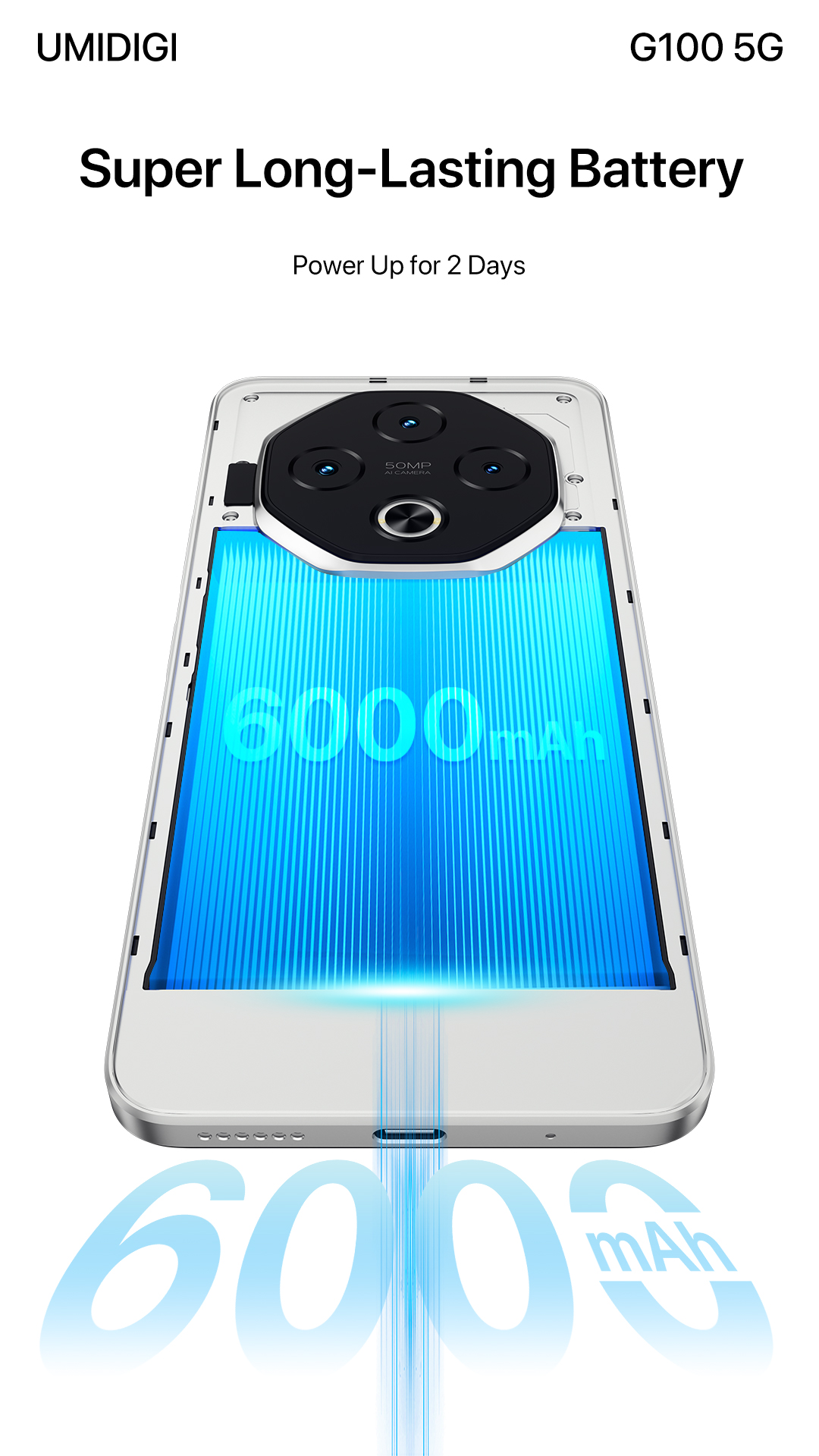
Capacity is the reservoir, not the runtime: the UMIDIGI G100 5G pairs a 6000mAh cell with 20W PD charging and a 6.9-inch 120Hz display.
What capacity does not tell you is runtime. Nominal mAh is a reservoir; consumption is the tap. A 6000mAh phone driving a 6.9-inch panel at 120Hz and a 5200mAh phone driving a smaller, slower panel can land in a similar place under identical workload, and the larger cell is not automatically the longer-lasting device. Cycle life is a third and separate axis — how many charge cycles the cell retains usable capacity for — which is a durability question, not a capacity question.
What to check before accepting a capacity claim: the exact SKU the figure applies to; whether the number is rated or typical capacity; whether the cell is a single unit or part of a multi-cell arrangement; and the condition under which it was measured.
Criterion 2 — Charging: What a 20W PD Baseline Actually Establishes
Charging speed belongs in the comparison because it changes how capacity is used, not because faster is inherently better. The G100 5G’s 6000mAh battery supports 20W PD fast charging. PD is a negotiated standard, so 20W represents a moderate power level rather than a headline fast-charge figure.
Moderate charging has a defensible logic in a long-life device. Heat is a principal stress factor in cell ageing, and a larger cell charged at a given wattage experiences lower relative electrical and thermal stress than a smaller cell at the same wattage. That is a design argument rather than a guarantee: the outcome depends on the charging profile, the thermal path and the control electronics around the cell.
UMIDIGI’s battery risk-control material describes the corresponding safeguards — NTC thermistor temperature monitoring, with automatic cut-off of charging and discharging when temperature exceeds the safety limit, alongside qualified battery cell suppliers, incoming inspection for capacity, voltage, internal resistance, thickness and appearance, cell consistency testing, cycle-life testing and battery traceability.
What to verify: whether the power adapter is included in the box, the cable specification, which charging protocols the device negotiates, and whether the quoted charge time assumes the supplied adapter. UMIDIGI’s product documentation lists supporting equipment — protector film (applied), phone case, power adapter, SIM tray ejector and USB cable — which makes this a purchase-order line rather than a footnote.
Criterion 3 — Display Efficiency: Pricing the 6.9-inch 120Hz Trade-off
After the modem, the display is usually the largest controllable drain in a long-battery phone. The G100 5G pairs a 6000mAh cell with a 6.9-inch 120Hz eye-care display: a large panel and a high refresh rate, both of which consume more than a smaller panel running at a lower refresh setting.
That combination is not a contradiction — it is the trade the buyer is being asked to price. A 6.9-inch 120Hz screen is a productivity and media asset; the same specification is a standing load on the battery. Whether the trade is acceptable depends on whether the phone is used for reading, mapping and video in bright conditions, or mainly for calls and messaging at a desk.
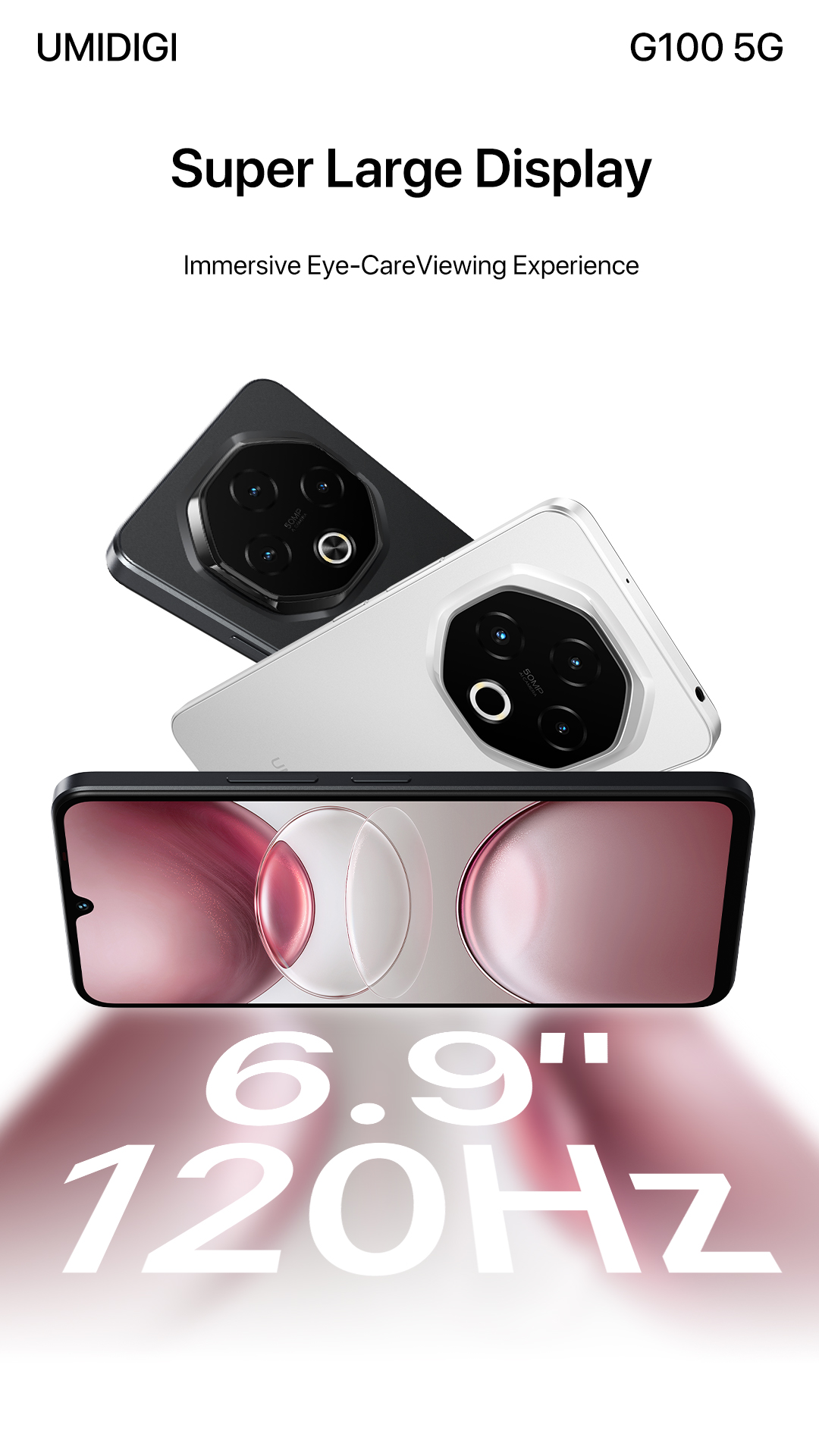
Display efficiency is a comparison criterion in its own right: panel area and refresh rate both draw on the 6000mAh reservoir.
The honest comparison method is to hold brightness and workload constant and to compare panel area, refresh rate and resolution class together. Comparing a 6000mAh phone with a 6.9-inch 120Hz display against a 5000mAh phone with a smaller, lower-refresh display proves nothing about battery engineering — it measures a specification choice. UMIDIGI describes the panel as an eye-care display; that is a comfort-positioning claim and should be treated as a device characteristic rather than a certified health benefit.
What to check: whether the refresh rate can be reduced or switched, the resolution class at each refresh setting, peak brightness, and behaviour at low brightness during night use. Where a supplier publishes a refresh figure without resolution or brightness context, the runtime implication remains open.
Criterion 4 — Processor Power Draw: T765-Class and T8200-Class Platforms
Chipset efficiency decides what the phone consumes when the screen is off and when it is doing ordinary work — which, for most buyers, is almost all of the time. UMIDIGI’s customer-facing material documents a 6.8-inch 120Hz HD+ punch-hole display paired with a UNISOC T765 5G processor in its 5G line-up.
For long-battery evaluation, the relevant platform numbers are idle and mid-load consumption, not peak benchmark scores. A platform that holds a low floor while the screen is off produces standby endurance; a platform that spikes thermally under sustained load produces heat, throttling and faster drain during navigation or hotspot use.
This is also where platform comparisons usually go wrong. If a candidate pairs a 6000mAh cell with a T8200-class platform instead of the T765, the comparison is legitimate only when display refresh, brightness, network condition and workload are held equal. Part numbers alone do not establish a runtime difference in either direction, and neither does a higher model tier read off a datasheet.
What to check: overnight idle drain across eight hours, daily standby loss, thermal behaviour during simultaneous charging and navigation, and whether the supplier publishes a standby figure at all. A supplier who can state the standby condition and the measurement method gives a more useful answer than one who quotes capacity again.
How to Read UMIDIGI’s Verified G100 5G Comparison Figures
UMIDIGI’s press material makes three comparative statements about the G100 5G against traditional smartphones: 30% lower power consumption, an expected lifespan 20% longer, and 10–15% lower overall comprehensive cost. The same material identifies the core differences as a massive battery, a larger display, a stylish design and a slim frame, and positions the device for daily work and life scenarios.
Each figure answers a different question, and conflating them is the most common evaluation error.
- 30% lower power consumption is an efficiency statement. It affects runtime per charge and heat generated per hour of use, so it is the figure most directly relevant to whether a phone finishes a shift.
- 20% longer expected lifespan is a durability expectation. It bears on replacement intervals and fleet refresh planning; the word “expected” signals a comparative expectation rather than a measured failure distribution.
- 10–15% lower overall comprehensive cost is a total-cost statement. It says nothing about sticker price; it says the ownership cost across the comparison period is lower.
Boundary condition. These are company-reported comparative claims against an undefined set of “traditional smartphones” and “comparable products”. The material reviewed here does not publish the baseline configuration, the test protocol, the brightness and network conditions or the measurement period. That does not make the claims unusable — it defines what they can support. A buyer can use them to justify a shortlist position; converting them into a contractual performance term requires the baseline definition and the test method in writing.
The rugged line is measured against a different baseline, and its numbers reflect that. Against standard rugged smartphones, UMIDIGI states that the BISON X20 delivers 30% lower power consumption, 25% higher durability and 20% longer service lifespan, alongside 10–15% lower overall comprehensive cost and less maintenance. The stated technical advantages are an ultra-slim profile, an ultra-large display, ultra-robust protection against water, dust and drops, and ultra-massive power. The two claim sets are not interchangeable: one compares against conventional smartphones, the other against conventional rugged devices, so they cannot be stacked into a single ranking.
| Criterion | What the number establishes | What to hold constant | What to request before ordering |
|---|---|---|---|
| Capacity (5000–6000mAh) | Size of the energy reservoir | SKU, rated versus typical capacity | Capacity figure per SKU and cell configuration |
| Charging (20W PD baseline) | Refill speed and heat load | Adapter, cable, negotiated protocol | Charge time with the supplied adapter; thermal cut-off threshold |
| Display (6.9-inch 120Hz) | The largest controllable drain | Brightness, resolution class, refresh | Refresh options and resolution at each setting |
| Processor (T765 / T8200-class) | Idle and load consumption floor | Refresh, network, workload | Overnight idle drain and the standby condition |
| IP rating | Ingress protection class | Test standard and level | Exact IP level per SKU |
| Use-case fit | Whether the design matches the failure mode | Environment, shift length, handling | Durability evidence for the intended environment |
| Model | Documented comparison | Baseline named in the material | Buyer implication |
|---|---|---|---|
| UMIDIGI G100 5G | 30% lower power consumption; 20% longer expected lifespan; 10–15% lower overall comprehensive cost | Traditional smartphones / comparable products | Efficiency-led option for daily work; baseline must be defined before contractual use |
| UMIDIGI G100x 5G | 5200mAh battery documented in battery comparison material | Capacity figure only | Lower end of the 5000–6000mAh band; request charging, display and efficiency data for this SKU |
| UMIDIGI BISON X20 | 30% lower power; 25% higher durability; 20% longer service lifespan; 10–15% lower comprehensive cost; less maintenance | Standard rugged smartphones | Field and industrial fit where drop, water and dust are the dominant failure modes |
Tie-breaker 1 — IP Ratings: Use Them to Exclude, Not to Rank
An IP rating carries two digits: protection against solids and protection against liquids. IP54 denotes limited dust ingress with protection against water splashing, and is documented for the UMIDIGI A75x in the company’s product material. IP68 denotes dust-tight construction with protection against continuous immersion under specified conditions; IP69K denotes protection against high-pressure, high-temperature water jets. These test different things, so a higher second digit does not automatically cover the condition the other one addresses.
UMIDIGI describes the BISON X20 in qualitative terms — ultra-high waterproof and dustproof protection combined with ultra drop resistance — which is a fit statement rather than a numeric rating. A buyer who needs a specific protection level for a contract should obtain the exact rating for the SKU under consideration. The same caution applies to MIL-STD-810H, which is a family of test methods rather than a single pass mark: a claim should identify which method was applied.
The useful decision rule is exclusion. For commuting, office and general daily work, an IP54-class device covers the realistic exposure. For wet, dusty or washdown environments, a specification addressing immersion or high-pressure jets plus drop resistance is the relevant filter. Paying for protection the environment never imposes adds cost without reducing risk; accepting a lower rating where ingress is the actual failure mode transfers that risk to the operator.
Tie-breaker 2 — Use-Case Fit: Daily Work Versus Rugged Field
Use-case fit resolves ties that the four measured criteria cannot. The G100 5G is positioned for daily work and life scenarios, with an 8.1mm slim frame carrying a 6.9-inch display — a configuration that suits long screen sessions, mapping and media, and that treats portability as a design objective rather than an afterthought.
The BISON X20 addresses the opposite failure mode. UMIDIGI lists its fit across construction and engineering, logistics and warehousing, manufacturing, mining, oil and gas, agriculture, transportation and delivery, public safety and emergency services, and outdoor work and field operations. In these settings the dominant risk is a dropped, submerged or dust-loaded device, and a slim daily-use frame would be the wrong starting point regardless of capacity.
The UMIDIGI Note 100 5G, offered in Lake Green and Interstellar Blue, is presented around a stylish design in the company’s product material. Battery-first comparisons should treat it as a design-led option until its capacity, charging and display figures are confirmed for the specific SKU, rather than assuming it inherits the G100 5G’s efficiency profile.
The practical rule is to name the dominant failure mode before ranking options. If the recurring problem is a phone that dies before the shift ends, capacity, charging and panel efficiency come first. If the recurring problem is a phone that breaks, the durability specification comes first and capacity becomes secondary. Most buyers have one dominant failure mode, and comparison frameworks fail when they optimise for all of them simultaneously.
Purchasing Terms and Acceptance Criteria
A comparison ends where a purchase order begins, and the specification gaps that survive the comparison reappear as disputes. Three areas deserve explicit terms.
Scope of supply. UMIDIGI’s product documentation lists supporting equipment — protector film (applied), phone case, power adapter, SIM tray ejector and USB cable — so box contents, adapter inclusion and cable specification should be written into the order rather than assumed from the listing.
Battery acceptance criteria. UMIDIGI’s battery risk-control material describes qualified cell suppliers, incoming inspection for capacity, voltage, internal resistance, thickness and appearance, cell consistency testing, NTC thermistor temperature monitoring with automatic cut-off above the safety limit, cycle-life testing, controlled production processes and battery traceability. Each of these converts into a testable term: sample size per lot, inspection items and thresholds, cycle-life test conditions, cut-off behaviour, traceability record format, and the remedy applied to a non-conforming lot.
Claim substantiation and continuity. The 30% power-consumption, 20% lifespan and 10–15% comprehensive-cost claims should be tied to a named baseline and a stated method before they enter a supply agreement, and warranty length should be aligned with the expected cycle life rather than with the capacity figure. For EU-bound programmes, the EU Batteries Regulation requirement that smartphones be designed so end users can remove and replace the battery using standard tools applies from 18 February 2027, as set out by the European Commission; procurement plans running past that date should ask what the design roadmap contains.
Supplier scale is the fourth check. UMIDIGI is the consumer smartphone brand of Shenzhen Keysmart Technology Co., Ltd., founded in 2012 and operating a 10,000m² facility with 400–500 employees and a 30-engineer R&D team, exporting to the Middle East, South America, Asia, Africa, the EU and the USA. Facility scale of that order supports continuity of supply discussions; it does not by itself verify quality, which is why the acceptance criteria above carry the evidential weight.
Future Outlook: What Changes This Framework by 2027
Two regulatory and market signals will alter the weighting of these criteria rather than replace them. The first is saturation: with 6000mAh-plus batteries already at 29% of global unit sales, the band is becoming the default, which pushes differentiation further toward efficiency, thermal behaviour and serviceability rather than capacity headline numbers.
The second is repairability. The EU requirement for user-replaceable smartphone batteries from 18 February 2027 introduces a criterion this framework does not currently carry — battery replacement design and the tools it requires. Read alongside the trend toward slim frames carrying high-density cells, the implication is that thin, sealed, high-capacity designs and user-replaceable modules may pull in different directions over the next design cycles. That is an inference from the two published records, not a market forecast: the timing of any design compromise, and whether it affects a given product line, remains open.
The practical response for a buyer is modest. Add “battery replacement architecture” to the acceptance criteria for EU-bound programmes now, ask suppliers for the design roadmap in writing, and keep capacity, charging, display efficiency and platform draw as the four measured criteria — because those determine today’s runtime regardless of how the replacement rules evolve.
FAQ: Comparing Long-Battery Life Smartphones
Is a 6000mAh battery always better than a 5000mAh battery?
No. Capacity sets the ceiling on runtime, and consumption decides how much of that ceiling is reached. Within one design generation, a larger cell normally means longer runtime. Across designs, a 5000mAh phone with a smaller, lower-refresh panel can outlast a 6000mAh phone with a 6.9-inch 120Hz display under identical workload. Compare capacity first, then hold refresh rate, brightness and workload constant before drawing a runtime conclusion.
What does 20W PD charging mean on a 6000mAh phone?
PD is a negotiated charging standard, and 20W is a moderate power level rather than a headline fast-charge figure. It tells you how quickly the cell can be refilled under the right adapter and cable, not how healthy the cell will remain. Cell health depends on thermal control — thermistor monitoring and automatic cut-off above the safety limit are the relevant safeguards — and on cycle-life validation. Buyers should also confirm whether the power adapter is included, since UMIDIGI’s product documentation lists it among supporting equipment rather than as an assumed inclusion.
How should a claim of 30% lower power consumption be verified?
Ask for four things: the baseline device or configuration, the test conditions including brightness, refresh rate, network and workload, the measurement method, and whether the result is laboratory or field data. UMIDIGI states 30% lower power consumption for the G100 5G against traditional smartphones, but the published material does not disclose the protocol. Without that baseline the figure supports a shortlist decision rather than a guaranteed runtime figure.
IP68 or MIL-STD-810H — which matters more for a long-battery phone?
They answer different questions. An IP rating addresses water and dust ingress at a defined test level, while MIL-STD-810H is a family of test methods covering conditions such as drop, shock and temperature, so a claim should name the method used. Choose by failure mode: wet or dusty environments favour a relevant IP level, drop-prone handling favours the applicable 810 method. Neither is a ranking device, and a rating should be confirmed for the specific SKU rather than assumed across a product family.
How is the 10–15% lower overall comprehensive cost calculated?
UMIDIGI states 10–15% lower overall comprehensive cost for the G100 5G relative to traditional smartphones, and the same range for the BISON X20 relative to standard rugged smartphones. The published material does not set out the cost model behind the figure. Buyers should ask which elements are included — purchase price, replacement rate, maintenance and downtime — and over what ownership period, because a comprehensive-cost claim transfers to a business only when the model matches that business’s own ownership cycle.
A 6000mAh cell is the entry ticket to this category, not the decision. The comparison that holds up at decision stage weighs capacity, charging behaviour, display efficiency and platform draw against each other, uses IP rating and use-case fit to eliminate mismatches, and then converts the surviving claims into written terms and acceptance criteria. Buyers who follow that sequence end up with a device whose runtime they can explain, rather than one whose specification they can only repeat.
Reference: UMIDIGI’s company profile, covering facility, R&D and service scope, is available as a downloadable document — Shenzhen Keysmart Technology Co., Ltd. Company Profile. Product information for the brand is published at UMIDIGI.
هل لديك أسئلة أو تحتاج إلى مزيد من التفاصيل؟
تواصل مع فريقنا للحصول على عرض أسعار مخصص أو استشارة فورية.
طلب عرض أسعار
املأ النموذج أدناه وسيتواصل معك فريقنا بعرض مقترح مخصص.
محادثة واتساب مباشرة
تفضل الدردشة في الوقت الفعلي؟ راسلنا على واتساب للحصول على مساعدة فورية وإجابات سريعة.
- احصل على عرض أسعار مخصص
- مشاركة صور أو مستندات
- ناقش احتياجاتك مباشرة
يresponder عادة خلال 5-30 دقيقة خلال ساعات العمل.