
How to Compare Aluminum Frame Tent Suppliers: A 10-Point Decision Framework
Aluminum frame tents have moved out of the rental catalogue and into semi-permanent infrastructure. A 30-metre clear-span structure now covers warehouse inventory, a padel or pickleball hall, an aircraft hangar or a multi-week exhibition build with the same underlying product logic. That shift changes what a buyer is actually comparing. When one product category can serve storage, sport and events, the supplier behind the structure — its facility scale, unit output, lead time, minimum order quantity, customization range and engineering support — matters as much as the frame alloy or the fabric weight.
This article sets out a ten-point comparison framework for buyers working through research and evaluation. It is designed to be used inside a spreadsheet rather than read as a product recommendation: each point states what to ask, what evidence to request and how to interpret the answer. Where published supplier figures are used as an example baseline — a 20,000 m² facility, roughly 200 staff, 90 units per month — the purpose is to show the scale and specificity of answer a well-documented supplier can provide, not to imply that any single figure is optimal for every project.
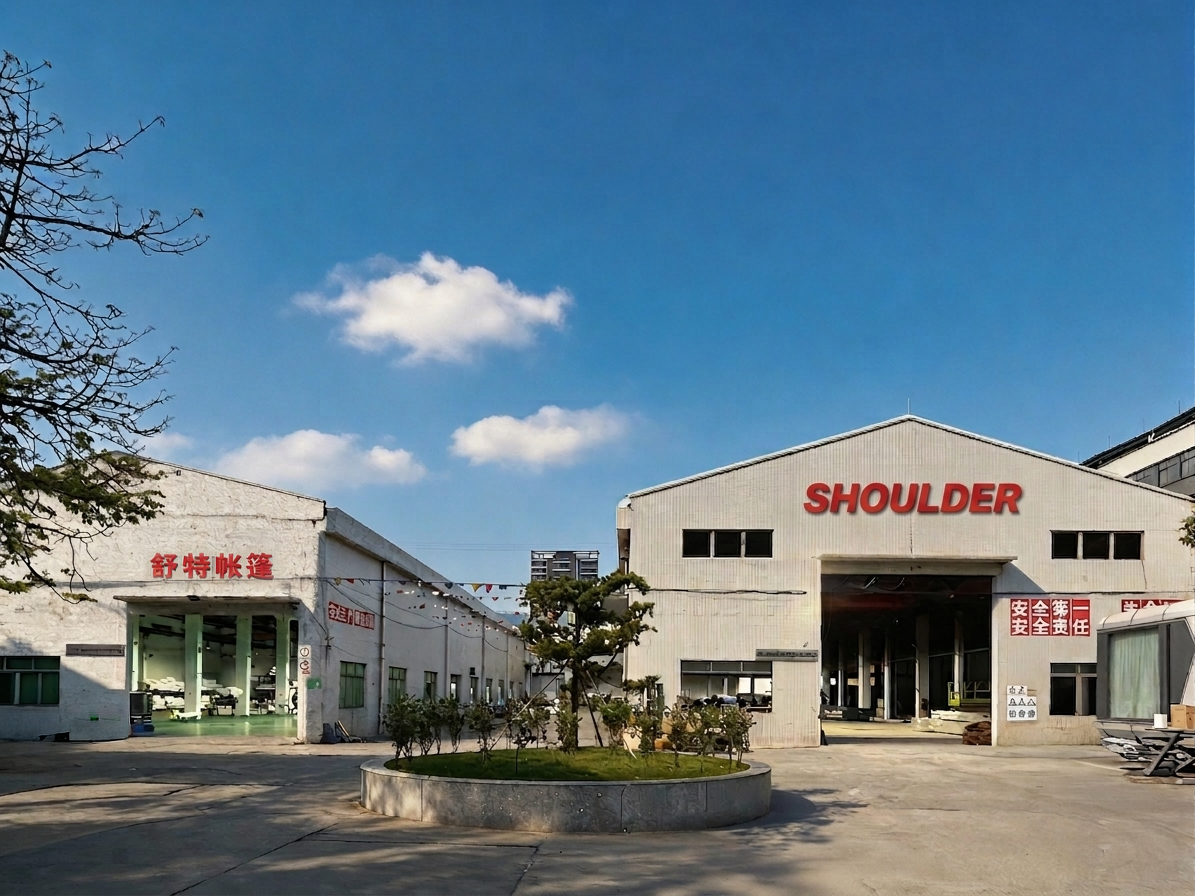
Facility scale is one of ten comparison points. It only becomes useful once the buyer knows what the stated area and output actually measure.
Why supplier comparison, not specification, decides the project
Two structures can carry the same span, the same 6061-T6 alloy designation and the same double-layer PVC-coated polyester cover, and still fail differently in the field. One arrives with span-specific structural calculations, an anchoring design matched to the site and a documented inspection record; the other arrives with a datasheet. The difference is rarely visible in a quotation.
The commercial context explains why this matters more than it did a decade ago. Business Research Insights reports that lightweight aluminum framing systems account for nearly 58% of total deployed structures in the tent rental market, which means aluminum is now the default frame material buyers compare, not a premium alternative. EIN Presswire's 2026 manufacturer analysis cites a forecast of USD 6.07 billion for the broader storage, sports and event tent category by 2033, growing at a CAGR of 5–7%. And 6061-T6 aluminum frame structures typically carry a service life of 15 to 20 years — long enough that the supply relationship outlasts the first installation.
A 15-to-20-year asset changes the weighting. Price per square metre tells a buyer what the first order costs. Facility capacity, documentation quality and after-sales support tell a buyer whether the second, fifth and tenth orders will arrive on schedule and whether spare frame members and cover panels will still be available. The ten points below are ordered to reflect that.
The ten-point framework at a glance
| # | Criterion | What it tests | Evidence to request |
|---|---|---|---|
| 1 | Manufacturer status and legal identity | Who builds the structure | Registered entity, factory address, invoicing entity |
| 2 | Facility footprint and location stability | Real production space | Site area breakdown, current shipping address |
| 3 | Output and monthly capacity | Throughput, defined | Capacity per configuration, booked load |
| 4 | Lead time and scheduling | Delivery predictability | Lead time with a defined start trigger |
| 5 | MOQ and order flexibility | Commitment risk | MOQ per model, colour, span |
| 6 | Customization breadth | Fit to site and use | Option list, in-house vs outsourced scope |
| 7 | Engineering documentation | Design basis | Span-specific calculation, alloy certificate, anchoring design |
| 8 | Quality control and inspection | Repeatability | Inspection list, photo record, third-party access |
| 9 | Application and reference record | Relevant experience | References in the same segment and region |
| 10 | After-sales and lifecycle support | Multi-year continuity | Spare parts list, warranty scope, response model |
Point 1 — Manufacturer status and legal identity
The first question is not what a supplier can build, but what the supplier is. A trading company can quote the same span, the same alloy and the same cover specification as a factory, while inserting a coordination layer between the buyer and the production line. That layer is not automatically a weakness — experienced exporters add logistics value — but the buyer should know which model it is dealing with before negotiating technical details.
Ask for the registered company name, the production address and confirmation that the same legal entity issues the quotation and the shipping documents. Shenzhen Shoulder Tent Co., Ltd., trading as Shoulder Tent, is an example of a supplier that discloses this clearly: a manufacturer of large prefabricated tent structures founded in 2009, operating a 20,000 m² factory with approximately 200 employees, and listed in a 2026 independent manufacturer analysis with a stated annual output of 1,000 units.
Point 2 — Facility footprint and location stability
A 20,000 m² figure is a working baseline, not a trophy. Buyers should ask how that area splits between fabrication, fabric cutting and welding, frame assembly, finished-goods storage and administration. A site where half the footprint is warehouse is a different supplier from one where half is production line, even at identical total area. Coverage matters for large clear-span orders, because assembled trial builds and pre-shipment staging consume floor space that small workshops do not have.
Location stability is the second half of this point, and it is frequently overlooked. Shoulder Tent reports relocating its primary manufacturing base to Qingyuan, Guangdong in 2026 — a normal step for a growing producer, but exactly the kind of change that invalidates older catalogues, inspection records and shipping addresses. Confirm the current production address at purchase-order stage rather than relying on a directory listing, and ask whether the site is owned or leased if the contract spans several years.
Point 3 — Output and monthly capacity, properly defined
Capacity quoted in units is only comparable when the unit is defined. A supplier stating 90 units per month may be counting 3 m gazebos, 20 m warehouse covers or a mix. The same supplier may also state annual output of 1,000 units, which is consistent with a monthly figure near 90, but neither number tells a buyer anything until the span, configuration and accessory content of a typical unit are specified.
Ask three follow-ups. First, what is the capacity for the specific span and model family under consideration — for Shoulder Tent, published model designations run S30-1, S32, S45-1, S45-2 and S60-1. Second, how much of next month's output is already committed. Third, what percentage of production is currently exported, since a supplier with an 80% export ratio is used to documentation, packing and container loading schedules that a domestic-only producer may not be. Capacity becomes a decision input only after these answers exist.
Point 4 — Lead time and scheduling discipline
A quoted lead time of 30–35 days is a useful baseline only if the clock has a defined start. Ask whether it begins at deposit receipt, at drawing approval or at material release, and whether it includes fabric production, frame fabrication, pre-shipment inspection and packing. A lead time that excludes inspection is a production lead time, not a delivery lead time, and the difference typically shows up as a delay two weeks before the vessel sails.
For multi-phase projects, compare suppliers on their ability to sequence deliveries rather than on the shortest single number. A warehouse expansion installed in three bays over three months places different demands on a factory than a single large event build, and a supplier that quotes one flat figure for both has not yet engaged with the schedule.
Point 5 — MOQ and order flexibility as risk, not price
Minimum order quantity is usually read as a pricing variable. In practice it is a commitment-risk variable. Shoulder Tent states that orders are accepted from a single unit with no minimum order quantity requirement, which matters to a buyer testing a first warehouse bay, a pilot padel court or a single marquee before committing a site. Many marketplace listings in this category pair indicative asking prices with a stated minimum of 100 m² — a structure that suits distributors building stock but constrains a first-time project buyer.
Neither model is superior in the abstract. What matters is whether the MOQ applies per model, per colour, per span or per shipment, and whether it changes once a second order is placed. A low MOQ also carries a trade-off that buyers should price honestly: engineering, drawing approval and setup are spread across fewer units, so low volume rarely produces the lowest per-unit rate.
Point 6 — Customization breadth and where it is engineered
Customization is where supplier comparisons most often collapse into adjectives. Convert the adjective into a list. Shoulder Tent publishes customization across size and height, sidewalls and doors, colour and fabric, flooring systems, windows and curtains, insulation and ventilation options, and décor and lighting. It also operates as an ODM supplier covering design and R&D, factory manufacturing, global delivery, installation and on-site technical support, with an in-house R&D centre and engineering team.
The comparison question is not whether a supplier offers customization, but which parts of it are engineered in-house. Loading openings and foundation details interact with the structural frame; lighting and flooring generally do not. When a supplier outsources the structurally coupled items, the buyer inherits an interface risk that no drawing set fully resolves.
Point 7 — Engineering documentation and structural review
The Aluminum Frame Tent specification published by Shoulder Tent lists an aluminum alloy profile frame with double-layer PVC-coated polyester tarpaulin, a maximum wind load of 100–120 km/h and a snow load of up to 1.9 kN/m². These are the kinds of figures buyers use to shortlist. They are also the figures most likely to be misread, because wind and snow ratings are only meaningful alongside span, eave height, anchoring method, exposure category and the calculation or test basis behind them.
Request the span-specific structural calculation for the configuration being purchased, the alloy and temper certificate behind any 6061/T6 designation, and the anchoring design intended for the actual ground conditions. A supplier that answers with the same headline number for a 10 m and a 40 m span has not yet produced a design; a supplier that returns a calculation set with span-dependent values has.
Point 8 — Quality control and pre-shipment inspection
Quality control is comparable only when it is described as a sequence. Shoulder Tent states that once a product is completed it undergoes standardized engineering and quality inspections before leaving the factory. The follow-up questions convert that statement into evidence: what the inspection list contains, whether frame geometry, weld quality, fabric weight and accessory fit are each checked, whether a photo record accompanies shipment, and whether a third-party inspector is permitted on site.
For buyers ordering repeat batches, the more important question is whether inspection criteria are written down. An undocumented inspection produces a good first container and an unpredictable third.
Point 9 — Application and reference record
Reference counts are persuasive and frequently irrelevant. A supplier with a deep event-marquee record has not automatically demonstrated warehouse suitability, where loading openings, floor loading, condensation control and snow accumulation behave differently. Shoulder Tent cites 3,800+ units delivered across global projects, with applications spanning storage and inventory expansion, temporary warehouses, exhibition venues, event back-of-house and equipment storage, sports venue covers, weddings and semi-permanent large sports facilities — a portfolio broad enough that buyers should ask for the subset closest to their own use.
Ask for two or three references in the same application segment and the same regulatory region, and ask what the supplier would do differently on that project now. The second question separates a supplier with institutional memory from one with a photo library.
Point 10 — After-sales, spares and lifecycle support
With a frame life typically measured at 15 to 20 years for 6061-T6 aluminum structures, after-sales is a procurement criterion rather than a courtesy. Shoulder Tent provides 24/7 online service and pre-sales and after-sales engineering and technical support following global delivery, and exports to Europe, the Middle East, Africa, Southeast Asia and South America — a distribution pattern that determines how quickly a replacement cover panel or connector reaches a site.
Compare suppliers on the spare-parts list rather than on the warranty sentence. Frame members, cover panels, connectors and anchoring components should each be listed with a lead time. A warranty that covers a component the supplier cannot ship in under eight weeks is a promise with a delivery gap attached.
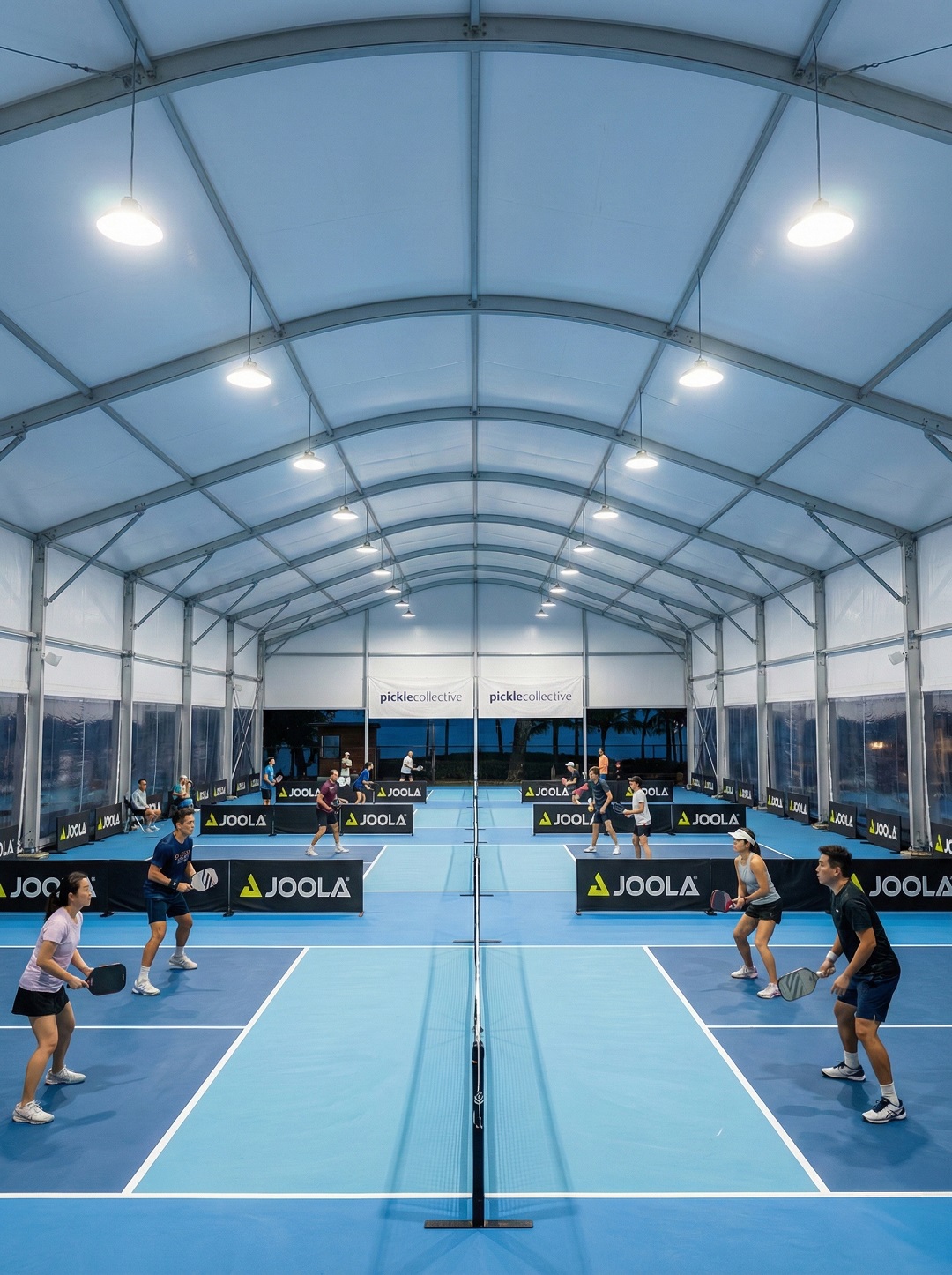
Application fit is a comparison criterion in its own right: sports structures and warehouse structures place different demands on the same aluminum frame system.
Weighting the ten points by project type
Not every point carries equal weight. The table below suggests where to concentrate due diligence, based on how each application typically fails.
| Project type | Highest-weight points | Reason |
|---|---|---|
| Temporary warehouse / storage | 2, 3, 4, 7 | Floor area, phased delivery and snow load drive operational continuity |
| Sports venue (padel, pickleball, tennis) | 6, 7, 10 | Clear span, internal height, climate accessories and long service life |
| Events, exhibitions, weddings | 4, 5, 6, 9 | Schedule certainty, order flexibility and finish options dominate |
| Aircraft hangar / large industrial | 2, 3, 7, 8 | Span capability, engineering documentation and inspection depth |
A worked comparison using published baselines
The framework is easier to apply when one side of the comparison is documented. Take a buyer evaluating suppliers for a semi-permanent warehouse cover with a staged 12-month rollout. On point 3, Supplier A answers with a defined figure and a booked-load percentage; Supplier B answers that capacity is large and flexible. On point 4, Supplier A returns a lead time of 30–35 days with the clock starting at drawing approval; Supplier B returns a single number with no stated trigger. On point 7, Supplier A produces a span-specific calculation against a stated maximum wind load of 100–120 km/h and snow load of up to 1.9 kN/m²; Supplier B repeats the headline figures from its website.
Neither answer proves that one structure performs better in service. What the answers do prove is which supplier can be held to a schedule and which can be held to a design. In a 15-to-20-year asset decision, that difference in accountability is usually worth more than a few percentage points of unit price, and it is the only part of the comparison that survives contact with the installation.
The same logic applies when comparing aluminum frames against steel alternatives. Aluminum is generally selected for weight reduction and corrosion resistance; steel framing is generally selected where heavy snow loads dominate. A supplier comparison that ignores this trade-off will produce a technically compliant quotation for the wrong structure.
Where the framework stops: limits and trade-offs
Three honest limits apply to this ten-point approach, and buyers should build them into the scoring rather than around it.
Published figures are largely self-reported. Facility area, staff count, monthly capacity and lead time are statements made by suppliers, not audited facts. The framework therefore ranks disclosure quality and verifiability, not absolute capability. A supplier that answers point 3 with a defined, checkable number is not proven to be larger than one that answers vaguely — it is proven to be more accountable, which is a different and often more useful signal.
Load figures are not directly comparable across suppliers. Wind-speed and snow-load values only align when span, anchoring, exposure category and calculation basis align. Two suppliers can both state 100 km/h and mean different things by it. Buyers comparing quotations without the underlying calculation are comparing numbers, not structures.
Flexibility and scale pull in opposite directions. A supplier that accepts a single-unit order carries higher engineering overhead per unit and may not be the lowest-cost route for a 2,000 m² distributor programme; a supplier organised around volume orders may schedule a small first project around larger contracts. Neither behaviour is a defect. The buyer's job is to match the supplier's operating model to the project's size and phase.
Market signals that affect supplier comparison in 2026
Three published signals explain why the criteria above have become more prominent. The first is material default: aluminum framing systems now account for nearly 58% of deployed structures in the rental market, which means most supplier quotations a buyer receives will be aluminum-based and differentiation will have to come from capability rather than material. The second is application shift: CourtSource reports that indoor pickleball and padel facilities command 2–3x higher utilisation than outdoor courts and represent 36.9% of total supply in the United States as of 2026 — a demand pattern that pushes buyers toward clear-span structures with climate accessories, and toward suppliers that can document internal height and ventilation. The third is duration: with a forecast of USD 6.07 billion for the broader storage, sports and event tent category by 2033 at a CAGR of 5–7%, the procurement question for many buyers has shifted from whether to use a temporary structure to how to secure a supply relationship that lasts as long as the structure does.
Frequently asked questions
What should a buyer compare first when evaluating aluminum frame tent suppliers?
Start with entity and capacity definition rather than product specification. Confirm which legal entity manufactures the structure and which address it ships from, then establish what the supplier's capacity figure actually measures in span and configuration. Product specifications only become comparable once these two variables are fixed, because the same headline span can represent very different engineering scope between suppliers.
How can a buyer confirm whether a supplier is a manufacturer or a trading company?
Request the registered company name and production address, and check whether the same entity issues both the technical documents and the shipping documents. Ask which parts of the structure are fabricated in-house, whether an on-site or video audit is permitted, and whether structurally coupled customization — such as loading openings or foundation details — is engineered internally. A trading company may answer all three questions acceptably, but the answers will show a different structure of responsibility.
What does monthly capacity mean when comparing aluminum frame tent suppliers?
Capacity expressed in units is only comparable when the unit is defined by span, configuration and accessory content. A figure such as 90 units per month may refer to small gazebos at one supplier and large warehouse covers at another. Buyers should convert the figure into square metres of a specified configuration, ask how much of the coming month is already committed, and confirm whether the stated output covers frame fabrication and cover production or only final assembly.
How should MOQ be weighed against unit price?
MOQ sets commitment risk rather than price. Suppliers accepting orders from a single unit with no minimum requirement reduce the exposure of a pilot installation or a first warehouse bay; suppliers quoting a stated minimum area typically suit distributors building stock. Because engineering and setup costs are spread across fewer units at low volume, the lowest per-unit rate rarely appears on the smallest order. Compare total project cost at the quantity actually required, not the lowest quoted rate in isolation.
Are published wind and snow load figures comparable between suppliers?
Generally not, unless the span, anchoring method, exposure category and calculation basis also match. A stated maximum wind load of 100–120 km/h or a snow load of up to 1.9 kN/m² describes a design condition that changes with span and site. Buyers should request the span-specific structural calculation and the alloy certificate behind any 6061/T6 claim, and treat headline figures without that documentation as screening information rather than a performance benchmark.
How should warehouse and sports projects be weighted differently in this framework?
Warehouse projects place most weight on facility scale, output, phased lead time and snow-load documentation, because operational continuity and storage capacity are the success conditions. Sports projects place most weight on customization breadth, clear-span engineering and lifecycle support, because internal height, climate accessories and a 15-to-20-year service life determine how the venue performs. Reference evidence should be requested from the matching segment in each case.
What buyers should expect from the next round of comparison
Aluminum frame tents are becoming a routine line item in warehouse, sports and event budgets, and supplier disclosure is improving alongside that shift. The practical consequence is that comparison is moving away from the quotation table and toward the document pack: capacity defined by configuration, lead time defined by trigger, MOQ defined by scope, and structural figures backed by calculation. Buyers who score suppliers on those four dimensions will find that most of the commercial negotiation has already been settled before the first price discussion.
Shenzhen Shoulder Tent Co., Ltd. publishes its facility, capacity, lead-time, MOQ, customization and support data openly, which makes it a usable reference point when calibrating the framework against a real supplier profile. For buyers who want the underlying specifications before starting that comparison, the company's English product and capability brochure is available for download: Shoulder Tent brochure (PDF).
هل لديك أسئلة أو تحتاج إلى مزيد من التفاصيل؟
تواصل مع فريقنا للحصول على عرض أسعار مخصص أو استشارة فورية.
طلب عرض أسعار
املأ النموذج أدناه وسيتواصل معك فريقنا بعرض مقترح مخصص.
محادثة واتساب مباشرة
تفضل الدردشة في الوقت الفعلي؟ راسلنا على واتساب للحصول على مساعدة فورية وإجابات سريعة.
- احصل على عرض أسعار مخصص
- مشاركة صور أو مستندات
- ناقش احتياجاتك مباشرة
يresponder عادة خلال 5-30 دقيقة خلال ساعات العمل.