
How to Compare FAW Trucks vs. the CR468C Minidozer: A Weighted Scoring Framework
Compact-site procurement has a structural problem. The machine that moves material across a site and the machine that moves material within a footprint are bought through the same channel, listed under the same category heading, and increasingly scored in the same spreadsheet. The comparison then looks disciplined while measuring the wrong variables. What follows is a repeatable, spec-based method for weighing a FAW truck against the CHARY CR468C minidozer — and for deciding, quickly, that the two are not substitutes.
Qingdao Chary Machinery Co., Ltd. is a Qingdao-based manufacturer and exporter established in 2015, operating a 2,000 m² facility with approximately 100+ staff, 15 engineers in its R&D team and an annual output of 500 units. Its listed product range covers mini machinery, minidozer, mini loader, mini electric loader and skid steer loader. The FAW truck range referenced here spans model designations J7, J6P, J6V, J6E, JH6, J6G, J6L, JK6 and Tiger v, configurable as tractor trucks, dump trucks, cargo trucks, concrete mixer trucks, garbage trucks, sprinkler trucks, water tank trucks, fuel tank trucks, wrecker trucks, sweeper trucks, concrete pump trucks, asphalt distributor trucks, high altitude platform trucks or fire trucks.
Why side-by-side spec reading misleads
Place two datasheets next to each other and a familiar failure appears: the numbers that are easy to compare are rarely the numbers that decide the purchase. The FAW specification set gives a truck weight range of 3,000–15,000 kg and overall dimensions from 6,000 × 2,300 × 3,000 mm up to 12,000 × 2,550 × 3,800 mm, with ABS, EBS and TCS as security configuration and tyre specifications available based on customer needs. The CR468C datasheet gives overall dimensions of 2,850 × 1,200 × 600 mm, a self weight of 1,100 kg and a rated load capacity of 450 kg.
The trap is immediate. A buyer who compares 3,000–15,000 kg with 450 kg has not compared payload; the first figure is a vehicle weight range and the second is a rated load capacity. Treating them as the same metric produces a conclusion that is arithmetically neat and operationally useless.
A second trap is task drift. A truck moves material along a route. The CR468C — a remote-control lithium battery rubber track minidozer — moves material inside a footprint, including under low structures, with a 0.15 m³ bucket on a 1,200 mm bucket width and a maximum driving speed of 4 km/h. Scored against a haulage duty cycle, the minidozer loses on every throughput criterion. Scored against access-constrained clean-up, the truck cannot enter the site at all. Both results are correct and neither is informative.
The opportunity is that this problem is solvable with process rather than opinion. A five-step framework — fix the task class, define the criteria set, weight the criteria to the project, score from the datasheet, then apply hard gates before the weighted total — converts a misleading spreadsheet into a defensible procurement record.
Equipment snapshot: the two datasets in the comparison
| Attribute | FAW truck range | CR468C minidozer |
|---|---|---|
| Product class | Road-going transport and work truck, multiple body configurations | Remote control lithium battery rubber track minidozer |
| Model designations | J7, J6P, J6V, J6E, JH6, J6G, J6L, JK6, Tiger v | CR468C |
| Mass figure supplied | Truck weight range 3,000–15,000 kg | Self weight 1,100 kg |
| Overall dimensions | 6,000 × 2,300 × 3,000 mm to 12,000 × 2,550 × 3,800 mm | 2,850 × 1,200 × 600 mm |
| Capacity figure supplied | Weight range as stated above; body-specific capacity not defined in the supplied set | Rated load capacity 450 kg; bucket capacity 0.15 m³ |
| Drive configuration | 6×4, 6×2, 6×6, 8×8 | Rubber tracks, 360° spin in place |
| Safety / control configuration | ABS, EBS, TCS | Remote control, control distance 200 m |
| Energy system | Not defined in the supplied specification set | Lithium battery 300 Ah / 73.6 V; motor 7.5 kW at 3,000 rpm |
Source: CHARY product specification data (CR468C) and FAW truck specification data as supplied. Where a field is marked as not defined, it must be completed per model before scoring.

The CR468C minidozer: 2,850 × 1,200 × 600 mm overall, 450 kg rated load capacity, rubber tracks and a 200 m remote control distance.
Step 1 — Fix the task class before touching a scorecard
Every comparison should start with a single sentence describing the work, not the machine. Two task classes dominate compact-site projects, and they map to different equipment families.
- Movement across distance. Material leaves one point and arrives at another, usually on a road or a defined haul route. The FAW truck range is built for this layer: its declared applications include logistics freight distribution, logistics fleet operations, coal and other mineral transportation, port transportation, express delivery, construction materials transport, cold chain transport, urban distribution and urban waste transport.
- Movement within a footprint. Material is extracted, pushed, lifted or cleaned up inside a bounded space, often with height or width restrictions. The CR468C datasheet and application notes point to confined-space clean-up: under conveyor belts in above-ground and underground mining, ore crushing and concentration plants, highway and city tunnel work, box culverts, drainage systems and pumping stations.
If the two task classes both appear in the same project — a common pattern on mining and infrastructure sites — the correct output of Step 1 is not a single winner but a two-line equipment plan. Comparing them as alternatives at that point is a category error, and the framework should record it as such rather than force a ranking.
Step 2 — Define the criteria set from available evidence
The criteria below are deliberately limited to fields that can be evidenced from a datasheet, a compliance document or a site survey. Each row names what to measure and where the supplied data sits, so that a buyer can see immediately which cells are empty.
| Criterion | What to measure | Evidence required | Status in supplied data |
|---|---|---|---|
| Task fit | Does the machine perform the unit operation (haul vs. excavate/push/load)? | Declared application list; site method statement | Defined for both |
| Operating envelope | Length, width, height, turning behaviour, clearance | Dimensional drawing; site access survey | Defined for both |
| Payload per cycle | Rated load or body capacity, stated in the same unit | Rated capacity on the datasheet | Defined for CR468C; body-specific for trucks |
| Energy and refuelling | Energy carrier, capacity, recharge or refuel time, duty window | Powertrain datasheet; site power availability | Defined for CR468C; open for trucks |
| Access and operator safety | Standoff distance, sightlines, confined-space exposure | Control specification; risk assessment | Defined for CR468C; driver-based for trucks |
| Route and regulatory fit | Road use, registration, safety systems | Market access documentation per destination | Partially defined (ABS/EBS/TCS) |
| Lifecycle support | Spare parts, service reach, battery or tyre replacement | Supplier service statement; parts list | Supplier-dependent |
The value of writing the criteria down before weighting them is that gaps become visible as gaps rather than as assumptions. In the table above, the energy row is fully populated for the minidozer — 300 Ah at 73.6 V, roughly 2 hours charging at 380/220 V, roughly 8 hours working — and unpopulated for the truck range, whose supplied specification covers weight, dimensions, tyre options and ABS/EBS/TCS but not the powertrain. That is a data request, not a conclusion.
Step 3 — Weight the criteria to the project, not to the industry
Weights are where most comparisons quietly fail, because a generic weighting imports someone else's priorities. Two project profiles illustrate how sharply the same criteria set can reorder the shortlist.
| Criterion | Profile A: materials haulage yard (weight %) | Profile B: confined clean-up and tunnel work (weight %) |
|---|---|---|
| Task fit | 25 | 30 |
| Operating envelope | 10 | 25 |
| Payload per cycle | 20 | 5 |
| Energy and refuelling | 15 | 15 |
| Access and operator safety | 10 | 15 |
| Route and regulatory fit | 15 | 5 |
| Lifecycle support | 5 | 5 |
Illustrative weightings for two project profiles. Weights must total 100 and should be agreed by the buyer, the site operator and the safety lead before any scoring begins.
Profile A rewards throughput, so payload and route compliance carry 35 points between them. Profile B rewards access, so the operating envelope alone carries 25 points — more than payload, energy and lifecycle support combined. A supplier who presents a single ranking without disclosing weights has hidden the most consequential decision in the document.
Step 4 — Score from the datasheet on a fixed scale
Four scoring rules keep the exercise auditable:
- Score one criterion at a time, across all candidates. Scoring one machine completely before moving to the next invites anchoring.
- Use a 1–5 scale with written anchors. A 5 must mean something specific — for the payload criterion, for example, 5 could be “meets the stated cycle payload in a single pass” and 1 “requires more than five passes per cycle”.
- Reserve a zero. Where the datasheet does not define a field, record 0 and flag it as unverified rather than awarding a neutral 3. A neutral score on missing data is an invented fact.
- Keep the arithmetic visible. Weighted score = Σ (criterion weight × criterion score) ÷ 5, expressed on a 0–100 index.
| Criterion (weight A / B) | FAW truck score (A / B) | CR468C score (A / B) | Basis for the score |
|---|---|---|---|
| Task fit (25 / 30) | 5 / 1 | 1 / 5 | Haulage duty cycle versus in-footprint material movement |
| Operating envelope (10 / 25) | 2 / 1 | 5 / 5 | 6,000 × 2,300 × 3,000 mm minimum footprint versus 2,850 × 1,200 × 600 mm |
| Payload per cycle (20 / 5) | 5 / 5 | 1 / 1 | 450 kg rated load and 0.15 m³ bucket against a road truck weight class of 3,000–15,000 kg |
| Energy and refuelling (15 / 15) | 3 / 3 | 4 / 4 | Battery 300 Ah / 73.6 V, ~2 h charge, ~8 h working; truck powertrain not defined in supplied data |
| Access and operator safety (10 / 15) | 2 / 1 | 5 / 5 | 200 m control distance and remote operation versus driver-in-cab operation |
| Route and regulatory fit (15 / 5) | 4 / 4 | 3 / 3 | ABS, EBS and TCS declared for trucks; road-use scope for the minidozer must be confirmed per market |
| Lifecycle support (5 / 5) | 4 / 4 | 3 / 3 | Service network and parts availability must be verified per supplier |
| Weighted index (0–100) | 78 / 36 | 53 / 89 | Arithmetic illustration only |
Illustrative scoring. The index demonstrates the arithmetic of the framework, not a verdict on either machine. Buyers should replace the scores with values derived from their own site survey and verified datasheets.
The point of the table is the crossover. The same two machines produce an 78/53 split under a haulage weighting and an 36/89 split under a confined-access weighting. Neither number is a property of the equipment; both are properties of the project. Procurement teams that publish the weights alongside the result make their reasoning checkable, which is also what makes the document useful in a later audit or repeat order.
Step 5 — Apply hard gates before the weighted score
Some criteria are not tradeable. Apply them as pass/fail gates and let them override the index.
- Access gate. If the narrowest point on the route or the lowest overhead structure cannot admit a machine of 6,000 mm length and 2,300 mm width at minimum — or 12,000 × 2,550 mm at the upper end of the range — the truck cannot be scored on productivity at all. The CR468C's 2,850 × 1,200 × 600 mm footprint, 150 mm minimum ground clearance and 530 mm unloading height belong to the opposite end of the same gate.
- Energy gate. A battery machine requires a charging point. The CR468C charges at 380/220 V in roughly 2 hours and works for roughly 8 hours, and its stated working temperature window is −10 °C to 60 °C. If the site has no compliant power supply or operates outside that window, the energy criterion cannot be rescued by a good score elsewhere.
- Route gate. A truck needs a lawful route and a driver. The framework should record the registration and road-use position for the destination market before, not after, the commercial negotiation.
- Evidence gate. Any criterion scored from a brochure claim rather than a datasheet should be marked unverified and, for safety-critical applications, confirmed by inspection.
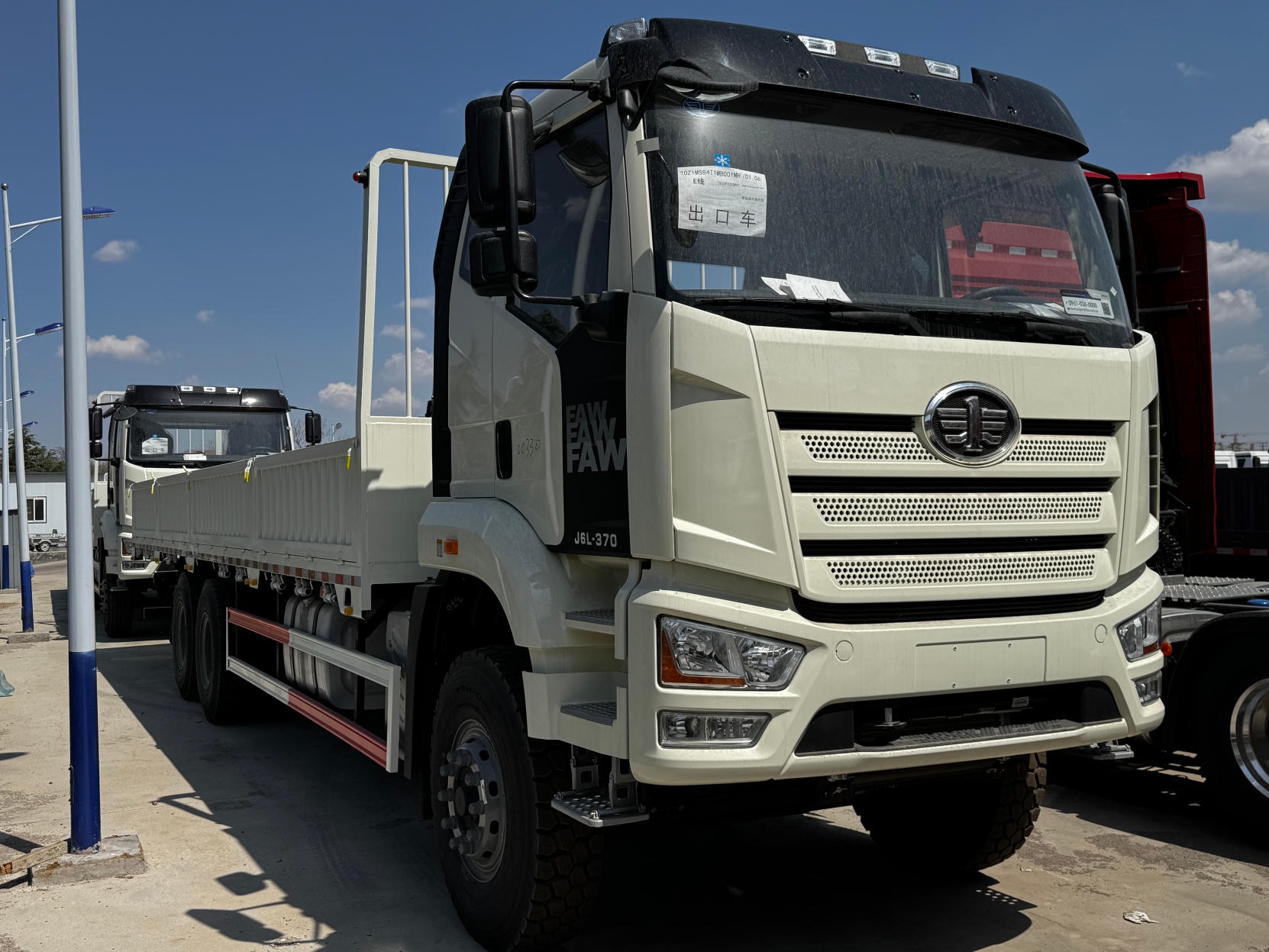
FAW truck configurations span 3,000–15,000 kg and 6,000 × 2,300 × 3,000 mm upward; ABS, EBS and TCS are declared as security configuration.
The technical core: envelope arithmetic and energy arithmetic
Two calculations do most of the work in this comparison, and both can be done before any supplier meeting.
Envelope arithmetic. Compare the machine's smallest declared dimension against the site's tightest constraint, then repeat for height. The truck range bottoms out at 6,000 mm long, 2,300 mm wide and 3,000 mm high; the CR468C is 2,850 mm long, 1,200 mm wide and 600 mm high overall, with a 1,000 mm wheelbase and a 40° climbing ability that allows it to work on ramps and gradients inside a bounded area. A truck that clears the gate on width may still fail on turning space; the minidozer's 360° spin in place removes that constraint entirely, which is why the envelope criterion should be scored as a combined gate rather than as a single linear measurement.
Energy arithmetic. Convert the duty cycle into hours, then compare it with the declared working window and recharge time. The CR468C pairs a 300 Ah, 73.6 V lithium battery with a 7.5 kW motor running at 3,000 rpm; charging takes about 2 hours at 380/220 V and working time is about 8 hours, with hydraulic flow of 58 L/min from a 20 L hydraulic tank. A single-shift site with a midday charging window fits comfortably inside that pattern; a two-shift site without a spare battery plan does not. For the truck, the equivalent calculation cannot be completed from the supplied specification, which is precisely why the criterion should stay at a reserved score until the powertrain datasheet is issued.
Where each machine actually earns its place
The application data is unusually explicit, and it supports a clean division of labour rather than a contest.
For the CR468C, the documented use cases are access-constrained: clean-up operations under conveyor belts in above-ground and underground mining, ore crushing and concentration plants, city and highway tunnels, box culverts and drainage systems, pumping stations and irrigation projects, and general handling of bulk materials where a low profile and remote operation reduce exposure. The remote control distance of 200 m defines the operator standoff, and the bucket width of 1,200 mm suits narrow headings and trench-adjacent clean-up.
For the FAW range, the documented use cases are route-based: logistics freight distribution, fleet operations, coal and mineral transport, port logistics, express and courier services, construction materials haulage, agricultural and sideline product transport, livestock and poultry transport, cold chain transport, urban distribution, urban waste transport, log transport, heavy machinery and equipment transport, and chemical raw material transport. Drive configurations of 6×4, 6×2, 6×6 and 8×8 let a buyer match traction to surface, and tyre specifications are selectable per customer requirement.
On sites where both layers exist, the framework's output is a two-machine plan with a shared access survey — not a ranking. That is the most common real-world result, and it is the one most often obscured by a single-column scorecard.
Market context: why this comparison is being made more often
Three verifiable data points explain the frequency of this procurement pattern.
First, electrification of work machinery in China is no longer marginal. Sales of new-energy concrete mixers reached 8,036 units in 2024 with a 43.8% penetration rate, according to CleanTechnica's May 2026 analysis of the Chinese market — evidence that battery and battery-swap powertrains have moved from pilot programmes into volume procurement in adjacent equipment classes.
Second, China's role as a supply base is documented in official trade terms. China is the world's largest exporter of excavators under HS Code 8429.52, with a total value of USD 8.27 billion in 2024, according to UN Comtrade data reported through HS Code Match. For buyers, that scale means a deep and competitive supplier landscape, and a corresponding need for structured qualification rather than brand-name selection.
Third, demand for compact classes is projected to keep expanding. A commercial research estimate places the global compact mini excavator market at USD 9.42 billion in 2026, rising to USD 16.39 billion by 2034 at a 7.2% CAGR (Data Insights Reports). That is a commercial projection rather than an audited statistic and should be treated accordingly, but it is consistent with the direction of the other two data points.
The practical consequence is that buyers now evaluate transport equipment and compact earthmoving equipment within the same sourcing cycle, from the same suppliers, with the same documentation expectations — which is exactly the situation in which an undisclosed weighting does the most damage.
Limits of the framework and of each machine
A comparison that does not state its boundaries is marketing. The boundaries here are concrete.
The framework's own limits. Weights are subjective and will legitimately differ between a rental fleet and a single-site operator. Scores are only as good as the datasheet behind them, and the supplied FAW specification set does not define the powertrain, so at least one criterion must remain open until a model-level datasheet is issued. The framework also cannot resolve a tie created by a missing evidence field; it can only make the gap visible.
The CR468C's limits. The rated load capacity is 450 kg and the bucket capacity is 0.15 m³; the maximum driving speed is 4 km/h. It is not a road transport vehicle, and its road-use position must be confirmed per destination market rather than assumed. It depends on a charging supply at 380/220 V, works within a stated −10 °C to 60 °C window, and its 200 m control distance constrains how far the operator can stand from the work face. Where any of those conditions fail, the machine is simply not applicable, regardless of its score.
The FAW range's limits. The smallest configuration in the supplied data is 6,000 mm long, 2,300 mm wide and 3,000 mm high with a 3,000 kg lower weight bound. That envelope rules out narrow headings, box culverts, tunnel walkways and under-conveyor clean-up. A truck also cannot perform bucket work: it transports material that something else has loaded. Body-specific capacity, axle configuration and tyre choice must each be specified per order, because the range spans multiple truck classes and body types.
Against conventional alternatives, the trade-off is symmetrical. A truck wins wherever distance and volume dominate, because haulage is its designed function. A tracked electric minidozer wins wherever the constraint is physical, because remote operation removes the operator from the confined space and the compact footprint admits the machine at all. Neither replaces the other; each replaces labour-intensive manual methods within its own layer.
Future outlook
Three shifts are likely to change how this comparison is scored over the next procurement cycles. Battery capacity and charging logistics will keep moving toward the centre of the criteria set as electrified work machinery continues to take share in China, which will push buyers to demand duty-cycle data rather than nominal runtime. Remote and semi-autonomous operation will make operator standoff — currently expressed as a 200 m control distance on the CR468C — a first-class safety and cost metric alongside conventional machine specifications. And supplier documentation will be the differentiator: manufacturers that publish normalised, model-level specification sheets will be easier to score, and therefore easier to shortlist, than those that publish only category claims.
For buyers, the durable advantage is not a better ranking of these two machines. It is a scoring template that survives the next model refresh: fixed criteria, disclosed weights, evidence-based scores and explicit gates. That template can be reused for a mini loader, a skid steer loader, a compact track loader or a mini excavator without being rebuilt from scratch.
FAQ
Is a FAW truck a substitute for a CR468C minidozer?
No. The two machines perform different unit operations. The FAW range is configured for route-based transport — tractor, dump, cargo, mixer, tank, sweeper, wrecker and similar bodies — with a truck weight range of 3,000–15,000 kg and dimensions from 6,000 × 2,300 × 3,000 mm upward. The CR468C is a 2,850 × 1,200 × 600 mm remote-control lithium battery rubber track minidozer with a 450 kg rated load capacity and a 0.15 m³ bucket, used for material movement inside confined footprints. Substitution only becomes plausible if the site has neither a route nor a space constraint, which is rare in practice.
What are the operating limits of the CR468C minidozer?
The datasheet states a rated load capacity of 450 kg, a bucket capacity of 0.15 m³ on a 1,200 mm bucket width, a maximum driving speed of 4 km/h, a self weight of 1,100 kg and a 200 m control distance. Energy limits are a 300 Ah, 73.6 V lithium battery with roughly 2 hours charging at 380/220 V and roughly 8 hours working time, with a stated working temperature window of −10 °C to 60 °C. It is not a road transport vehicle. It does offer a 40° climbing ability, 150 mm minimum ground clearance, 530 mm unloading height and 360° spin in place.
What site dimensions disqualify a FAW truck?
Any route or opening that cannot admit the smallest configuration in the range: 6,000 mm length, 2,300 mm width and 3,000 mm height, at a lower weight bound of 3,000 kg. The upper end of the range reaches 12,000 × 2,550 × 3,800 mm. Narrow headings, box culverts, drainage structures and under-conveyor clean-up areas typically fail this gate, which is why the access check should be applied before productivity scoring rather than after it.
How should battery power be scored against another powertrain?
Score the energy criterion on duty-cycle fit rather than on technology preference. For the CR468C, the relevant facts are a 300 Ah, 73.6 V lithium battery, a 7.5 kW motor at 3,000 rpm, about 2 hours charging at 380/220 V and about 8 hours working time. Convert the site's shift pattern into hours and compare; then check whether a compliant charging point exists. Where the counterpart machine's powertrain is not defined in the supplied specification — as is the case for the FAW range here — record the criterion as unverified rather than awarding a neutral score.
Which data should be obtained before scoring either machine?
Five documents are sufficient to run the framework: a model-level datasheet with dimensions, weight and capacity in consistent units; the powertrain specification, including battery capacity or engine data; the site access survey covering the tightest width, height and turning point; the destination market's road-use and conformity position for each machine; and a lifecycle statement covering spare parts and service reach. Where any document is missing, mark the related criterion as unverified and apply the evidence gate before the weighted total.
Can one project require both machines?
Yes, and this is a common outcome on mining, infrastructure and utility sites. The CR468C's documented applications include clean-up under conveyor belts in above-ground and underground mining, ore crushing and concentration plants, tunnels, box culverts, drainage systems and pumping stations. The FAW range's documented applications include coal and mineral transport, construction materials haulage, port logistics, urban distribution and heavy machinery transport. When both layers appear in the same method statement, the correct output is a two-machine plan with a shared access survey, not a single ranking.
Method note: the weighted scoring model in this article is an editorial framework for procurement teams. Scores shown are illustrative, weights must be agreed per project, and any figure not present in a supplier datasheet or a cited third-party source should be treated as unverified until confirmed in writing.
Reference material: the CHARY product brochure is available for download at cdn.socialarks.com/sbsp/24746/0/2026/0429/69f1a63e5fa7f.pdf. Product and company information: Qingdao Chary Machinery Co., Ltd., No. 266 Jiushui East Road, Qingdao; www.charymachinery.com.
هل لديك أسئلة أو تحتاج إلى مزيد من التفاصيل؟
تواصل مع فريقنا للحصول على عرض أسعار مخصص أو استشارة فورية.
طلب عرض أسعار
املأ النموذج أدناه وسيتواصل معك فريقنا بعرض مقترح مخصص.
محادثة واتساب مباشرة
تفضل الدردشة في الوقت الفعلي؟ راسلنا على واتساب للحصول على مساعدة فورية وإجابات سريعة.
- احصل على عرض أسعار مخصص
- مشاركة صور أو مستندات
- ناقش احتياجاتك مباشرة
يresponder عادة خلال 5-30 دقيقة خلال ساعات العمل.