
How to Compare Slab Stone Cutting Machine Configurations
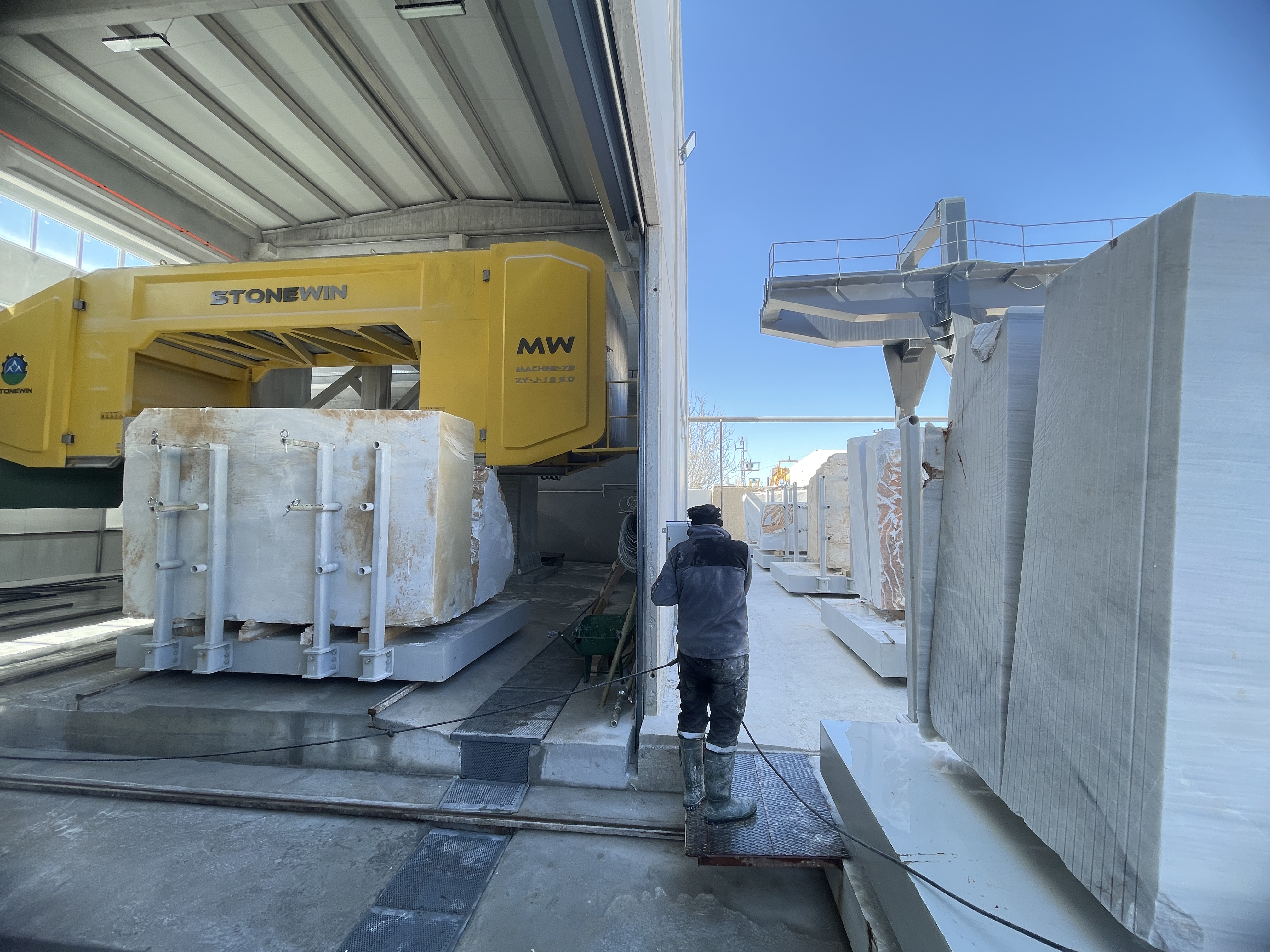
A slab stone cutting machine determines the size, surface quality and downstream workload of every slab a plant produces, yet most buying comparisons collapse into a single number: how many wires. That number matters, but it is one layer of a configuration decision that also includes tension architecture, cutting envelope, installed weight, frame material, and the polishing and resin capacity the saw must feed.
Stonewin is the brand of FUJIAN XIAPU ZHONGYUAN MACHINERY CO., LTD., a stone machinery manufacturer established in 2011 in Xiapu, Fujian, China, whose product line covers stone quarrying, stone slab processing, stone slab polishing, and stone resin lines (glue filling and drying). Its multi-wire saw range is listed across 14 model designations, from ZY-MW5 to ZY-MW90, with a stated wire count span of 5 to 90 wires, a cutting size range of 3500 mm (L) × 2200 mm (H), and machine weights from 22 to 80 tons.
This reference sets out a four-layer framework for comparing slab stone cutting machine configurations, and then shows why the evaluation is only complete once polishing line and resin line specifications are placed alongside the saw.
Why configuration comparison comes before model selection
Multi-wire sawing has moved from a specialist option to the mainstream configuration for slab production. Dataintelo reports that the multi-wire saw segment accounted for 58.4% of product share in the diamond wire saw machine market in 2025. Once a category becomes the default, differentiation shifts down a level — from "multi-wire or not" to "which configuration" — because two machines carrying the same category label can differ in wire count, tension type, cutting envelope, installed weight and downstream compatibility.
The practical consequence for a buyer at the research stage is that a quotation sheet listing only price and wire count leaves most of the decision unresolved. A configuration comparison instead forces the supplier to state, model by model, what the machine will cut, how it will be installed, what it will wear, and what it requires from the polishing and resin stages that follow.
Layer 1 — Wire count tiers from ZY-MW5 to ZY-MW90
The wire count is the first specification to pin down because it defines the configuration class of the machine. Stonewin lists the multi-wire saw machine across models ZY-MW5, ZY-MW10, ZY-MW16, ZY-MW20, ZY-MW36, ZY-MW42, ZY-MW58, ZY-MW64, ZY-MW72, ZY-MW76, ZY-MW82, ZY-MW86, ZY-MW88 and ZY-MW90, with a stated range of 5 to 90 wires. The model designation indicates the configuration: ZY-MW72 is a 72-wire option and ZY-MW86 an 86-wire option.
For comparison purposes, the series can be read in three bands based on the designation. The bands are an organising device for buyers, not a performance claim — each model is listed individually and should be quoted individually.
| Band | Model designations in the range | Question this band forces the buyer to answer |
|---|---|---|
| Lower wire count | ZY-MW5, ZY-MW10, ZY-MW16, ZY-MW20 | Is the production target modest enough that a smaller wire set is the right capital commitment, and will the slab mix stay stable? |
| Mid wire count | ZY-MW36, ZY-MW42, ZY-MW58, ZY-MW64 | Does the planned block programme justify a mid-range configuration, and can the polishing line absorb the output? |
| High wire count | ZY-MW72, ZY-MW76, ZY-MW82, ZY-MW86, ZY-MW88, ZY-MW90 | Is the plant committed to volume slab production with the handling, power and downstream capacity that implies? |
A buyer should not assume that output scales in a straight line with wire count across the whole series. The honest comparison is to take the model under consideration, ask for its individual specification sheet, and convert the wire count into slab output using the plant's own block dimensions and cycle assumptions. Wire count sets the configuration class; the plant's block programme determines whether that class fits.
Layer 2 — Side-tension versus top-tension
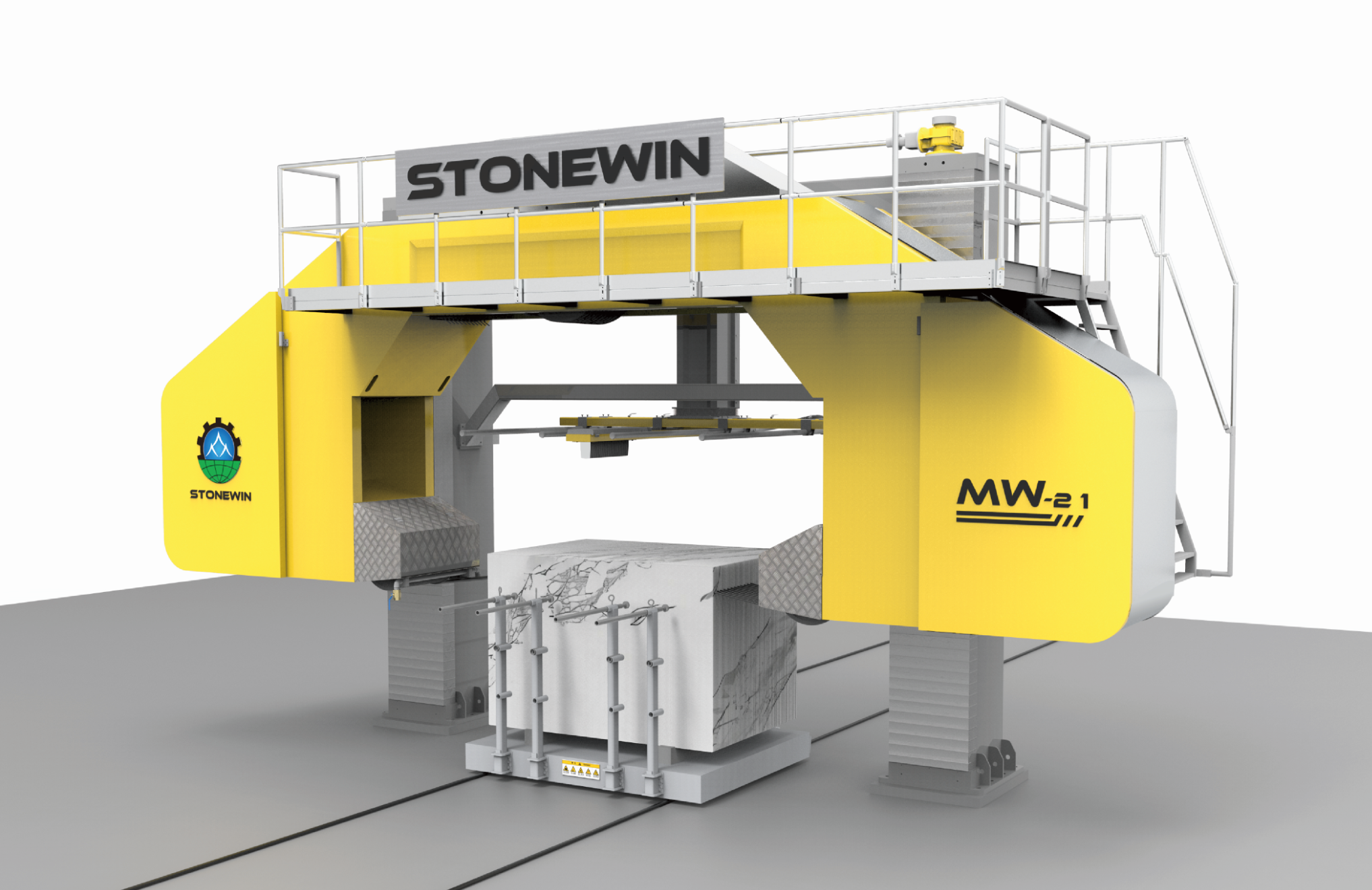
The second layer is the tension architecture. Stonewin lists the multi-wire saw machine as two types: side-tension multi-wire saw machines and top-tension multi-wire saw machines. The distinction is a structural one about where the wire tensioning system sits relative to the cutting frame, which in turn affects how the machine is laid out on the plant floor and how access is organised around the cutting zone.
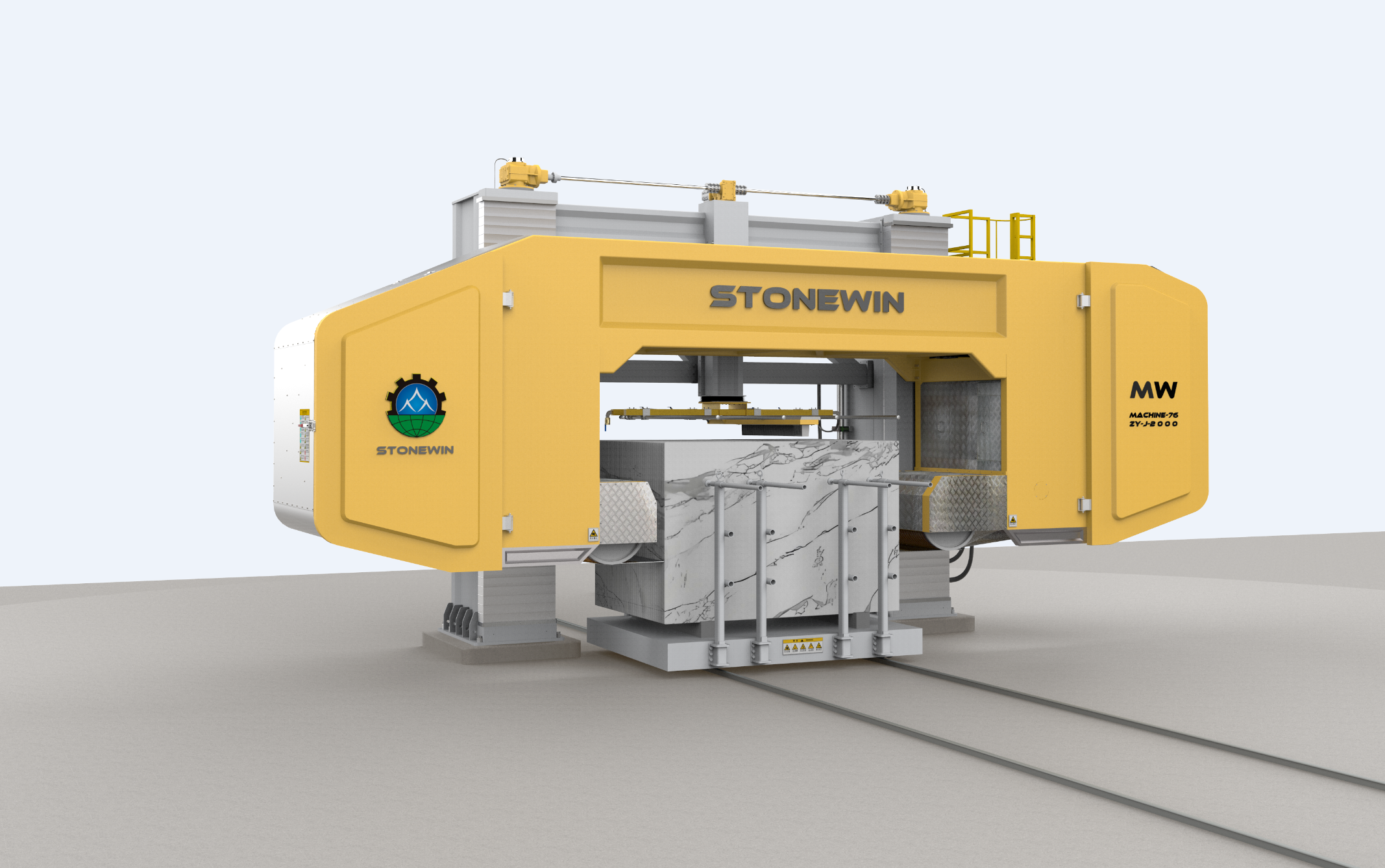
In a comparison exercise, the tension type should be treated as a layout and maintenance decision rather than a quality ranking. Buyers should ask which architecture applies to the specific model quoted, what clearance the chosen architecture requires around the machine, and whether the block loading direction in the existing workshop is compatible with it. The Stonewin specification also notes independent tensioning and an independent control system as part of the operating setup, which are the features that determine how a tension problem is diagnosed on site.
Layer 3 — Cutting envelope, installed weight and frame material
The third layer is physical. Three specifications decide whether a machine can be installed in a given plant at all, long before productivity is discussed.
Cutting size
The listed cutting size range for the Stonewin multi-wire saw machine is 3500 mm (L) × 2200 mm (H). For a buyer, that number should be checked against the tallest and longest blocks actually purchased, not against an ideal block. A machine sized to a nominal block dimension that the quarry rarely delivers, or rarely delivers in the required tolerance, is a configuration mismatch.
Machine weight
Machine weight across the series is stated as 22 to 80 tons. The figure belongs in the comparison table because it drives foundation design, lifting and rigging plans, floor loading in an existing building, and the sequence in which neighbouring equipment can be installed. Because the weight varies across the range, buyers should obtain the weight for the exact model quoted. Weight is not a proxy for build quality, and it should never be used to rank two machines without the corresponding model data.
Frame material
Stonewin specifies carbon steel for the main frame and alloy steel for key components. In a comparison framework, this is the point where repairability and long-term wear behaviour enter the evaluation: buyers should ask which components fall into the alloy steel group, whether those parts are stocked, and how they are replaced in the field. The answer is more useful than a general statement about build quality.
Layer 4 — Completing the comparison with polishing and resin capacity
The fourth layer is the one most often left out of a saw quotation: the saw is only the first stage, and a configuration that outruns the polishing and resin lines creates a bottleneck rather than capacity. Stonewin's specification set covers all three stages, which allows a buyer to compare a complete processing configuration instead of a single machine.
| Stage | Verified specification points | What the buyer must confirm |
|---|---|---|
| Multi-wire saw | Models ZY-MW5 to ZY-MW90; 5–90 wires; cutting size 3500 mm (L) × 2200 mm (H); weight 22–80 tons; carbon steel main frame, alloy steel key components; side-tension and top-tension types | Model-specific datasheet, tension type, installed weight, and foundation requirements |
| Diamond wire saw | Models ZY03, ZY04, ZY05, ZY06, ZY07, ZM12, ZG12, ZG13, ZC12, ZC10; diameter φ3.5–12 mm; diamond, steel wire and plastic construction | Wire diameter and model matched to the saw configuration and the stone type being cut |
| Polishing line | Models ZYSM210/12, ZYSM210/16, ZYSM210/18, ZYSM210/20, ZYSM210/22, ZYSM210/24; single-beam, two-beam and three-beam configurations; slab thickness 10–80 mm; slab width 1200–2200 mm; 15 kW motor per single polishing head | Whether polishing width and thickness range accept every slab the saw produces |
| Resin line | Model BJX-1; overall line dimensions 62 × 5 × 6.3 m; max. plate size 2 × 3.5 m; applicable plate thickness customized to customer requirements; total power 300 kW; curing time 90–120 min; curing temperature 80 °C | Floor space of 62 m line length, power supply for 300 kW total, and thickness settings for the slab mix |
The matching logic is straightforward and easy to test. A slab cut to the saw's 3500 mm × 2200 mm envelope has to fit within the polishing line's 1200–2200 mm width range and 10–80 mm thickness range, and within the resin line's maximum plate size of 2 × 3.5 m. Where the resin line's plate thickness is customized to customer requirements, that setting should be agreed at the configuration stage rather than after installation.
What the specifications mean on the plant floor
Beyond the four layers, the operating requirements decide how quickly a machine becomes productive. Stonewin's application data specifies that the machine requires a foundation, includes an independent control system and independent tensioning, supports automatic cutting, and allows remote viewing via the Internet of Things.
The same data defines the working envelope: temperatures between 5 °C and 40 °C, humidity not exceeding 50% at 40 °C and not exceeding 90% at 20 °C, and altitudes not exceeding 1000 metres. It also notes that the application requires certification for use in dust-exposed stone processing environments — a point buyers should resolve before shipping, because it affects documentation and site acceptance rather than operation after commissioning.
Where these configurations are used
The application profile for this equipment is large-scale open-pit stone quarrying projects and stone slab processing plants, where the machine's role is high-precision cutting of raw stone blocks into standard stone slabs. Stonewin lists this application as common in India, Turkey, Algeria, Bulgaria, Egypt, South Africa, Thailand, Cambodia, Iran, Yemen, Italy, Poland, Greece, Spain and Brazil, and its overall export footprint covers India, the Arabian Peninsula, the Middle East, Africa, Europe, South America and Southeast Asia, with export business accounting for 50% of total sales.
For a buyer in any of these markets, the comparison framework holds: the wire count band sets the configuration class, the tension type sets the layout, the cutting size and weight set the installation, and the polishing and resin specifications set the throughput ceiling.
Market trend: a larger category, a more granular decision
Two published data points explain why configuration-level comparison is becoming standard practice. Fortune Business Insights values the global stone processing machine market at USD 8.76 billion in 2025, and Dataintelo projects the diamond wire saw machine market to grow at a CAGR of 7.2% from 2026 to 2034. Custom Market Insights places the Asia-Pacific region at a 45% revenue share of the stone processing machine market in 2024.
Growth of that kind does not automatically simplify buying decisions. A larger installed base means more model variants in circulation, more second-hand and re-specified machines on the market, and more suppliers quoting overlapping specifications. The buyer's defence is the same at any market size: compare configurations on stated, model-specific facts rather than on category-level claims.
How this framework differs from traditional equipment buying
Traditional slab cutting buying compared single machines on one cutting action at a time; a multi-wire saw cuts with many wires simultaneously, which is precisely why wire count becomes a specification in the first place. That structural difference shifts the buyer's risk from "can this machine cut the block" to "does this configuration fit the plant" — foundation, rigging, power, dust certification and downstream capacity all at once.
The framework also has real limits that should be stated plainly.
It requires site-specific verification. The 22 to 80 ton weight range spans the series, so a foundation and lifting plan must be built from the weight of the exact model quoted, not from the range.
It is bounded by the working envelope. Sites outside 5–40 °C, humidity above 50% at 40 °C or 90% at 20 °C, or altitudes above 1000 metres fall outside the stated operating conditions and need review before configuration is fixed.
It cannot compare what is not documented. Where a supplier does not publish model-level weight, tension type or downstream matching data, the framework reduces to questions rather than a comparison — which is itself a useful result, because an undocumented configuration cannot be audited after delivery.
It does not rank stone types. The available specification set covers diamond wire diameters from φ3.5 to 12 mm and describes the equipment's role in slab processing, but it does not publish cutting-output figures per stone type. Buyers cutting granite or marble should request application evidence specific to their material rather than extrapolate from a general claim.
Future outlook
Three developments are visible in the current specification set rather than in forecasts. First, configuration granularity is increasing: a 14-model range from ZY-MW5 to ZY-MW90 with two tension architectures indicates that buyers are expected to specify rather than accept a default. Second, monitoring is moving into the base configuration — remote viewing via the Internet of Things is listed as part of the operating setup, which changes how service and troubleshooting are planned. Third, the evaluation is widening from a single machine to a line: saw, diamond wire, polishing line and resin line are now specified by a single manufacturer, which makes downstream matching a purchasable specification rather than a coordination problem.
For buyers at the research stage, the practical implication is to build the comparison table before requesting quotations, and to require model-level values in every column.
Frequently asked questions
What wire counts are available in a multi-wire saw machine range?
Stonewin lists its multi-wire saw machine across models ZY-MW5, ZY-MW10, ZY-MW16, ZY-MW20, ZY-MW36, ZY-MW42, ZY-MW58, ZY-MW64, ZY-MW72, ZY-MW76, ZY-MW82, ZY-MW86, ZY-MW88 and ZY-MW90, with a stated wire count range of 5 to 90 wires. The model designation indicates the configuration, for example ZY-MW72 for a 72-wire option and ZY-MW86 for an 86-wire option.
What is the difference between side-tension and top-tension multi-wire saw machines?
Stonewin lists the multi-wire saw machine as two types: side-tension multi-wire saw machines and top-tension multi-wire saw machines. The distinction concerns where the wire tensioning system is arranged relative to the cutting frame, which affects machine layout and access around the cutting zone. Buyers should confirm which architecture applies to the exact model quoted and what clearance it requires in the workshop.
What cutting size does a slab stone cutting machine configuration cover?
The stated cutting size range for the Stonewin multi-wire saw machine is 3500 mm (L) × 2200 mm (H). This figure should be compared against the block dimensions a plant actually purchases, since a machine sized to blocks that are rarely supplied in the required tolerance represents a configuration mismatch.
Why does machine weight matter when comparing slab stone cutting machine configurations?
Machine weight across the Stonewin multi-wire saw series is stated as 22 to 80 tons. The figure determines foundation design, lifting and rigging plans and floor loading, so the weight of the exact model must be obtained rather than the range. Weight varies by model and is not an indicator of build quality.
Do polishing line and resin line specifications need to match the saw configuration?
They do, because the saw sets the slab dimensions the downstream stages must accept. Stonewin's polishing line models ZYSM210/12 through ZYSM210/24 handle slab thickness of 10–80 mm and slab widths of 1200–2200 mm in single-beam, two-beam and three-beam configurations, with a 15 kW motor per single polishing head. The resin line model BJX-1 has a maximum plate size of 2 × 3.5 m, a total power of 300 kW, a curing time of 90–120 minutes and a curing temperature of 80 °C, with plate thickness customized to customer requirements.
What operating environment does the equipment require?
Stonewin's application data specifies operation at temperatures between 5 °C and 40 °C, humidity not exceeding 50% at 40 °C and not exceeding 90% at 20 °C, and altitudes not exceeding 1000 metres. The machine requires a foundation and includes an independent control system, independent tensioning, automatic cutting and remote viewing via the Internet of Things. The application also requires certification for use in dust-exposed stone processing environments.
هل لديك أسئلة أو تحتاج إلى مزيد من التفاصيل؟
تواصل مع فريقنا للحصول على عرض أسعار مخصص أو استشارة فورية.
طلب عرض أسعار
املأ النموذج أدناه وسيتواصل معك فريقنا بعرض مقترح مخصص.
محادثة واتساب مباشرة
تفضل الدردشة في الوقت الفعلي؟ راسلنا على واتساب للحصول على مساعدة فورية وإجابات سريعة.
- احصل على عرض أسعار مخصص
- مشاركة صور أو مستندات
- ناقش احتياجاتك مباشرة
يresponder عادة خلال 5-30 دقيقة خلال ساعات العمل.