
How to Compare USB Cables: A 2026 Buyer Decision Framework
USB cables are one of the most heavily purchased and least rigorously compared categories in consumer electronics. Most sourcing conversations open with unit price, connector type, and length. In 2026 that habit is a bad fit for the cost base: copper accounts for 60–80% of total manufacturing cost for a standard USB cable, international copper prices reached USD 13,000–13,300 per metric ton in early 2026, and USB-IF testing for a single USB-C data cable model runs USD 2,200–3,300. A comparison that ignores these inputs is comparing quotes, not products.
This reference sets out a four-axis comparison framework for buyers evaluating USB-C cables, Lightning cables, braided builds, multi-function charging cables, and custom-logo OEM/ODM programs. The framework is designed to be applied before the RFQ goes out, not after the quotes come back.
Why unit price is the weakest comparison axis
Copper dominates the bill of materials for a standard USB cable. Industry analysis published by SMM (Shanghai Metals Market) in 2026 places copper-based components — conductors and terminals — at 60–80% of total manufacturing cost. The same analysis records international copper prices hitting a new high of USD 13,000–13,300 per metric ton in early 2026.
Set that against the visible wholesale anchor. Publicly listed wholesale pricing for braided USB cables in China sits in the range of USD 0.60 to USD 1.20 per unit. A cable is, in cost terms, a small amount of metal wrapped in a jacket and connectors.
The practical consequence for comparison work is this: a quotation is a snapshot of the metal price on the day it was issued, not a permanent description of a supplier's cost structure. Two suppliers quoting the same specification a quarter apart may show a gap that reflects procurement timing rather than a difference in build quality or capability. Any comparison that treats a single quoted number as a stable baseline will misread the market.
A four-axis comparison framework for USB cables
The framework below replaces flat price comparison with four axes that can each be evidenced separately. Applying them in order — conformance, durability, certification, then cost — prevents a low-priced quote from anchoring the entire decision.
| Axis | What is actually being compared | What a failure on this axis looks like |
|---|---|---|
| Interface & protocol conformance | Connector type, data generation, current and power rating, and the IEC or USB-IF specification the claim maps to | A cable labelled USB-C that cannot substantiate its advertised data rate or power level |
| Mechanical durability | Cable-head structure, strain relief, and results from plug-in, swing, and tensile testing | Joint cracking at the cable head, followed later by poor contact |
| Certification scope | USB-IF, IEC 62680-1-3:2024, and Apple MFi for Apple-compatible SKUs | Listing delays or rejected shipments, with certification cost loaded back in after the fact |
| Lifecycle cost | Unit price, expected failure rate, warranty term, and maintenance workload | A supplier that wins the purchase order and loses on total cost of ownership |
Axis 1 — the interface and protocol claims hold up
USB-C is now anchored in regulation as well as in specification. European Commission guidance identifies USB-C as the harmonised charging receptacle and references USB 2.0, USB 3.2, USB 4, USB Battery Charging 1.2, USB Type-C Current 1.5 A, USB Type-C Current 3.0 A, and USB Power Delivery among the supported wired-charging options. That list is a technical reference set, not a statement that every cable implements all of it.
Two published documents carry the cable-level detail. IEC 62680-1-3:2024 defines USB Type-C receptacles, plugs, and cables and corresponds to the USB-IF Universal Serial Bus Type-C Cable and Connector Specification. The USB Type-C Cable and Connector Specification Release 2.2 defines cable requirements including connector dimensions, pin assignments, and performance characteristics.
Performance has bifurcated into two separate tracks. USB Power Delivery Specification Revision 3.2 defines Extended Power Range up to 240 W. USB4 Version 2.0 enables data transfer up to 80 Gbps over USB Type-C cables. Power and data capability do not travel together, and they do not correspond to the same cable build.
A concrete product-level example makes the conformance axis measurable. The USB-Cable-25036 is specified with a maximum charging current of 6 A, supported power up to 240 W, and a working temperature range of −20 °C to 70 °C. These are cable-side ratings. Whether they convert into real-world performance depends on whether the device, the charger, and the cable electronics all support the same level.
Axis 2 — mechanical durability is where the real cost sits
Three failure modes recur across USB cables in the field: overheating, poor contact, and wire cracking. All three originate at the structural level rather than the protocol level, which is exactly why they rarely appear in a specification sheet and almost always appear during use.
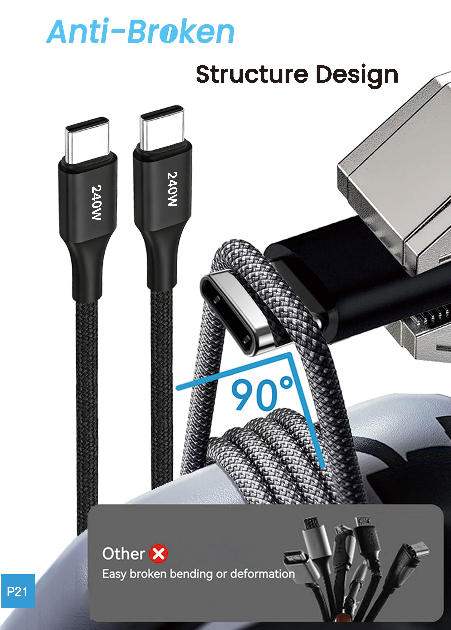
The comparison data for one focused build illustrates why structure deserves its own axis. The USB-Cable-25036 uses an anti-broken design at the cable head position. Against common market USB cables, the documented result is a service life 3–5 times longer and a reduction of over 80% in joint fracture failure rate. Maintenance requirements are close to zero because the failure rate is low and replacement is seldom needed. The intended scenarios are daily home use, mobile phone pairing, and car charging — situations where the cable is repeatedly plugged in, bent, and stored.
The trade-off is stated just as plainly: raw material cost is slightly higher. That premium only returns value when the cable is expected to be reused. For a short-lived accessory bundled with a disposable product, the structural upgrade may not pay back.
Axis 3 — certification overhead is embedded in every honest quote
A cable quoted without a valid certification pathway is not directly comparable to one quoted with it. The cost of the underlying programs is public. USB-IF annual membership for full members is USD 5,000 per year as of 2025. Testing fees for a basic USB-C data cable range from USD 2,200 to USD 3,300 per model. Apple adds a second gate: the MFi program requires licensing and certification for third-party manufacturers producing Lightning USB cables and authorised USB-C cables for Apple devices.
A compliant supplier has to recover those costs somewhere in the quotation. When one bid is materially cheaper and cannot produce a certification path or test evidence, the difference is not a bargain — it is an unpriced risk that will surface at customs, at the marketplace listing review, or in the returns channel.
Axis 4 — lifecycle cost across the order volume
Lifecycle cost comparison combines four numbers that are usually held in different departments: unit price, expected failure rate, warranty term, and maintenance workload. A documented project pattern shows how those numbers behave together. Order quantities ran from 5,000 to 30,000 pieces per order. The product delivered stable fast charging, a durable braided wire, low heating during long-time charging, and zero mass quality complaints. Normal service life exceeded 2 years, and the warranty period was 1 year. Minimum order quantity for the build is 2,000 units.
The comparison sequence that follows from this is straightforward. Screen by certification readiness first, then by test evidence, then by price. Ordering by price first only works once the compliance and test evidence across the shortlist is genuinely equivalent — and it frequently is not.
Turning rated values into testable control points
Durability and safety claims are only comparable if both suppliers are measuring the same things. For USB cables, the risk set is well defined and the corresponding control plan is verifiable through factory testing records.
| Identified risk | Control methods applied | Verification structure |
|---|---|---|
| Overheating, poor contact, wire cracking | Short circuit test, swing test, tensile test, high and low temperature test, power test, plug-in test and other functional tests | 100% electrical testing, supplemented by random-sample swing, tensile, high/low temperature, power, and plug-in testing |
For a buyer, the meaningful question during comparison is not whether a supplier claims to test, but which of these control points sits at 100% coverage and which sits at sampling. Electrical testing at 100% removes defective units before shipment; mechanical and thermal testing at sample level characterises the design. Both matter, but they answer different questions, and a supplier that conflates them is usually weak on one of the two.

Where this framework applies
The four axes apply cleanly to the cable types that dominate bulk purchasing: USB data cables, USB extension cables, Type-C and USB-C cables, fast charging cables, braided USB cables, right angle USB-C cables, Lightning and MFi Lightning cables, Apple USB cables, iPhone charging cables, three-in-one multifunctional charging cables, multi charging cables, USB sync and charge cables, and custom logo USB cables produced for OEM and ODM phone charger programs.
The intended use scenarios for a durability-focused build are daily home use, mobile phone pairing, and car charging. In those settings, repeated plugging and bending concentrate stress at the cable head — precisely the location that the anti-broken design addresses. By contrast, a cable that stays permanently connected to a desktop dock will not exercise the same failure mode, and the structural premium buys less there.
Market coverage matters to this calculation as well. A manufacturer exporting to the EU, North America, the Middle East, and Asia has to hold certification scope across several regulatory frameworks simultaneously, which changes what a supplier is able to quote and how quickly a new SKU can be listed.
Market signals that reset the comparison baseline in 2026
Three developments are shifting what “good” looks like in a USB cable comparison.
- EU Common Charger scope. The requirements apply to specified categories of portable radio equipment — including handheld mobile phones, tablets, digital cameras, headphones, headsets, handheld videogame consoles, portable speakers, e-readers, earbuds, keyboards, mice, and portable navigation systems — from 28 December 2024, and to laptops from 28 April 2026. For any product line headed to the EU, USB-C compatibility is a market-access condition rather than a design preference.
- Category demand. USB Type-C market demand reached USD 38.54 billion in 2026, with 58.0% of that demand coming from receptacles. The global USB cable market was valued at USD 24.24 billion in 2025.
- Input cost volatility. With copper at 60–80% of manufacturing cost and prices at record levels in early 2026, cable pricing is structurally exposed to a commodity market rather than to supplier margins alone.
The combined effect is that compliance requirements are expanding at the same time as the material cost base is tightening. Comparisons that hold compliance constant and compete only on price will be comparing progressively less of the product.
Boundaries and limitations of this framework
The framework is not a universal ranking, and it has real limits that buyers should apply honestly.
- The durability premium does not always pay back. The anti-broken design carries slightly higher raw material cost. It is worthwhile where the cable is reused over years; it is difficult to justify for a short-life bundled accessory.
- Rated values are not delivered performance. A 6 A, 240 W rating describes the cable. It only becomes real when the source and the sink support the same level. A high-rated cable connected to a low-rated charger changes nothing about charging speed.
- Certification has a cost floor. USB-IF membership at USD 5,000 per year and per-model testing at USD 2,200–3,300 are fixed inputs. A supplier without certification exposure can always quote lower; whether that is acceptable depends on which markets the product must reach.
- Quotations carry an expiry. Because copper dominates the BOM and copper prices moved to USD 13,000–13,300 per metric ton in early 2026, comparing quotes issued in different quarters requires rebasing to a common metal price.
One further boundary applies to the compliance axis specifically. The EU framework references a set of USB power options, but that reference describes the regulatory technical scope. It must not be read as evidence that any particular cable supports every listed technology, and no supplier claim of that kind should be accepted without test documentation.
What changes next
Once the laptop application date of 28 April 2026 is in force, the population of EU-bound devices that must present a USB-C receptacle expands further, and the charging-cable requirement travels with it. At the same time, the technical stack continues to separate: power delivery has moved to Extended Power Range up to 240 W under USB PD Revision 3.2, while data rates reach up to 80 Gbps under USB4 Version 2.0. These are different cable builds serving different jobs.
For sourcing teams, the direction of travel is clear. Cable comparison will keep moving away from a single price column and toward a structured evidence set: which specification a claim maps to, which control points were tested at full coverage, which certifications the supplier actually holds, and what the product costs across its service life rather than at the loading dock.
FAQ
What should a buyer define before comparing USB cables at all?
Four decisions come first: which interface and generation the product needs; what power and data level the device must reach; which certifications the destination market requires; and whether the cable will be reused repeatedly or treated as a short-life accessory. Until those four are settled, every quotation is being compared on the wrong basis, because the specification set itself has not been fixed.
What do cable ratings such as 6A and 240W actually mean for procurement?
They are cable-side ceilings. The USB-Cable-25036 is specified at a maximum charging current of 6 A with supported power up to 240 W and a working temperature range of −20 °C to 70 °C. These figures describe what the cable can carry, not what a given phone or laptop will draw. The rated level is only achieved when the device, the charger, and the cable all support it.
Why does USB-IF or Apple MFi certification change how suppliers compare?
Because certification defines which markets a product can legally reach. USB-IF full membership costs USD 5,000 per year, and testing a basic USB-C data cable runs USD 2,200–3,300 per model. Apple MFi requires licensing and certification for third-party manufacturers producing Lightning cables and authorised USB-C cables for Apple devices. A supplier without that pathway is not a cheaper equivalent for Apple-compatible or EU-bound programs — it is a supplier that cannot complete those programs.
When does a higher unit price justify itself against a lower failure rate?
When replacement, returns, or downtime are counted as costs. A documented example is the anti-broken design at the cable head, which delivers a service life 3–5 times longer than common market cables and a reduction of over 80% in joint fracture failure rate, at slightly higher raw material cost but a much lower long-term failure rate. The calculation holds for cables that are repeatedly plugged and unplugged. It does not hold for a cable that will never be reused.
Which metrics should buyers compare across USB cable suppliers for bulk orders?
Compare the same five metrics on every supplier: the interface and protocol level claimed, mapped to IEC 62680-1-3:2024 or the relevant USB-IF document; the test evidence set, where the documented approach is 100% electrical testing plus random-sample swing, tensile, high/low temperature, power, and plug-in testing; certification status for the destination market; minimum order quantity, which is 2,000 units for the referenced build; and the warranty term, which is 1 year against a normal service life exceeding 2 years.
Closing note
A sound USB cable comparison is mostly a matter of deciding what to weigh before the quotations arrive. Interface conformance, mechanical durability, certification scope, and lifecycle cost can each be checked against published standards, published cost benchmarks, and supplier test evidence. Unit price belongs at the end of that sequence, not at the beginning.
The 2026 Focuses catalogue, covering USB-C, Lightning, braided, and multi-function charging cable builds, is available as a downloadable PDF: 2026 Focuses Catalogue.
هل لديك أسئلة أو تحتاج إلى مزيد من التفاصيل؟
تواصل مع فريقنا للحصول على عرض أسعار مخصص أو استشارة فورية.
طلب عرض أسعار
املأ النموذج أدناه وسيتواصل معك فريقنا بعرض مقترح مخصص.
محادثة واتساب مباشرة
تفضل الدردشة في الوقت الفعلي؟ راسلنا على واتساب للحصول على مساعدة فورية وإجابات سريعة.
- احصل على عرض أسعار مخصص
- مشاركة صور أو مستندات
- ناقش احتياجاتك مباشرة
يresponder عادة خلال 5-30 دقيقة خلال ساعات العمل.