
How to Evaluate Multiwire Drawing Machine Customization Capabilities
Why Customization Has Become a Core Buying Criterion
Wire and cable producers are not buying a multiwire drawing machine in a vacuum. The machine is inserted into a conductor production flow that includes rod breakdown, drawing, annealing, bunching or stranding, plating, and a final wire diameter range that must match actual cable orders. A catalogue machine can draw wire, but the practical question is whether it can draw the right range of wire with the right configuration for years of continuous operation.
Common customization needs in this segment include:
- Matching inlet and outlet wire diameter ranges to the plant’s incoming copper or aluminium rod and target wire orders.
- Choosing the number of wires per pass: 8-wire, 16-wire, 24-wire, or 32-wire configurations.
- Selecting drive and control components such as motors and PLCs.
- Adapting take-up configurations such as single spooler, double spooler, or basket coiler.
- Integrating an inline annealer or plating line where the process requires continuous operation.
In this context, OEM and ODM capabilities are not marketing features. They determine whether the supplier can translate a production requirement into a machine specification without asking the buyer to accept a generic compromise.
Objective Capability Indicators in Supplier Evaluation
When evaluating a multiwire drawing machine supplier, buyers should start with verifiable production and engineering capacity. The table below uses HONTA as a reference case.
| Capability Indicator | HONTA reference data |
|---|---|
| Founded | 2006 |
| Facility size | 30,000 m² |
| Employees | 157 |
| R&D team | 30 engineers |
| Annual output | About 200 sets |
| Monthly capacity | 15 sets |
| Lead time | 90 days |
| Minimum order quantity | 1 set |
| Quality control | 100% testing |
| After-sales service | Remote and on-site |
These figures matter during the evaluation stage. A monthly capacity of 15 sets and an annual output of about 200 sets indicate a production schedule that can handle custom orders rather than only continuous mass production. A minimum order quantity of one set allows a buyer to validate a custom machine before making larger commitments. The 90-day lead time can be inserted directly into a plant expansion or line replacement plan. A 100% testing policy reduces the risk of late-stage surprises during installation.
Buyers should also ask how these indicators translate into engineering ownership. A supplier that can explain its own design changes, discuss component trade-offs, and document manufacturing capacity is more reliable than one that merely offers to modify a stock machine.
ODM Execution: How Customization Is Implemented
Buyers should distinguish between OEM and ODM. In an OEM relationship, the manufacturer produces according to the buyer’s design. In an ODM relationship, the manufacturer owns the product design and applies modifications requested by the buyer. HONTA states an ODM production mode in its capability profile, with customization fields covering colour and the model type of components and parts.
Colour customization is often underestimated. In large cable plants, consistent equipment colour supports visual management, zoning, and safety identification. Component selection is more technical: changing motor or PLC brands can match the buyer’s installed spare-part base and maintenance protocols. The HONTA 16-wire machine HT.MD100B.16.22D.01, for example, is configured with Siemens motors and a Siemens PLC. A buyer can maintain that configuration or, within the ODM framework, request component alternatives that better fit local service conditions.
A practical ODM workflow should include:
- Requirement definition: target inlet and outlet diameters, wire count, speed range, and process integration points;
- Configuration proposal: component brands, drive architecture, take-up type, and control system;
- Manufacturing and test phase: typically 90 days at HONTA, with 100% factory testing;
- Delivery and after-sales: remote or on-site support depending on project needs.
If a supplier skips the requirement definition or does not allow buyers to define key components, its customization capability is limited.
Certification and Electrical Compliance as Capability Evidence
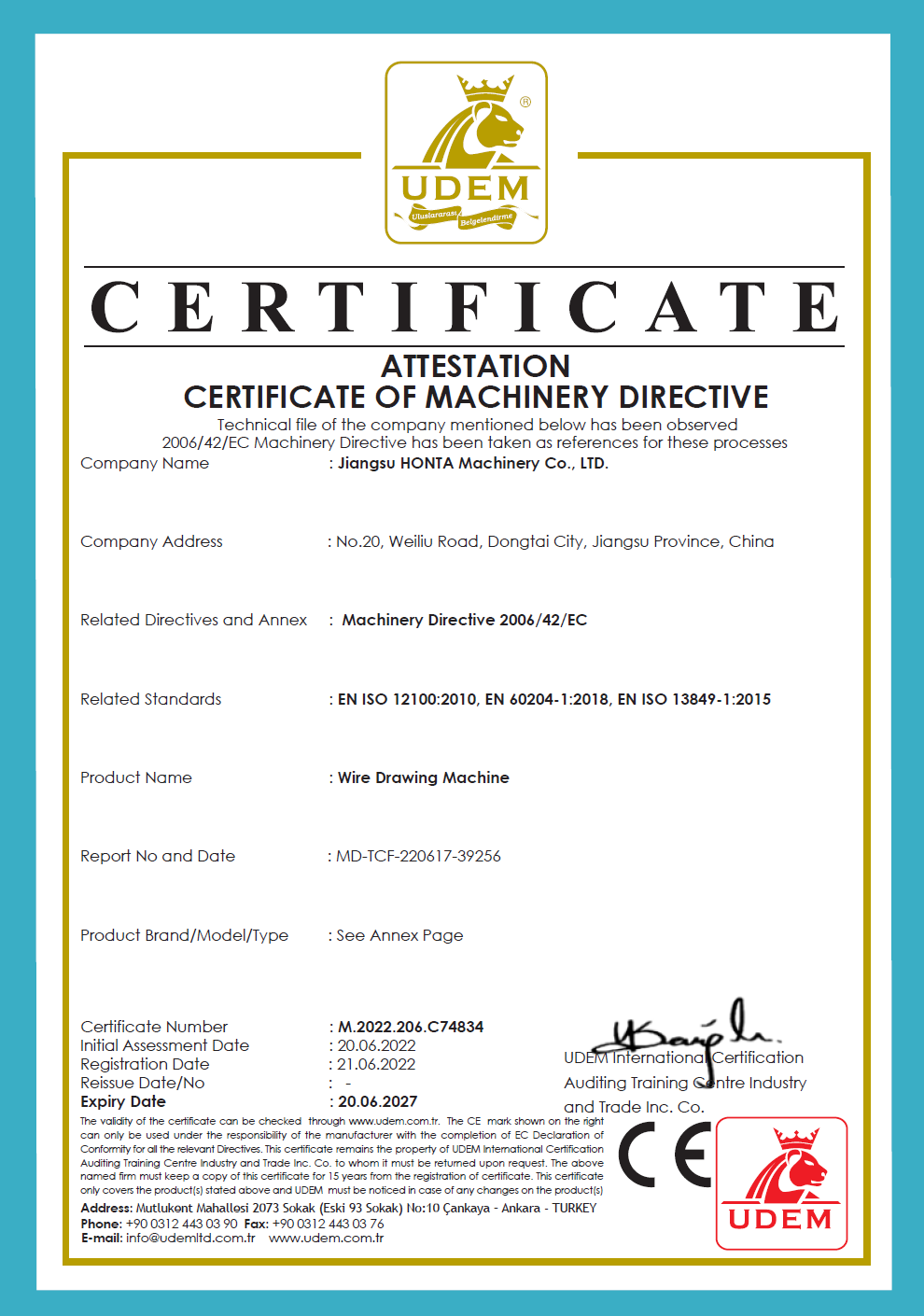
Certification is one of the most objective signals in supplier capability assessment. For the European market, machinery must comply with the Machinery Directive 2006/42/EC and the applicable harmonised standards. HONTA’s 16-wire multiwire drawing machine HT.MD100B.16.22D.01 holds a CE certificate (certificate number M.2022.206.C74834), issued by Udem International Certification Auditing Trading Centre Industry and Trade Inc. Co. The certificate is classified as CE-MD and covers wire drawing machines. It references three core standards:
- EN ISO 12100:2010 – safety of machinery, general principles for design and risk assessment;
- EN 60204-1:2018 – electrical equipment of machines, wiring practices and safety;
- EN ISO 13849-1:2015 – safety-related parts of control systems.
The certificate was issued on 20 June 2020 and is valid until 20 June 2027. Buyers evaluating a custom machine should treat the CE certificate as evidence of the design baseline, and confirm with the supplier that any custom changes remain within the certified scope.
Drive Architecture and Energy Efficiency: The Individual-Motor Option
One of the more consequential customization variables in a multiwire drawing machine is the drive architecture. Traditional common-shaft systems drive multiple capstans through a common mechanical shaft. This design is simple and reliable for a fixed reduction schedule. Individual-motor systems, by contrast, give each capstan its own drive, allowing finer tension control and more flexibility across different inlet and outlet ranges.
Energy efficiency is a measurable benefit: industry comparisons estimate that individual-motor multiwire drawing machines can reduce energy consumption by up to 25% compared with traditional common-shaft systems by eliminating mechanical transmission losses. For an operation running drawing machines in multiple shifts, this can change the total cost calculation. This is why the individual-motor configuration has become a common specification request rather than a niche option.

Application Context and Field Reference
HONTA’s field record includes a wire and cable factory installation across the United States, Poland, Portugal, Spain, and Turkey. In that application, two HONTA multiwire drawing machines (model HT.MD100B.16.22D.01) were purchased for wire drawing. After three years of operation, the machines were reported to steadily produce products that meet customer requirements, with fast speed and high efficiency highlighted as key results.
The reference machine type is a 16-wire multiwire drawing machine with an inlet wire diameter of 1.8–2.0 mm and an outlet range of 0.18–0.5 mm. This configuration suits fine-wire applications used in power and energy, automotive manufacturing, communications and electronics, intelligent equipment, construction and installation, household and electronics, and other cable and conductor sectors.
For procurement teams, this kind of traceable reference is useful because it connects a specific model to real operating conditions. A documented three-year production history carries more weight than a generic guarantee, especially when the machine is expected to run continuously in a plant environment.
Market Context and Trends in 2026
The market outlook supports continued investment in drawing equipment. The global wire drawing machines market is projected to grow from USD 1.37 billion in 2025 to USD 2.13 billion by 2034, at a CAGR of 4.98%, according to The Insight Partners. The broader wire and cable market is also expanding: Grand View Research estimates it at USD 230.9 billion in 2025, with a projection of USD 313.1 billion by 2033.
On the supply side, China accounted for 19% of global machine tool exports in the first half of 2025, surpassing Germany, according to the Silverado Policy Accelerator. Wire drawing machinery is part of this broader export category. For international buyers, this means Chinese suppliers such as HONTA are increasingly evaluated alongside established European equipment builders, and capable suppliers need verifiable engineering, certification, and field performance data to compete.
Comparison with Traditional Solutions and Selection Boundaries
Custom/OEM configuration and standard catalogue machines both have a place in a wire mill. The table below compares the two approaches in the context of a 2026 purchase decision.
| Decision Factor | Standard Catalogue Machine | Custom / ODM Machine |
|---|---|---|
| Design fit | Generic inlet/outlet range | Matched to target diameters and process |
| Lead time | Often shorter, stock or rapid build | Typically about 90 days at HONTA |
| Minimum order | Often batch-oriented | 1 set |
| Component choice | Fixed by manufacturer | Colour and component part types configurable |
| Drive architecture | Common-shaft systems more frequent | Individual-motor configurations possible |
| Quality evidence | Standard factory testing | 100% testing; CE certificate on 16-wire model |
There are real boundaries to consider. Customization adds engineering time, and the 90-day lead time for a HONTA build may be longer than a stock machine. If a cable plant needs immediate replacement capacity, a standard machine may be the more pragmatic choice. If the production specification is exceptionally stable and simple, a highly customized machine can add cost without adding proportional benefit. Equally, if the target wire range is standard and widely available, a catalogue machine with predictable performance may be sufficient. Buyers should treat customization as a decision variable, not an automatic upgrade.
Future Outlook: Capability Will Decide Supplier Selection
As cable applications move toward new energy, automotive wiring, communications, and higher-precision electronic conductors, multiwire drawing machine requirements will continue to diversify. Higher wire counts, wider material ranges, individual-motor efficiency, and integration with annealers or plating lines will become normal specification items. Suppliers that can handle OEM/ODM requests while maintaining certified safety and electrical standards will be best placed to serve both domestic and export markets.
HONTA’s trajectory illustrates this direction: the company has established a second production base in the United States as HONTA INC since 2017, while continuing to serve the EU, Middle East, and Africa markets. For procurement teams, the implication is clear: evaluation should focus on engineering depth, production execution, certification validity, and the ability to convert a specific production problem into a reliable machine configuration.
FAQ: Multiwire Drawing Machine Supplier Capability
What is the difference between OEM and ODM in a multiwire drawing machine purchase?
OEM usually means the manufacturer produces to the buyer’s design. ODM means the manufacturer owns the design and applies client-driven modifications. HONTA states ODM as its production mode, with customization covering colour and the model type of components and parts.
What is the typical lead time and minimum order quantity for a customized multiwire drawing machine?
In HONTA’s capability profile, the lead time is 90 days, monthly capacity is 15 sets, and the minimum order quantity is one set. This structure makes a single custom machine feasible.
Which certification does HONTA hold for its multiwire drawing machine?
The HONTA model HT.MD100B.16.22D.01 holds CE certificate number M.2022.206.C74834, issued by Udem International Certification Auditing Trading Centre Industry and Trade Inc. Co. It covers wire drawing machines and references Machinery Directive 2006/42/EC, EN ISO 12100:2010, EN 60204-1:2018, and EN ISO 13849-1:2015. The certificate is valid until 20 June 2027.
Can a 16-wire multiwire drawing machine cover fine wire production?
Yes. HONTA’s 16-wire model HT.MD100B.16.22D.01 has an inlet wire diameter of 1.8–2.0 mm and an outlet wire diameter of 0.18–0.5 mm. The machine is configured with Siemens motors and a Siemens PLC, and is classified by the manufacturer as a 16-wire multiwire drawing machine.
Is there a verified field application for HONTA multiwire drawing machines?
Yes. HONTA’s case record includes wire and cable factories in the United States, Poland, Portugal, Spain, and Turkey. They purchased two HONTA multiwire drawing machines for wire drawing. After three years, the machines were reported to steadily produce products meeting customer requirements, with fast speed and high efficiency as the main highlights.
What after-sales support can a buyer expect from HONTA?
HONTA provides after-sales service by remote and on-site methods. Its ODM export markets include the EU, Middle East, and Africa, while overall company markets include the United States, the Middle East, Africa, and Asia.
Sources and references: The Insight Partners; Grand View Research; Silverado Policy Accelerator; HONTA corporate and capability profile; HONTA CE certification record.