
How to Evaluate a China T-Shirt Manufacturer for OEM and Private Label Work
A t-shirt manufacturing partnership is judged by execution, not by promises. For brands at the evaluation or execution stage, the practical question is how much of the production chain a supplier actually controls. A one-stop custom T-shirt manufacturer is expected to manage fabric sourcing, pattern development, cutting, sewing, decoration, finishing and packaging under one roof. Guangzhou Qianshi Apparel Co., Ltd, known as Qianshiwear, provides a documented example of this capability model.
Why capability review matters before sourcing T-shirts in China
International buyers searching for a China t-shirt manufacturer encounter vendors that range from trading agents and printing workshops to vertically integrated garment factories. The challenge is not supplier quantity but supplier verification. An order moved into production too early can fail because of vague fabric specifications, unclear decoration methods, or an unplanned compliance requirement.
China's position in the textile supply chain remains significant. According to the Observatory of Economic Complexity, China's total textile exports reached USD 268 billion in 2024. Industry mapping for apparel clusters commonly points to Guangdong and Zhejiang: Guangzhou and Dongguan are associated with fast fashion and streetwear, while Ningbo is known for premium knitwear. For a brand evaluating manufacturers, geography is less important than what the supplier controls in-house.
Demand for customized T-shirts is also expanding. Grand View Research estimates the custom t-shirt printing market at USD 5.46 billion in 2024 and projects it to reach USD 9.82 billion by 2030, a CAGR of about 11.5 percent. This creates a commercial opportunity for brands that can move from an idea to a finished program with a reliable manufacturing partner.
Qianshiwear as a capability reference
Guangzhou Qianshi Apparel Co., Ltd is a professional apparel manufacturer and trading company based in Guangzhou, Guangdong. The company, commonly referred to as Qianshiwear, supplies T-shirts, hoodies, sweatshirts, sweatpants, joggers, tracksuits, polos, jerseys, jeans, caps and outerwear. Its stated background includes over 20 years in fabric weaving and more than 15 years in garment production.
The production structure is designed to cover more than one process. Factory areas include 600 sqm of sewing space, 700 sqm of warehouse space, 1500 sqm of finishing space and 200 sqm of packing space. The team includes 200 to 250 production-line workers, quality control staff and pattern makers, while commercial and design support includes sales representatives, order coordinators and 15 designers. Annual output is stated at 3,000,000 units, with monthly capacity of 250,000 units.
Qianshiwear exports 85 to 90 percent of production. Documented export markets include the United States, the United Kingdom, Canada, Australia, Germany, France, the Netherlands, Sweden, Japan, South Korea and the United Arab Emirates. This export mix is relevant to buyers because it implies familiarity with international size, labeling and shipping expectations.
Production service modes
The manufacturer offers OEM, ODM, Full Custom Manufacturing and Private Label Production. For a brand, these service modes answer different questions. OEM is suitable when the brand has a detailed specification; ODM is useful when design support is needed; full custom manufacturing usually means the garment is developed from fabric and pattern, not from an existing blank; private label production adds branded neck labels, hang tags and packaging.
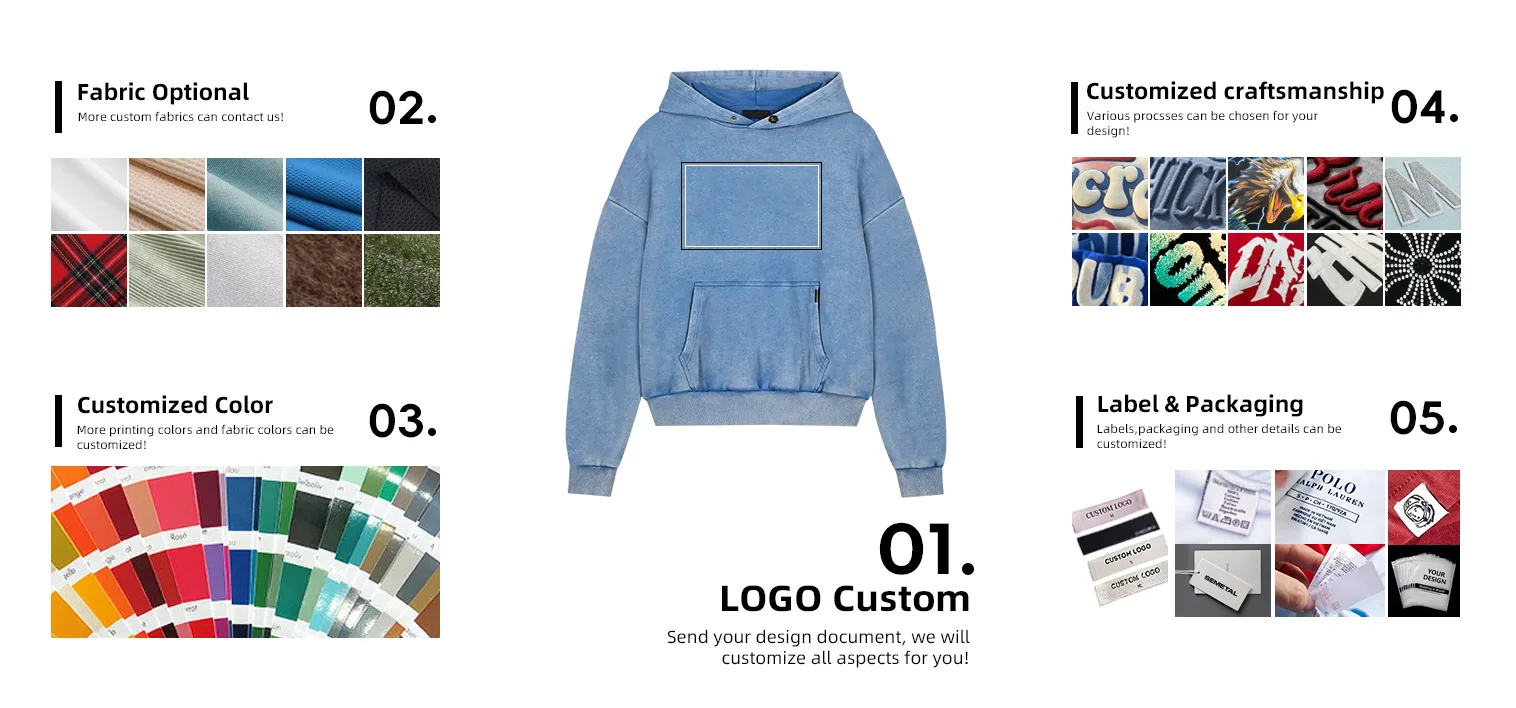
Customization options in the company's capability list are broad: garment style, fabric type and weight, Pantone color matching, logo application, garment washing, custom neck labels and hang tags, packaging design, size grading and hardware. Buyers do not need to treat every listed option as an extra; they should identify which options are critical to their product story.
Technical capabilities that define a custom T-shirt program
The first test of a t-shirt manufacturing company is whether it can work beyond standard stock. The custom blank T-shirt program RTS001 includes style options such as crewneck, v-neck, oversized, long-sleeve, polo and drop-shoulder. Fabric weights are grouped from 160 to 220 GSM for lightweight and 220 to 300 GSM for mid-weight, with materials including 100% combed cotton, cotton-polyester blends, 100% polyester, organic cotton, slub cotton and pique. Size grading from XS to XXL and Pantone color matching are available.
For a buyer, specifying only cotton is insufficient. Fabric composition, GSM and finish should be explicit. A streetwear collection will typically require heavyweight cotton or French terry; an event T-shirt may work with a lighter jersey. Disciplined manufacturers explain these trade-offs early.
Decoration and finishing
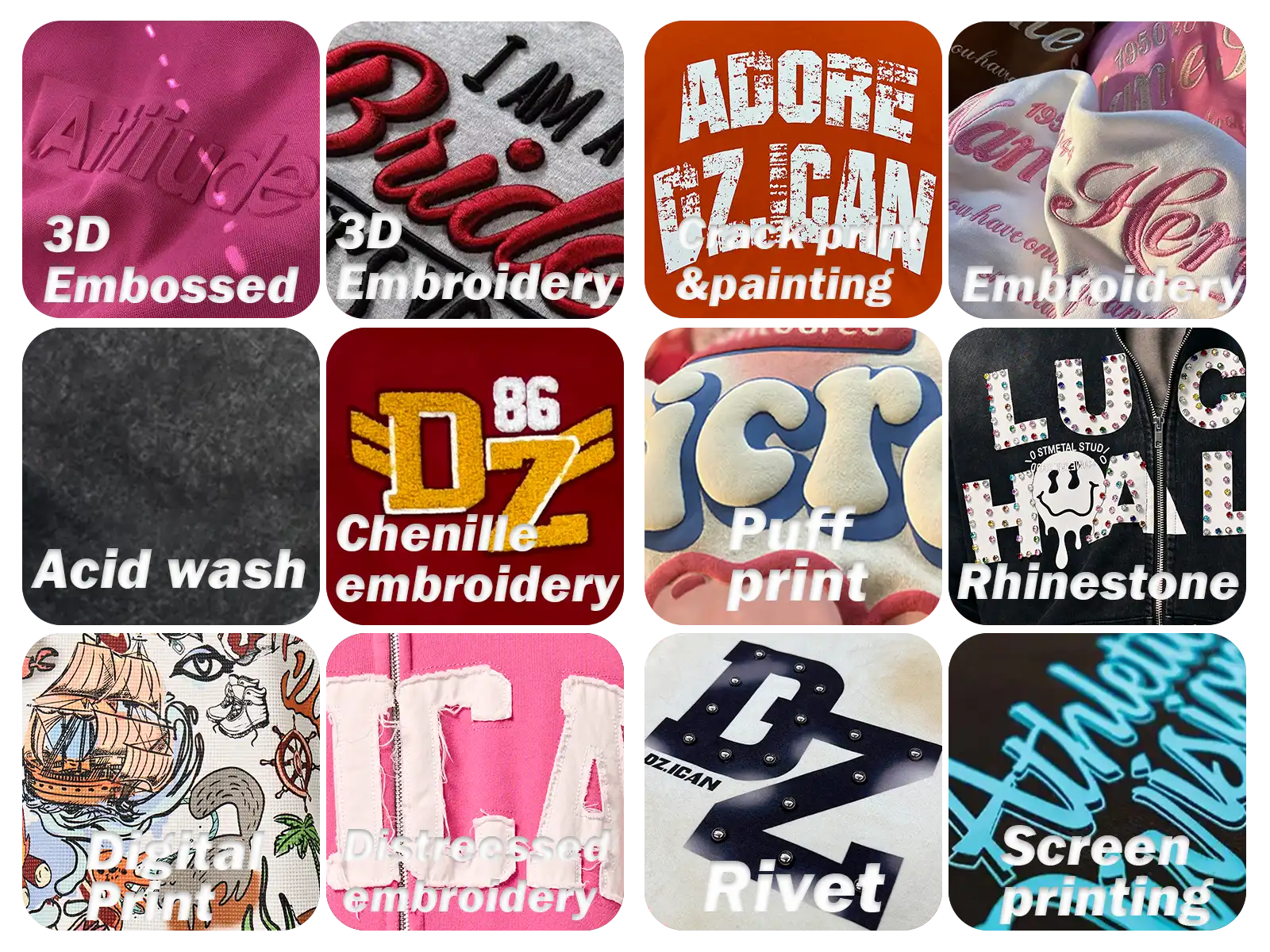
Decoration capability usually separates a printing vendor from a full t-shirt manufacturer. In Qianshiwear's production line, buyers can choose screen printing, DTG, sublimation, heat transfer, puff print and embroidery, including flat embroidery, 3D puff embroidery and chenille. Wash options, such as pigment dye, enzyme wash, snow wash and vintage wash, change the surface character of the garment. Custom neck labels and hang tags complete the brand presentation.
All decoration techniques have constraints. Screen printing is efficient for consistent color blocks; DTG works better for detailed designs; puff and embroidery create texture but may require placement testing. A capable supplier should confirm print placement, color fastness and wash behavior before bulk production.
Compliance information buyers should request
Compliance is not only a legal issue; it is also a supplier selection signal. A manufacturer with documented quality and testing records can reduce the work a buyer must do before entering a new market.
| Document | Reference | What it indicates |
|---|---|---|
| ISO 9001 | 51825Q10787R0 | Quality management system covering process control and continuous improvement. |
| BSCI | 156-065504-000 | Social compliance audit report addressing labor conditions, working hours and occupational health. |
| AZO dye test | TST20240903560-6EN | Testing for carcinogenic aromatic amines released by azo dyes in textiles. |
| RoHS / CE | NAP25090679C01E | Applies only to smart or electronic apparel, such as heated or LED-embedded garments. |
For buyers planning an organic cotton T-shirt line, the Global Organic Textile Standard is a useful benchmark: products with an organic claim must contain at least 95 percent certified organic fibers. In Europe, the General Product Safety Regulation also shapes the documentation needed for apparel placed on the EU market.
From evaluation to execution: ordering conditions that matter
At the execution stage, minimum order quantity, lead time, payment structure and inspection policy shape the relationship. Qianshiwear's stated MOQ is 50 pieces per color per design. That is low enough to test a range of styles but high enough to ensure production supervision. Sample production takes 7 to 15 working days; bulk production takes 20 to 35 working days. Payment for samples is generally 100 percent upfront; bulk orders are typically 50 percent deposit and 50 percent before shipment.
Quality control should not be a surprise. Qianshiwear reports 100 percent pre-shipment inspection, with photo and video reports available on request. Buyers can arrange third-party inspection by SGS or similar at the buyer's cost, and on-site inspection is welcomed for bulk orders. Logistics can be negotiated as EXW, FOB, CIF and DDP. Payment is accepted via bank T/T, Alibaba Trade Assurance, Alipay and WeChat Pay where relevant.
Low MOQ is sometimes framed only as startup support. In practice, a small initial quantity can reduce risk for any new drop, while a manufacturer's larger capacity supports scale after validation.
Application patterns across buyer types
Qianshiwear's documented cases show capability used in different purchase contexts instead of a single order profile.
| Buyer profile | Markets | Scale or duration | Operational evidence |
|---|---|---|---|
| Established streetwear brand and multi-store retailer | US, UK, France, Australia, Germany | 7,000 pieces per quarter; 28,000 pieces annually; 3 years with quarterly reorders | 100% on-time delivery across 12+ drops; 90% reorder rate season-over-season; 98% sell-through on core styles; zero major quality claims in 3 years |
| Music artist management and tour merchandise agency | US, Canada, UK, Australia, France | 5,000 pieces across 12 tour stops; 6-month tour duration | 92% sell-through rate; 4 reorders during tour; 100% QC pass rate for rush orders |
| International tech company and corporate group | UK, Germany | 3,500 pieces across 3 regions; 2-year annual contract | 98% employee satisfaction; no quality complaints after 100+ washes per garment; 100% on-time delivery |
| Startup streetwear brand and DTC label | US, Canada | 100 pieces initial order; 1,000 pieces reorder | 95% sell-through within 2 months; 85% positive customer reviews; 2 reorders within 12 months |
The cases cross streetwear retail, music merchandise, corporate uniforms and DTC launches. Each required different product emphasis, from heavyweight French terry and garment wash treatments to DTG printing and consistent corporate sizing.
Market context for private label and custom T-shirt sourcing
Commercial demand for customized garments is being measured by more than the blank apparel market. Grand View Research estimates that T-shirts and tank tops represent 48.39 percent of the global blank apparel market, which was worth about USD 15.23 billion in 2024. This suggests that basic garment manufacturing will remain a foundation of apparel sourcing.
Product trends point to heavier fabrics. Industry sourcing guides tracking streetwear T-shirt manufacturing in China describe a move toward 300 to 500 GSM fabrics and complex finishes such as acid wash and puff print. Qianshiwear's product options include heavyweight French terry and brushed fleece up to 500 GSM, puff print and garment wash finishes, which align with this direction but are only one supplier example.
The direction in Europe is also toward traceability. GPSR applies to non-food consumer products, including clothing, and requires authorized representative arrangements and technical documentation. BSCI social audits and AZO dye testing address labor and chemical risk. Buyers should integrate these requirements into supplier scorecards, not only into legal review.
Comparing one-stop custom manufacturing with traditional blank-tee routes
The traditional route for many t-shirt programs begins with pre-made blank T-shirts. The brand selects a blank style, adds screen printing or embroidery, and orders a relatively small batch. This route is fast and can be economical for simple designs. Its limitation appears when the brand needs control over fit, fabric, neckline, sleeves, wash and labeling. A cut-and-sew T-shirt manufacturer can produce a garment from fabric according to a buyer's own specification.
Companies offering cut-and-sew and one-stop production, such as Qianshiwear, take responsibility for fabric sourcing, cutting, sewing, decoration, finishing and packing. This reduces the number of parties a buyer must coordinate, but it shifts more decisions to the buyer during product development. The technical package must be precise, and samples should be approved before bulk production.
A full-service manufacturer also has a boundary: it is not always the lowest-cost choice for high-volume, extremely simple blank orders. A specialized bulk blank factory or local print-on-demand shop may offer lower unit cost when no custom fabric, wash or fit development is needed. The correct model depends on whether the product is a commodity or a brand-specific item. Buyers should see these as two different sourcing problems.
Future outlook for T-shirt manufacturers and sourcing teams
The next phase of apparel sourcing will probably combine small-batch flexibility with stronger compliance evidence. Startups will continue to use low-MOQ production to test products, while established brands will ask manufacturers to support quarterly replenishment and seasonal drops. The manufacturers that succeed are likely to be those that can manage product development, quality and export logistics at the same time.
Regulatory alignment will become more visible. Exporters that already hold ISO 9001, BSCI and chemical testing documentation can reduce friction when EU or other regulated markets require evidence. Importers should build a review calendar for certificates and audit reports to avoid expired or missing documents.
FAQ
What should brands evaluate when choosing a China T-shirt manufacturer for OEM or private label work?
Brands should compare the supplier's production mode, in-house processes, capacity, quality-check system, MOQ and documentation. In the example of Qianshiwear, a t-shirt manufacturer based in Guangzhou, the production list covers OEM, ODM, full custom manufacturing and private label. Its stated monthly capacity is 250,000 units and all bulk orders receive pre-shipment inspection.
Can a buyer start with a low MOQ custom T-shirt order in China?
Yes, but thresholds vary. Some Chinese manufacturers set MOQ at 50 pieces per color per design. Qianshiwear applies this threshold. A lower MOQ is mainly a way to validate a product before committing to larger quantities; it does not replace sample approval or pre-production quality checks.
How long does custom T-shirt manufacturing take?
The timeline varies by product. Under Qianshiwear's stated lead time, sample production takes 7 to 15 working days and bulk production takes 20 to 35 working days. The buyer should confirm the schedule before production, because decoration type and fabric sourcing affect actual timing.
Which certifications should a T-shirt importer request?
Certifications depend on the destination and product type. For Europe, GPSR documentation, BSCI audit reports and AZO dye testing are common requirements; for smart garments with electronic components, RoHS and CE apply. ISO 9001 indicates a quality management system. Buyers should request current certificates and report copies before a bulk order.
What is cut-and-sew manufacturing and when is it needed?
Cut-and-sew means the garment is cut and assembled from fabric according to a brand's pattern and specifications, rather than buying finished blank garments. It allows changes in fabric weight, fit, sizing, and finish. However, it requires a complete technical package and sample approval. This is relevant for brands wanting custom neck labels, oversized or boxy fits, or unique fabric compositions.
How can buyers control quality before shipment?
Buyers can apply pre-shipment inspection and third-party testing. In Qianshiwear's process, all bulk goods receive pre-shipment inspection, and photo or video reports are available on request. Buyers can also arrange third-party inspection by SGS or a similar service, usually at the buyer's cost.
Supplier reference: Qianshiwear company brochure (PDF).
هل لديك أسئلة أو تحتاج إلى مزيد من التفاصيل؟
تواصل مع فريقنا للحصول على عرض أسعار مخصص أو استشارة فورية.
طلب عرض أسعار
املأ النموذج أدناه وسيتواصل معك فريقنا بعرض مقترح مخصص.
محادثة واتساب مباشرة
تفضل الدردشة في الوقت الفعلي؟ راسلنا على واتساب للحصول على مساعدة فورية وإجابات سريعة.
- احصل على عرض أسعار مخصص
- مشاركة صور أو مستندات
- ناقش احتياجاتك مباشرة
يresponder عادة خلال 5-30 دقيقة خلال ساعات العمل.