
How to Match Outdoor Webbing to Stroller, Camping and Backpack Gear
Outdoor webbing is often purchased as a commodity line item: a width, a colour and a roll length. In reality, the same 25 mm webbing that performs well on a stroller harness can be the wrong choice for a tent guy line or a load-bearing shoulder strap, because each application imposes a different dominant constraint. Grand View Research valued the global webbing market at USD 4.2 billion in 2023 and projects USD 5.7 billion by 2030, with Asia Pacific accounting for 66.3% of revenue in 2023 — a scale that reflects how many outdoor product categories depend on this single component.
This industry reference maps three high-volume outdoor applications — stroller restraint systems, camping hardware and backpack load carriage — to the material, structural and certification constraints that actually govern a purchase decision, then extends the same logic to tubular and aramid webbing and closes with the sourcing parameters (MOQ, lead time, cutting and colour control) that determine whether a specification is producible at scale.
Why the Application, Not the Material, Comes First
Answer first: the application defines the failure mode, and the failure mode defines the specification.
A stroller harness is not judged primarily on tensile strength. It is judged on what touches an infant, how many adjustment cycles the buckle area survives, and whether the edge profile is safe against skin. A camping strap is judged on how much tensile strength remains after a season of UV exposure, how little water it absorbs, and how predictably it runs through a tensioner or around a pole. A backpack shoulder or compression strap is judged on sustained load, abrasion against garment fabric and pack frame, and compatibility with the buckles already on the assembly line.
Three different products, three different dominant constraints. Choosing "nylon" or "polyester" first skips that step, which is why the same fibre family can produce both a well-performing part and a poorly-performing one.
The Three Application Profiles at a Glance
| Application | Dominant constraints | Documented performance reference | Typical spec levers |
|---|---|---|---|
| Stroller / juvenile gear | Child-contact chemistry, fatigue life, edge softness | OEKO-TEX Standard 100 Class 1 (baby articles); RoHS compliance for the EU market; fatigue test >10,000 buckle cycles | 20/25/38/50 mm width; 1.20 mm thickness; rounded, smooth edge |
| Camping & shelter | UV retention, water absorption, knot and buckle handling | UV fastness Grade 4.5 after 1000 h (ISO 105); water absorption <0.5% | Weave structure (twill, plain, flat, herringbone, tubular); ultrasonic cut edge; controlled stiffness |
| Backpack & pack | Load bearing, abrasion, buckle fit | Breaking strength min. 500–2000 lbs by specification; UV fastness Grade 4.5 after 1000 h (ISO 105) | Twill / plain / herringbone weave; 20–50 mm width; soft-touch or high-tenacity filament |
| Technical / climbing | Rated strength, knotting, abrasion | 15 kN–25 kN breaking strength; abrasion verified beyond CE/UIAA requirements through a European testing agency | 10/12/16/19/25 mm width; 2.0–3.5 mm thickness; seamless tubular weave |
Stroller Webbing: Safety Chemistry, Fatigue and Edge Profile
Stroller webbing is specified as a safety-certified juvenile component, and chemistry plus fatigue — not load — drive the decision. JUDECAM's stroller webbing is produced from 100% high-tenacity polyester or nylon filament and supplied in 20/25/38/50 mm widths at 1.20 mm thickness in 50-metre rolls. Three published parameters matter most for a gear brand.
- Certification scope: Bluesign System Partner, GRS 4.0 and OEKO-TEX Standard 100 Class I (baby safe) — the class that applies to baby articles.
- Fatigue: tested to more than 10,000 buckle cycles, which speaks to the adjustment points rather than the strap body.
- Edge design: rounded edges are specified for infant skin protection, with a soft edge and smooth surface.
For the EU market the same product family is supported by a RoHS test report (COBO21080021, issued by COBO Testing Institute) covering Directive 2011/65/EU and amendment (EU) 2015/863. OEKO-TEX Standard 100 Class 1 certification is held under certificate number SH010273603.1, issued by TESTEX AG, the Swiss Textile Testing Institute. The listed applications are strollers, car seats, infant carriers and high chairs, where the webbing carries the harness and adjustment straps that hold the child and let the caregiver reposition the seat.
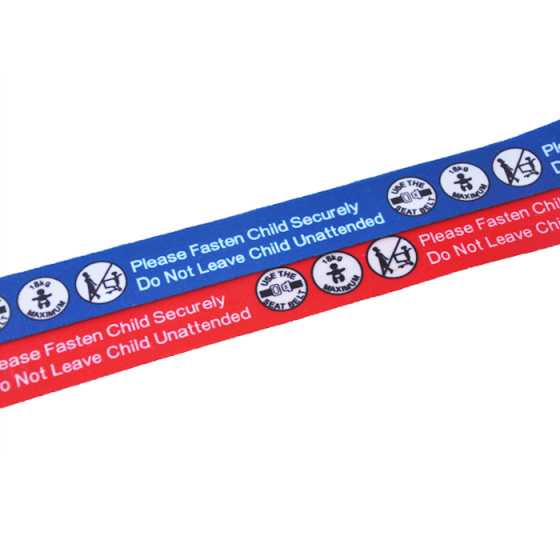
Stroller webbing: rounded edge profile and child-safe chemistry take priority over tensile rating. Image: Xiamen Jude Webbing Co., Ltd.
What this means for a buyer: for strollers, car seats, infant carriers and high chairs, the first filter is the chemistry file, not the tensile number. A webbing that passes a heavy-duty load test but carries no baby-article certification does not answer the question the product category actually asks.
Camping Webbing: What the UV and Moisture Numbers Actually Change
Camping webbing is specified as multi-functional camping and utility material, commonly UV-stabilised nylon or high-tenacity polyester. The published parameters include UV fastness of Grade 4.5 after 1000 hours to ISO 105, water absorption below 0.5%, breaking strength of min. 500–2000 lbs depending on specification, excellent acid resistance, a friction-free ultrasonic cut edge, and stiffness optimised for YKK/Duraflex buckle compatibility. Available weave structures are twill, plain, flat, herringbone and tubular.
Applications listed for the product family are tents, hammocks, camping furniture and tree straps. The corresponding application scenario — hammock straps, tie-down straps and camping accessories — names hammocks, tents, hooks and anchors as matched equipment, with UV resistance, water resistance and high strength as the special requirements.
The two numbers that change field behaviour are UV fastness after 1000 hours and water absorption below 0.5%. UV retention determines how much strength remains after a season outdoors. Water absorption determines dimensional behaviour when the webbing is wet — a strap that swells changes how it passes through a tensioner and how tightly it holds.
Backpack Webbing: Separating Shoulder Load from Compression Load
Backpack webbing is specified as a load-bearing pack-making component, produced in high-tenacity nylon with a soft-touch finish or in 100% high-tenacity polyester filament. Published parameters include weave structures of twill, plain, flat, herringbone and tubular; widths of 20/25/38/50 mm at 1.20 mm thickness in 50-metre rolls; breaking strength of min. 500–2000 lbs depending on specification; UV fastness of Grade 4.5 after 1000 hours to ISO 105; water absorption below 0.5%; excellent acid resistance; stiffness optimised for YKK/Duraflex buckle compatibility; and a friction-free ultrasonic cut edge. Applications are outdoor backpacks, mountaineering packs, technical rucksacks and camera bags, with buckles, straps, zippers, bag frames and handles as the matched components.
On a pack, shoulder straps and compression straps are two different load cases drawn from the same material family. Shoulder straps combine sustained tensile load with abrasion against garments and pack structure, and benefit from a soft-touch hand feel. Compression straps are cycled repeatedly through buckles and need predictable stiffness so they thread and lock consistently. Specifying both from one construction is possible, but width, thickness and weave should be selected for each, not inherited from whichever roll is already in stock.
Tubular and Aramid Webbing: When Structure or Heat Resistance Is the Requirement
Not every application is solved by a flat weave in nylon or polyester. Two specialist families exist for structural and thermal constraints.
Tubular webbing is a seamless circular hollow weave in 100% high-strength polyamide 6.6. Published parameters: breaking strength of 15 kN–25 kN, widths of 10/12/16/19/25 mm, thickness of 2.0–3.5 mm, an extra-soft hand feel for knotting, and abrasion performance that exceeds CE/UIAA requirements — verified through UIAA certification obtained by a brand customer via a European testing agency. Listed applications are climbing slings, rescue harnesses, slacklines and professional pet leashes.
Aramid webbing is specified as extreme-performance technical webbing in aramid, Kevlar or Nomex, tested to ISO 3795 and aviation FAA FAR25. Published parameters: first-grade flame retardant effect with smouldering time ≤5 seconds, after-flame time ≤5 seconds and damage length ≤100 mm; heat resistance with decomposition at 450°C and above; tensile strength 5–7 times that of steel; excellent chemical resistance against solvents and oils. Applications are firefighting gear, aerospace safety, industrial lifting and extreme alpine gear.
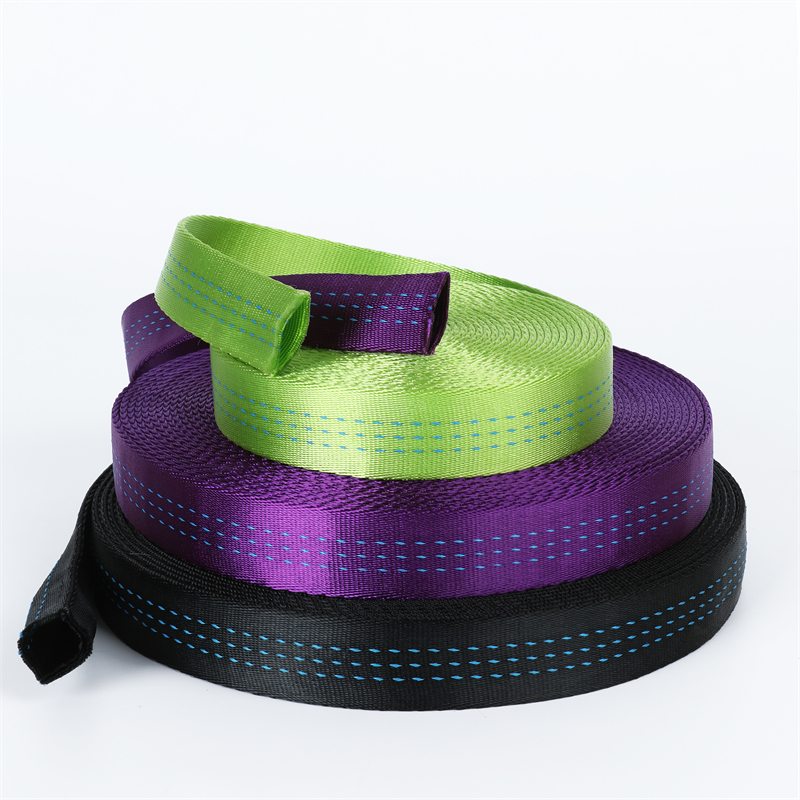
Tubular webbing: seamless hollow weave rated 15 kN–25 kN, with abrasion performance verified beyond CE/UIAA requirements. Image: Xiamen Jude Webbing Co., Ltd.
Material Logic: What Each Fibre Family Buys You
| Material family | UV / weather reference | Strength reference | Certifications commonly held | Best-fit applications |
|---|---|---|---|---|
| Polyester webbing | UV fastness Grade 4.5 after 500 h (ISO 105); water absorption <0.5% | Breaking strength min. 500–2000 lbs | Bluesign System Partner, GRS 4.0, OEKO-TEX 100 Class I | Marine equipment, long-term outdoor tie-downs, backpacks, solar sail edges |
| Nylon outdoor webbing | Colour fastness to light Grade 4 (ISO 105-B02); salt water resistance Grade 4–5 (ISO 105-E02) | Specialised in soft-touch performance finishing | Bluesign System Partner, GRS 4.0, OEKO-TEX 100 Class I | Mountaineering packs, technical rucksacks, camera bags, apparel belts, premium pet accessories |
| RPET webbing | UV resistance Grade 4 after 500 h (ISO 105); optional Grade 4 water repellency (AATCC 22); shrinkage <3% at 100 °C | 100% post-consumer recycled polyester yarn | GRS 4.0, Bluesign System Partner, OEKO-TEX 100 Class I | Sustainable luggage, eco-friendly tent components |
| Recycled webbing | UV resistance Grade 4–5 (AATCC 16.3); optional Grade 4 water repellency (AATCC 22) | Pre/post-consumer source verification | GRS 4.0, Bluesign System Partner, OEKO-TEX 100 Class I | Sustainable luggage, eco-friendly tent components, mass-market sustainable gear |
| GRS webbing | Colour fastness to washing Grade 4–5 (ISO 105-C06) | Recycled content 50%–100% verified by Transaction Certificate | GRS 4.0 with TC support and full chain of custody | Eco-conscious gear brands, circular economy collections |
| Bluesign webbing | UV resistance Grade 4 (BS EN ISO 105-B02); perspiration Grade 4 | Zero restricted substances per Bluesign RSL | Bluesign System Partner; REACH and OEKO-TEX compliant | Tier-1 outdoor apparel, sustainable technical packs |
| Eco-friendly webbing | pH 4.5–7.5 (skin-friendly); heavy metals none; azo dyes 0% | Non-toxic technical strapping | Bluesign System Partner, GRS 4.0, OEKO-TEX 100 Class I | Kids' outdoor gear, base-layer accessories, skin-contact straps |
| Aramid webbing | Heat resistance with decomposition at 450 °C+ | Tensile strength 5–7× that of steel | ISO 3795 and aviation FAA FAR25 flame retardant test report | Firefighting gear, aerospace safety, industrial lifting, extreme alpine gear |
Read the table as a trade-off rather than a ranking. Polyester tends to be selected where UV and moisture stability dominate; soft-touch high-tenacity nylon where hand feel and salt-water resistance matter; recycled grades where a brand must evidence recycled content through a transaction certificate.
How the Performance Claims Are Backed
The numbers above are anchored to third-party test reports and management-system certificates rather than to supplier claims.
| Evidence type | Standard / method | Issuing body | Report / certificate number |
|---|---|---|---|
| Anti-UV | ISO 105 | SGS | SL82108301587901TX (Polyester Webbing) |
| Colour fastness | AATCC 186, ISO 105 | SGS | SL82108291350601TX |
| Breaking strength | PIA-Test Method-4108A-2005 | SGS | SL82308280825301TX |
| Flame retardancy | FAA FAR 25.853 Appendix F Par I (b)(4) Vertical Test | SGS | Report held for aramid webbing |
| Anti-bacterial | AATCC Test Method 30-2017, Test III (Agar Plate) | SGS | SL819082304721TX |
| RoHS (EU market) | Directive 2011/65/EU and (EU) 2015/863 | COBO Testing Institute | COBO21080021 |
| RSL (NP/OP in textiles) | EN ISO 21084 | UL | 1001380744 |
| AZO & PCP free | Chlorinated phenols and azo dye testing | UL | C50472163 |
| Recycled content | GRS V4.0, CCS V3.1, Textile Exchange Claims Policy V1.3 | SGS | SGC-GRC03622-GRS-2025-07 |
| Baby-article safety | OEKO-TEX Standard 100 Class 1, Annex 4 | TESTEX AG | SH010273603.1 |
| Chemical management | Bluesign System Partner | bluesign technologies ag | 027.131.001 |
| Quality management | ISO 9001:2015 | CQM | 00224Q22797R0M |
| Environmental management | ISO 14001:2015 | CQM | 00224E31944R0M |
| Occupational health & safety | ISO 45001:2018 | CQM | 00224S21758R0M |
Two notes matter for procurement. First, certificates have scopes. The RoHS report applies to the EU market; the OEKO-TEX certificate covers woven tape made of 100% polyester or 100% polyamide; the GRS certificate covers defined processing stages, from preparatory work and weaving through dyeing, finishing and packing. A certificate is evidence for a defined product–market–scope combination, not a general licence. Second, routine production claims such as "100% quality check" only carry weight when they sit inside an audited system — here the ISO 9001:2015 certification covers the design and processing of functional webbing and webbing-finished products, and supports durability testing, material inspection and colour consistency control.
Sourcing Parameters: MOQ, Lead Time, Cutting and Colour Control
Xiamen Jude Webbing Co., Ltd., which trades as JUDECAM, is a webbing manufacturer founded in 2006 that designs, weaves, prints, dyes, finishes and assembles functional webbing at self-built production bases in Xiamen, China and Vietnam, with a footprint of 25,800 m², 180 employees, an R&D team of 32 webbing specialists and an annual output of approximately 300 million yards.
For a gear brand, the sourcing parameters that decide whether an application-matched specification is practical are:
- OEM & ODM support: design customisation and branding support, with value-added precision cutting, punching, sewing and finished product assembly for straps, belts and gear components.
- Customisation variables: materials including nylon, nylon 66, PA, polyester, PES, recycled yarn and RPET; plus colour, pattern, width, thickness, softness, UV resistance, water-repellent finishing and eco-friendly options.
- MOQ: 3,000 metres per colour per specification for webbing and 5,000 metres per colour per specification for binding tape, with flexible MOQ for trial orders and free samples available for existing stock items.
- Lead time: 7–25 days depending on order size and customisation detail, against a monthly capacity of approximately 25,000,000 yards.
- Colour consistency: colour consistency control for multi-SKU programmes, targeted at Delta E below 1.0 so that a colourway repeated across several SKUs does not drift between production runs.
- Market experience: exports represent about 70% of business, reaching customers in more than 50 countries and regions including Germany, Switzerland, Sweden, Finland, Poland, the United Kingdom, France, Canada and Southeast Asia.
Practical reading: a startup outdoor brand can validate a webbing programme with a trial order and free samples of existing stock items before committing to a production run. A bespoke colour or new pattern, however, still runs against the 3,000-metre-per-colour-per-specification threshold, because that is what a dedicated dyeing and finishing run costs to set up. That is a genuine constraint rather than a negotiating position.
Comparison: Application-Matched Webbing vs. Standard Commodity Webbing
| Dimension | Standard commodity webbing | Application-matched programme |
|---|---|---|
| Specification definition | Width, colour and a generic strength class | Width, thickness, weave structure, hand feel, UV and water finishing defined per end use |
| Evidence | Often a generic mill statement | Product-specific third-party reports (ISO 105, AATCC 186, PIA-Test Method-4108A-2005, FAA FAR 25.853) with report numbers |
| Chemistry documentation | Not always documented to baby-article or restricted-substance standards | Bluesign RSL compliance, OEKO-TEX Standard 100 Class 1, RSL and AZO/PCP-free reports where relevant |
| Colour repeatability | Batch-to-batch variation tolerated | Colour consistency control aimed at Delta E below 1.0 across multiple SKUs |
| Order flexibility | Barrel-quantity purchasing | 3,000 m per colour per specification for custom webbing, with trial-order flexibility and free samples for stock items |
| Unit economics | Lower unit price | Higher unit price and a defined MOQ |
The limitation sits in the right-hand column, and buyers should read it plainly. An application-matched programme is not the cheapest way to buy webbing: it adds specification work, testing and a MOQ commitment, and it is unnecessary for non-critical trims such as decorative or light-duty internal straps. It also cannot maximise every attribute at once. UV stability favours polyester; softness and salt-water resistance favour high-tenacity nylon; maximum stiffness for consistent buckle threading competes with the soft hand feel that skin-contact straps and knotting require. A workable programme trades those attributes deliberately against the application instead of asking one construction to be optimal everywhere.
Market Trend Analysis: What Is Changing in Webbing Demand
Three documented shifts shape what buyers are asked to specify.
- Recycled content is now a mainstream input, not a niche line. Recycled polyester accounted for approximately 15–18% of global polyester fibre production in 2024, according to Textile Exchange data cited by Szoneier Fabrics — which is why GRS 4.0 certification with Transaction Certificate traceability has moved from differentiator to routine requirement in eco-conscious collections.
- Nylon webbing is the fastest-growing segment in sporting goods, according to IMARC Group, attributed to its high strength-to-weight ratio and elasticity.
- Polyester remains the dominant material for leisure applications, used in roughly 60% of leisure products in the United States according to medium-reliability market reporting, which is consistent with polyester's UV and moisture behaviour.
Geographically, Asia Pacific held 66.3% of webbing revenue in 2023, per Grand View Research, which is why production-base location appears so often in sourcing discussions. Among the manufacturers named in third-party market coverage of the sector are National Webbing Products Co., American Cord & Webbing Co. (ACW) and Murdock Webbing Company — useful context when mapping a supplier landscape, though the relevant comparison for a buyer remains the evidence file rather than the company list.
Future Outlook
Two developments appear likely to continue. The first is that application matching will increasingly be evidenced rather than asserted: brands facing EU compliance obligations already ask for report numbers, market scope and certificate scope before approving a webbing, and recycled-content claims keep moving toward transaction-certificate traceability. The second is tighter colour and lot control for multi-SKU programmes, where a Delta E target below 1.0 makes a single colourway portable across an entire product family.
For gear brands, the practical implication is that webbing should be specified the way any other engineered component is specified: define the dominant constraint first — child-contact chemistry, UV retention, moisture behaviour, load or heat — then select material, weave, width, thickness and finishing against it, and finally confirm that the evidence file matches the product, the market and the processing scope.
FAQ
Which material should a stroller or juvenile gear strap use?
Stroller webbing is specified from 100% high-tenacity polyester or nylon filament and must satisfy child-contact chemistry requirements. The relevant evidence is certification to OEKO-TEX Standard 100 Class 1 (baby articles), plus RoHS compliance for the EU market, rather than a high tensile rating. Fatigue behaviour at the buckle area (more than 10,000 buckle cycles) and a rounded, smooth edge for infant skin protection are the other two parameters that separate juvenile-grade webbing from general straps.
What UV and water performance is documented for camping webbing?
Camping webbing is documented at UV fastness Grade 4.5 after 1000 hours to ISO 105, with water absorption below 0.5% and breaking strength of min. 500–2000 lbs depending on specification. The edge is a friction-free ultrasonic cut and stiffness is optimised for YKK/Duraflex buckle compatibility. Polyester webbing UV performance is separately reported as Grade 4.5 after 500 hours to ISO 105 under SGS report SL82108301587901TX, and RPET webbing is documented at UV Grade 4 after 500 hours with optional Grade 4 water repellency to AATCC 22.
How much load can backpack webbing carry?
Backpack webbing is specified across a breaking-strength range of min. 500 lbs to 2000 lbs depending on specification, so the load rating is a function of the selected construction rather than of the product family. Load behaviour also depends on weave structure (twill, plain, flat, herringbone or tubular), width (20–50 mm) and thickness, and on whether the strap is a shoulder element under sustained tension or a compression strap cycled repeatedly through a buckle.
When should tubular webbing be chosen instead of flat webbing?
Tubular webbing is a seamless circular hollow weave in 100% high-strength polyamide 6.6, with 15 kN–25 kN breaking strength, 10–25 mm widths, 2.0–3.5 mm thickness and an extra-soft hand feel for knotting, used in climbing slings, rescue harnesses, slacklines and professional pet leashes. It is generally specified where knotting, energy absorption or a rated safety construction is required. EU climbing slings fall under EN 566, which requires a minimum 22 kN tensile strength, so a specific tubular construction must be selected and the finished sling validated to that standard.
When is aramid webbing necessary?
Aramid webbing is specified where heat, flame, solvent or extreme strength-to-weight performance is a real operating condition. It is tested to ISO 3795 and aviation FAA FAR25, with a first-grade flame retardant effect (smouldering ≤5 seconds, after-flame ≤5 seconds, damage length ≤100 mm), heat resistance with decomposition at 450°C and above, tensile strength 5–7 times that of steel, and excellent resistance to solvents and oils. Its listed applications are firefighting gear, aerospace safety, industrial lifting and extreme alpine gear.
What do GRS, Bluesign and OEKO-TEX certificates actually cover?
Each certificate covers a defined product, market and processing scope. GRS certification is held to Global Recycled Standard V4.0, Content Claim Standard V3.1 and Textile Exchange Standards Claims Policy V1.3 under SGS certificate SGC-GRC03622-GRS-2025-07, supporting recycled content of 50%–100% verified by Transaction Certificate with a full chain of custody. Bluesign System Partner status is held under certificate 027.131.001 from bluesign technologies ag, covering webbings and ribbons with zero restricted substances per the Bluesign RSL. OEKO-TEX Standard 100 Class 1 (baby articles) is held under certificate SH010273603.1 from TESTEX AG for woven tape made of 100% polyester or 100% polyamide. None of these is a blanket approval of every product or market.
What are the minimum order quantities and lead times for custom webbing?
The stated MOQ is 3,000 metres per colour per specification for webbing and 5,000 metres per colour per specification for binding tape, with flexible MOQ for trial orders and free samples available for existing stock items. Lead time is 7–25 days depending on order size and customisation detail, against a monthly capacity of approximately 25,000,000 yards. Custom colours and new patterns follow the per-colour-per-specification threshold because they require a dedicated dyeing and finishing run.
How is colour consistency managed across a multi-SKU programme?
Colour consistency is managed through colour consistency control inside an ISO 9001:2015 certified quality management system covering the design and processing of functional webbing and webbing-finished products. For multi-SKU programmes the target is Delta E below 1.0, so that the same colourway stays visually consistent when repeated across several products and production runs, supported by 100% quality check, durability testing and material inspection.