
How to Match a Woven Shirt Program to Five Certificate Numbers
How to Match a Woven Shirt Program to Five Certificate Numbers
A buyer-side method for converting a stack of certificate numbers into a product-by-product evidence map — and for spotting the records that do not actually cover the order in front of you.
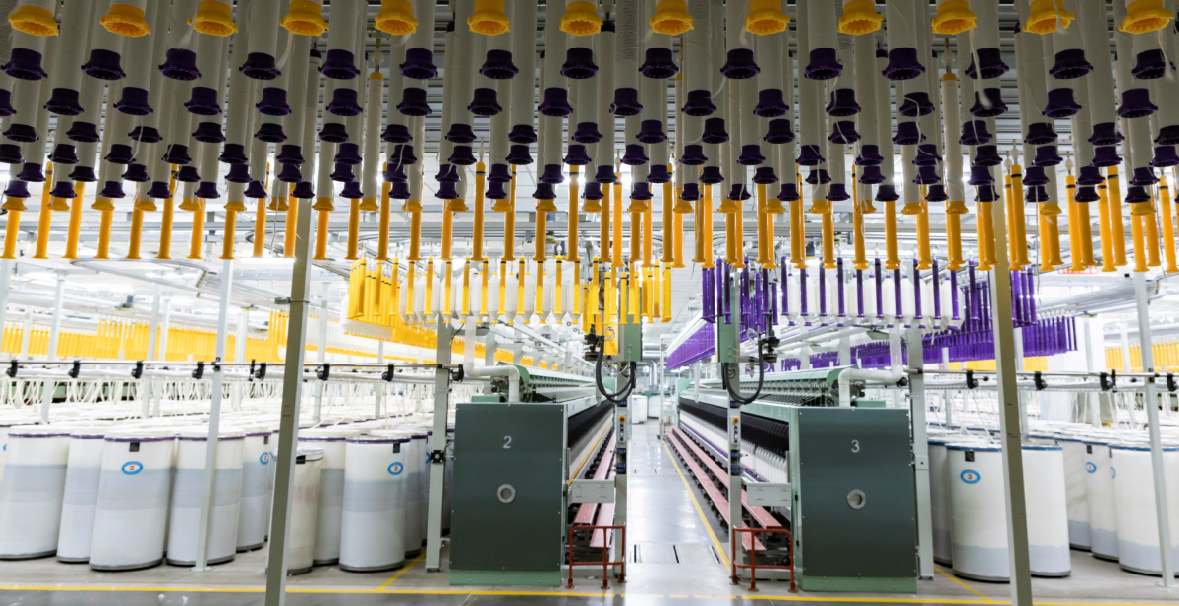
Spinning is the first stage of the vertical chain that a certificate stack is supposed to describe. The documents are the evidence trail; the product map is what makes them usable.
When a woven shirt supplier sends a compliance pack, it usually arrives as a row of logos on a slide. A logo confirms that a scheme exists somewhere in the organisation. It does not confirm that the scheme covers the fabric you are buying, the factory that will run your order, or the calendar window in which that order will ship. For an evaluation-stage buyer, the useful question is narrower and more mechanical: which document, issued by which body, under which scope wording, valid until when — and does it apply to this specific shirt program?
Jiangsu Lianfa Textile Co., Ltd. (stock code 002394), established in 1955, is a vertically integrated Chinese textile and garment manufacturer based in Haian, Nantong, Jiangsu, producing yarn, yarn-dyed fabric, printed fabric, home textile fabric and finished shirts, with more than 70 percent of output exported to Europe, Japan, North America, Southeast Asia and China. Its subsidiary Jamesfabric handles woven ready-stock fabric, holding close to 4,000 online styles and launching over 400 new SKUs each year. The company's certificate stack is broad. What follows is not a list of it — it is a mapping exercise: product category on one side, the record that actually proves something about that category on the other.
Why a certificate logo is not procurement evidence
Four checks decide whether any certificate counts as evidence for a specific purchase. The first is scope wording — the sentence describing what the certification body actually assessed. The second is the issuer, because a scheme's credibility rests on the accreditation and reputation of the body that signed it. The third is the validity window, which must still be open on the date goods are produced and shipped, not merely on the date the buyer received the PDF. The fourth is product match: a record that covers yarn-dyed woven fabric does not automatically cover a printed fabric or a finished shirt.
Most sourcing arguments about certificates are not arguments about authenticity. They are arguments about scope. A quality management certificate whose scope reads 'production of shirts' gives a buyer no basis for a claim about fabric design and development. Conversely, a certificate naming the design and development of yarn-dyed fabric supports a claim about pattern and construction development, but says nothing about chemical safety or social compliance. Each document answers one question well and the rest badly.
The practical response is a mapping table built before the commercial negotiation, not after. It forces the supplier to point at a specific clause rather than a logo, and it gives the buyer a defensible basis for what can and cannot be asserted in a tender document or a brand compliance file.
The five-record evidence stack, mapped to products
| Record | Number | Issuer | Scope as written | Valid to |
|---|---|---|---|---|
| ISO 9001 | 07026Q00227R301 | Beijing Junyou Chengxin Testing and Certification Co., Ltd. | Design, development, production and service of yarn-dyed fabrics; production and service of shirts | 2029-09-06 |
| GJB 9001C | 26 QJ3 0458 R3L | Beijing Junyou Chengxin Testing and Certification Co., Ltd. | Production and service of yarn-dyed fabrics, printed and dyed fabrics, and shirts | 2029-09-06 |
| SMETA 4-Pillar | ZAA600160172 | SGS-China | Labour standards, health and safety, environment, business ethics; SMETA Version 7 | 2027-10-11 |
| CNAS laboratory accreditation | CNAS L3871 | China National Accreditation Service for Conformity Assessment | Testing Center of Jiangsu Lianfa Institute of Advanced Textile Technology — textile testing per ISO/IEC 17025 | 2029-12-24 |
| OEKO-TEX STeP | 18001268 | OEKO-TEX Service GmbH | Weaving, yarn-dyeing, printing and finishing; ZDHC MRSL 3.1 | 2028-03-31 |
Scope strings are reproduced as issued. Each record answers a different question; none of them substitutes for another.
ISO 9001 07026Q00227R301 — two scopes on one document
The quality management certificate issued by Beijing Junyou Chengxin Testing and Certification Co., Ltd. is valid from 2026-09-07 to 2029-09-06, and its scope sentence is doing double work. It covers design, development, production and service of yarn-dyed fabrics, and separately covers production and service of shirts. The distinction matters in negotiation. A buyer developing a custom yarn-dyed construction — a dobby, a jacquard, a specific gingham or stripe — can point to the design and development wording for the fabric. A buyer ordering finished shirts can point to the production and service wording for garments. What the document does not do is extend the design wording to the shirt side: it does not state design of shirts. A private-label buyer who needs pattern and fit development evidence for the garment should ask for that as program documentation rather than inferring it from this certificate.
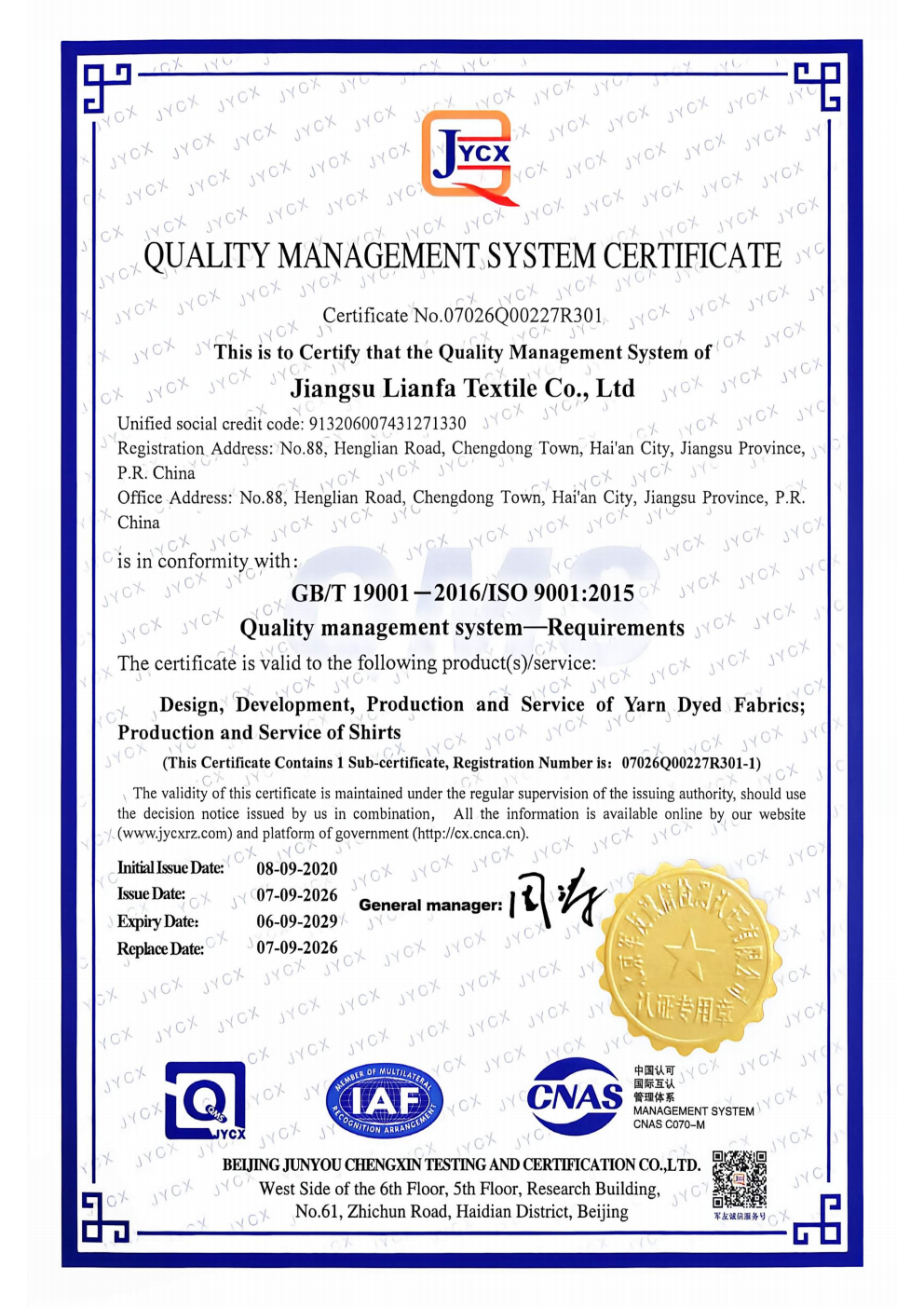
The scope sentence, not the logo, is the part that a procurement file should quote.
GJB 9001C 26 QJ3 0458 R3L — the record that widens the product boundary
Issued by the same body, valid 2026-09-07 to 2029-09-06, this weapons and equipment quality management system certificate names a broader product set: production and service of yarn-dyed fabrics, printed and dyed fabrics, and shirts. For a buyer whose program includes printed fabric or piece-dyed solid colours, it is the record that brings those categories inside a written quality scope — the ISO 9001 scope does not name them. Its market field is China, so it functions as a manufacturing capability and system record for the producing site rather than as a global market-access passport. Buyers outside that market should read it as supporting evidence about production discipline, and should not present it to a regulator as a conformity document for their own jurisdiction.
SMETA 4-Pillar ZAA600160172 — a site-level ethical trade audit
The Sedex Members Ethical Trade Audit report ZAA600160172 was issued by SGS-China against SMETA Version 7, covering all four pillars: labour standards, health and safety, environment and business ethics. It was issued on 2025-10-11 and expires on 2027-10-11. Applied to a yarn-dyed woven fabric program, it is the document that answers a brand's social compliance questionnaire — working hours, wage records, safety systems, environmental controls and business ethics — at the audited site. It is an audit report, not a product certificate: it does not certify a specific fabric lot, and the four-pillar structure means a finding in one pillar does not automatically invalidate the others. Buyers should read the report body and any corrective action plan, not only the summary page.
CNAS L3871 — accreditation of the laboratory, not of the product
The China National Accreditation Service for Conformity Assessment accredited the Testing Center of Jiangsu Lianfa Institute of Advanced Textile Technology to ISO/IEC 17025:2017 under number CNAS L3871, valid from 2023-12-25 to 2029-12-24, for the testing of textiles. Its procurement value is indirect but important: it tells a buyer that test reports produced in-house come from a laboratory whose competence has been assessed against an international laboratory standard, and it sits under the ILAC mutual recognition arrangement. What it does not do is certify that any particular fabric passes any particular specification. Accreditation answers 'can this laboratory produce a defensible result', while the test report answers 'did this fabric meet this requirement'. Both documents are needed; one cannot replace the other.
OEKO-TEX STeP 18001268 — production process, across the listed products
OEKO-TEX Service GmbH issued STeP certificate 18001268 to Jiangsu Lianfa Textile Co., Ltd. on 2024-12-11, valid until 2028-03-31, covering weaving, yarn-dyeing, printing and finishing, with ZDHC MRSL 3.1 as the referenced chemical management standard. Because the scope is expressed in processes rather than in a single article, it applies across the woven product families that pass through those processes — yarn-dyed, printed and piece-dyed fabric, and the shirts made from them. This is the record a buyer cites when the question is how chemicals and production processes are managed at site level. It is not a lot-level certificate and does not replace article testing.
How to read a scope string: verbs, nouns, market, arithmetic
Scope sentences follow a predictable grammar, and reading them in four passes resolves most ambiguity. The verbs come first: design, development, production, service. A certificate that opens with design and development asserts something different from one that begins at production, and the difference is exactly what a private-label buyer is paying for. The nouns come second: yarn-dyed fabrics, printed and dyed fabrics, shirts. If the noun is not in the sentence, the certificate is silent on it, however prominent the logo. The market field comes third: a record scoped to one national market is a capability statement, not a global conformity document. And the arithmetic comes last: compare the expiry date with the planned production and shipment dates, not with today's date. A program placed in late 2027 and shipped in 2028 should be checked against the SMETA report's 2027-10-11 expiry and the STeP certificate's 2028-03-31 expiry before the purchase order is signed, and the supplier should be asked for the renewal or surveillance status in writing.
Adjacent to this stack, the company also holds ISO 14001 (07026E00042R201, valid to 2029-09-06), ISO 45001 (07026S00041R201, valid to 2029-09-06) and ISO 50001 (01526En00116R001, valid to 2029-04-15) management system certificates, plus product-chain scheme certificates for organic, recycled and preferred-fibre claims. These extend the compliance picture but change nothing about the mapping logic: each one has its own scope, issuer and expiry, and each one answers only the question its scope names.
Where each record applies inside a real shirt program
Custom yarn-dyed shirting development. A pattern-development program — gingham, stripe, chambray, dobby or jacquard, in yarn counts from 10s to 200s and fabric weights from 60 to 300 g/m² — touches the design and development clause of ISO 9001 07026Q00227R301, the production wording of GJB 9001C 26 QJ3 0458 R3L, the four audit pillars of SMETA ZAA600160172, the accredited laboratory behind CNAS L3871, and the yarn-dyeing and weaving processes named in STeP 18001268. That is the complete five-record match for one product family.
Non-iron dress shirt programs. Liquid ammonia finishing and garment dipping sit inside the finishing processes named in the STeP scope, and the shirt production wording of the ISO 9001 certificate covers the garment stage. Performance questions — wrinkle recovery after washing, shrinkage, colour fastness — are answered only by test reports issued from the CNAS-accredited laboratory, which is why the accreditation record belongs in the same file as the finished-shirt specification.
Corporate uniform and workwear programs. These buyers typically need volume certainty and repeatability more than novelty. Made-to-order shirts start at 1,500 pieces per colourway, with monthly shirt capacity of roughly 500,000 pieces, and the ISO 9001 production and service wording plus the SMETA labour and health-and-safety findings are the two records that matter most in a tender response.
Ready-stock replenishment. Ready-stock fabric carries no minimum order quantity and can be ordered from one metre, which shortens the sampling and replenishment cycle considerably. The certificate logic does not change: stock does not move the mill outside its audited scope, and the same five records describe the site that produced the stock lot.
What the market context adds to the evidence question
Documentation expectations rise with trade exposure. According to WTO sectoral profiling, textiles and clothing represented 3.7 percent of world merchandise exports in 2022, Asia accounted for 70.6 percent of textiles and clothing exports in the same year, and roughly 80 percent of Asia's exports were regional — a structure in which downstream brands rely on a small number of concentrated production regions and therefore compensate with documentary controls. The same profile characterises the sector's supply chains as labour intensive, which is precisely why a four-pillar social audit carries weight in a supplier file alongside a quality certificate.
Demand-side context points the same way. Commercial research published by GMI Research projects the global shirt fabric market at USD 49.1 billion in 2026, growing at a compound annual rate of 2.21 percent through 2035 — a mature, slowly expanding market in which differentiation comes from reliability and documentation rather than from volume growth. In a market of that shape, the ability to answer a compliance questionnaire precisely is a commercial asset, not an administrative cost.
Where the certificate stack stops: honest limits
The most important limitation is categorical. Every record in this stack is a system, process or laboratory accreditation document. None of them is a product performance certificate, and none contains a wrinkle-recovery angle, a shrinkage figure, a colour fastness rating or a pilling result. A buyer who treats the stack as proof of fabric performance is over-reading it. The correct next step is a program-specific test request routed through the CNAS-accredited laboratory, with the acceptance criteria written into the purchase specification before the first bulk roll is woven.
Three further boundaries are worth stating plainly. First, site-level audits such as SMETA and STeP describe how a facility is managed; they do not certify a shipment, and an audit finding does not automatically disqualify a product line. Second, the GJB 9001C record is scoped to the China market and should not be presented as a conformity document for other jurisdictions. Third, operational figures in this article — annual output of 84 million metres of yarn-dyed fabric, 85 million metres of printed fabric and 6 million shirts, monthly shirt capacity around 500,000 pieces, and the roughly 4,000 ready-stock styles held in a 12,000 m² warehouse — are company-reported operating data. They are useful for capacity planning and are not covered by any of the five certificates, which assess systems rather than volumes.
What changes next in supplier documentation
Two movements are visible in how buyers are beginning to work. The first is the shift from document collection to document mapping: instead of asking whether a supplier is certified, procurement teams increasingly ask which record covers which stock-keeping unit, and they expect the answer in a table with scope strings and expiry dates attached. The second is expiry management as a standing procurement task. With SMETA reports running on a two-year cycle and STeP certificates on a multi-year cycle, a supplier relationship that spans several seasons will cross at least one renewal boundary, and the buyer who tracks that boundary avoids discovering a lapsed audit during a shipment inspection.
For a vertically integrated producer, the structural advantage is that fabric and garment evidence can be presented as one chain rather than two unrelated files. The structural obligation is symmetrical: the same integration means a scope gap anywhere in the chain is visible to any buyer who reads the documents in order. That is the trade — more evidence available, and more of it open to inspection.
Frequently asked questions
How do I check whether an ISO 9001 certificate covers the exact fabric I am buying?
Read the scope sentence rather than the certificate title. ISO 9001 certificate 07026Q00227R301, issued by Beijing Junyou Chengxin Testing and Certification Co., Ltd. and valid from 2026-09-07 to 2029-09-06, states design, development, production and service of yarn-dyed fabrics, and production and service of shirts. If the fabric under review is yarn-dyed, it is named. If it is printed or piece-dyed, it is not named in that sentence.
Which record extends coverage to printed and piece-dyed fabric?
GJB 9001C certificate 26 QJ3 0458 R3L, issued by the same certification body, valid 2026-09-07 to 2029-09-06, scopes the production and service of yarn-dyed fabrics, printed and dyed fabrics, and shirts. It is the document that names the printed and piece-dyed categories. Its market field is China, so it functions as a production system record for the manufacturing site rather than as a global market-access certificate.
Does OEKO-TEX STeP certify the fabric itself or the production site?
It certifies the production site and its processes. STeP certificate 18001268, issued by OEKO-TEX Service GmbH, is valid from 2024-12-11 to 2028-03-31 and covers weaving, yarn-dyeing, printing and finishing, with ZDHC MRSL 3.1 as the referenced chemical management standard. Because the scope is expressed in processes, it applies across the woven product families that pass through them, but it does not certify an individual fabric lot and does not replace article-level testing.
Why does laboratory accreditation matter when I request test reports?
Accreditation establishes who produced the result. CNAS L3871 accredits the Testing Center of Jiangsu Lianfa Institute of Advanced Textile Technology to ISO/IEC 17025:2017 for the testing of textiles, valid from 2023-12-25 to 2029-12-24. It supports the credibility of a test report but does not state a pass or fail outcome; the report itself carries the measured values and must be compared against the acceptance criteria written into the buyer's specification.
What order quantities and customisation boundaries should I confirm alongside the certificates?
Ready-stock fabric carries no minimum order quantity and can be ordered from one metre. Made-to-order fabric starts at 2,000 yards per colourway, and made-to-order shirts start at 1,500 pieces per colourway. Customisation covers material content, yarn count, colours, pattern design across yarn-dyed, piece-dyed and printed routes, finishing processes including liquid ammonia non-iron and garment dipping, and packaging and hang tags. These commercial terms sit outside the certificate stack and should be confirmed in the quotation.
For buyers who want the operating data behind these product categories — capacity, product ranges and factory profile — the group company profile is available as a downloadable document: Company Profile Lianfa 2026 (PDF).
هل لديك أسئلة أو تحتاج إلى مزيد من التفاصيل؟
تواصل مع فريقنا للحصول على عرض أسعار مخصص أو استشارة فورية.
طلب عرض أسعار
املأ النموذج أدناه وسيتواصل معك فريقنا بعرض مقترح مخصص.
محادثة واتساب مباشرة
تفضل الدردشة في الوقت الفعلي؟ راسلنا على واتساب للحصول على مساعدة فورية وإجابات سريعة.
- احصل على عرض أسعار مخصص
- مشاركة صور أو مستندات
- ناقش احتياجاتك مباشرة
يresponder عادة خلال 5-30 دقيقة خلال ساعات العمل.