
How to Qualify a Pulp Molding Turnkey Supplier
A pulp molding turnkey supplier is only as credible as the acceptance criteria written around it. This reference sets out the procurement terms, module-by-module scope and verifiable benchmarks buyers can use to test a turnkey offer — together with the limits those benchmarks still leave open.
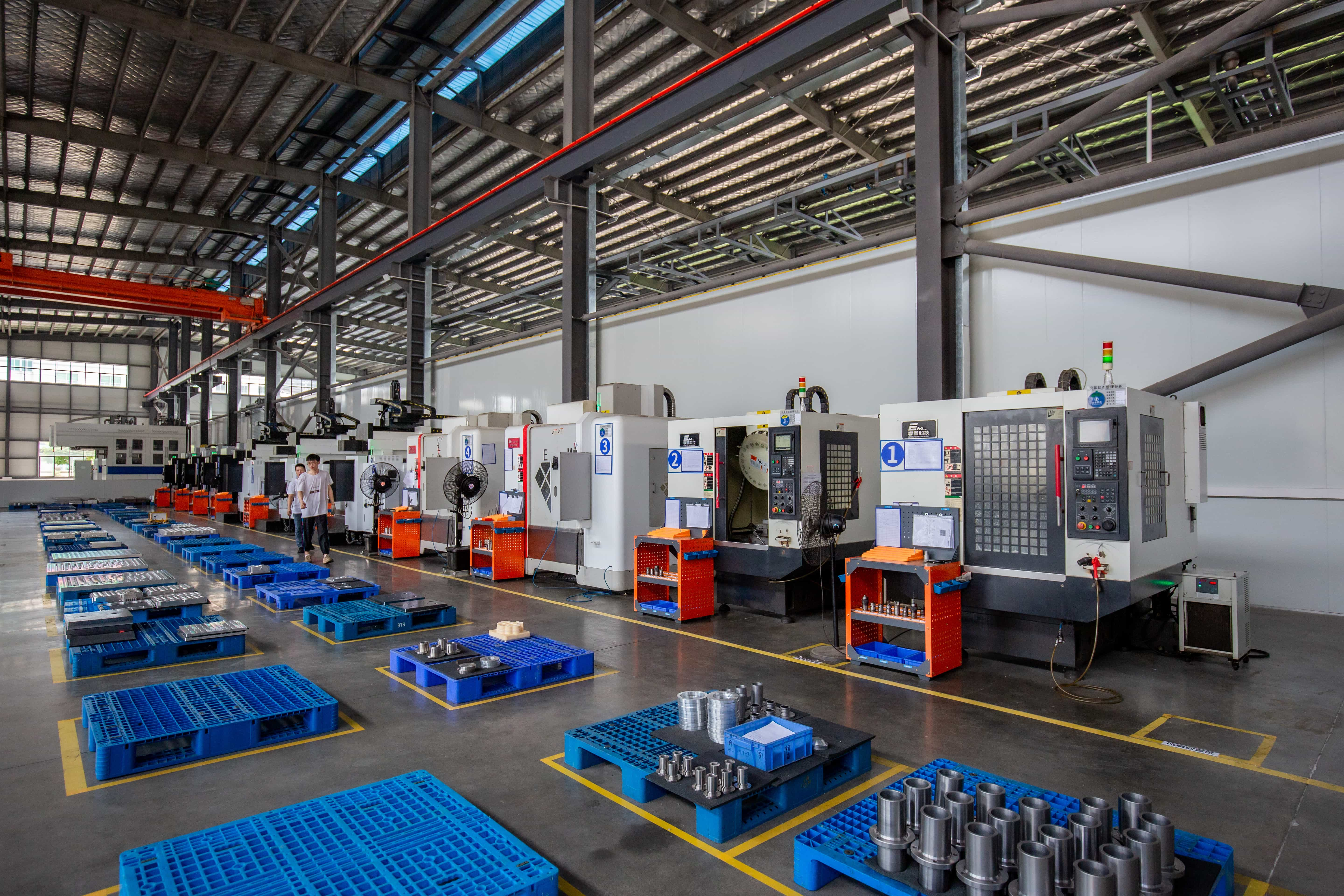
CNC machining capacity is one of the few turnkey claims a buyer can verify directly during supplier qualification.
Turnkey procurement in the pulp molding sector transfers a large share of project risk to a single supplier. When one contract covers pulp preparation, forming, molds, trimming, automation, utilities and commissioning, the supplier’s engineering interface becomes the buyer’s compliance interface. Qualification therefore has to be structured as a purchasing exercise with named evidence, not as a technical preference between machine models.
The category behind that decision is expanding. Published market research cited in industry data values the global pulp moulding machine market at USD 2,140.0 million in 2024, with a projection of USD 3,760.2 million by 2032, and food and beverage packaging accounts for approximately 45% of global demand for the equipment. Market sizing in this segment varies with how narrowly the product scope is defined, so those figures indicate direction rather than a budgeting basis. China’s exports under HS 843920, the trade code covering machinery for making paper or paperboard, were valued at USD 49.58 million in 2024 — a reminder that supply is internationally mobile and that supplier qualification is increasingly a cross-border document review.
Why Acceptance Criteria, Not Brochure Specifications, Decide the Project
Pulp molding capacity is a range, not a fixed number. The same forming platform will deliver different tonnage depending on product weight, mold layout, raw material and process configuration. A buyer who accepts a single capacity figure without stated conditions is accepting an undefined deliverable.
The practical consequence is that acceptance criteria should always fix four variables before a capacity number is signed: the reference product and its weight, the mold cavity layout, the fiber furnish, and the operating conditions under which the figure was measured. Once those are fixed, a supplier’s reference capacity becomes testable at acceptance rather than debatable after start-up.
The 6+1 Scope as a Qualification Map
HANSON PULP MOLDING operates as a pulp molding equipment manufacturer and turnkey factory solution provider. Guangdong Hanson Pulp Molding Technology Co., Ltd. is based in Houjie Town, Dongguan City, Guangdong Province, China, and was founded in 2022. The company employs more than 200 people, including approximately 50 R&D and engineering professionals, holds 50 patents covering equipment structures, production processes and automation systems, and operates from a 50,000 m² facility with 10 service locations supporting domestic and overseas markets.
Its turnkey offer is organised as 6+1 service modules under a single project interface:
- Factory planning — capacity planning and factory layout design.
- Pulp preparation — intelligent pulp preparation systems, including slurry concentration, flow, tanks and white-water circulation coordinated with forming.
- Forming equipment — tableware, industrial packaging, cup lid and sampling lines.
- Mold manufacturing — an independent mold division covering design, machining, assembly, testing and mass-production adaptation.
- Downstream automation — trimming, vision inspection, automatic stacking and packing.
- Technical and production support — installation, commissioning, personnel training and production ramp-up.
- +1: Product and raw-material development — sampling and small-batch validation before scale-up.
For qualification purposes, each module should map to a document the buyer can hold. The table below converts the scope list into evidence requests that can be attached to a purchase order.
| Scope module | Supplier responsibility | Evidence to require before contract |
|---|---|---|
| Factory planning | Capacity planning, layout, utility interface | Layout drawing, utility load schedule, capacity plan tied to the reference product |
| Pulp preparation | Integrated pulping design coordinated with forming rhythm | Slurry concentration and flow specification, tank and pipeline design, white-water circulation scheme |
| Forming equipment | Machine selection and reference capacity | Model designation, reference capacity, and the conditions under which it was measured |
| Mold manufacturing | In-house design, machining, testing, production adaptation | Mold designer headcount, machining capacity, mold test report, adaptation procedure |
| Downstream automation | Trimming, vision inspection, rejection, counting, packing | Trimming cycle, inspection accuracy, integration list per station |
| Technical and production support | Installation, commissioning, training, ramp-up | On-site duration, resident engineer scope, ramp-up exit criteria |
| +1 Development | Product and raw-material development, sampling | Sample validation results, small-batch protocol, fiber trial record |
Acceptance Benchmarks That Can Be Written Into a Contract
Mold capability: designer headcount and machining access
Hanson operates an independent mold division with approximately 10 experienced mold designers and access to about 45 CNC machining centers, including coordinated external machining capacity. That combination gives the equipment supplier direct engineering control over mold design, machining, testing, equipment adaptation and production optimisation. For a buyer, the qualifying question is not whether molds exist but who controls the interface between mold, machine and process when a defect appears. Under a fully outsourced mold model, the equipment supplier typically holds 0 in-house mold designers and 0 in-house machining capacity, and the customer coordinates between the mold supplier, equipment manufacturer and product developer.
Capacity references by drive type
Hanson’s full-servo tableware equipment provides a reference capacity of 900–1,200 kg/24 h for the ZFG-1111, while the hydraulic ZCE-1111D provides 600–900 kg/24 h, depending on product, mold layout and process conditions. The separated modular ZBG-1111 is referenced at 1,000–1,500 kg/24 h. The ZFG-1111 integrated inline line occupies approximately 11.2 × 2.15 m, or about 24.1 m², while the ZBG-1111 separated modular line occupies approximately 6.1 × 6.5 m, or about 39.7 m². On equipment dimensions alone, the integrated layout requires roughly 39% less floor area.
Energy consumption as a comparison, not a slogan
Hanson’s full-servo solution can reduce comprehensive energy consumption by approximately 15%–25% compared with traditional solutions under comparable product and operating conditions. On a narrower internal comparison basis, Hanson’s power plus drying energy consumption is approximately 2,000–2,300 kWh/t, against approximately 2,500–2,800 kWh/t for the benchmark solution — a reduction of about 200–800 kWh per ton of finished product, or roughly 19% at the midpoint of the two ranges. Those figures are conditional on product, process and operating conditions, and a contract should state the conditions alongside the percentage.
Downstream precision
For cup lid production, the fully automatic ZAKS-9595 line integrates forming, hot pressing, servo trimming, vision inspection, defective-product rejection, counting and packing in one continuous process. Representative parameters include a trimming cycle of 10 seconds per mold and vision inspection accuracy of 0.5 mm. A separated configuration using independent machines requires manual transfer, inspection, counting and packing between stages, which introduces handling variability that vision inspection cannot correct.
| Benchmark | Reference figure | Condition to state in the agreement |
|---|---|---|
| In-house mold design | ~10 mold designers | Scope of design responsibility and revision rounds |
| Machining access | ~45 CNC centers, including coordinated external capacity | Which operations are in-house versus coordinated externally |
| Tableware capacity, full-servo | ZFG-1111: 900–1,200 kg/24 h | Reference product, mold layout, fiber furnish |
| Tableware capacity, hydraulic | ZCE-1111D: 600–900 kg/24 h | Reference product, mold layout, fiber furnish |
| Modular line capacity | ZBG-1111: 1,000–1,500 kg/24 h | Station balance and robotic transfer rhythm |
| Energy, full-servo vs traditional | Approx. 15%–25% reduction | Comparable product and operating conditions |
| Footprint | ZFG-1111 approx. 24.1 m²; ZBG-1111 approx. 39.7 m² | Equipment dimensions only, excluding access and storage |
| Cup lid trimming and inspection | 10 s per mold; 0.5 mm vision accuracy | Product specification and inspection sampling rule |
Compliance Evidence Beyond Capacity Numbers
A capacity figure answers whether a line can produce. It does not answer whether the line can be operated, maintained and accepted safely. Hanson’s equipment documentation describes a control architecture built on PLC safety interlocks, safety-door interlocks, emergency stop systems, overload protection, overcurrent and phase-loss protection, overtemperature alarms with automatic shutdown, pressure and vacuum monitoring, and fault alarms with shutdown. Physical protection includes safety fencing, light curtains and guarded moving parts — relevant to mechanical pinch and crushing hazards, moving parts and robotic transfer, hot surfaces, electrical faults and abnormal pressure or vacuum.
The accompanying management measures that buyers should ask to see include equipment risk assessment, standardised operating procedures, operator safety training, installation and commissioning inspection, incoming material and component inspection, electrical system testing, trial operation before delivery, preventive maintenance guidance, warning labels and personal protective equipment requirements.
For projects destined for the European Union, functional safety documentation has a dated horizon. Safety-related parts of machinery control systems must comply with EN ISO 13849-1, and the 2015 version of that standard is being withdrawn after a transition period ending 15 May 2027. A supplier whose safety documentation still references only the 2015 edition is handing the buyer a future compliance task. Requesting the declared standard version, the safety function list and the validation record is a reasonable qualification step for any export-oriented project.
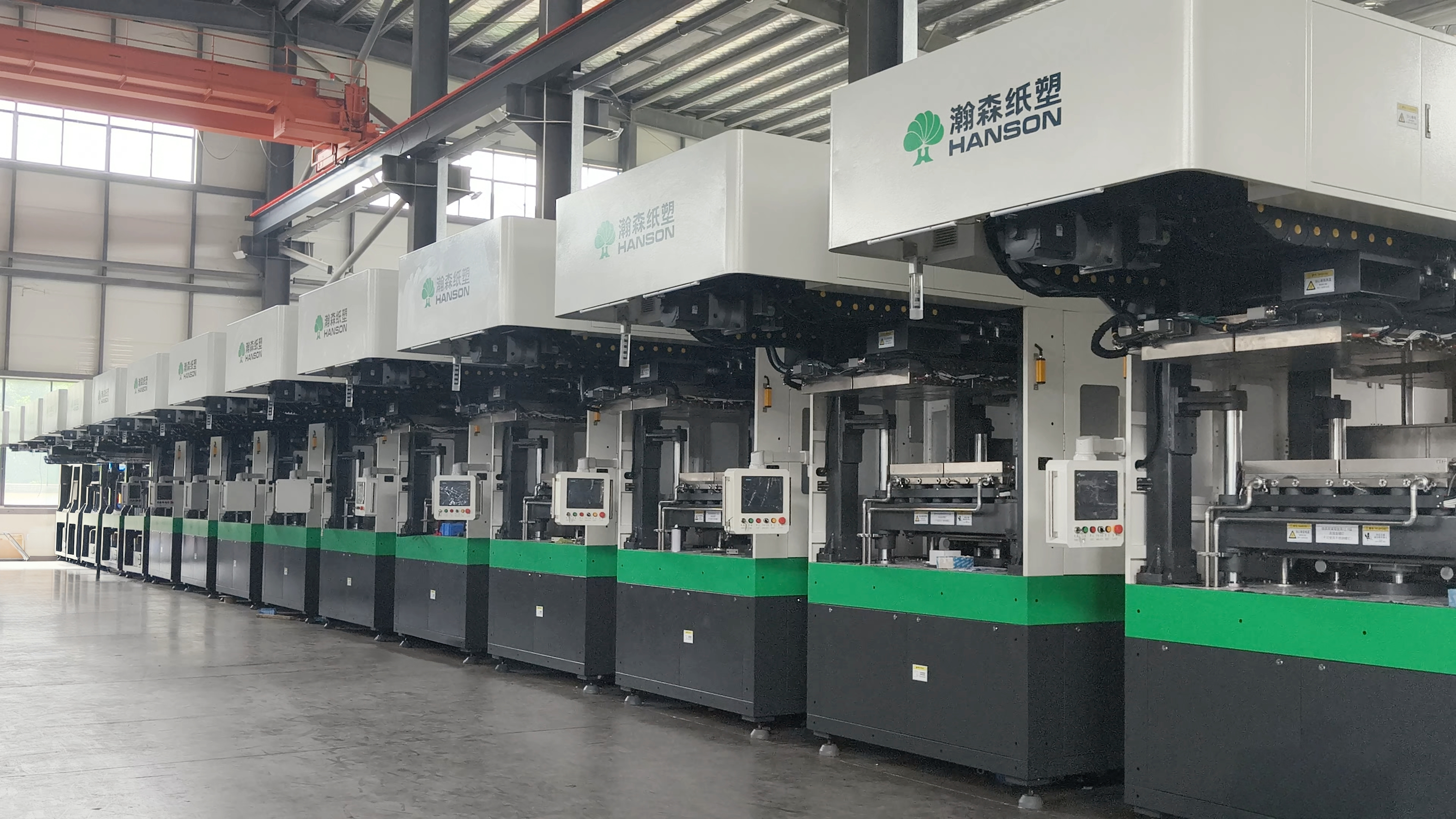
Pre-delivery trial operation and inspection records are part of the compliance file, not an optional courtesy.
Resident Service and Ramp-Up as Contractual Commitments
Service scope is the part of a turnkey offer most often left vague, and the part that most often determines when a factory reaches stable output. Hanson’s resident on-site service covers installation, utility connection, multi-system commissioning, process coordination, trial operation, operator training and project acceptance. That contrasts with a short-term commissioning model, which generally ends after installation and basic functional testing, with later issues handled through remote support or separate service visits.
For turnkey projects, Hanson can provide up to six months of production ramp-up and on-site support, depending on the contract and project requirements. Ramp-up support addresses the production process rather than the machine alone: pulp formulation adjustment, forming-parameter optimisation, defect analysis, production-rhythm improvement, mold adaptation and operator coaching. Standard after-sales service, by comparison, focuses on equipment troubleshooting, maintenance, spare parts and remote technical support.
The commercial logic is straightforward. Ramp-up support requires a greater service investment, but it can reduce trial-production losses, product defects, operator errors and the time needed to reach stable production. Standard after-sales service carries a lower continuous service cost but places greater responsibility on the customer’s own process team. A service network of 10 locations supports installation and commissioning, maintenance, technical support and spare parts for projects after handover.
Applying the Criteria to Different Project Types
The same qualification framework produces different priorities depending on what the buyer is building.
- New factories and overseas projects without an experienced pulp molding engineering team gain most from a turnkey structure, because pulping, vacuum, compressed air, heating, water circulation and production rhythm can be optimised as one system by one project team.
- Multi-fiber operations — bagasse, bamboo and agricultural fiber furnish — place the heaviest demands on pulp preparation. An integrated pulping design, where slurry concentration, flow, pipelines, tanks and white-water circulation are coordinated by the same engineering team as the forming equipment, removes an interface that would otherwise sit between two suppliers.
- Cup lid production rewards downstream integration. Vision inspection, rejection, counting and packing inside one line eliminate manual handling steps between stages.
- Premium industrial packaging with strict appearance and dimensional requirements favours automatic integrated equipment over manual production, because automated forming, wet-preform transfer, in-mold drying and hot pressing remove operator participation from at least three major process steps.
Where Turnkey Qualification Stops: Limits and Trade-Offs
A qualification framework that only lists advantages is not a qualification framework. Several boundaries matter at decision stage.
A turnkey project may carry a higher total contract value than separate procurement, even though it reduces repeated engineering, interface modification, multi-supplier coordination and project-delay risk. Separate procurement lets a buyer compare the price of each individual machine, but additional integration, modification and management costs can arise during implementation. Experienced manufacturers that already operate mature pulping, process, engineering and project-management capabilities are therefore reasonable candidates for separate purchasing, while turnkey structures suit new factories, large-scale projects and overseas projects without an established engineering team.
Second, capacity and energy figures are ranges with conditions attached. Actual capacity and energy consumption depend on product weight, mold layout, raw material and production configuration, and the energy difference also reflects vacuum system, compressed-air system and heating configuration. A buyer who converts a range midpoint into a production plan without validating it against their own product is taking a commercial risk that no supplier document can remove.
Third, drive technology involves an investment trade-off. The full-servo solution generally requires a higher initial investment in control and drive systems, though it reduces long-term losses related to product inconsistency, inefficient movement and energy management. The pneumatic-hydraulic solution may offer a lower initial equipment configuration cost and uses a mature mechanical and pressure structure that some operators find more familiar, but requires regular inspection of air, hydraulic and pressure-boosting components.
Fourth, scope boundaries need explicit confirmation. Hanson’s broader turnkey description references electrical control, utilities, wastewater treatment, installation, commissioning and personnel training under one project-management system, while the 6+1 module list is expressed at a higher level. Buyers should confirm line by line which items are inside the contracted scope, because utility and wastewater interfaces commonly remain customer-side obligations even in an integrated project.
Finally, qualification verifies capability claims; it does not verify product-market fit. A supplier can demonstrate mold capacity, reference tonnage and service depth while the buyer’s own product, price point and order book remain the larger variables.
Market Outlook for Buyer-Side Qualification
Three trends are pushing pulp molding procurement toward documented acceptance. The first is scale: a market moving from roughly USD 2.14 billion in 2024 toward a projected USD 3.76 billion by 2032 attracts more suppliers, which raises the value of comparable evidence. The second is application concentration in food and beverage packaging, where inspection, cleanliness and dimensional consistency are contractual rather than cosmetic requirements. The third is regulatory: the transition away from EN ISO 13849-1:2015 by May 2027 will force safety documentation reviews across installed and incoming equipment in EU-bound projects.
Alongside those, energy performance is becoming a line item in the purchase decision rather than an afterthought. Where full-servo configurations can reduce comprehensive energy consumption by approximately 15%–25% under comparable conditions, the payback argument depends entirely on the buyer’s operating hours, tariff and product mix — which is precisely why the conditions belong in the contract rather than in the brochure.
Frequently Asked Questions
What is a pulp molding turnkey supplier responsible for?
A turnkey pulp molding supplier takes responsibility for an integrated project scope rather than individual machines. In Hanson’s case that scope is organised as 6+1 modules: factory planning, pulp preparation, forming equipment, mold manufacturing, downstream automation, technical and production support, plus product development, raw-material development, sampling and small-batch validation. The buyer’s qualification task is to confirm which of those modules are contractually inside the scope and which remain customer-side, particularly utilities and wastewater treatment.
What capacity figure should be written into acceptance criteria?
Capacity should be written as a range tied to stated conditions. Hanson’s full-servo tableware equipment, such as the ZFG-1111, provides a reference capacity of 900–1,200 kg/24 h, while the hydraulic ZCE-1111D provides 600–900 kg/24 h, depending on product, mold layout and process conditions. The separated modular ZBG-1111 is referenced at 1,000–1,500 kg/24 h. An acceptance clause should name the reference product, mold layout and fiber furnish so the figure can be tested rather than interpreted.
How can a buyer verify in-house mold capability?
Ask for designer headcount, machining capacity and the mold test procedure. Hanson operates an in-house mold division with approximately 10 experienced mold designers and access to about 45 CNC machining centers, including coordinated external machining capacity, covering product evaluation, structural design, mold design, machining, assembly, testing and mass-production adaptation. Under a fully outsourced mold model the equipment supplier typically has 0 in-house mold designers and 0 in-house machining capacity, which changes who diagnoses a defect when product quality deviates.
What does resident on-site service include compared with short-term commissioning?
Hanson’s resident on-site service covers installation, utility connection, multi-system commissioning, process coordination, trial operation, operator training and project acceptance. For turnkey projects, up to six months of production ramp-up and on-site support can be provided, depending on the contract and project requirements. A short-term commissioning model generally ends after installation and basic functional testing, with later issues handled through remote support or separate service visits.
What compliance evidence should be requested for EU-bound projects?
Request the declared functional safety standard and its version, because safety-related parts of machinery control systems must comply with EN ISO 13849-1 and the 2015 edition is being withdrawn after a transition period ending 15 May 2027. Supporting evidence includes the safety function list, validation record, and documentation of PLC safety interlocks, safety-door interlocks, emergency stop systems, pressure and vacuum monitoring, plus installation and commissioning inspection and electrical system testing records.
When is turnkey procurement the wrong choice?
Turnkey procurement is less suitable for manufacturers that already operate mature pulping, process, engineering and project-management capabilities, since separate equipment purchase allows machine-by-machine price comparison and greater supplier flexibility. It also carries a potentially higher total contract value. In addition, buyers must accept that capacity and energy figures are ranges dependent on product weight, mold layout, raw material and operating conditions, and that full-servo configurations require a higher initial investment in control and drive systems than pneumatic-hydraulic alternatives.
Hanson Pulp Molding publishes its equipment portfolio, turnkey scope and service structure in a downloadable brochure, which buyers can use as a starting point for the evidence requests described above: Hanson Pulp Molding company and product brochure (PDF).
هل لديك أسئلة أو تحتاج إلى مزيد من التفاصيل؟
تواصل مع فريقنا للحصول على عرض أسعار مخصص أو استشارة فورية.
طلب عرض أسعار
املأ النموذج أدناه وسيتواصل معك فريقنا بعرض مقترح مخصص.
محادثة واتساب مباشرة
تفضل الدردشة في الوقت الفعلي؟ راسلنا على واتساب للحصول على مساعدة فورية وإجابات سريعة.
- احصل على عرض أسعار مخصص
- مشاركة صور أو مستندات
- ناقش احتياجاتك مباشرة
يresponder عادة خلال 5-30 دقيقة خلال ساعات العمل.