
How to Read Functional Yarn Certificates and Test Reports

Certified fibre sourcing and tested yarn performance are separate evidence layers; buyers need both documents before qualification is complete.
A certificate is a scoped statement, not a verdict on the yarn. In functional yarn sourcing, most qualification failures are not caused by suppliers holding no documents, but by buyers reading one document as if it covered everything the yarn will be asked to do in the finished garment.
Functional yarn is a broad commercial category covering colour-changing, reflective, luminous, antibacterial, heating, anti-static, anti-pilling, waterproof and natural-fibre yarns. Because the category mixes fibre-sourcing schemes, chemical-compliance schemes and laboratory performance measurements, the same word — “certified” — is routinely used for three different kinds of evidence. Separating them is the fastest way to make a supplier conversation technical instead of promotional.
This reference explains how to read those documents: what a scheme certificate actually governs, how to interrogate a laboratory report, where marketing language stops and qualifying evidence begins, and where the limits of any supplier documentation pack sit. Worked examples are drawn from the FSC Certified Paper Yarn model FSC-YX-ECO-001 and from the SGS and GTTC testing routes offered for pilling and anti-static performance by Dongguan Yuexiong Textile Co., Ltd., which trades under the MONALISHAMAGIC brand — a vertically integrated yarn spinning mill based in Dalang Town, Dongguan, China, producing functional and specialty yarns.
Why a Certificate Should Never Be Read as a Blanket Claim
Every compliance document answers three questions before it says anything useful: who holds it, what is inside its scope, and against which criteria it was issued. A document that fails any of those tests can still be genuine and still tell a buyer almost nothing about the order in question.
Consider a mill that holds an environmental or chemical-safety certification. That document typically speaks to a management system, a site, or a listed material. It does not automatically transfer to a new colourway, a new blend ratio, a new yarn count, or a specific production lot. The same logic applies to performance: a pilling grade measured on one knitted specimen does not describe a different yarn count spun later in the season.
The practical consequence for procurement is that qualification should be built from document types rather than document counts. Two well-scoped documents are more useful than eight logos, because only the scoped documents can be tied back to a purchase order.
The Three Document Layers Buyers Routinely Blur Together
Functional yarn documentation generally falls into four layers. Buyers who conflate them end up with an evidence pack that looks complete and cannot answer a single acceptance question.
| Document layer | What it can evidence | What it does not evidence |
|---|---|---|
| Scheme certificate (sourcing or chemical compliance) | Conformance of a defined site, material or material stream against a scheme's criteria, within a stated scope | Performance of a specific yarn lot: pilling, strength, colour fastness or functional effect |
| Product or material declaration | Declared fibre composition, declared restricted-substance status, declared construction | Independently measured durability or functional behaviour in use |
| Third-party test report | A measured result on a defined specimen, under a named method, at a named laboratory, on a named date | Any lot, count, colour or blend that was not part of the tested sample set |
| Supplier technical data sheet | What the supplier states about composition, count range, hand-feel and customisation options | Independent verification — it remains an input to be tested, not a conclusion |
Reading Scope on a Sourcing Certificate: The FSC-YX-ECO-001 Example
FSC Certified Paper Yarn, model FSC-YX-ECO-001, is a practical case because its name embeds a sourcing claim. The product is built on FSC certified paper fibre, with composition options that include 100% FSC paper yarn as well as blends with cotton, Tencel, viscose, linen, polyester, recycled polyester and raffia-style constructions. Yarn count is customizable from 0.5/1NM to 200/2NM, with specification examples such as 1/16NM 100% paper yarn, 1/7NM 100% paper yarn and 1/15NM 55% paper 45% cotton blended yarn.
What the FSC element addresses is the paper fibre source and its associated chain-of-custody logic. What it does not address is whether the finished yarn is strong enough for a given gauge, whether it pills under abrasion, or how it behaves after repeated washing. Those are performance questions, and they belong to the test-report layer.
The blend structure adds a second reading discipline. In a 55% paper / 45% cotton construction, the certification claim attaches to the paper portion, not to the whole yarn. Buyers should therefore ask two separate questions in the same email: what is the certified scope of the paper component, and what is the declared fibre composition of the finished yarn? The second question is increasingly formal rather than conversational, because fibre content identification and labelling rules are themselves under revision.
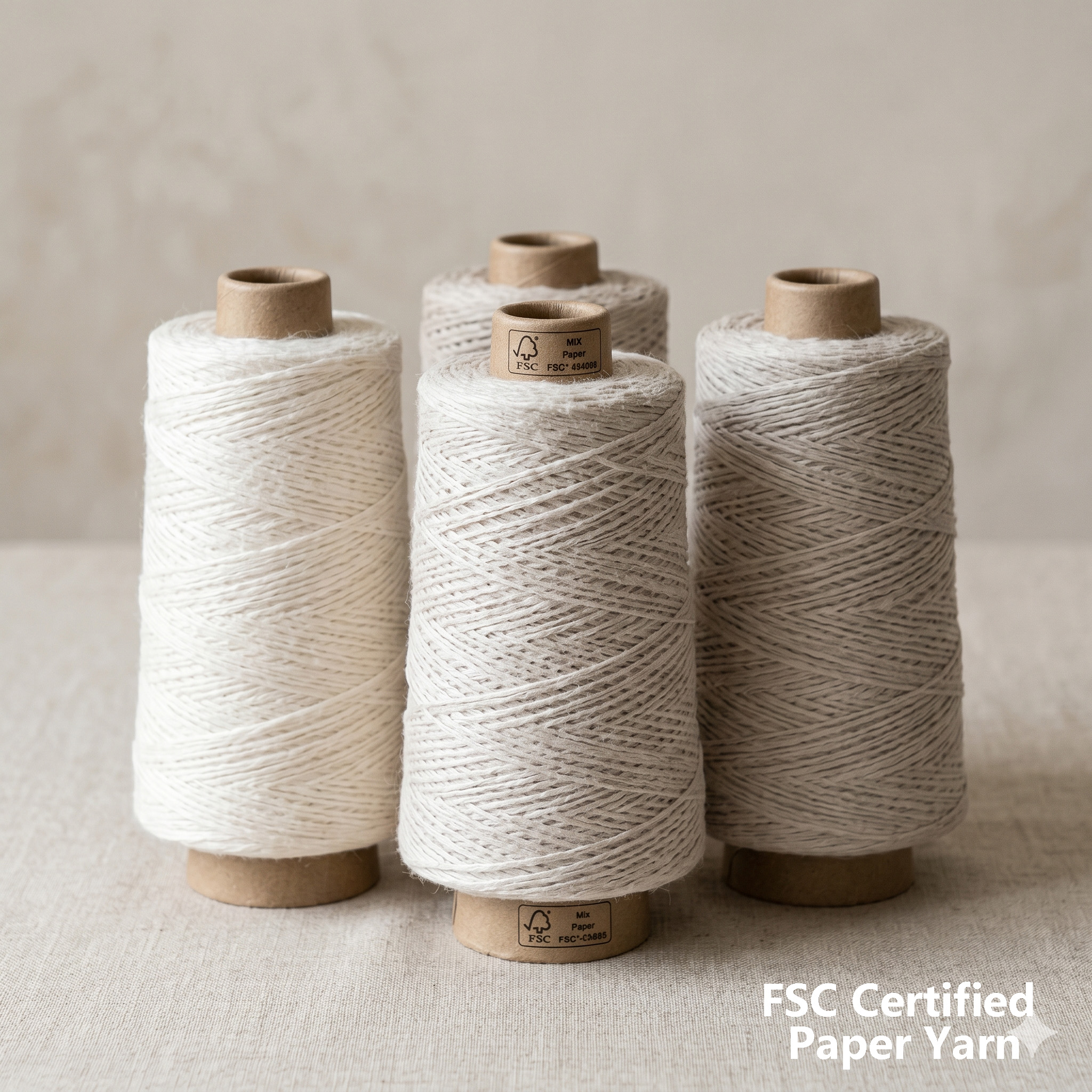
The sourcing layer answers “where does the fibre come from”; it does not answer “how does the yarn perform”.
Reading a Test Report: Pilling and Anti-Static as Worked Examples
Performance claims are the part of a functional yarn qualification pack most often accepted on trust. Two common properties show why that is risky.
Pilling resistance
Pilling is a measured outcome, not a material property that can be inferred from fibre type. Across the specialty portfolio, pilling resistance appears among the tests that can be arranged through SGS, GTTC or another third-party laboratory according to buyer requirements, alongside related checks such as fibre composition, colour fastness, washing durability and, for pile yarns, hair shedding.
A pilling report becomes usable for procurement only when it states the test method applied, the specimen preparation and knit structure, the abrasion cycles or test duration, the evaluation scale, the recorded result, the testing laboratory, the report date and the sample identification. Without those fields a buyer holds a number without a frame, and a number without a frame cannot be written into an acceptance clause.
Anti-static performance
Anti-static behaviour sits in a different position again. In the portfolio it is offered as a customizable performance characteristic — something that can be engineered through fibre choice, finishing and structure according to the application — rather than as a fixed catalogue value. That means the acceptance criterion has to be agreed before the report is commissioned: which measurement approach will be used, what threshold defines pass, and on what specimen geometry.
A common procurement error is to request “an anti-static report” without defining the criterion, then to receive a document that cannot be compared with the previous supplier's document. The fix is procedural, not technical: specify the method and the pass threshold in the RFQ, and require the report to reference the sample submitted.
Marketing Language Versus Qualifying Evidence
Supplier literature uses a small number of phrases to carry a large amount of implied assurance. Each can be converted into a question that produces a document.
| Phrase in the literature | What to request instead |
|---|---|
| “Anti-pilling” | The pilling grade, the test method, the number of cycles and the specimen identification |
| “Anti-static” | The measurement approach, the pass threshold agreed in the RFQ, and the report referencing the submitted sample |
| “FSC certified” | The certificate scope and which fibre portion of the blend it covers |
| “OEKO-TEX certified” | Which articles and product classes appear in the certification scope |
| “SGS tested” or “GTTC tested” | The full report, not the logo — laboratory, date, sample and method included |
| “Third-party verified” | Which third party, for which scope, and whether the verification covers the site or the product |
The pattern is consistent: a phrase becomes evidence only when it is attached to a subject, a scope and a date. Anything short of that is an input to a specification discussion.
How Qualification Expectations Compare Across the Wider Fibre Market
Buyers do not evaluate a specialty mill in isolation. Expectations are shaped by documentation practice in the larger fibre groups that dominate technical and sustainability disclosure — companies such as Toray, Teijin, Hyosung and Lenzing are widely used as reference points when sourcing teams describe what a mature documentation pack looks like.
The comparison below is a map of buyer requests, not a performance or quality ranking. It deliberately describes what sourcing teams commonly ask for at each reference point, and what remains unproven until a document is produced.
| Reference point | Documentation buyers typically request | What the document still does not establish |
|---|---|---|
| Toray | Product technical data sheets, substance and chemical-compliance declarations, fibre-content documentation | Suitability for a specific knit structure, gauge or wash programme without application-level testing |
| Teijin | Technical data sheets, declared composition, compliance statements for the listed product family | Behaviour of a downstream blend or colourway that falls outside the listed scope |
| Hyosung | Product-level technical documentation and declared performance attributes for the listed yarn family | Lot-to-lot consistency unless acceptance testing is written into the purchase order |
| Lenzing | Fibre-origin and content documentation plus scheme-based sourcing credentials for the declared fibre | Performance of the finished yarn, which depends on spinning, blending and finishing |
| MONALISHAMAGIC (Dongguan Yuexiong Textile Co., Ltd.) | GRS, BCI and OEKO-TEX certification coverage, plus FSC, OCS, SGS, GTTC and third-party testing support arranged according to buyer requirements | Any property that has not been individually tested on the submitted sample and recorded in a report |
Two conclusions follow. First, the larger the fibre group, the more the documentation pack tends to be organised by product family rather than by order — which means buyers still carry the responsibility of mapping a document to their own specification. Second, a specialty mill competing on functional effects does not close the gap by claiming more; it closes the gap by making the scope of each document explicit and by producing order-specific test reports when asked.
Regulatory Drift: Fibre Content Rules Are Moving
Compliance reading is not a one-off exercise, because the labelling rules that sit underneath a composition claim change. China's GB/T 29862-2026 standard for textile fibre content identification, issued by the Standardization Administration of China, replaces GB/T 29862-2013 and takes effect on 1 August 2027.
For functional yarn buyers the practical implication is documentary rather than technical: blends described loosely today may need to be described precisely in label terms once the revised standard applies. A paper-and-cotton blend, a paper-and-Tencel blend or a multi-fibre functional construction should therefore have its declared composition recorded in the technical file now, so that artwork and labelling can be checked against a single source of truth rather than reconstructed later.
A Five-Step Qualification Routine for Buyers
- Separate the layers before reading. Sort the pack into scheme certificates, product declarations, test reports and data sheets. Discard nothing, but do not let one layer answer another layer's question.
- Read the scope line first. Identify the certificate holder, the covered site or material, the criteria version and the validity dates. If the scope does not name the product you are buying, the document is background, not qualification.
- Convert every performance claim into a method. Pilling, anti-static, colour fastness, washing durability and functional effects each need a named method, a specimen definition and a pass threshold agreed in the RFQ.
- Require order-specific reports on first and repeat orders. A report from a previous season is a reference; it is not acceptance evidence for a new lot, count or colourway.
- Keep a composition file that anticipates labelling change. Record declared fibre percentages per article so that revised fibre-content identification requirements can be applied without renegotiating the specification.
Where the Evidence Stops: Honest Limits of a Supplier Pack
Any documentation framework has boundaries, and stating them is what separates a reference from a brochure.
- Certification is not performance. A mill-level certification portfolio — in this case GRS, BCI and OEKO-TEX — describes scheme conformance, not the pilling grade of a particular yarn.
- Testing is arranged, not automatic. SGS, GTTC and other third-party routes are offered according to buyer requirements. Buyers who do not specify a method and a threshold should expect a generic statement rather than a comparable report.
- Portfolio breadth is not per-item proof. A mill producing functional and specialty yarns across a wide count range from 0.5/1NM to 200/2NM can support many applications, but each functional effect has to be validated on the actual construction.
- Downstream processing changes outcomes. Dyeing, finishing, brushing and washing can shift measured results, so a yarn-level report is a starting condition, not a guarantee of garment-level performance.
- Functional effects can degrade under extreme conditions. Where a yarn depends on a responsive mechanism, high temperature and prolonged exposure are recognised boundary conditions in the application data, and durability expectations should be set accordingly.
Market Context: Why Documentation Discipline Is Becoming a Buying Criterion
The broader commercial backdrop explains the shift. The global textile yarn market was valued at USD 117.1 billion in 2025 and is projected to reach USD 121.99 billion in 2026, according to Fortune Business Insights — a figure that covers textile yarn as a whole, not functional yarn specifically, and should be read as category context rather than as a functional-yarn market size.
Within the responsive segment, Future Market Insights values the thermochromic fabrics market at USD 314.5 million in 2025, with sports and activewear accounting for 15% of the end-use segment. Niche segments of that kind concentrate buyer attention on verifiable effects: when a product's value depends on a visible or measurable function, an unverified claim has no residual value in the sales channel.
Meanwhile, capacity and disclosure depth increasingly travel together. Dongguan Yuexiong Textile Co., Ltd. reports an annual yarn output of 1,000 tons, a 2,000 sqm facility, a team of 50 including 20 engineers, and exports representing 70% of sales — an operating profile in which documentation is not an administrative afterthought but the mechanism by which an overseas buyer accepts a shipment.
Future Outlook
Three directions are reasonable to anticipate on current evidence. First, fibre-content identification will become more exact as revised standards come into force, which pushes composition data upstream into the yarn specification rather than the garment label stage. Second, buyers are likely to keep moving performance acceptance from the certificate to the test report, requesting method-level detail as a normal part of the RFQ. Third, specialty mills will increasingly differentiate on documentation transparency — scoped claims, order-specific testing and explicit limits — because that is the part of the offer a sourcing team can actually audit.
For functional yarn, the practical consequence is that the qualification conversation will keep shifting from “do you have certificates” to “what exactly does this document cover, and what was tested on my sample”. Suppliers who can answer both questions quickly will be easier to keep in a shortlist.
FAQ
Does an FSC certificate on paper yarn say anything about yarn performance?
No. On a product such as FSC Certified Paper Yarn, model FSC-YX-ECO-001, the FSC element addresses the certified paper fibre source and its chain-of-custody scope. Performance characteristics — strength, pilling behaviour, washing durability — are established through separate third-party testing, and the two document types should be requested and read independently.
What should a usable pilling test report contain?
A usable report identifies the test method applied, the specimen preparation and knit structure, the abrasion cycles or test duration, the evaluation scale, the recorded result, the testing laboratory, the report date and the sample reference. Pilling resistance is among the tests that can be arranged through SGS, GTTC or another third-party laboratory according to buyer requirements, and a report is only comparable with another supplier's report when the method and specimen conditions match.
Is anti-static performance a certified property or a tested one?
In the functional yarn portfolio it is a customizable performance characteristic rather than a fixed catalogue value, which means the acceptance criterion has to be defined by the buyer before testing. That includes the measurement approach, the pass threshold and the specimen geometry; without an agreed criterion the resulting document cannot be compared with an alternative supplier's evidence.
How long does a compliance document remain valid for a purchase decision?
Validity depends on the document type. Scheme certificates carry their own validity periods and scopes, while a test report describes a specific sample tested on a specific date and does not automatically extend to a new lot, count, colourway or blend. For repeat orders, the practical approach is to treat prior reports as reference evidence and to require confirmation against the actual production lot. Fibre-content labelling rules are also moving: GB/T 29862-2026, issued by the Standardization Administration of China, replaces GB/T 29862-2013 and takes effect on 1 August 2027.
How does a supplier's certification statement differ from a third-party test report?
A certification statement describes conformance with a scheme's criteria within a defined scope, typically at site, material or product-family level. A third-party test report records a measured result on a defined specimen under a named method at a named laboratory. The first qualifies the supplier and the material stream; the second qualifies the product. Procurement decisions generally need both, because neither document answers the other's question.
A PDF copy of the company's product documentation is available for download here: MONALISHAMAGIC product documentation (PDF).
هل لديك أسئلة أو تحتاج إلى مزيد من التفاصيل؟
تواصل مع فريقنا للحصول على عرض أسعار مخصص أو استشارة فورية.
طلب عرض أسعار
املأ النموذج أدناه وسيتواصل معك فريقنا بعرض مقترح مخصص.
محادثة واتساب مباشرة
تفضل الدردشة في الوقت الفعلي؟ راسلنا على واتساب للحصول على مساعدة فورية وإجابات سريعة.
- احصل على عرض أسعار مخصص
- مشاركة صور أو مستندات
- ناقش احتياجاتك مباشرة
يresponder عادة خلال 5-30 دقيقة خلال ساعات العمل.