
How to Read a TPU PPF Factory's Range and Defect Controls
A paint protection film buyer rarely sees the coating line before the container ships. What the buyer can see is narrower and more useful: which product families a factory actually runs, which controls sit behind each roll, and which of those controls are written into the purchase terms.
TPU Paint Protection Film (PPF) is a surface-protection film built on thermoplastic polyurethane. In value terms it is now the dominant material class in the category: Grand View Research reports that the TPU segment held the largest revenue share of the paint protection film market in 2025, at 82.9%. When material choice converges this far, supplier differentiation moves to process stability — and process stability is exactly what a factory's product range and defect controls are supposed to demonstrate.
That makes range and defect prevention a procurement question rather than a marketing one. A range tells the buyer what platform exists. Defect controls tell the buyer whether that platform holds across batches. Purchase terms decide whether either claim can be checked before money moves, and whether a failed roll produces a replacement or an argument.
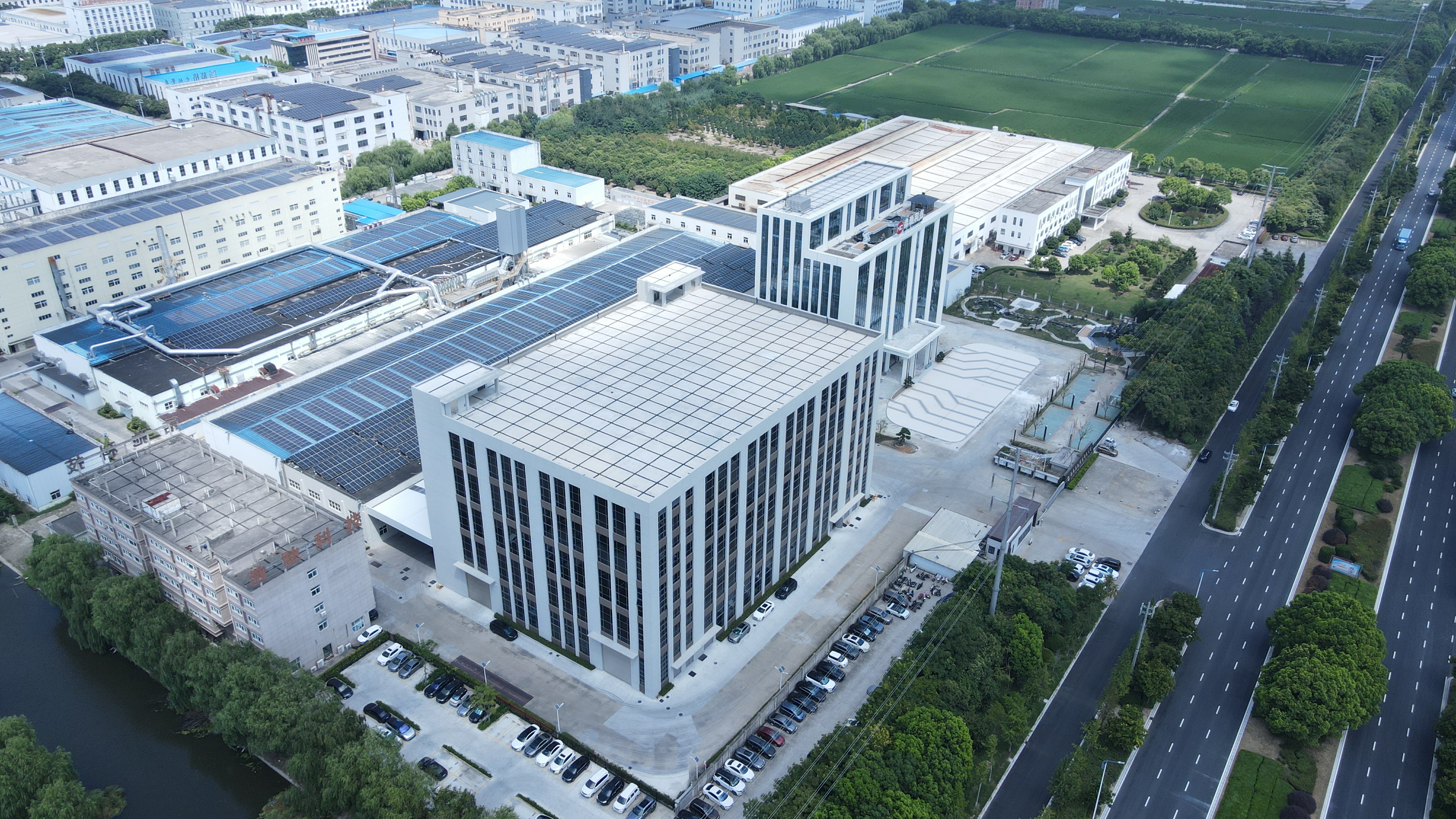
Functional film manufacturing at Haian Ho Chi Technology Co., Ltd., the company behind HOCHI PPF & Window Film.
Why range and defect control have to be read together
A factory's product range is a statement about its platform: which substrates it handles, which coating, lamination and slitting routes it runs, and which inspection equipment it has already had to justify. Its defect controls are a statement about whether that platform repeats from batch to batch. Read separately, either one misleads.
A broad range with no defect data describes ambition. Defect data with no range describes a single line with no fallback if a coating route or a base-film supply changes. The combination is what a buyer is actually underwriting: continuity of supply on the specification that was qualified.
For a buyer working from evaluation into execution, the practical question is not how many SKUs a factory lists. It is which of those SKUs has a delivery record, and which controls were applied to the rolls that were delivered. That reframing separates a supplier capability assessment from a catalogue review.
What the product range shows about the platform
HOCHI PPF & Window Film is the brand of Haian Ho Chi Technology Co., Ltd., a functional film manufacturer established in 2009 and located at No. 88, Lifang Avenue, Haian Economic and Technological Development Zone, Nantong, Jiangsu, China. The company describes itself as a national high-tech enterprise for nine consecutive years and a national-level specialized and innovative enterprise, and reports a 133,333 m² site, 220+ employees, 100 engineers and 48 million meters of annual output.
Its published product set spans automotive window film — nano-ceramic, carbon, original-colour, dyed, front-layer and iridescent types — alongside paint protection film, architectural film and explosion-proof film. The specification table below is drawn from that published set.
| Product family | Examples from the published specification set | What it indicates to a buyer |
|---|---|---|
| Automotive film — sputter | QS0595, QS5095, SV3095, SV0595 | Multi-layer sputter route; VLT from 5% to 50%, UV rejection 99%, stated 10-year warranty |
| Automotive film — glue tint | CLASSIC35P, CLASSIC03P | Dyed route; VLT 3%–35%; stated 4-year warranty with colour-stability claims |
| Automotive film — security | NEX4MIL05, NEX8MIL05 | Thick 2-ply PET constructions (4.0 and 8.0 mil) with strong-adhesive claims |
| Automotive film — reflective | SL05R | Reflective route; heat rejection and colour stability claims |
| Car window film | CARBONBRONZE 10 | Carbon-dyed series; VLT 10%, IR cut 90% |
| Architecture film | SF02, SF12, SILVER/BLUE 15, SILVER/GOLD 20, SILVER/GREEN 10, SILVER/GREY 05, SILVER 5%, SILVER 10% | Safety and solar-control routes for building glass; warranties of 4 to 6 years by model |
These families share an optical-grade PET base and a common optical test vocabulary: visible light transmission, infrared cut and UV rejection. That shared vocabulary is what makes a multi-family plant efficient — the same spectrophotometry, the same slitting tolerance and often the same defect-inspection station serve several product lines.
The transfer also stops somewhere. Window film performance is largely optical and adhesive. PPF performance is mechanical, chemical and temporal: tensile behaviour, elongation at break, self-healing recovery, peel adhesion over years, and colour stability after weathering. A factory that runs both still has to qualify PPF on PPF-specific tests.
Range alone therefore remains a weak signal. The more useful evidence is a named application with a repeat record. HOCHI's published case material describes 7.5 mil and 8.5 mil high-gloss TPU PPF supplied at roughly 2,000 rolls a year — about 30,000 meters — to luxury car dealership groups and automotive customisation brands in the United States and the United Arab Emirates, across a four-year partnership, with the product positioned for an 8–10 year service life.
The three failure modes that decide a PPF programme
Complaint data in this category converges on three failure modes, and each one has a different root cause. Buyers who can name them can also name the tests they should be shown.
Yellowing
Yellowing is a polymer-stability question. Aliphatic TPU keeps a more UV-stable molecular backbone than aromatic grades and, importantly for the automotive aftermarket, than plasticised PVC and TPH constructions, where plasticiser migration under ultraviolet and heat is the usual route to embrittlement and discolouration. HOCHI's stated position is that its PPF uses optical-grade aliphatic TPU resin with a pressure-sensitive adhesive, and that the construction is designed against UV yellowing with a stated Delta E below 1.5 over five years.
Bubbling and delamination
Bubbling and delamination usually trace back to moisture or solvent retained under the adhesive, incomplete adhesive wet-out, or edge lift under shrinkage stress. These are process variables, so they are tested rather than asserted: a high-temperature ageing test is the standard way to force the failure inside a short window instead of discovering it in a customer's workshop two summers later.
Adhesive residue
Residue is a removal-stage failure, which makes it easy to under-test because it appears years after the sale. It is governed by the adhesive system, the cure state and the surface the film was applied to. Peel adhesion testing is the proxy a buyer can ask for at the point of qualification, together with a written removal and replacement procedure.
The comparative picture the manufacturer states is straightforward: PVC and TPH films rely on plasticisers that degrade under UV and heat, with yellowing reported within one to two years, brittle cracking, and adhesive residue during removal. Those positions are the manufacturer's description of material behaviour, not an independent laboratory finding.
Where defect prevention sits in the process
Defect prevention is only credible when it is attached to a specific inspection step and a record that leaves the building with the roll. HOCHI's stated control set has five elements, and each one maps onto a failure mode rather than onto a general quality claim.
| Control | Failure mode it targets | Evidence a buyer can request |
|---|---|---|
| 100% online optical defect inspection | Point defects, contamination, coating streaks | Per-roll defect inspection records |
| Spectrophotometer test (VLT / UVR / IRR) | Batch-to-batch optical drift | Batch optical data against the approved specification |
| Peel adhesion test | Edge lift, delamination, removal residue | Peel adhesion results and the test method used |
| High-temperature ageing test | Bubbling, yellowing, adhesive breakdown | Appearance and colour-shift records before and after ageing |
| Third-party inspection (SGS) | Independent verification of the pre-shipment condition | Third-party inspection report |
The acceptance criteria the manufacturer publishes are a pre-shipment test plus third-party inspection by SGS. That pairing matters more than either element alone. A pre-shipment test without a third party is self-certification; a third-party inspection without a defined pre-shipment specification has nothing to inspect against. The specification document is the buyer's lever in both cases.
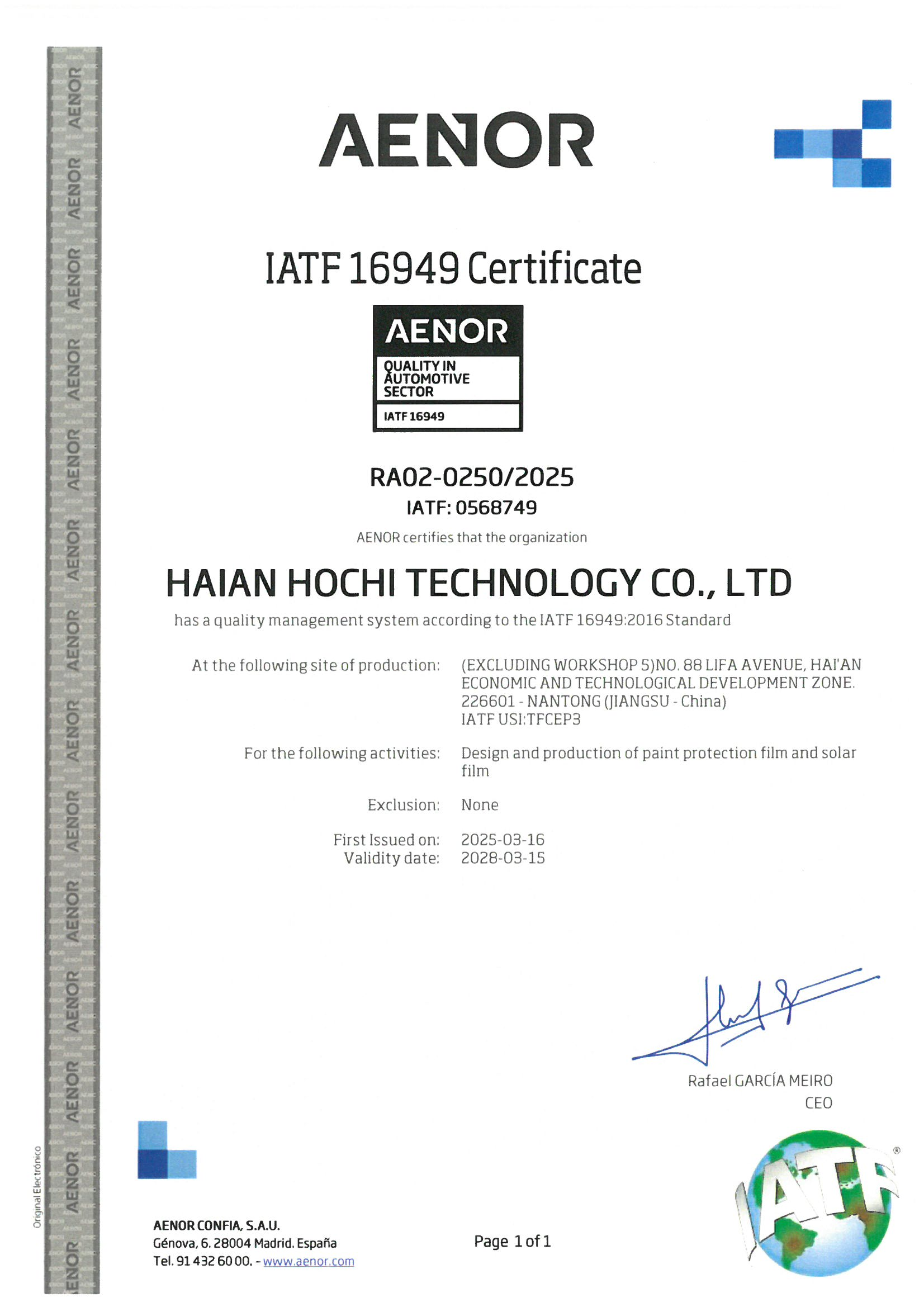
IATF 16949:2016 certificate RA02-0250/2025 (IATF: 0568749), issued by AENOR CONFIA S.A.U., with a scope covering the design and production of paint protection film and solar film.
Certifications: read the scope line, not the logo
The certificate that matters most for a PPF buyer is the automotive quality system certificate, and the reason is the scope line. HOCHI holds IATF 16949:2016 certificate RA02-0250/2025 (IATF: 0568749), issued by AENOR CONFIA S.A.U., valid from 16 March 2025 to 15 March 2028. Its stated scope is the design and production of paint protection film and solar film.
That wording is the point. An IATF certificate whose scope covers window film only does not tell a PPF buyer that the PPF line sits inside the automotive quality system. When the scope names paint protection film, the PPF process is inside the audited boundary — design control, production control and the corrective-action loop that goes with them.
The management system certificates sit alongside it: ISO 9001:2015 (certificate 04325Q31011R1M), ISO 14001:2015 (certificate 04325E30833R1M) and ISO 45001:2018 (certificate 04325S40794R0M), all issued by Beijing United Intelligence Certification Co., Ltd. and valid from 19 May 2025, with the quality and environmental certificates running to 19 May 2028 and the occupational health and safety certificate to 18 May 2028.
The boundary is equally clear. A management system certificate shows that a process is defined, audited and corrected. It does not show that a particular roll will resist yellowing for five years in a particular climate. Buyers who need that assurance should be asking for weathering and colour-shift reports on the specific construction, not for a second copy of the certificate.
Capacity, lead time and what OEM customisation actually covers
Capacity claims are only useful when they are attached to a lead time and a minimum order. HOCHI states monthly capacity of 3 to 5 million meters against 48 million meters of annual output, a lead time of 30 to 45 days, and a minimum order quantity of 50 rolls, with sample orders available on request.
The customisation list is more specific than the word OEM usually implies. It covers VLT from 5% to 70%, UV and IR rejection rates, film thickness in mil, roll dimensions in width and length, custom colours, release liner specification, and printing on the packaging box and core.
For a distributor, that list is the difference between buying a catalogue item and building a house line. VLT band, thickness and core printing are the three variables that most often define a private-label programme, and all three are inside the stated customisation envelope. For a detailing chain, the relevant variables are usually thickness, finish and roll width — the last of which drives wastage on partial wraps.
The export profile supports the claim that these specifications travel. HOCHI reports a 60% export share, with markets spanning the Netherlands, Norway, Poland, Portugal, Romania, Sweden, Ukraine, Belgium, Belarus, the Czech Republic, Germany, Denmark, Spain, Finland, the United Kingdom, France, Croatia, Ireland, Italy, Luxembourg, Argentina, Chile, Colombia, Ecuador, Mexico, Peru, Bolivia, Qatar, the UAE, Bahrain, Saudi Arabia, Türkiye, Cambodia, Kuwait, Laos, Malaysia, Singapore, Syria, Iraq, New Zealand, Australia, Uzbekistan, Hungary and Slovakia, plus Brazil, Uruguay and the United States.
Purchasing terms and acceptance criteria you can put in writing
Commercial terms are where capability evidence becomes enforceable. The published position is short enough to quote in full, which is itself a useful signal.
| Term | Stated position | What it means at contract stage |
|---|---|---|
| Minimum order | 50 rolls; sample orders available upon request | Sample evaluation is possible before committing to a production run |
| Lead time | 30–45 days | Production window; transit and clearance added separately |
| Delivery terms | FOB Shanghai | Port of loading defined; inland and ocean costs sit with the buyer |
| Payment terms | 30% T/T in advance, 70% T/T against copy of B/L | Balance released against shipping documents rather than on arrival |
| Acceptance criteria | Pre-shipment test; third-party inspection (SGS) | Two-stage verification before the container leaves |
| Warranty | 5–10 years against bubbling, fading and delamination; 100% free replacement for defectives | Defect classes and claim process need to be written into the annex |
| Technical support | 24/7 technical support and installation guidance | Relevant to installers handling thick or high-gloss constructions |
The practical work for a buyer is converting this into an acceptance annex. That annex should define the defect classes being accepted or rejected, the sampling basis per shipment, the colour-shift threshold expressed as a Delta E limit, the peel adhesion floor and its test method, and which party commissions the third-party inspection. None of those details are decided by a warranty headline; they are decided in the annex, and a supplier that resists writing them is telling the buyer something useful.
Aliphatic TPU versus PVC and TPH: where the boundary actually sits
The material comparison is not close, but it is also not universal. The table below reflects the manufacturer's stated position and the material chemistry described alongside it.
| Dimension | Aliphatic TPU PPF | PVC / TPH film |
|---|---|---|
| Polymer basis | Aliphatic TPU with a pressure-sensitive adhesive | Plasticised PVC or modified PVC |
| UV and heat behaviour | UV-stable backbone; stated Delta E below 1.5 over five years | Plasticiser migration and degradation; yellowing reported within one to two years |
| Self-healing | Instant thermal self-healing of micro-scratches | Not offered |
| Elongation | Stated 300%+, supporting edge wrapping on complex panels | Lower, and falls further as the film embrittles with age |
| Removal | Designed for clean removal within the stated service window | Adhesive residue risk on removal, with paint damage as the downstream cost |
| Stated service window | 7–10 year factory warranty | Short-term protection, typically under six months |
| Cost position | Higher | Lower |
The boundary deserves stating plainly. PVC and TPH remain a rational choice for temporary protection under six months on budget or transit work, where the film is removed before plasticiser breakdown begins and paint safety risk is accepted. They are a poor choice where the film is expected to stay on a vehicle for years and then come off cleanly.
Applications where a wide-range factory fits
Range becomes operationally useful when a buyer sources more than one film category and would rather carry one qualification file than three.
- Luxury dealership groups and customisation brands. The published case record describes 7.5 mil and 8.5 mil high-gloss TPU PPF at roughly 2,000 rolls a year — about 30,000 meters — over a four-year partnership, with reported outcomes of instant micro-scratch self-healing at 60°C, a zero-orange-peel finish, Delta E below 1.5 across three years of anti-yellowing performance, and zero warranty claims on bubbling or delamination.
- Regional distributors running mixed portfolios. A United States programme combining 3,500 rolls of ceramic window film with 1,200 rolls of TPU PPF — around 150,000 meters a year — covers automotive paint protection, cabin heat rejection and commercial glazing retrofit from a single supplier relationship, running for more than three years.
- Architectural and commercial glazing contractors. On the building side, 65,000 m² of silver and neutral solar-control film, roughly 2,200 rolls, went into curtain-wall retrofit projects in the United States, the UAE and Germany, evaluated over three years post-installation against a ten-year product warranty.
The common thread is not the film type. It is that each buyer needed continuity across categories, and continuity is easier to audit when the same quality system, the same inspection vocabulary and the same acceptance annex apply to every line.
Where it does not fit
Capability claims become more credible when their edges are stated, and several limits are structural rather than commercial.
- Small trial orders. A 50-roll minimum is a reasonable production threshold and a real barrier for a single installation bay. Sample orders are available, but a sample is not a batch, and a pilot should be built around at least one production run.
- Independent weathering evidence. Test reports on yellowing, gloss retention and adhesion after accelerated weathering are not part of the standard document set described here. Buyers in formal tenders should request them explicitly and confirm the laboratory and test conditions.
- Cross-supplier thickness comparison. Published thickness figures are not directly comparable unless the same inclusion rules apply — whether the adhesive, top coat and liners are counted, and how the measurement was taken. A thicker number is not automatically a stronger film.
- Finish-specific durability data. Long-term weathering data for matte, satin and coloured constructions is not covered in the material reviewed here. Buyers specifying those finishes should qualify them separately.
- Certification scope. IATF 16949 covers paint protection film and solar film. It should not be read as covering every product family on the price list.
Market context buyers should carry into negotiation
Three reference points are useful when a specification is being priced.
The first is material dominance. With TPU at 82.9% of paint protection film revenue in 2025 according to Grand View Research, the material argument is largely settled and negotiation has moved to process consistency, finish range and documentation rather than to polymer category.
The second is a technical floor. High-end TPU PPF products are described in industry technical guidance as requiring a tensile strength of at least 25 MPa under ASTM D412. That is a specification line a buyer can put into a request for quotation, and a number a supplier either has or does not.
The third is price context. Wholesale TPU PPF for a standard roll of 1.52 m by 15 m is reported in the range of USD 150 to 350 for low-volume orders. The figure is a low-volume reference band, before freight, duties and brand premium, and it should be treated as a starting point for a landed-cost model rather than as a quotation.
For classification purposes, TPU PPF is commonly traded under HS code 3919.90.90, the heading for self-adhesive plates and sheets of plastics.
Future outlook
The direction of buyer scrutiny is reasonably clear even without a forecast. When one material class holds more than four-fifths of category revenue, supply-side competition stops being a material story and becomes a documentation story: who can show batch optical data, peel adhesion results, ageing records and a third-party inspection report without being asked twice.
For factories, that favours plants that already run several film families under one quality system, because the inspection infrastructure and the acceptance vocabulary are reusable across automotive, architectural and protective lines. For buyers, it favours shorter supplier lists with deeper qualification files.
The unresolved questions sit where the evidence is thinnest. Independent comparative weathering data across TPU, PVC and TPH, standardized thickness measurement conventions, and long-term performance data for matte and coloured constructions are all gaps that a careful buyer currently has to close on their own initiative. Closing them at tender stage, rather than after the first warranty claim, is the cheaper route.
FAQ
What does a TPU PPF factory's product range tell a buyer?
A product range indicates which coating, lamination, slitting and inspection platform a factory operates. HOCHI PPF & Window Film, the brand of Haian Ho Chi Technology Co., Ltd., publishes specifications across automotive window film, paint protection film, architectural film and explosion-proof film, with TPU PPF supplied in 7.5 mil and 8.5 mil high-gloss constructions. Range alone does not prove the performance of an individual SKU; the useful test is whether that SKU has a delivery record and which controls were applied to the rolls delivered.
How does the factory prevent yellowing, bubbling and adhesive residue?
Prevention sits in three layers. At material level, HOCHI states that its PPF uses optical-grade aliphatic TPU resin with a pressure-sensitive adhesive, designed against UV yellowing with a stated Delta E below 1.5 over five years. At process level, the control set comprises 100% online optical defect inspection, spectrophotometer testing of VLT, UV rejection and IR rejection, peel adhesion testing and high-temperature ageing testing. At verification level, acceptance relies on a pre-shipment test plus third-party inspection by SGS.
How should a buyer choose between aliphatic TPU PPF and PVC or TPH film?
The decision rests on intended service life and removal conditions. Aliphatic TPU is positioned for 7 to 10 years of protection, with instant thermal self-healing, stated elongation of 300%+ for edge wrapping, and clean removal within the warranty window. PVC and TPH films depend on plasticisers that degrade under UV and heat, with yellowing reported within one to two years, brittleness and residue risk on removal. PVC and TPH remain reasonable for temporary protection under six months where paint safety risk is accepted.
What can be customised under OEM terms, and what are the minimums?
The stated customisation scope covers VLT from 5% to 70%, UV and IR rejection rates, film thickness in mil, roll dimensions in width and length, custom colours, release liner specification, and printing on the packaging box and core. The minimum order quantity is 50 rolls, with sample orders available upon request, and the stated production lead time is 30 to 45 days.
What purchasing terms and acceptance criteria can be requested?
The published terms are a minimum order of 50 rolls with samples available on request, delivery FOB Shanghai, payment of 30% T/T in advance with 70% T/T against copy of the bill of lading, and acceptance based on a pre-shipment test plus third-party inspection by SGS. The warranty is stated at 5 to 10 years against bubbling, fading and delamination, with 100% free replacement for defectives, and 24/7 technical support and installation guidance are included.
What does the IATF 16949 certificate actually cover?
HOCHI holds IATF 16949:2016 certificate RA02-0250/2025 (IATF: 0568749), issued by AENOR CONFIA S.A.U. and valid from 16 March 2025 to 15 March 2028. The stated scope is the design and production of paint protection film and solar film, which places the PPF line inside the automotive quality system. It is supported by ISO 9001:2015, ISO 14001:2015 and ISO 45001:2018 certificates issued by Beijing United Intelligence Certification Co., Ltd. and valid from 19 May 2025. System certification confirms a controlled process; it does not substitute for construction-specific weathering test reports.
Reference document. The HOCHI PPF & Window Film specification brochure, covering automotive and architectural film ranges, is available for public download: WINDW FILM HC SPECIFICATIONS (PDF).
Manufacturer: Haian Ho Chi Technology Co., Ltd., No. 88, Lifang Avenue, Haian Economic and Technological Development Zone, Nantong, Jiangsu, China. Website: hochitech.net.
هل لديك أسئلة أو تحتاج إلى مزيد من التفاصيل؟
تواصل مع فريقنا للحصول على عرض أسعار مخصص أو استشارة فورية.
طلب عرض أسعار
املأ النموذج أدناه وسيتواصل معك فريقنا بعرض مقترح مخصص.
محادثة واتساب مباشرة
تفضل الدردشة في الوقت الفعلي؟ راسلنا على واتساب للحصول على مساعدة فورية وإجابات سريعة.
- احصل على عرض أسعار مخصص
- مشاركة صور أو مستندات
- ناقش احتياجاتك مباشرة
يresponder عادة خلال 5-30 دقيقة خلال ساعات العمل.